ChatGPT vs Gemini in 2026: Which One Is Worth Paying For?
As of 5 November 2026, ChatGPT sells Go at $8, Plus at $20 and Pro at $100, $200 or $500 a month. Google sells AI Plus at $4.99, AI Pro at $19.99 and AI Ultra at $99.99 or $199.99. Gemini includes video generation and 5 TB of storage on Pro; ChatGPT has no video generator since Sora closed.
The short version
Pick Gemini if you live in Google apps, make video or want storage bundled in: AI Pro is $19.99. Pick ChatGPT for agents at $20, voice and a lower cost per hard task on the one independent test we read. Neither site publishes clean message counts, so test the cheaper plan first.
Want this decided for your own case? Find your tools with Smart Match, starting from this guide's question.
ChatGPT Plus costs $20 a month on 5 November 2026 and Google AI Pro costs $19.99, but only one of the two comes with 5 TB of storage and an assistant inside Gmail.
That single line is why "which is better" is the wrong question. ChatGPT sells a chat assistant with agents and images attached, while Gemini sells a Google subscription that happens to include an assistant, a video studio and a pile of cloud storage that most households already pay for in some form. Different products. You compare the two by what you already pay for and what you make every week. Both have shipped big changes in the last five weeks, so old reviews are stale.
This guide reads the plan pages, release notes and privacy pages of OpenAI and Google as they stood today. Where a page contradicted itself or said nothing, we say so in the sentence, and because we did not run a controlled head-to-head, every winner below rests on what the vendors publish plus one independent cost test that prices a standard task across the two model families.
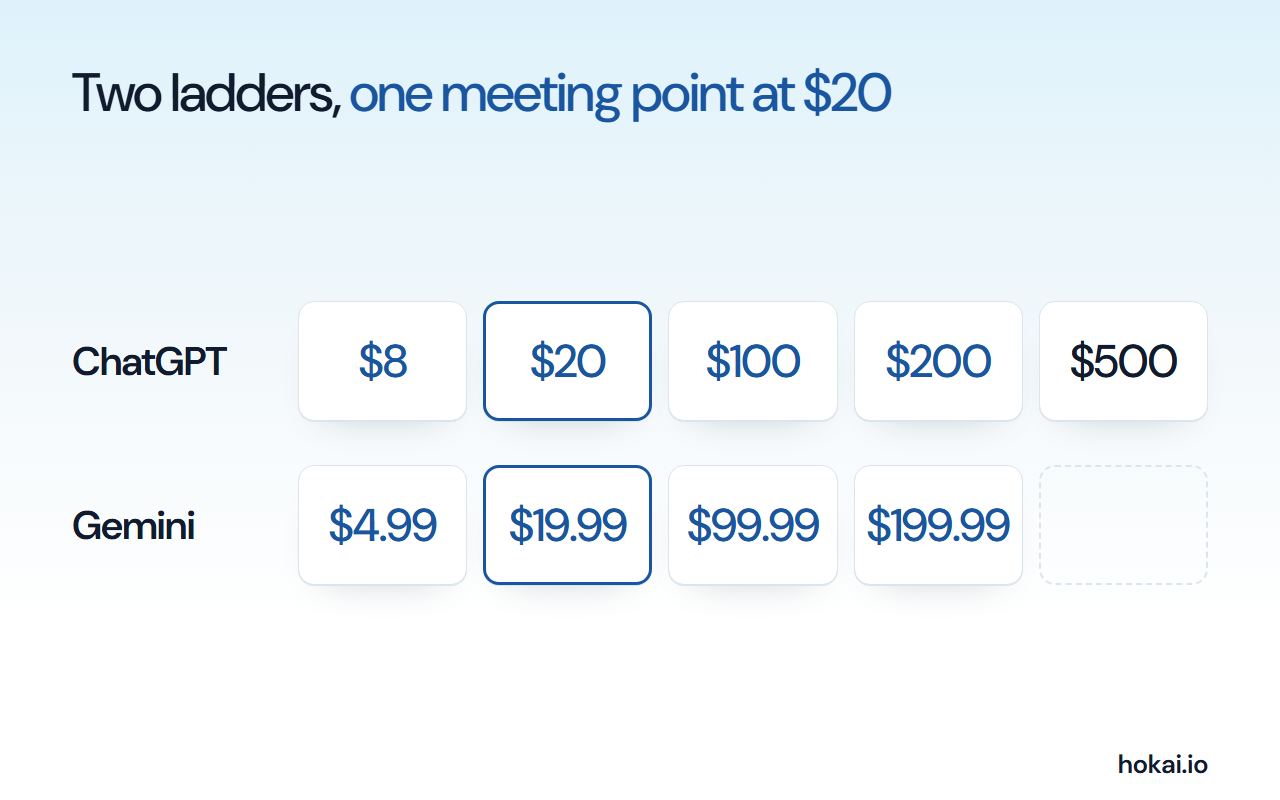 Chart by Hokai: the monthly price of every personal plan, read from OpenAI's Codex pricing page and Google's subscriptions page on 5 Nov 2026.
- ChatGPT Go, the cheapest ChatGPT step
- $8
- Google starts at $4.99
- Where the two flagship plans meet
- $20
- Plus $20, AI Pro $19.99
- Storage inside Google AI Pro
- 5 TB
- ChatGPT sells no storage
- Video generators on ChatGPT's plan table
- 0
- Sora ended on 26 April
What each plan costs, rung by rung
Start with the table. The ladders line up better than most pairs do. Both vendors sell a cheap step, a standard step and two heavy steps. Only one goes higher.
| Price point | ChatGPT plan | Gemini plan |
|---|---|---|
| $0 | Free | Free |
| $4.99 | None | Google AI Plus |
| $8 | Go | None |
| $19.99 to $20 | Plus | Google AI Pro |
| $99.99 to $100 | Pro 100 | AI Ultra, 5x Pro |
| $199.99 to $200 | Pro 200 | AI Ultra, 20x Pro |
| $500 | Pro 500 | None |
Read from OpenAI's Codex pricing page, its Pro tiers help article and Google's Gemini subscriptions page.
The Codex pricing page lists the cheap and standard ChatGPT plans in dollars. A help article lists the three Pro sizes, named for their price, and says Pro bills monthly with no annual option. The main pricing page showed us rupiah, so we took US prices from the docs.
The subscriptions page is the source for the other column. It shows two Ultra sizes, at 5x and 20x the Pro usage limits. It does not say whether annual billing exists, so we claim nothing.
The real gap is what else the money buys. Google folds in storage at every rung.
| Google plan | Storage across Gmail, Drive and Photos |
|---|---|
| Free | 15 GB |
| AI Plus | 400 GB |
| AI Pro | 5 TB |
| AI Ultra | 20 TB and up |
If you already pay for storage, a Gemini plan can replace that bill. Then the ChatGPT price is purely extra. If you do not, ignore the storage row and judge the assistant alone.
Which model you actually get in the chat box
Both vendors run several models at once, and the newest one is often not in the chat window. The notes answer it.
On the ChatGPT side, the release notes for 7 October say paid plans use GPT-6 Sol in the Chat tab, while the cheap ones use GPT-6 Luna. The Pro reasoning option runs on GPT-6 Astra. The models behind Work and Codex were not changing.
The newer GPT-6.1 Sol arrived on 29 September, but only in Work and Codex. So a $20 subscriber who wants the latest model has to leave the chat tab. GPT-6.1 Terra, added on 26 October, sits in the same place. A third model, GPT-6 Rosalind, serves life-science labs and sits outside this comparison.
Gemini draws its line by plan instead. Argon began rolling out on 13 October to the two upper tiers, per the release notes. The plan page lists it there and nowhere lower.
| Gemini plan | Models the plan page names |
|---|---|
| Free | Flash-Lite |
| AI Plus | Flash |
| AI Pro | Argon, a Pro model, Flash |
| AI Ultra | Highest access to all three |
One contradiction is worth flagging. A July note says 3.6 Flash is going to "all Gemini app users globally", yet the plan page still gives the free plan its Flash-Lite model. We cannot tell which is current. Check the model picker before you judge the free tier.
Another model, Gemini 4 Carbon, was announced on 28 October. Only a subset of cyber defenders can use it. You cannot buy it.
The plan page is also partly stale. Its FAQ still talks about "3.1 Pro" and a "Veo 3.1 Lite" trial. We trusted the table and the dated notes over the FAQ.
Cost per task on an independent test
Plan pages describe access. They do not say how smart a model is, or what a hard job costs to finish. Artificial Analysis publishes an Intelligence Index plus a cost and a time per task, so we read its leaderboard today.
| Model setting | Index | Cost per task | Minutes per task |
|---|---|---|---|
| GPT-6 Astra, max | 57 | $6.24 | 19.0 |
| GPT-6 Astra, high | 55 | $3.24 | 8.1 |
| GPT-6.1 Sol, max | 55 | $1.27 | 21.2 |
| Gemini 4 Argon, high | 50 | $9.95 | 26.2 |
Read from the Artificial Analysis models leaderboard.
Run at high, Argon lands on 50 and bills $9.95 for each task. Astra, also at high, lands on 55 for $3.24. That is a wide gap. It decides a lot. On this test the OpenAI model finishes the same job for about a third of the money and in about a third of the time.
Three cautions apply, and they matter. A row is one model at one setting, which is not a score for a whole product. The test describes the API, not what a chat plan allows. And Argon's token price is introductory: a Google announcement says it doubles after the launch period. Costs may move. Our three-way model comparison goes deeper on that cost story, and the model leaderboard shows the rest of the field.
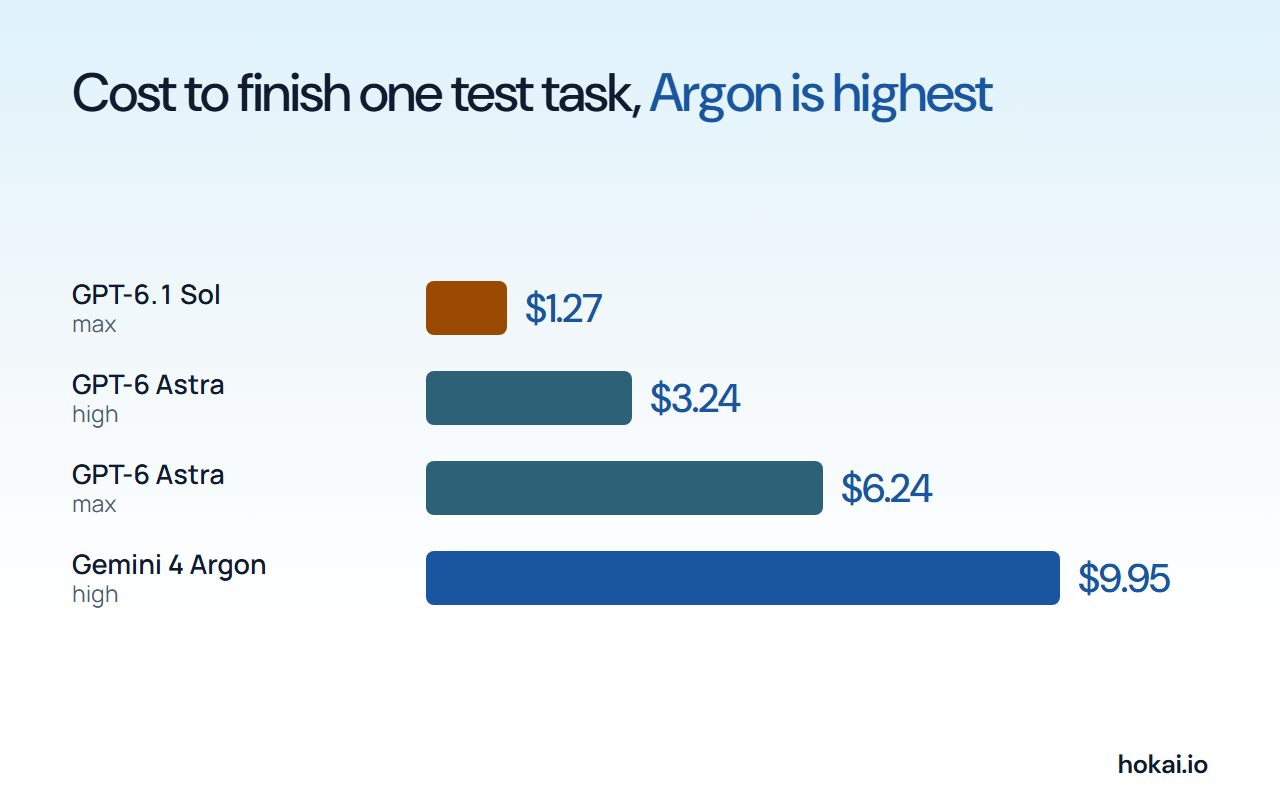 Chart by Hokai: what four model settings charge to finish one test task, read from Artificial Analysis on 5 Nov 2026.
Everyday answers, writing and long documents
For plain questions and drafting, neither plan page offers evidence that separates them, so we call it a tie and say what breaks it. The tie-breaker is the app you already open each morning, plus how each handles limits.
The free ChatGPT plan promises unlimited text chats, subject to abuse guardrails, and the standard paid plan lists "limits apply". Gemini explains its meter: limits are compute-based, refresh every 5 hours until a weekly cap, and can be extended with AI credits. The $4.99 plan doubles the free allowance. The $19.99 plan quadruples it.
Neither vendor states a message count for its entry plans, so plan around how big your tasks are, because one long agentic job can burn through an allowance that would cover a hundred short questions.
Long documents are the one place a published number separates them. The Gemini page promises a 1M token context window and uploads up to 1,500 pages on paid plans. ChatGPT's table lists a 256K reasoning window at the $20 level and 400K at the top, with the Instant window at 54K and 128K.
On paper that favours Gemini for a big contract or a long transcript. The 1M figure sits in a page FAQ that also mentions the old 3.1 Pro model, so treat it as a ceiling that "varies by model", not a promise for every chat.
What the free plans give you
Start here before paying anything. Both free plans are generous, in different directions.
| What you get free | ChatGPT | Gemini |
|---|---|---|
| Everyday chat | Unlimited text, guardrails apply | Flash-Lite, usage-metered |
| Images | Limited | Generation and editing |
| Deep research | Limited | Included |
| Voice | Limited | Gemini Live |
| Storage | None | 15 GB |
ChatGPT's free tier is long on messages. Gemini's is long on features. If you mostly ask questions and want no cap anxiety, the ChatGPT free plan fits. If you want to try pictures, research reports and voice before spending a cent, the Gemini free plan covers more ground.
One test settles it. Run your three most common tasks on both free plans for a week, then price the upgrade you actually hit.
Where Gemini wins: video, free images and the Google apps
Three advantages are plain. The other side's plan table lists nothing equivalent, and none of the three depends on a benchmark chart or on a model that only a few subscribers can open today.
Video first. Sora's web and app ended on 26 April 2026 and its API on 24 September, per OpenAI's discontinuation notice. ChatGPT's plan table lists no video generator today. Video is not close. Gemini Omni went to all paying subscribers on 19 May, and the paid plans carry Flow credits.
| Google plan | Flow credits |
|---|---|
| AI Plus | 200 |
| AI Pro | 1,000 |
| AI Ultra | 10,000 or 25,000 |
Our Gemini Omni Flash explainer covers what a credit buys, and the video generator roundup shows the field beyond these two.
The second is the free tier for pictures. Google's image page says image generation and editing are free, and paid plans add Nano Banana 2.1 plus a "Redo with Pro" option. The free ChatGPT plan lists only "limited image creation".
The third is the Google estate, and it is the one that is easiest to overlook. The $19.99 plan lists the assistant in Gmail, Docs and Vids, plus Chrome auto browse and YouTube Premium Lite. If your mail, calendar and documents live there, an assistant inside them beats one you paste into. The Ultra tiers go further, adding storage from 20 TB, a YouTube Premium subscription, and Project Genie, a tool for creating and exploring interactive worlds in real time that the page says only an Ultra plan includes.
Where ChatGPT wins: agents, price floor and the heavy tiers
The clearest ChatGPT lead is agents you can use today at $20. ChatGPT Work is limited to the desktop app on the cheap plans and spans desktop, web and mobile on the paid ones. It shares its allowance with Codex, the coding agent.
Gemini's equivalent is gated higher. The release notes put Gemini Spark, its always-on personal agent, in beta for top-tier adult subscribers in the US, with a Mac app since 30 June. That is a $99.99 ticket for something ChatGPT hands out at $20.
The second lead is the price floor in the middle. Go adds more messages, uploads, images and voice than Free. Google has no step between its two cheapest paid plans, and the lower one skips Argon. The catch is that the pricing page says Go "may include ads", which our ChatGPT ads explainer unpacks.
The third is image tooling. Images 2.6 shipped on 4 November with GIF creation and saved reference images, and version 2.5 added templates and sketch-to-image in September. The top tier lists unlimited, faster image creation. We did not test image quality on either side. We cannot call a winner on looks.
Voice is the fourth. The release notes give daily voice caps: up to 3 hours on the two cheaper paid plans, 15 hours at the $100 tier, and no cap from the $200 tier. We found no equivalent numbers for Gemini Live.
Agents and browsers at each price
Agents are where the two plan tables diverge most, and the names are easy to confuse.
| Job | ChatGPT route | Gemini route |
|---|---|---|
| Work across apps | Work, from Plus | Spark, Ultra only |
| Browse sites for you | Work's cloud browser, Plus and Pro | Chrome auto browse, Pro and up |
| Always-on agent | Dot, Pro | Spark, Ultra |
| Coding agent | Codex, limited on Free | Antigravity, Pro and up |
Dot launched on 29 September for eligible top-tier users in supported markets, and access excludes the EEA, Switzerland and the UK. Texting your dot began in US beta on 28 October. Our Dots explainer has the long version.
On the Google side, Antigravity is built into the Mac app, and the $19.99 plan lists "entry rate limits" to its agent model. The Gemini CLI repository says the command-line tool was replaced by Antigravity CLI in June. Old tutorials will mislead you.
The tie-breaker is the work, not the brand, and the question is whether your chores live in documents and schedules or in a browser tab you already have open all day. For documents, spreadsheets and scheduled chores, ChatGPT's $20 plan reaches further. For browsing inside Chrome while you stay signed in, Google's Pro plan is the cheaper door. For coding, compare the pair directly in our coding assistant roundup before paying for either.
Shopping, bookings and connected apps
Both assistants now book and buy through partners, and the names overlap. Gemini's notes show OpenTable, Canva and Instacart, and say you can connect more than 40 apps across every tier.
ChatGPT's notes cover restaurant bookings through OpenTable, Resy and Yelp from August, plus a virtual clothing try-on from October. A Finances tool reached the free plans in the US on 2 October.
We call shopping a tie, leaning to ChatGPT for the try-on. Small edge. Neither vendor publishes how many partner stores exist, so the longer list on either side proves little.
Office files differ more. ChatGPT for Word reached every plan, free included, on 17 September, joining Excel and PowerPoint in one Microsoft add-in. Google's equivalent is the assistant inside Docs and Gmail, which needs the $19.99 plan. Our office assistant guide compares the wider field.
Students, teachers and free years
Education offers can swing the decision, and the two vendors went different ways. A 19 August note says eligible college students get one year of the $19.99 plan free in the US, or the $4.99 plan in more than 140 countries, with redemption open until 31 December 2026. It renews at the standard price afterwards, so set a reminder.
ChatGPT's pricing FAQ describes a free Teachers plan for verified US K-12 educators through June 2027. Universities buy the Edu plan for a campus.
The honest read: a US college student should take the Google year first, because it removes the monthly question for twelve months. A US schoolteacher has the free ChatGPT route.
Who should pick which, job by job
| Job | Winner | Why |
|---|---|---|
| Video generation | Gemini | ChatGPT's plan table has none |
| Free images and edits | Gemini | Image generation is on Free |
| Long documents | Gemini | 1M window published, with a caveat |
| Google Workspace users | Gemini | Assistant inside Gmail and Docs |
| Hard work, cost per task | ChatGPT | Astra high $3.24 against Argon $9.95 |
| Agents at $20 | ChatGPT | Work on Plus, Spark needs Ultra |
| Voice on a budget | ChatGPT | 3 hours a day on Go and Plus |
| Everyday writing | Tie | No evidence either way |
| Shopping and bookings | Tie | Same partners, different extras |
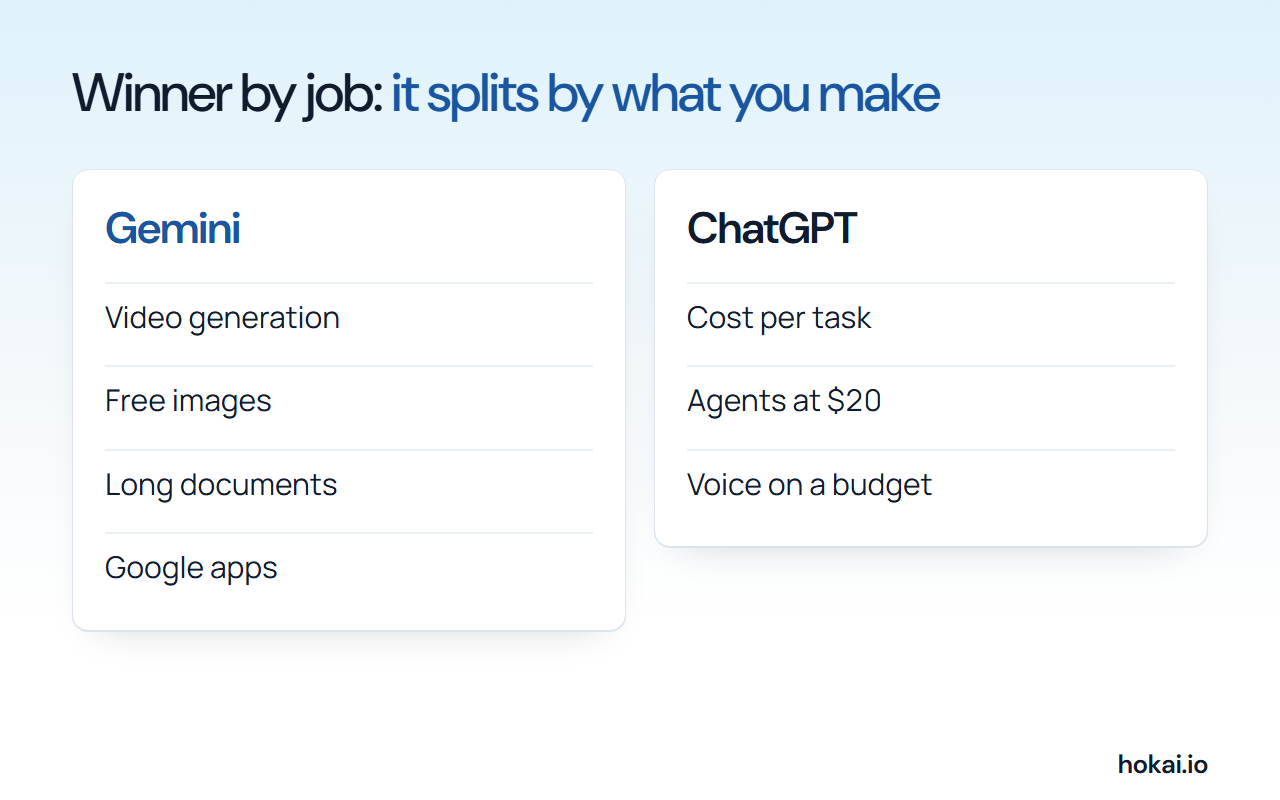 Hokai summary of the table above, from the vendor pages and the Artificial Analysis leaderboard read on 5 Nov 2026.
Two rows deserve a longer answer. "Google Workspace users" is not a quality claim. It says an assistant in your inbox saves the copy-paste step, and that matters more than a few index points for most office days.
"Hard work, cost per task" is a finding about the API, not the chat plan. It matters most to builders and to anyone paying for credits on top of a subscription.
For a ranking built around your own stack, Smart Match takes your job, budget and stack, then ranks the assistants for you. If you are choosing among more than two assistants, our five-way assistant chooser and the free AI image generator roundup widen the field.
The best argument against picking Gemini
The strongest case against the verdict above is that a plan price is not a quality score. Gemini's storage and Google apps are real, but a buyer who never opens Gmail pays for a bundle they do not use. If you strip the bundle out, the $19.99 plan buys a model that costs more per task on the one independent test we read.
There is also a gating problem. The top Gemini model is on Pro and Ultra only, the always-on agent is Ultra only, and Free and Plus users may not see the models Google advertises most loudly.
Our answer: it holds if the assistant is your only reason to subscribe. It weakens as soon as you count storage you would otherwise buy, or video you cannot make elsewhere on a ChatGPT plan. For a sole-assistant buyer who writes, researches and codes, ChatGPT Plus is the safer first month. Pair it with the ChatGPT versus Claude comparison and the Claude versus Gemini guide to see where a third vendor changes the maths.
What switching costs you
Neither vendor locks you in on price, but your context lives inside each product. Google built an import path: a 26 March note says Settings lets you bring context and chat history over from other AI apps by pasting a prompt and returning a summary. The ChatGPT notes we read list no equivalent, so moving there is manual.
Cancelling ChatGPT is mild: a cancelled Pro plan keeps working to the end of the billing period. The Google pages we read say nothing about what happens to 5 TB of storage when a plan ends. Find that answer before you move files into it.
Phone questions are their own story, covered in our Android assistant guide.
A month on the cheaper side of the one you do not use teaches you more than any table. At $4.99 or $8, the test is cheap.
Data handling, training and ads
Both vendors let you opt out of training on personal plans, but the defaults and the retention rules differ.
ChatGPT's pricing table says "Opt-out available" for training on every personal plan, and the Go plan "may include ads".
Google's privacy hub, updated 26 October, states that chats are not being used to show you ads, and that Google will say so if that changes. It also says human reviewers read a subset of chats. Any chat a reviewer has seen is retained for as long as three years, even after you delete your activity.
| Setting | What Google's page says |
|---|---|
| Default auto-delete | 18 months |
| Other auto-delete choices | 3 months, 36 months, indefinite |
| Temporary chats | Kept 72 hours, not used for training |
| Keep Activity off | Kept 72 hours, not used for training unless you send feedback |
If client work goes through the chat window, the temporary-chat setting and the human-review rule matter more than the price.
What would change this verdict
Four checkable things would flip a row in the table above.
If ChatGPT adds a video generator, the biggest Gemini advantage shrinks. If Google moves Spark below Ultra, or opens Argon to its cheapest paid plan, the agent and price-floor points weaken. If the cost-per-task gap closes, the independent-test lead goes. And if the plan FAQ states a context limit per plan, the long-document edge becomes firm or disappears.
Prices move first. A Pro 200 cut was announced and reversed within a month, and Google added a $100 Ultra tier in May. Read both pages again the day you buy.
If search is the job you care about, our Perplexity versus ChatGPT search comparison tests that angle on price, limits and citations.
Frequently asked questions
Is ChatGPT or Gemini better?
It depends on the job. Gemini wins on video, free image generation, long-document ceilings and Google app integration. ChatGPT wins on agents at the $20 level, daily voice allowances and cost per task on the Artificial Analysis test, where GPT-6 Astra at high scores 55 for $3.24 against Argon's 50 for $9.95.
How much do ChatGPT and Gemini cost per month?
ChatGPT: Go $8, Plus $20, Pro $100, $200 or $500. Gemini: Google AI Plus $4.99, AI Pro $19.99, AI Ultra $99.99 or $199.99. Both have a free plan. Prices are US figures read on 5 November 2026 from OpenAI and Google pages.
Does ChatGPT still make videos?
Not on its plan table. OpenAI ended the Sora web and app on 26 April 2026 and the Sora API on 24 September 2026. Gemini Omni, Google's video model, went to Google AI subscribers on 19 May 2026, and paid plans include Flow credits.
Which Gemini plans include Gemini 4 Argon?
Google AI Pro and AI Ultra. Google began rolling Argon out to them in the Gemini app on 13 October 2026. The plan page does not list it under Free or Google AI Plus, which get Flash-Lite and Flash.
Which one is more private?
Both offer a training opt-out on personal plans. Google says Gemini chats are not used to show ads, keeps temporary chats for 72 hours and retains human-reviewed chats for up to three years. OpenAI says ChatGPT Go may include ads.
Covered in this guide
- ChatGPT: ChatGPT is OpenAI's AI assistant, with 1.2 billion weekly users by OpenAI's count, the GPT-6 model family and plans that run from a free tier to a premium Pro tier.
- Gemini: Google's multimodal AI assistant and model family, sold as a free app, tiered subscriptions and a pay-per-token API
- Antigravity: Google's successor to Gemini CLI, running subagents and a 5-model picker (Gemini, Claude, GPT-OSS) from the terminal.
- ChatGPT Work: OpenAI's ChatGPT Work agent plans and finishes multi-step projects across connected apps and files. It launched on 9 July 2026 and now reaches every ChatGPT plan, with limits.
- Gemini 3.6 Flash: Released July 21, 2026, Gemini 3.6 Flash is Google DeepMind's Flash-tier model built for agentic coding, computer use and long-context work.
- Gemini 4 Argon: Google DeepMind's Gemini 4 frontier model, generally available on the paid Gemini API: 1M-token context and output, text, image, video, audio and PDF input.
- Gemini 4 Carbon: Google DeepMind's Gemini 4 Carbon, announced in October 2026: a cybersecurity and long-horizon coding model in limited access for approved cyber defenders.
- Gemini Omni: Gemini Omni is Google DeepMind's multimodal world model (May 2026) that generates and conversationally edits 10-second 1080p video from text, image, audio and video.
- Gemini Spark: Gemini Task, called Gemini Spark until Google renamed it, is the Task mode in the Gemini app that runs multi-step jobs and schedules in the background for Google AI Pro and Ultra subscribers.
- Google: Google (Alphabet, NASDAQ: GOOGL) runs Search, Cloud and the Gemini models, including Gemini 4 Argon (October 2026).
- GPT-6 Astra: OpenAI's flagship model, launched September 2026 as the first ever rated at the Preparedness Framework's Critical cybersecurity level.
- GPT-6 Luna: GPT-6 Luna (Sept 2026) is OpenAI's lowest-cost GPT-6 model, tuned for high-volume chat, extraction and classification with six adjustable reasoning-effort levels.
- GPT-6 Rosalind: OpenAI's life sciences reasoning model on GPT-6 Astra weights, released in October 2026 for organizations approved through its trusted-access program.
- GPT-6 Sol: OpenAI's mid-tier GPT-6 model (Sep 2026), 1.05M-token context, 68.8% on DeepSWE v1.1 coding, half GPT-5.6 Sol's price.
- GPT-6.1 Sol: GPT-6.1 Sol is OpenAI's September 2026 mid-tier reasoning model for coding, computer use and document work, built to sit just below GPT-6 Astra.
- GPT-6.1 Terra: GPT-6.1 Terra is OpenAI's October 2026 model for computer use, image reading and writing, built for high-volume agent work.
- Nano Banana 2.1: Google's image generation and editing model in the Gemini API, with 1K to 4K output and multi-image reference mixing, generally available since October 2026.
- OpenAI: OpenAI builds ChatGPT, the GPT-6 family (Astra, Sol, Luna), Codex and the OpenAI API. It reports 1.2B weekly ChatGPT users and an $852B valuation after its March 2026 round.
- Codex: Clones a GitHub repo into a sandbox, writes and tests code, then opens a pull request; OpenAI reported 20 million active users in August 2026.
- Dot: OpenAI's always-on agent in ChatGPT runs on GPT-6 Astra with its own cloud computer, and asks approval before consequential actions.
- Project Genie: Google DeepMind's web-based prototype turns a prompt, photo or Street View location into a world you can explore in real time for 60 seconds at a time.
Sources
Still deciding?
This guide covers a handful of options. Smart Match checks every listing in the directory against how you actually work and what you can spend, then hands you the shortlist and the reason behind each pick.
Find your toolsRelated guides
- The AI 80s Photo Trend: How to Make Yours (and Turn It Into a Video) in 2026AnalysisWhat changed and who it affects
- AMD Buys World Labs for $8.2B: What It Means for Marble UsersAnalysisWhat changed and who it affects
- Attio vs HubSpot in 2026: Which CRM for a Startup?ComparisonHead-to-head, with a verdict
- Best Agentic AI in 2026: Manus, Genspark and the Platforms That Finish Whole TasksBuyer's guideHow to pick, across a category
- Best AI Agent Builders in 2026: Automate, Build or Self-HostBuyer's guideHow to pick, across a category
- Best Autonomous AI Agents in 2026: How Much Control to Hand OverBuyer's guideHow to pick, across a category