AMD Buys World Labs for $8.2B: What It Means for Marble Users
World Labs, the company behind the Marble 3D world generator, signed a definitive agreement on 28 September 2026 to join AMD. Fei-Fei Li becomes AMD's executive vice president and chief scientist. The deal needs regulatory approval, so Marble's terms stay unchanged until closing, expected by 31 December 2026.
The short version
AMD agreed on 28 September 2026 to buy World Labs for about $8.2 billion in stock, closing by year end. Neither announcement mentions Marble's pricing or API. Keep your plan, export your worlds, cap API credits and test one fallback tool.
AMD said on 28 September 2026 that it will buy World Labs, the lab behind Marble, in an all-stock deal valued at about $8.2 billion. The announcement came from both companies on the same day. Neither one says a word about what happens to the product.
That silence is the story for anyone who pays for Marble or builds on its API, because the deal is a chip company buying a research team and the release is written for investors, not for customers. Short version: nobody has said. If you create 3D worlds for a living, the useful questions are narrower: will the price hold, will the API stay up, and where do you go if either changes? This piece answers those from the primary documents, and marks where the documents run out.
What actually changed on 28 September
AMD announced a definitive agreement to acquire World Labs, the San Francisco lab co-founded in 2024 by Fei-Fei Li. The transaction is all-stock, valued at roughly $8.2 billion, and expected to close by the end of 2026. It still needs regulatory approvals and the usual closing conditions, so nothing has changed legally yet.
Fei-Fei Li will join AMD as executive vice president and chief scientist, reporting to Lisa Su, while Justin Johnson and Ben Mildenhall stay on to lead the World Labs team, which AMD's release says will keep working on model research after closing. Continuity of people is promised. Continuity of products is not.
The relationship is not new. AMD was named among the investors in the $1 billion raise of February 2026, and Li says the two companies began working together on model training and inference optimization on AMD GPUs a year earlier, well before anyone talked about a purchase. This is a partner becoming a parent. That is a softer risk than a stranger buying in.
| Date | Event |
|---|---|
| 12 Nov 2025 | Marble opens to everyone |
| 21 Jan 2026 | World API launches |
| 18 Feb 2026 | $1B raise, AMD among investors |
| 21 Jul 2026 | SceniX acquired for robotics simulation |
| 1 Sep 2026 | Atlas world model announced |
| 28 Sep 2026 | AMD agrees to acquire World Labs |
Order matters. In 10 months the company went from one launch to a platform: an app, an API, a robotics arm and a new base model. An acquirer pays $8.2 billion for that trajectory, and a trajectory is not a product roadmap.
Why a chip company wants a world-model lab
AMD's own explanation is short. As AI moves into reasoning, robotics, simulation and physical AI, the demands on compute get more varied. A team that builds those models sees the workloads before the silicon does. Owning that team, AMD argues, shapes its future roadmaps.
World Labs' July post on robotics fills in the picture. The lab says robot training is bottlenecked by experience, not by model design. Every robot trial eats hardware time, objects must be reset, and failures are slow and costly to recover from. Its answer is a real-to-sim-to-real engine that turns one physical task into thousands of controllable variations.
That engine came from SceniX, which World Labs bought on 21 July 2026. The lab says the approach let robots learn complex manipulation tasks with zero real-world training data. These are the lab's own claims from a vendor blog, and no independent test is cited.
Put the two together and the AMD logic is easy to read. Robot simulation is a hungry workload. A lab whose models already train on AMD GPUs is a natural showcase for it. The Marble app, a consumer 3D product, is a smaller part of that story than the headline suggests.
What the announcements leave out
Read both announcements for the word Marble. In the body text of the AMD release it does not appear. In the World Labs post it appears only in the site footer, which links to the product. Pricing, the API, existing subscribers and the free tier get zero lines between them.
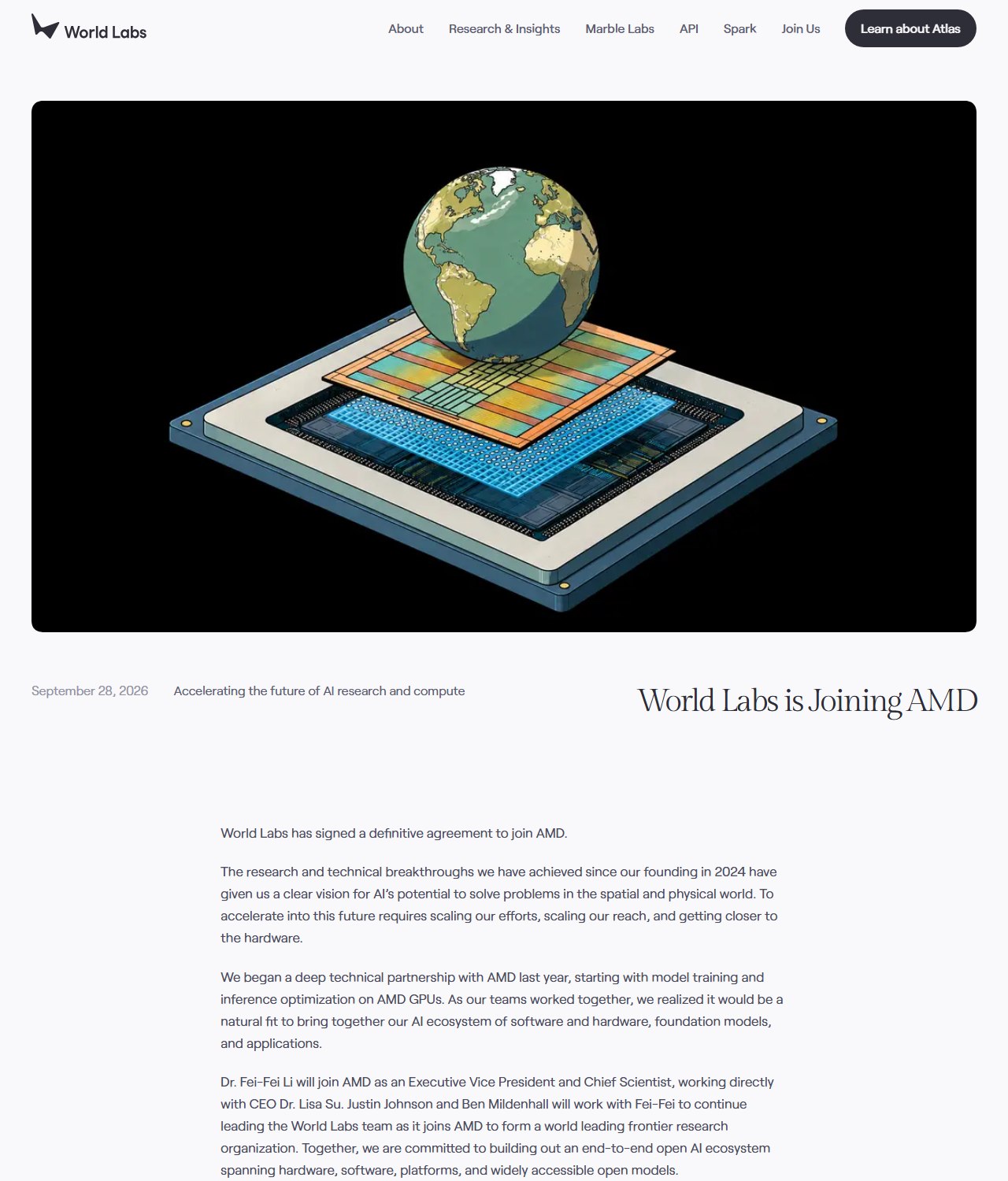 The World Labs announcement as served on 2 October 2026: the product is absent from the text.
What the documents do say is about direction. World Labs describes an "end-to-end open AI ecosystem" spanning hardware, software, platforms and "widely accessible open models". AMD frames the purchase as a way to see how workloads are changing, in areas such as reasoning, robotics and simulation, so it can shape its chip roadmaps.
Read together, the logic is a hardware vendor buying model expertise. The consumer app is not mentioned as a reason for the deal. Not once. That does not mean it is in danger. It means nobody has promised anything yet, and a promise is what a subscriber needs.
Who this affects
Three groups carry real exposure, and they are not equally exposed.
- App subscribers on Standard, Pro or Max. They pay monthly and can leave monthly. Their risk is a price or credit change after closing. Small, but real.
- API developers. They hold a separate credit pool, may have built Marble into a product, and cannot swap vendors in an afternoon.
- Robotics and simulation teams. They are the group the deal logic points toward, because World Labs bought a robotics-simulation company in July 2026 and AMD cites robotics in its release.
The January launch post names real API users. Escape.ai turns 2D films into navigable 3D scenes, Lightwheel runs evaluation across many generated environments, and Interior AI uses worlds for design previews. The post also says the worlds plug into simulators such as NVIDIA Isaac Sim, MuJoCo and RoboSuite. NVIDIA was also named among the investors in the February raise, so the chip rivalry runs through this customer base.
Hobbyists on the free Marble plan are affected least. The free plan gives a few generations a month, and nothing about it depends on a roadmap. Free is free.
The lab's newest model matters here too. Atlas, announced on 1 September 2026, is described by its makers as the engine for future versions of Marble and other World Labs products. It generates up to one minute of 1440p video from a few reference images. So the product you use today is likely to be rebuilt on a new base model whether or not an acquisition happens.
What Atlas says about the next version of Marble
Atlas is the most concrete product signal in the whole story. It predates the deal by four weeks. World Labs describes it as an omni model, pretrained from scratch to work natively on text, images, video and 3D. It is a multimodal autoregressive diffusion transformer, which in plain terms means it predicts what the camera would see next while staying consistent with everything it has already seen.
The post lists four jobs: camera-controlled generation, spatial reconstruction, space-time simulation and image generation. The lab claims Atlas beats specialised models at rebuilding a scene from a handful of photos. It also says Atlas will power future versions of Marble. Early access is by request.
For a Marble user the point is simple. The engine under the app is about to change. New outputs, new limits and new credit costs would follow from that swap alone. So a price change next year may have nothing to do with AMD.
What Marble costs today, and why the price page matters
A caution first. The Marble pricing page did not render for the readers we use to check sources on 2 October 2026: both a headless fetch and a real Chrome session came back empty. The figures below come from HokAI's own Marble listing, last checked against the vendor on 4 September 2026. Treat them as a baseline, and confirm on the live page before you decide anything.
| Plan | Monthly price | Generations | Commercial use |
|---|---|---|---|
| Free | $0 | About 4 | No |
| Standard | $20 | Up to 12 | No |
| Pro | $35 | Up to 25 | Yes |
| Max | $95 | Up to 75 | Yes |
Commercial rights start at Pro, which is the line a working studio crosses first, so any future repricing or any change to what the licence covers will land hardest on the people who earn money from the output and cannot easily absorb a surprise. Watch that tier.
The API is a different meter. It runs on its own credits, bought at $1.00 per 1,250 with a $5 minimum, and a standard world generation costs 1,500 of them. Credits bought for the app do not carry over. That separation is worth knowing before closing, because a new owner could change how the two meters are billed.
On data, there is no public SOC 2, GDPR or HIPAA documentation for Marble in the listing we hold. A new owner with a large enterprise sales arm could change that. It could also change who is allowed to see your uploaded photos and video, and that is something to read in the terms when they update.
What to do about it this month
Do not cancel a plan because of a press release. Not yet. Do these four things instead, in this order, and treat each as an afternoon of work rather than a project.
- Export the worlds you rely on.
- Check your renewal date.
- Cap your API credit balance.
- Test one fallback tool.
Take them one at a time. Marble supports splat and mesh export on paid tiers, so step one is simple: pull each finished Marble world into files you own. Monthly subscribers can leave at the next renewal. Annual buyers should read the refund terms now, while nobody is in a hurry.
For the API, keep the balance small and top up often instead of pre-buying a large block. For the fallback, run your most common prompt through a second tool so you know what a switch costs in hours.
The point is to make the choice cheap. A tested fallback costs an afternoon. An untested one costs a week of a live project.
Where the alternatives are, and where they are not
Be honest about the field: no vendor offers a like-for-like Marble substitute today. The nearest products solve neighbouring problems.
| Option | What it makes | Where it fits |
|---|---|---|
| Project Genie | Worlds you explore live | Play, not export |
| Hunyuan 3D | 3D assets from prompts | Game and print pipelines |
| Runway | 2D video | Video deliverables |
| Luma Dream Machine | 2D video | Video deliverables |
Project Genie comes from Google DeepMind. Its page describes worlds built from text, images or Street View that you walk, ride, fly or drive through while they generate. Access runs through Google's AI Ultra plan. It is an early research prototype, so it suits exploration more than a production pipeline.
Hunyuan 3D is Tencent's open 3D generation family. It makes objects and assets rather than whole explorable scenes, but its open licence means you can self-host. That matters if vendor risk is your worry.
If your real deliverable is a clip, not a scene, the video tools in our video generator roundup are the better home. Browse the wider video generator category for pricing, and the image generator guide if stills are enough. For a mixed pipeline, see the all-in-one versus specialist comparison. Teams starting from photos should read the photo-to-video guide, and small studios will find the no-production-team walkthrough useful. Stills-only users can stay with Midjourney. Not sure which of these fits? Smart Match asks about your deliverable and narrows the list.
The case for staying calm
The strongest argument against worrying is the investor relationship. AMD was already on the cap table, so this is not a stranger buying a product it does not understand. Li stays in a senior role and the founders keep the research team.
The second argument is incentive. A chip company gains little by shutting down a product that gives its GPUs a visible showcase, brings in subscription revenue, and keeps a well-known founder talking about its hardware in public. Stranger things have happened, but not often. Li says the lab's training and inference work already runs on AMD GPUs, and a public product is the visible result of that work. Killing it would waste the showcase.
The third is time. The deal closes by year end at the earliest, and regulators come first. Until then World Labs runs as an independent company with its own terms. Most of the changes people fear, such as repricing or API sunsets, can only start after closing, and usually months later.
This does not make the risk zero. It makes the risk slow. A slow risk is one you can plan for, and planning for it is the whole point of the checklist above. Act early, act small.
What would change this: three signals
Three signals would move the verdict from "wait" to "act".
- A Marble line in the closing filing. If AMD or World Labs names the product, its pricing or its API in a regulatory document, that is the first binding statement.
- A terms or privacy update. A new data clause or a change in who can train on uploads is a reason to review your account the same week.
- A credit change. Any shift in the 1,250-credits-per-dollar rate or the 1,500-credit generation cost means the economics were reset.
Two things would make this guide wrong. If Atlas ships inside Marble before closing, the product will already be moving on its own schedule. And if AMD folds the team into its cloud business, the consumer app could be repackaged rather than closed.
The next date to circle is the close itself, due by 31 December 2026. Until then, keep your exports current and your fallback warm. Then read the new terms on the day they land.
Frequently asked questions
Is Marble shutting down after the AMD deal?
Neither announcement says so, and neither mentions Marble's future at all. The deal is not expected to close until the end of 2026, so Marble runs under World Labs' current terms until then.
How much is AMD paying for World Labs?
AMD's release values the all-stock transaction at approximately $8.2 billion. It is subject to regulatory approvals and customary closing conditions, with closing expected by the end of 2026.
Will Marble prices change?
No change has been announced. HokAI's listing, last checked on 4 September 2026, shows a free plan and paid plans from $20 to $95 a month, so confirm the live price page before buying.
Should API developers worry about the acquisition?
Nothing published signals an API change. Keep your credit balance small and test one fallback tool, because API credits are a separate pool from the app and a billing change is the likeliest first move.
What is a good alternative to Marble?
No tool matches it exactly. Project Genie generates explorable worlds in real time, Hunyuan 3D makes 3D assets, and video tools such as Runway suit clip deliverables.
Covered in this guide
- Marble: Marble by World Labs turns text, images, video, or panoramas into persistent 3D worlds, free tier to $95/month in 2026.
- World Labs: San Francisco AI startup founded 2024 by Fei-Fei Li, raised $1.23B, builds Marble, a model that turns prompts into 3D worlds.
- Google DeepMind: Google DeepMind, Alphabet's AI research division formed in 2023, builds Gemini, AlphaFold, and Gemma with 8,000+ researchers across six continents.
- Hunyuan 3D: Tencent open-weight 3D generation model family (1.0/2.0/3.0) with text-to-3D, image-to-3D, sketch-to-3D, and smart topology: Apache 2.0 license, 3M+ Hugging Face downloads, paid API via Tencent Cloud.
- Luma Dream Machine: Creative agents that make you prolific: AI video and image generation for creators
- Midjourney: An independent research lab creating stunning AI-generated images from text prompts
- NVIDIA: Founded 1993, NVIDIA is the world's most valuable company (~$4.85T, July 2026), building the GPUs, CUDA stack, and open Nemotron models that run most of the AI industry.
- Project Genie: Google DeepMind's web-based tool converts a prompt, photo, or sketch into a walkable AI-generated world you can explore in real time.
- Runway: AI to simulate the world through generative video and world models
- Tencent: Chinese tech giant (founded 1998) with $500B+ market cap, developing Hunyuan foundation models, Tencent Cloud AI services, and AI integration across WeChat, gaming, and enterprise products.
Sources
Still deciding?
This guide covers a handful of options. Smart Match checks every listing in the directory against how you actually work and what you can spend, then hands you the shortlist and the reason behind each pick.
Start Smart MatchRelated guides
- Adobe Firefly or Gencraft: A 2026 Pricing and Feature ComparisonComparisonHead-to-head, with a verdict
- The AI 80s Photo Trend: How to Make Yours (and Turn It Into a Video) in 2026AnalysisWhat changed and who it affects
- Best AI Companies in 2026: Who Is Actually LeadingBuyer's guideHow to pick, across a category
- Best AI Content Creation Tools in 2026: Pick By the Job, Not the CategoryBuyer's guideHow to pick, across a category
- Best AI Tools for Graphic Designers in 2026Buyer's guideHow to pick, across a category
- The Best Free AI for Turning a Photo Into a Video in 2026Buyer's guideHow to pick, across a category