Best Open-Weight Models in 2026: Ranked by Job, Hardware and Licence
Open-weight models publish their trained weights for download, but the licence decides what you may do with them. On 5 November 2026 the top open models on the Artificial Analysis index were DeepSeek V4.1 Flash 1017, GLM-5.3 and MiMo-V2.6-Pro, each needing a multi-GPU server to self-host at full size.
The short version
DeepSeek V4.1 Flash 1017 scores highest among open-weight models (33 on Artificial Analysis, MIT licence), with GLM-5.3 and MiMo-V2.6-Pro close behind. Closed models still lead by 27 points. For one 24GB GPU pick Qwen3.8-27B, and read the licence clause before you ship.
Want this decided for your own case? Find your tools with Smart Match, starting from this guide's question.
Artificial Analysis scored the best open-weight model at 33 on its Intelligence Index on 5 November 2026, and the best proprietary model at 60. That 27-point gap is the honest starting point for any list of the best open weight models, because it tells you what downloading buys you and what it does not.
It buys you control: the weights sit on your disk, the licence says what you may do with them, and no vendor can retire the model under you. It does not buy you the frontier. Not yet. This guide ranks what you can download today by job and by the hardware that runs it, with the licence terms read from each model's own files this week.
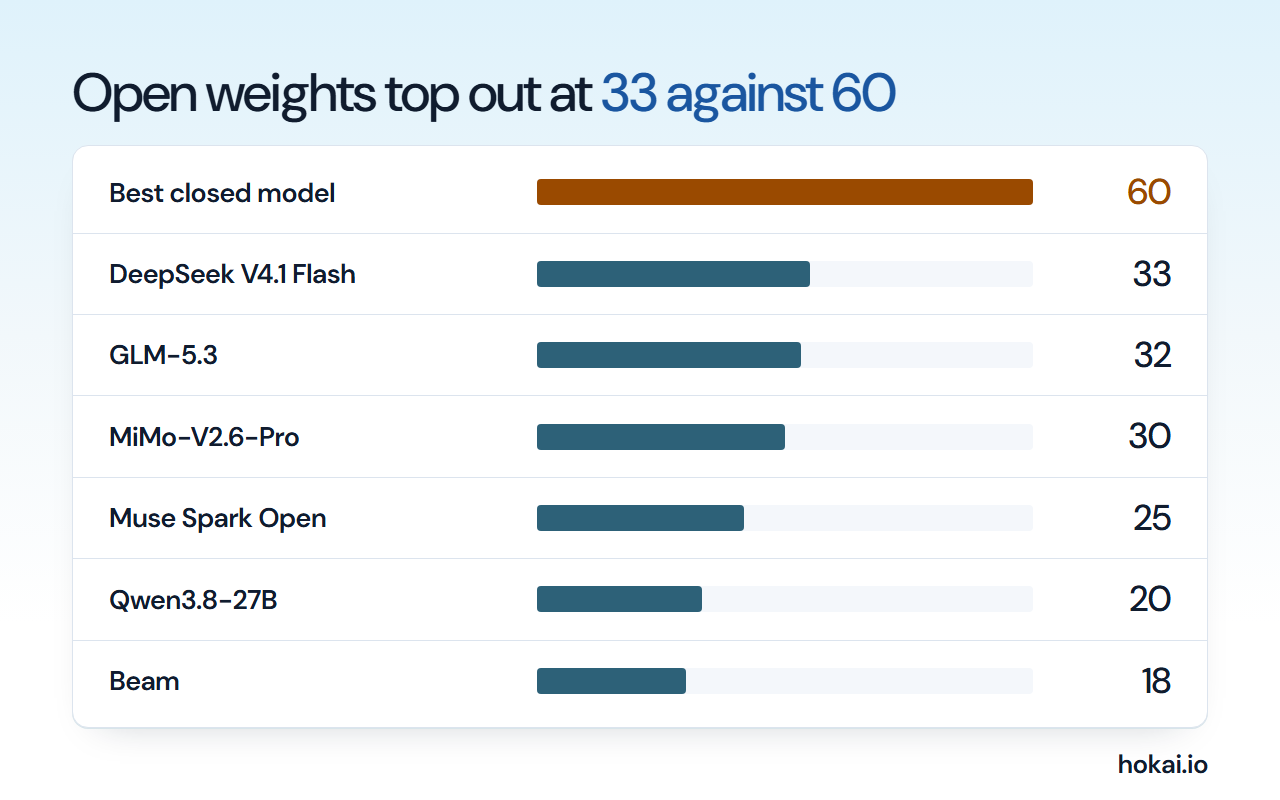 Hokai chart of open-weight Intelligence Index scores, from Artificial Analysis as checked on 5 November 2026.
Three things decide which model belongs on your shortlist: the job you need done, the memory you can spare once the browser, the editor and the operating system have taken their share, and the licence clause that applies to a business of your size and shape. Most roundups answer only the first. That is a mistake. The next section sets out the questions that settle all three, and the sections after it walk the field from datacentre models down to a phone.
- Best open score on the Artificial Analysis index
- 33
- DeepSeek V4.1 Flash 1017
- Best score of any model on the same index
- 60
- Proprietary
- Total parameters in MiMo-V2.6-Pro
- 1.02T
- 42B active
- Memory budget NVIDIA states for its Bolt model
- 24GB
- Native 2-bit
- Annual revenue where LFM3 stops being free to use commercially
- $10M
- Liquid AI licence
Four questions decide the shortlist
Answer these before you read a single model name. They remove most of the field.
- How much memory can you dedicate? A laptop has 16GB to 32GB, a workstation GPU 24GB, a rack hundreds of gigabytes.
- What is the job? Agent work, code, translation and speech each have a different winner.
- Which licence clause touches you? Several "open" licences carry a revenue threshold or an attribution rule.
- Do you host it yourself? Weights are open; a vendor's API is not. Only your own server keeps the privacy.
Each answer removes part of the field. Memory alone cuts the list in half, and the licence cuts it again.
If you want a shortlist built from your own constraints rather than ours, Smart Match asks the same questions and returns a ranked set from the full directory.
The ranking by job
The table lists one pick per job. Scores are the Artificial Analysis Intelligence Index v5.0.1, read from its leaderboard on 5 November 2026. A dash means the index does not score that model or job.
| Job | Pick | AA index | Licence |
|---|---|---|---|
| Highest open score | DeepSeek V4.1 Flash 1017 | 33 | MIT |
| Close second | GLM-5.3 | 32 | GLM-5.3 License |
| Best score per dollar | MiMo-V2.6-Pro | 30 | MIT |
| Long agent runs | Ling 3.1 Flash | 30 | MIT |
| Largest open weights | Kimi K3 | not scored | Kimi K3 License |
| Big model from Meta | Muse Spark Open | 25 | Muse Model License |
| Big model, Apache 2.0 | Beam | 18 | Apache 2.0 |
| One workstation GPU | Qwen3.8-27B | 20 | Apache 2.0 |
| 24GB memory budget | Nemotron 3.5 Bolt | not scored | OpenMDW-1.1 |
| Dense 31B, 256K context | Gemma 4 31B | 4 | Apache 2.0 |
| Phone and laptop | LFM3-1.7B | not scored | LFM Open License |
| Translation | Index-Translate | not scored | Apache 2.0 |
| Speech to text | Nemotron 3.5 ASR | not scored | OpenMDW-1.1 |
Read the index column with care. It is a snapshot. Artificial Analysis builds v5.0.1 from nine evaluations, among them Terminal-Bench 4.0, FrontierCode 2.0 and HLE-Diamond. Those reward long agentic work, the kind where a model has to plan, call tools, recover from its own mistakes and keep going for an hour, and which small models rarely finish. A 4 for Gemma 4 31B says the model does not do that work, not that it is useless at chat or extraction.
Read from the Artificial Analysis leaderboard; the highest reasoning setting is shown for each model.
DeepSeek, GLM and MiMo lead, and none of them is a laptop model
Artificial Analysis names DeepSeek V4.1 Flash 1017 and GLM-5.3 as the two highest-intelligence open models, followed by MiMo-V2.6-Pro and Ling 3.1 Flash. The scores are 33, 32, 30 and 30. They are close enough that the licence and the price decide more than the score does. Pick on those.
DeepSeek's model card, read on 5 November, states an MIT licence for both the repository and the weights, a 1M-token context window and 763B parameters. MIT is the cleanest outcome in this guide. No revenue test. No attribution rule. From DeepSeek, it costs $0.60 per task on the Artificial Analysis cost measure.
GLM-5.3 comes from Z.ai with 753B parameters on its Hugging Face card, and it costs $5.01 per task in the same measure. That is more than eight times DeepSeek for one point less. Its licence is custom, covered in the licence section below, and it is the only one of the four that is not MIT.
MiMo-V2.6-Pro is the value pick, and the one we would try first. Xiaomi's card describes a sparse mixture-of-experts model with 1.02T total and 42B activated parameters, a 1M context length and an MIT licence. Artificial Analysis puts its cost at $0.26 per task, the lowest of the top four. One gap: Artificial Analysis lists it as MiMo-V2.6-Pro while the Hugging Face repository is named MiMo-V2.6-Pro-RL, and neither page says outright that they are the same checkpoint.
Ling 3.1 Flash from InclusionAI completes the group. Its Hugging Face card lists 560B total and 25B active parameters, a 1M context and an MIT licence, and Artificial Analysis scores it 30 at $3.19 per task.
Kimi K3, Muse Spark Open and Beam: huge, open, harder to compare
Three more large releases belong on the list. Each comes with a caveat the leaders do not.
Kimi K3 from Moonshot AI is the largest set of open weights here. Its card lists 2.8T total parameters, 104B active per token, 896 experts with 16 selected per token, and a 1,048,576-token context. Artificial Analysis lists Kimi K3.1 Pro at 46 but does not place it among its open models, and the open K3 checkpoint has no score on that leaderboard. So there is no number to rank it by, and the table says so.
Muse Spark Open from Meta has 816B total and 42B active parameters. Artificial Analysis scores it 25 at its xhigh setting, $2.02 per task. Meta's card says you need a GPU with at least 700GB of memory for the NVFP4 version and 2TB for BF16.
Beam from Reflection AI has 501.3B total and 23.4B active parameters, a 1M context and an Apache 2.0 licence on its Hugging Face card. It scores 18, and at $0.28 per task it is one of the cheapest big models to run through a hosted API. If your lawyers want a standard licence and not a custom one, Beam is the large model with no strings. Simple.
One workstation GPU: Qwen3.8-27B, Bolt and Gemma 4
Below the datacentre tier, the field changes character. Here the question is what fits, not what scores highest.
Qwen3.8-27B is the dense pick. Its card shows an Apache 2.0 licence, about 28B parameters and a native 262,144-token context, extensible to 1M. Artificial Analysis scores it 20 at its highest reasoning setting. Our arithmetic: 28B parameters at 4 bits per weight is about 14GB of weights, before the context cache, so a 24GB card is comfortable. Qwen's family has its own explainer if you need the wider picture.
Nemotron 3.5 Bolt from NVIDIA takes a different route. It has 74B total and 9B active parameters, and NVIDIA's card says a native 2-bit quantisation lets it fit 24GB of memory "alongside other applications", with up to 256K tokens of context. There is a catch, and it is the serving stack: the card names vLLM on A100, H100 or Blackwell GPUs. It is a 24GB model for people with datacentre-class silicon, not for a gaming card.
Gemma 4 31B has an Apache 2.0 licence on its Google card, 31B parameters and a 256K context. Its smaller sibling Gemma 4 12B shares the licence. For which of these writes better code on one 24GB card, our local coding guide compares them head to head, so this guide does not repeat it.
To run any of them, Ollama, LM Studio and llama.cpp are the usual runners, and our Ollama vs LM Studio comparison explains how to choose between the first two.
Small and specialist: LFM3, Index-Translate and Nemotron ASR
The smallest useful models are no longer toys. LFM3-1.7B from Liquid AI lists 1.73B parameters and a 256K-token context. Liquid's card says it takes about 1GB of memory at 4-bit precision, "so it fits on any phone or laptop". Use it for on-device extraction, routing and light agent work, the jobs where a one-gigabyte model on a phone is more useful than a seven-hundred-gigabyte model in a data centre you cannot reach. Do not expect a frontier answer.
Index-Translate-35B-A3B-preview is a specialist worth knowing. The card describes a 35B-total, 3B-active model built on Qwen3.5 that translates across 150 languages, with image translation included, under Apache 2.0. Only 3B parameters are active per token, so it should run quicker than its size suggests, though the card is a preview and we have not benchmarked it.
Nemotron 3.5 ASR handles speech. NVIDIA's card lists a 0.6B streaming model covering 35 languages under OpenMDW-1.1. It suits live captioning and voice agents where a 0.6B footprint matters more than a leaderboard.
Which pick fits which reader
Rankings flatten the choice. Three readers, three different answers, and the licence changes at least one of them.
A solo developer on a 24GB card wants Qwen3.8-27B. It is Apache 2.0, it fits with room for the cache, and nothing in the licence ever needs reading again. If the card is smaller, Gemma 4 12B is the step down.
A startup under $10 million in revenue has the widest choice. Every licence in this guide allows its use, including the strictest. The deciding factor becomes cost per task, which points at MiMo-V2.6-Pro or DeepSeek, or at Beam if a plain Apache licence matters to your investors.
A regulated enterprise that must keep prompts on its own servers has the narrowest. It needs a model it can host, a licence legal will sign, and a runtime its engineers can operate. That points at DeepSeek V4.1 Flash 1017 or MiMo-V2.6-Pro on MIT terms. Both are huge, and neither is quick to stand up. Budget a multi-GPU server and an owner for it.
The licence column: open weights are not one thing
"Open weight" means you can download the file. That is all. It says nothing about what you may do next. The five clauses below are the ones that can change your decision, each quoted from the licence file or card read on 5 November 2026.
| Model | Licence | The clause that can bite |
|---|---|---|
| DeepSeek V4.1 Flash, MiMo-V2.6-Pro, Ling 3.1 Flash | MIT | None |
| GLM-5.3 | GLM-5.3 License | Security review for large service operators |
| Kimi K3 | Kimi K3 License | Separate deal above $20M service revenue |
| Muse Spark Open | Muse Model License | "Built with" notice; deal above $20M |
| LFM3 | LFM Open License v1.0 | Commercial use only under $10M revenue |
| Beam, Qwen3.8-27B, Gemma 4 31B | Apache 2.0 | None |
The thresholds are narrower than they look. GLM-5.3's licence applies its security review only when a licensee or its affiliates run a Model as a Service business and exceed $10 billion in revenue over 12 months. Kimi K3 requires a separate agreement if you run a Model as a Service business above $20 million in revenue over 12 months. Both exempt end-user products that embed the model in a feature.
Meta's Muse Model License adds two rules. Anything built with the software must display "Built with Muse Spark Open", and a service business that sells model access and passes $20 million in gross revenue must notify Meta and sign a separate agreement. Kimi also asks products with more than 100 million monthly active users, or $20 million in monthly revenue, to display "Kimi K3".
The strictest is Liquid's, and it is easy to miss. Section 5 of the LFM Open License v1.0 licenses commercial use only while the legal entity stays under $10,000,000 in annual revenue. A startup is fine. A funded scale-up is not.
We did not read the OpenMDW-1.1 text line by line. NVIDIA's cards for Bolt and ASR both carry it, and NVIDIA describes it as commercially usable, so read it before shipping.
What it costs: memory first, then cost per task
Self-hosting is priced in memory. Not subscriptions. The table converts each model's published size into the weights alone at 4 bits per weight. This is our arithmetic, not a vendor figure, and it excludes the context cache, which adds more at long context.
| Model | Total / active parameters | Weights at 4-bit |
|---|---|---|
| Kimi K3 | 2.8T / 104B | about 1.4TB |
| MiMo-V2.6-Pro | 1.02T / 42B | about 510GB |
| Muse Spark Open | 816B / 42B | about 410GB |
| DeepSeek V4.1 Flash 1017 | 763B / not stated | about 380GB |
| GLM-5.3 | 753B / not stated | about 375GB |
| Ling 3.1 Flash | 560B / 25B | about 280GB |
| Beam | 501.3B / 23.4B | about 250GB |
| Qwen3.8-27B | about 28B dense | about 14GB |
Meta's own sizing is bigger than the arithmetic: 700GB for the NVFP4 build, against about 410GB of weights. The gap is the cache and runtime, so treat the table as a floor.
The practical reading is blunt. The top four need a multi-GPU server whichever way you slice them, and the same is true of K3 and Muse. If you do not own one, their open weights matter in a different way: several hosts can serve them, so you are not locked to one vendor's price.
Artificial Analysis publishes a cost per task for the hosted versions, and the spread is wide.
| Model | AA index | Cost per task |
|---|---|---|
| MiMo-V2.6-Pro | 30 | $0.26 |
| Beam | 18 | $0.28 |
| DeepSeek V4.1 Flash 1017 (max) | 33 | $0.60 |
| Muse Spark Open (xhigh) | 25 | $2.02 |
| Ling 3.1 Flash 1019 | 30 | $3.19 |
| GLM-5.3 (max) | 32 | $5.01 |
Same score band, nearly twenty times the bill. MiMo and GLM-5.3 are two points apart on the index and $4.75 apart per task. Our cheapest LLM API guide goes deeper on hosted prices, and the model leaderboard shows current blended price, speed and benchmarks side by side.
From download to first answer
The route is short once the hardware exists.
- Read the licence Before downloadingOpen the LICENSE file on the model card, not the summary badge.
- Download the weights One-offPull the files from the model's Hugging Face page.
- Pick a runner Per machineOllama, LM Studio or llama.cpp for a single machine; vLLM or SGLang for a server.
- Test on your own prompts Day oneRun ten real tasks and compare against your current model.
The cards name vLLM, SGLang or Transformers as the supported serving routes for the large models. Single-machine runners work for the dense picks and the small ones. The big mixture-of-experts models need the server stacks, which is a skill set of its own.
Step four matters most, by a distance. An index score tells you where a model sits on average, and your tasks are not average. Ten of your real prompts, scored by someone who knows the answers, beat any leaderboard.
Data handling: open weights keep prompts home only if you host them
Downloading the weights and calling a vendor's API are two different things. Marketing blurs them. A model licensed MIT on Hugging Face can still be served by a company whose terms let it retain prompts.
Run it yourself and prompts never leave your machine. That is the real reason regulated teams ask for open weights, and it holds only for the teams that actually operate the server. Hugging Face hosts the files, but downloading them is a one-off transfer, and after that inference needs no network at all. If you use a third-party host instead, read that host's retention terms, not the model's licence.
Two checks before sending sensitive data through any open model. First, confirm where inference runs. Second, check the Usage Policy that rides with the licence: Meta's licence, for example, incorporates a Usage Policy into its terms. Our guide to running AI locally walks through the setup that keeps everything on one machine.
Who should skip open weights
Open weights are the wrong tool in four cases, and it is better to know them before you buy hardware.
- You need the frontier. The best closed score is 60 and the best open one is 33. See how to choose the right LLM for that decision.
- You have no one to run it. Serving a 700GB model is an infrastructure job, and it costs engineers' time.
- Your volume is low. At a few hundred requests a day, a hosted API costs less than an idle server.
- You need a vendor to call. A closed vendor offers support and an SLA. An MIT file offers neither.
The turn: is a 27-point gap a dealbreaker?
The strongest case against this ranking is that the gap makes the whole list academic. If the best open model scores 33 and closed models score 59 and 60, why bother?
It depends on the job. The index weights long agentic work, and plenty of production tasks (extraction, routing, translation, transcription) never need that ceiling. A 0.6B speech model and a 3B-active translator do their jobs without a high index score, and they run on hardware you already own. For those jobs, open weights beat a closed API on cost, privacy and permanence.
For the hardest tasks, the objection stands. We would not move a frontier agent workload to DeepSeek on a score of 33. We would move the calls that are not frontier work.
What would change this ranking
Four events would reorder it. A score for the open Kimi K3 checkpoint could reorder the top, since Artificial Analysis gives K3.1 Pro a 46. A permissive relicensing from Liquid would move LFM3 up the small tier. A Gemma 4 point release that finishes agentic tasks would end the 4. And any new release above 33 would reset the top of the table.
Go and check the live leaderboard before you commit, because every figure here is a snapshot from 5 November 2026. The first number to watch is whether K3's open weights get an Artificial Analysis score.
Frequently asked questions
What is the best open-weight model in 2026?
On the Artificial Analysis Intelligence Index, DeepSeek V4.1 Flash 1017 scored highest among open models at 33 on 5 November 2026, ahead of GLM-5.3 at 32 and MiMo-V2.6-Pro at 30. It is MIT licensed. The best model for you depends on the memory you have and the licence clause that applies to your business.
Is open-weight the same as open source?
No. Open weight means the trained file is downloadable. Open source also implies a licence that places no limits on use. DeepSeek, MiMo and Ling use MIT, but GLM-5.3, Kimi K3, Muse Spark Open and LFM3 carry custom terms with revenue or service thresholds.
Which open-weight model runs on one GPU?
Qwen3.8-27B is the dense pick: about 28B parameters, Apache 2.0, and roughly 14GB of weights at 4-bit by our arithmetic. NVIDIA says Nemotron 3.5 Bolt fits 24GB of memory with 2-bit weights, but its card names datacentre GPUs for serving.
Can I use open-weight models commercially?
Usually yes. MIT and Apache 2.0 models carry no revenue test. Custom licences add limits: Liquid AI licenses LFM3 commercially only under $10 million in annual revenue, and Kimi K3 and Muse Spark Open require agreements for service businesses above $20 million.
How far behind are open models on benchmarks?
On 5 November 2026 the top open score on the Artificial Analysis index was 33 against 60 for the best proprietary model. The index weights long agentic tasks, so the gap is smaller for extraction, translation and speech work.
Covered in this guide
- Beam: Reflection AI's open-weight sparse MoE for coding and agents, with a 1M-token context window and 128K output, under a permissive Apache licence.
- DeepSeek: DeepSeek is a Chinese AI research company developing frontier language and reasoning models, including DeepSeek V4-Pro. Founded by High-Flyer hedge fund CEO Liang Wenfeng in 2023, the company is known for achieving GPT-level performance at dramatically lower compute and API cost.
- DeepSeek V4.1 Flash 1017: DeepSeek's October 2026 update to V4.1-Flash: MIT-licensed weights, image input and a 1M-token context, tuned for coding agents and long task loops.
- Gemma 4 12B: Gemma 4 12B is Google's June 2026 open-weight multimodal model with a 256K context window and native audio/video input on 8GB of VRAM.
- Gemma 4 31B: Gemma 4 31B, released April 2, 2026 by Google DeepMind, is a 31B open-weight multimodal model with a 262,144-token context window.
- GLM-5.3: GLM-5.3 is Z.ai's text-only flagship for agentic coding and security work, with a 1M-token context, a live API and open weights.
- Hugging Face: The AI community building the future. Platform for discovering, sharing and collaborating on machine learning models, datasets and applications.
- InclusionAI: Ant Group's open AGI lab behind the MIT-licensed Ling, Ring and Ming model families, and the new Ling-3.1-flash preview.
- Index-Translate: Open MoE translation model from Bilibili with 35B total and 3B active parameters, image translation and downloadable weights, released in 2026.
- Kimi K3: 2.8T-parameter open-weight MoE model from Moonshot AI (July 2026) with a 1M-token context window and the top published open-weight result on GPQA Diamond.
- LFM3-1.7B: Six open-weight models from Liquid AI, each near 2B parameters, spanning text, vision, audio, omni and decision work, launched in October 2026.
- Ling 3.1 Flash: InclusionAI's text-only reasoning model for coding agents and long tasks, released on 30 September 2026 as the successor to InclusionAI's July flash model.
- Liquid AI: Liquid AI is an MIT CSAIL spinout with over 3,100 Liquid Foundation Model variants built for phones, cars, and other edge devices instead of the cloud.
- llama.cpp: Free MIT-licensed C/C++ engine that runs LLMs locally. 130,000+ GitHub stars, GGUF models, OpenAI-compatible server. A developer tool.
- LM Studio: Free desktop app that runs open LLMs locally on llama.cpp and MLX, with an OpenAI-compatible local server and an optional $20 cloud plan.
- Meta: Meta AI ships open-weight Llama (1B+ downloads) and the closed Muse models, led by Muse Wonder with a 1M-token context window.
- MiMo-V2.6-Pro: Xiaomi's MiMo-V2.6-Pro is a 1.02T-parameter open-weights MoE model (Sept 2026) with 1M-token context, MIT license, and $0.435 per 1M input tokens.
- Moonshot AI: Beijing AI lab founded in 2023 by Yang Zhilin, maker of Kimi and the open-weight Kimi K3 models, valued at $20B at its May 2026 round.
- Muse Spark Open: Meta's open-weight model for coding and agents: 816B total parameters, 42B active, released October 2026 under the Muse Model License.
- Nemotron 3.5 ASR: NVIDIA's open streaming speech recognizer, released 4 June 2026, transcribing dozens of language-locales from a single checkpoint.
- Nemotron 3.5 Bolt: NVIDIA's open 74B-A9B vision-language MoE, quantized to 2 bits to fit 24GB, built for local agents. Released in October 2026 with 256K context.
- NVIDIA: Santa Clara chipmaker that supplies the GPUs, networking, CUDA software and open Nemotron models behind most large AI training and inference clusters.
- Ollama: MIT-licensed runtime that runs open-weight LLMs on macOS, Windows and Linux with a local API, plus an optional paid cloud for larger models.
- Qwen3.8-27B: A dense 27B vision-language model from Alibaba's Qwen team, open-weight since 2026 with native text, image, and video understanding.
- Reflection AI: US lab founded by ex-DeepMind researchers. Its first open-weight model, Beam, is a large mixture-of-experts built for coding and agents.
- Z.ai: Z.ai (formerly Zhipu AI) is a Beijing lab behind the GLM model family, founded 2019 and listed on the Hong Kong Stock Exchange (2513) since January 2026.
Sources
Still deciding?
This guide covers a handful of options. Smart Match checks every listing in the directory against how you actually work and what you can spend, then hands you the shortlist and the reason behind each pick.
Find your toolsRelated guides
- What Happened When 7 AI Agents Got Real Bank Accounts and No SupervisionAnalysisWhat changed and who it affects
- The AI Tool Ecosystem in 2026: Buy the Meter, Not the CategoryBuyer's guideHow to pick, across a category
- AMD Buys World Labs for $8.2B: What It Means for Marble UsersAnalysisWhat changed and who it affects
- The Best Android AI Assistant in 2026, Free and Paid, Now That Google Assistant Is GoneBuyer's guideHow to pick, across a category
- Best AI Coding Assistants in 2026: Pick the Job, Not the BrandBuyer's guideHow to pick, across a category
- Best AI for Coding Machine Learning in 2026Buyer's guideHow to pick, across a category