Best AI 3D Model Generators in 2026: What a Credit Really Buys
AI 3D model generators turn a prompt or a photo into a textured mesh and bill by the credit. On 8 November 2026 entry plans ran from $9.99 at Triverse to $30 at Rodin, and one model cost between $0.075 and $0.375 on the vendors' own counts. Hunyuan 3D's licence excludes the EU, UK and South Korea.
The short version
Tripo Pro at $20 a month is the safest default for client work: private, commercial output and ten concurrent tasks. Triverse costs less per model on paper, Rodin suits studios that need an API, and Hunyuan 3D suits self-hosters outside the EU, UK and South Korea. Free plans publish your models.
Not sure which one fits you? Describe your situation and Smart Match names three tools.Find my AI tools
In this guide11 sections
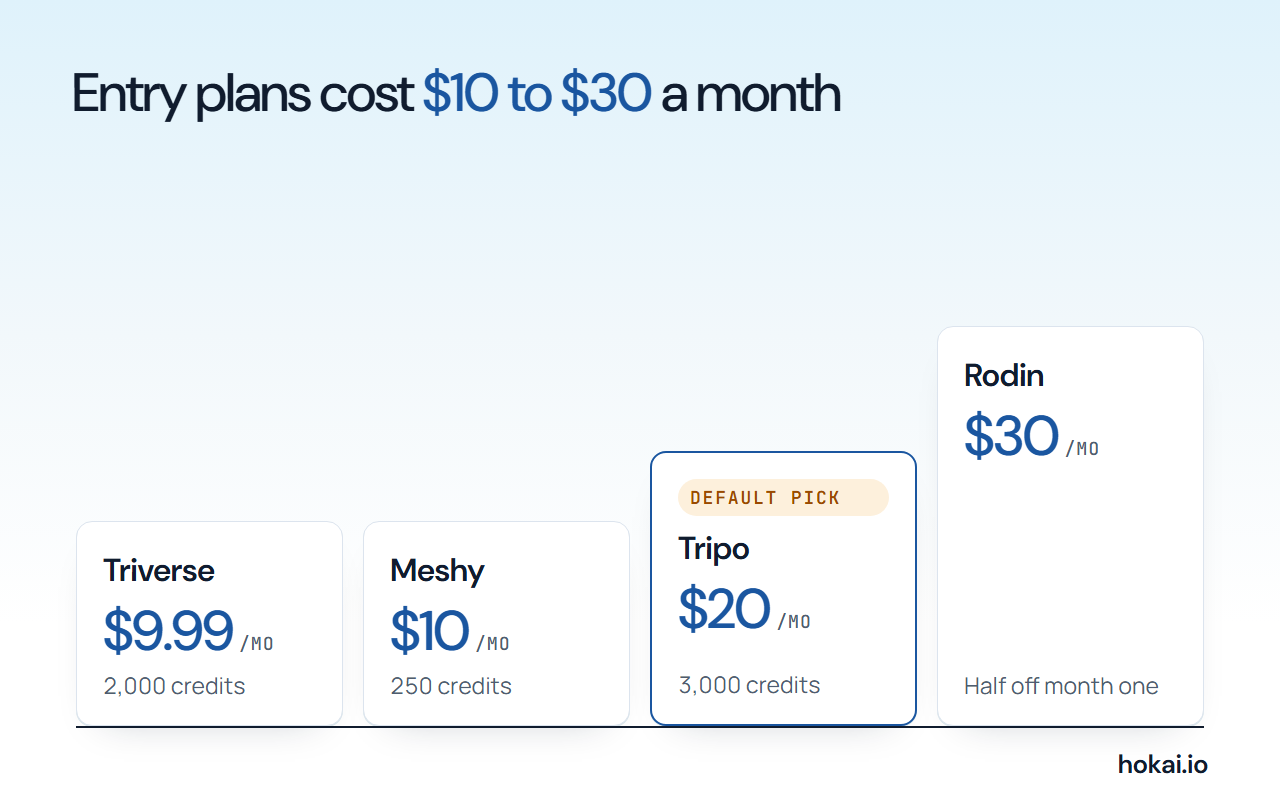 Hokai chart of the cheapest paid plan at each vendor, from the vendors' own pricing pages as read on 8 November 2026. Rodin's list price is shown; its page currently discounts the first month by half.
Four AI 3D generators sell the same promise, a textured mesh from a prompt or a photo, but their entry plans run from $10 to $30 a month and their credit allowances differ twelvefold, from 250 on Meshy Starter to 3,000 on Tripo Pro.
We read each vendor's own pricing page on 8 November 2026, plus Tencent's billing page for the open-weight Hunyuan 3D family. Then we compared what an entry plan buys in credits, private storage and rights to the output. Two pages had moved since our last read: Rodin now shows half off the first month, and Meshy opened in rupiah on the machine we used.
Three questions settle the pick: whether the output is private and licensed for client work, what one finished model really costs, and where you live. The third surprised us: one of the best-known open-weight 3D models ships under a licence that stops at the border of the European Union, and that single clause decides whether a studio in Berlin may use it at all.
How to choose: five questions before you spend a credit
A 3D generator is a credit meter with a modeller attached. Plan around the meter. Decide five things first, because each one removes tools from the list.
- What leaves the tool? Printing needs watertight geometry in STL or 3MF. Engines want clean triangles in FBX or GLB.
- Who may use the output? Free plans at Tripo and Triverse publish your models.
- What does one model cost? Credits per finished model, not the plan price.
- How many tasks run at once? Free plans queue one. Paid plans run 10 to 30.
- Where will you use it? Some licences carve out regions, and one carves out three.
Image in, mesh out: what to feed the generator
Most image-to-3D work starts with a picture, so the input sets the ceiling. A clean single-object render from Midjourney beats a busy photo every time. A flat, evenly lit render from FLUX works too. Hidden sides have to be inferred, so give the model a front view with no props in frame.
Our image generator guide prices both tools, and the free image generator guide covers the no-budget route. Browse the whole AI image generator category if you need another picture source.
Text prompts are the lazier route and the less predictable one. They suit blocking out a scene fast. Tripo lists multi-view to 3D on its Max plan, and Hunyuan 3D charges 10 extra credits for multi-view input. A set of views gives the geometry far less to invent.
The AI 3D generators directory lists every tool below with its plans side by side. Our guide to creating images and videos with AI covers the wider workflow around them.
The shortlist: six tools, one job each
Six tools sit in Hokai's 3D category. Four are generators you buy by the credit, one is an open-weight family you can host yourself, and one is an editor that rents you generation on the side.
| Tool | Best for | Entry paid plan | Free tier |
|---|---|---|---|
| Tripo | Batch production | $20 a month, 3,000 credits | 200 credits, public models |
| Meshy | Print and engine pipelines | $10 a month, 250 credits | 100 credits, no card |
| Rodin | Studios that need an API | $30 a month list | 10 private assets |
| Hunyuan 3D | Self-hosting, pay as you go | Prepaid from $15 | 200 credits, one year |
| Triverse | Cheapest private plan | $9.99 a month, 2,000 credits | 300 credits, public |
| Spline | Interactive web scenes | $15 a month | No AI credits |
Tripo is the volume pick: Pro gives ten concurrent tasks, private models and commercial use, according to its pricing page, while Free gives one task at a time and public, non-commercial models, which makes it a sandbox rather than a studio tool.
Meshy is the pipeline pick. Its docs list export to GLB, FBX, OBJ, STL, USDZ and 3MF, plugins for Unity, Blender and Maya, and an MCP server so agents can call the API. The Free plan needs no card.
Rodin is the studio pick. API access starts at Business. The page lists 120 or 240 requests a minute there. Its free plan sells credits at $1.50 each and, per the page, you pay only after previewing a result.
Hunyuan 3D is the only tool here you can run yourself, and the only one without a subscription, which changes how you budget for it entirely. Tencent sells API credits by the pack or postpaid, which the next section prices.
Triverse undercuts everyone on the entry plan. Paid assets are private and customer owned, per its pricing page, while free assets go out publicly under a Creative Commons licence.
Spline is the odd one out because it is an editor first. Hokai's October read found four generation engines inside the Spline editor, among them Hunyuan3D and Meshy, so it is a way to rent them while you build the scene.
What it costs: credits set the price, not the plan
Plan prices look tight, $10 to $30. This table lists every rung we could read on 8 November 2026.
| Tool | Plan | Per month | Credits |
|---|---|---|---|
| Tripo | Free | $0 | 200 |
| Tripo | Pro | $20 | 3,000 |
| Tripo | Max | $90 | 25,000 |
| Meshy | Starter | $10 | 250 |
| Meshy | Pro | $20 | 1,000 |
| Meshy | Premium | $40 | 3,000 |
| Triverse | Pro | $9.99 | 2,000 |
| Triverse | Max | $19.99 | 5,000 |
| Triverse | Ultra | $49.99 | 20,000 |
| Spline | Hobby | $15 | 2,000 |
| Spline | Pro | $30 | 3,000 |
Tripo Team is $110 a month per seat, or $55 on yearly billing. Team and Max both sit above the entry rung, so most solo buyers never meet them.
Spline Max is $70 for 10,000 credits, and its Free plan carries none, per Spline's pricing page. Rodin does not state a credit allowance on either paid plan, so it is missing from the table above. Its prices move more than the rest:
| Rodin plan | List | First month | Yearly, per month |
|---|---|---|---|
| Creator | $30 | $15 | $24 |
| Business | $120 | $60 | $96 |
Yearly billing charges $288 and $1,152 up front. The half-price first month is a promotion, so expect the list figures to return.
Hunyuan 3D has no plan at all. Tencent's billing page sells prepaid credit packs that stay valid for a year:
| Pack | Credits | Price | Per credit |
|---|---|---|---|
| Small | 1,000 | $15 | $0.015 |
| Medium | 10,000 | $145 | $0.0145 |
| Large | 50,000 | $700 | $0.014 |
| Largest | 100,000 | $1,350 | $0.0135 |
Postpaid billing costs $0.02 a credit with daily settlement. A new account also gets 200 free credits.
Meshy's page opened in rupiah for us: Rp 175,000 for Starter and Rp 350,000 for Pro. The dollar figures are the list prices Hokai recorded on 13 October. The rupiah numbers match them at 17,500 to the dollar, and Premium (Rp 700,000) follows the same ratio against $40.
Cost per model: the same plans, divided
Credits are not comparable across vendors, so divide each plan by the models it makes. The gap between cheapest and dearest opens to a factor of five.
| Tool | How the vendor counts | Cost per model |
|---|---|---|
| Triverse | 15 credits a Standard model | $0.075 |
| Tripo | About 200 models for $20 | $0.10 |
| Meshy | Up to 100 assets for $20 | $0.20 |
| Hunyuan 3D | 25 credits at $0.015 | $0.375 |
Computed from each vendor's pricing page; Triverse's 15-credit Standard model is from its pricing FAQ as Hokai read it on 29 October.
These are best-case counts. Treat them as floors. Triverse's Standard model is untextured, while Hunyuan's 25-credit price includes texture. Geometry alone is 15 credits there, or $0.225, and PBR materials add 10 credits, which takes a Hunyuan model to $0.525.
Tripo's own arithmetic does not reconcile, and that matters for anyone budgeting a batch. On Pro the page prints about $0.16 a model, yet its own 200-model count implies $0.10. Max shows the same pattern, with a printed figure well above the plan price divided by its 1,660 models. We could not tell which number is stale, so budget from credits and confirm the total at checkout.
Meshy has its own gap. The "up to 100 assets" headline works out to 10 credits an asset. The API price list charges 30 credits for a textured image-to-3D request on the latest model, three times that. Read the estimate before you queue a batch.
A worked example: thirty props for a small game
Say you need 30 textured props for a Unity prototype. The table multiplies the per-model figures by 30, then triples them for a team that keeps only one result in three. This is arithmetic on the vendors' counts, not a test.
| Tool | 30 models | Keep one in three |
|---|---|---|
| Tripo | $3.00 | $9.00 |
| Meshy | $6.00 | $18.00 |
| Hunyuan 3D | $11.25 | $33.75 |
Triverse is left out because its Standard model has no texture, and Meshy's figure assumes the headline count of 10 credits a model, so a team that mostly runs textured API jobs should read that row as a floor rather than a forecast. If every model costs 30 credits, as the API list suggests, the first column becomes $18 and the second $54.
The ranking survives the stress test, but the gaps shrink in absolute terms. What the cheap column cannot buy is a clean mesh. Budget cleanup time per prop, and keep the 3D directory open while you compare how each vendor sells retopology.
If you want to prototype the whole scene before you spend a single paid credit on any of the generators above, Spline lets you place and light the props, and Smart Match can recommend a generator from your engine and budget.
Where each tool wins, and where it loses
Cost per model is one axis. It is not the only one. Here is what each tool does well and badly, using only what its own pages state.
Tripo wins on throughput and clarity of rights. Ten concurrent tasks on Pro is ten times the free queue. The page spells out private models and commercial use. It loses on trust in its own numbers, because the per-model figures do not divide cleanly, and on the free tier, which publishes everything you make.
Meshy wins on pipeline reach: six export formats, three editor plugins and an MCP server cover most game, print and AR workflows without custom glue, which saves a small team weeks of scripting. It loses on predictability. A textured model costs 10 credits by the pricing headline and 30 by the API list, and the retention windows differ by plan.
Rodin wins on risk control. The page lets you preview a result before confirming the credit spend, and the free plan keeps ten assets private. It loses on price transparency, since neither plan lists a credit allowance and the free plan sells credits at $1.50 each. Education pricing needs verification of student or educator status.
Hunyuan 3D wins on openness and flexibility, because the weights sit on GitHub for anyone inside the licensed territory to run on their own GPUs, and because the hosted API charges nothing for a failed task. It loses on scale and territory. Default concurrency is 3 on the Professional API, each extra slot costs $5,000 a month, and the licence excludes three markets.
Triverse wins on entry price and loses on certainty. Hokai's 29 October read found its terms of service and its homepage FAQ disagree about commercial use. The page itself is clear that free assets are public.
Studios that already pay for an editor have a shortcut. Spline bundles generation into a seat that also holds your scene, so check its credit meter before you add a second subscription. For raw texture quality we have no test to offer. Read that twice. Every vendor claims the best output, and none of the pricing pages we read published a blind comparison.
Read this section next to the cost table. A tool that wins on cost and loses on rights is a prototype tool, and a tool that wins on rights and loses on cost is a delivery tool.
Rights and data: what you may do with the output
Free plans are where rights go wrong. Read them first. Tripo's free models are public and non-commercial. Triverse's free assets are public under CC BY 4.0, which allows reuse with credit, so a free generation is effectively open content. Rodin's free plan keeps 10 assets private, and its page says paid plans carry broader export and usage rights without spelling them out. Read the current terms before any regulated or high-risk use.
Hunyuan 3D is where the licence matters most. Tencent publishes the weights and training code on GitHub, where the 2.1 repository showed about 4,400 stars on 8 November. The file in that repository is the Tencent Hunyuan 3D 2.1 Community License Agreement, not an OSI licence. It excludes the European Union, the United Kingdom and South Korea, and it bars use of the output outside the territory. A company above 1 million monthly active users must ask Tencent for a separate licence.
So "open weights" means different things here. A studio in Berlin or London cannot lawfully self-host Hunyuan 3D 2.1 under that file. Our guide to open-weight models ranks the text and image models by licence, and the same check applies to 3D. The hosted API runs under Tencent's cloud terms instead, and we did not review those, so check them before you send customer assets.
Treat the licence as a line item in the budget. A studio that delivers to clients should price the paid plan at Tripo from the first model, because a free generation cannot be re-licensed later. Do not prototype on a public free tier with a client's brief typed into the prompt. The prompt alone can give the project away.
Retention is the quieter data question. Meshy's Studio plan lists 14-day API asset retention, and the tier above it lists forever retention. If you build a pipeline on a generator's API, download results the day you generate them.
Who should skip AI 3D generation and stay with a modeller
If your deliverable is a rigged hero character, a product with exact dimensions or a mesh an animator will deform, a generator gives you a starting point and a cleanup job. Tripo lists retopology in its free toolkit, and Meshy's API has a remeshing endpoint. Both tell you what raw output needs.
Hobbyists printing figurines are the happy case: one model, one export, one slicer. Meshy lists STL for geometry only and 3MF when colour matters, so check which file your printer reads before you generate.
Buyers who make one model a quarter should skip the subscription as well. A free tier or a single paid month costs less than a plan you forget to cancel. Triverse's $4.99 first month or Rodin's half-price first month make a one-off job cost less than a lunch. Download the file. Cancel the plan.
Game developers who want engine-ready props should read our Unity coding guide for the scripting side, since a generator only fills the asset folder. Anyone building a real-time web scene should start in Spline rather than export a mesh from another tool.
Run this check before paying anyone. It takes an afternoon.
- Generate the same ten prompts on each free tier.
- Open every result in your target tool, not the vendor's viewer.
- Count the models you would actually ship.
- Divide the plan price by that count.
- Confirm the licence for your market in writing.
The picks by job
The right answer changes with the deliverable, so these are picks by job rather than a single score.
- Batch production with private output
- Tripo Pro, $20 for 3,000 credits
- Cheapest private entry
- Triverse Pro, $9.99 for 2,000 credits
- Print and engine pipelines
- Meshy, six export formats and plugins
- Studio with an API
- Rodin Business, $120 list
- Self-hosting outside the EU, UK and South Korea
- Hunyuan 3D
Tripo takes the default recommendation because it pairs a low cost per model with output its page licenses for commercial use and ten concurrent tasks. Its price page needs a calculator, but even the pessimistic $0.16 a model beats Meshy's $0.20 best case.
Triverse is cheaper on paper, yet its Standard model is untextured and its commercial-use terms are unclear. Choose Hunyuan 3D only after the licence check, since its hosted API and its downloadable weights sit under different terms. Smart Match can narrow the choice by pipeline if your constraints are unusual.
The strongest objection to ranking by cost per model is that nobody pays for the models they throw away. A cheap tool with a 50% discard rate costs double. Vendors publish no keep rates, so the best proxy is how a tool charges for misses. Rodin lets you preview a result before spending credits. Hunyuan does not charge failed tasks. Tripo's page lists more free retries on Pro and unlimited ones on Max.
What would change this verdict
Three things could flip the order. If Rodin makes its half-price first month permanent, Creator at $15 would undercut Meshy Pro and Tripo Pro on price. Watch that one.
If Tripo corrects its per-model figures upward, its lead over Meshy narrows from 2x to under 1.3x. And if Tencent extends the licence on the open weights to the EU and the UK, Hunyuan 3D becomes the cheapest serious choice for European studios, because a self-hosted model has no per-model fee at all.
Our own number is the weakest link: the per-model figures are vendors' best-case counts, not a keep-rate test. Run your own prompts through each free tier first. Check Rodin's discount and Tripo's page again at the next price read, because both are the figures most likely to move.
Frequently asked questions
Which AI 3D generator is cheapest per model?
On each vendor's own count, Triverse is lowest at about $0.075 for a Standard model, then Tripo at about $0.10, Meshy at about $0.20 and Hunyuan 3D at $0.375 for a textured model. The bases differ, because Triverse's Standard model has no texture. Treat all four as best-case floors, since no vendor publishes how many generations users discard.
Can you use free-plan 3D models in client work?
Not safely. Tripo's free models are public and non-commercial, and Triverse publishes free assets under CC BY 4.0. Rodin keeps 10 free assets private. We did not review Meshy's free-plan licence terms, so read them before you ship anything.
Can a European studio self-host Hunyuan 3D?
Not under the 2.1 licence on GitHub. The Tencent community licence excludes the European Union, the United Kingdom and South Korea, and it bars use of the output outside the territory. The hosted Tencent Cloud API runs under separate terms that Hokai has not reviewed.
Which of these generators offer an API?
Rodin starts API access at its Business plan, and Meshy sells prepaid API credits plus an MCP server for agents. Hunyuan 3D is sold through Tencent Cloud with prepaid packages or postpaid billing at $0.02 a credit. Check each vendor's concurrency limit before you plan a batch.
Which tool exports files for 3D printing?
Meshy's docs list STL for geometry only and 3MF for colour, alongside GLB, FBX, OBJ and USDZ. Print work also needs watertight meshes, so run the printer's slicer check on any generated file before you commit filament.
Covered in this guide
- Hunyuan 3D: Tencent open-weight 3D generation model family (1.0/2.0/3.0) with text-to-3D, image-to-3D, sketch-to-3D, and smart topology: Apache 2.0 license, 3M+ Hugging Face downloads, paid API via Tencent Cloud.
- Meshy: Turns text, photos and sketches into textured 3D models with rigging, animation and 6 export formats, on web, iOS, Android and an API.
- Rodin: Text or up to 5 reference images in, textured 3D meshes out, with Blender, Unity and Unreal add-ons, a REST API and an MCP server for agents.
- Tripo: Text, image or multiview in, textured 3D out: HD and quad Smart Mesh models, auto-rigging, Blender and Unity plugins, and a REST API with a CLI.
- FLUX: FLUX by Black Forest Labs is an AI image generation and editing model family built to keep characters and products visually consistent across dozens of generated variations.
- Midjourney: An independent research lab creating stunning AI-generated images from text prompts
- Spline: Browser and desktop 3D design tool with 4 AI generation engines, MCP control from Claude and Cursor, and exports to web, iOS and Android.
- Tencent's: Chinese tech giant (founded 1998) with $500B+ market cap, developing Hunyuan foundation models, Tencent Cloud AI services, and AI integration across WeChat, gaming, and enterprise products.
- Triverse: Browser-based image and text to 3D with a low-poly Artist Mesh mode, HD Mesh, PBR texturing and a REST API; Free-plan output is public.
Sources
Still deciding?
This guide covers a handful of options. Smart Match checks every listing in the directory against how you actually work and what you can spend, then hands you the shortlist and the reason behind each pick.
Find your tools