Midjourney vs Nano Banana vs GPT Image: Which Image AI Fits Your Work in 2026?
On 5 November 2026 the three engines were Midjourney V8.2, Google Nano Banana 2.1 and OpenAI GPT Image 2.6. Midjourney bills GPU hours from $10 a month, Nano Banana charges $0.0336 per 1K image by API, and OpenAI prices images by output token at $30 per million.
The short version
GPT Image leads both Artificial Analysis blind boards, so pick it for editing and layout. Nano Banana 2.1 costs about a sixth as much per image and has a free tier in the Gemini app. Midjourney sells a house style and has no public blind score. Match the engine to the job.
Want this decided for your own case? Find your tools with Smart Match, starting from this guide's question.
OpenAI shipped Images 2.6 on 4 November 2026, so every public ranking of these three image engines is already one version behind. Midjourney moved its default to V8.2 on 24 July. Google's Nano Banana 2.1 reached the Gemini API in October. Versions move fast.
The three are sold in three different ways. Midjourney is a subscription that bills in GPU hours. Nano Banana is a Google model, free in the Gemini app or paid by the image in the API. GPT Image is OpenAI's model, inside ChatGPT and the API.
What settles the choice is what you make each week, whether you edit photos you already own, and who holds the rights to the result. We did not run our own prompt shoot-out. This guide marks every place where that leaves a gap.
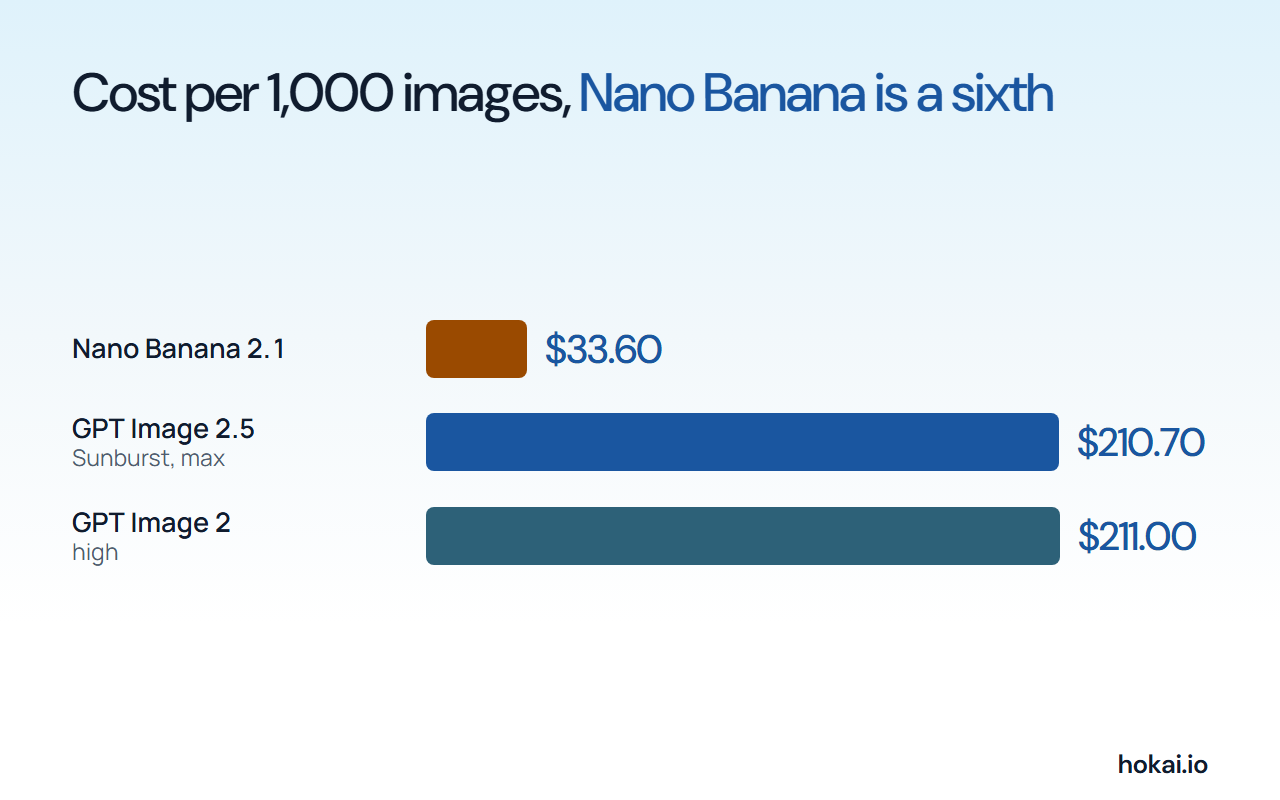 Hokai chart of cost per 1,000 images, from the Artificial Analysis text-to-image leaderboard as read on 5 November 2026. The OpenAI figure is at maximum quality.
- Elo for OpenAI's top model, first on the text-to-image board
- 1225
- Artificial Analysis
- Elo for Google's Nano Banana, fourth on the same board
- 1175
- Artificial Analysis
- Midjourney's cheapest plan, a month
- $10
- Midjourney plans page
- One small Nano Banana image by API
- $0.0336
- Google pricing page
Three engines, three ways to pay, one fresh release
Start with what you are actually comparing. Each vendor ships a family of models, and the name on the box hides which one you get.
| Engine | Current model | Where you use it | Entry price |
|---|---|---|---|
| Midjourney | V8.2, 24 Jul 2026 | Web and Discord | $10 a month |
| Nano Banana | 2.1 paid, 2 free | Gemini app, Gemini API | Free, then $4.99 a month |
| GPT Image | Images 2.6, 4 Nov 2026 | ChatGPT, Codex, API | Free, then $8 a month |
Midjourney's version page names V8.2 as the default, says the release is an update focused on aesthetics, image quality and Personalization, and adds that a new Edit Model replaces Omni Reference, Character Reference and the Retexture tool, so anyone who built habits on those older tools has to relearn the workflow. V8.1, released on 14 April 2026, added 2K HD images.
Google's image page draws a line most reviews miss. Free users in the Gemini app get Nano Banana 2. Subscribers to a Google AI plan get 2.1, which Google calls its best image model. So a free test of "Nano Banana" does not test the model people pay for.
OpenAI's launch post says Images 2.6 reached ChatGPT, Codex and the API on 4 November, for all subscription tiers. The API has two models, GPT Image 2.6 Flare for speed and Sunburst for detail. The earlier ChatGPT Images 2.5 used the same two names, and GPT Image 2 came before both.
- Midjourney V8.1 14 Apr 2026Faster renders and 2K HD images.
- GPT Image 2 Apr 2026The OpenAI snapshot dated 2026-04-21.
- Midjourney V8.2 24 Jul 2026Becomes the default version.
- Nano Banana 2.1 Oct 2026Arrives in the Gemini API.
- Images 2.6 4 Nov 2026Flare and Sunburst reach ChatGPT and the API.
What the three cost, starting with Midjourney's GPU hours
Three pricing models do not compare cleanly, so take them one at a time.
Midjourney sells GPU time. The plans page lists four tiers:
| Plan | Monthly | Billed yearly | Fast GPU time |
|---|---|---|---|
| Basic | $10 | $8 a month | 3.3 hours |
| Standard | $30 | $24 a month | 15 hours |
| Pro | $60 | $48 a month | 30 hours |
| Mega | $120 | $96 a month | 60 hours |
Extra GPU time costs $4 an hour on every plan. Unlimited images in Relax mode start at Standard, and unlimited Relax video starts at Pro. The page lists no free tier.
From V8.1, an HD run uses 1.3 minutes of GPU time and a standard-definition run uses 0.8. At the $4 hourly rate that works out to about 5 cents for a standard run and 9 cents for HD. The pages we read do not say how many pictures one run returns, so a fair per-image price for Midjourney is a gap we cannot close.
What the API and chat plans cost per image
The two API prices are easier. Both Google and OpenAI charge $30 per million image output tokens on their current models, so the gap comes from how many tokens an image uses.
| Model | Setting | Cost per image |
|---|---|---|
| Nano Banana 2.1 | 1K, 1024 pixels | $0.0336 |
| Nano Banana 2.1 | 4K, 4096 pixels | $0.113 |
| GPT Image 2 | Square, low | $0.006 |
| GPT Image 2 | Square, high | $0.211 |
OpenAI's own guide lists the medium square at $0.053. By our arithmetic, the high-quality square implies roughly 7,000 output tokens, against 1,120 for a 1K Nano Banana image. OpenAI's launch post says Flare at low quality can render in as little as six seconds, which is the cheap end of that range.
Read from the Artificial Analysis text-to-image leaderboard. The OpenAI figures are at the board's maximum quality setting.
Most people never see an API bill. For the apps, we use the US plan prices from our ChatGPT vs Gemini guide, read on 5 November 2026, because the ChatGPT page we opened showed local currency. ChatGPT's page lists "limited image creation" on Free, "more image creation" on Go, and "unlimited and faster image creation" on Pro. Google's page says Nano Banana is available free, with higher generation limits on paid plans. Neither vendor publishes a daily image count for any plan.
How the blind votes rank them, and who is missing
Artificial Analysis runs the one independent test that covers two of the three. Its voters see two images from the same prompt without knowing which model made them. The board sets the open model FLUX.2 dev as its anchor at 1000.
| Model | Text to image | Editing | Per 1,000 images |
|---|---|---|---|
| GPT Image 2.5 Sunburst (max) | 1225 | 1200 | $210.70 |
| GPT Image 2.5 Flare (max) | 1208 | 1183 | $210.70 |
| GPT Image 2 (high) | 1188 | 1136 | $211.00 |
| Nano Banana 2.1 | 1175 | 1151 | $33.60 |
The first line is OpenAI's. GPT Image 2.5 Sunburst leads text to image by 50 points over Nano Banana 2.1, and leads editing by 49. On a standard Elo scale a 50 point gap means the higher model wins about 57 of every 100 matchups. That is a real lead, not a rout. It is narrower than the marketing suggests.
The intervals matter too. Nano Banana 2.1 sits at 1175 with a range of 1163 to 1187, and the board places it between ranks three and six. GPT Image 2 at high quality sits at 1188, so those two overlap. Two other models share fifth place at 1168: Microsoft's MAI-Image-2.6 and Grok Imagine Image 2.0. The full set of model ranks lives on Hokai's model leaderboard, and the image generator directory lists the tools.
Midjourney does not appear on either board. We searched the page text for it and found nothing, and the board does not say why. So any claim that Midjourney V8.2 beats or loses to the other two in a blind test has no public number behind it today. Treat confident rankings of the three as opinion.
One more limit. The board lists Images 2.5, not 2.6, because 2.6 is a day old. OpenAI says 2.6 is 50 percent faster and better at keeping characters and products consistent across edits, but no one has measured that independently yet.
Where GPT Image wins: editing, layout and the top of the board
OpenAI holds the first three places on the text-to-image board and the first and third on editing. That is the strongest published evidence for any of the three engines.
The editing lead is the practical one. Small edits are where models differ most. If you start from a photo you already have, such as a product shot, a headshot or a room, the job is to change one thing and leave the rest alone. The OpenAI docs say GPT Image 2 processes every image input at high fidelity automatically. They also say that makes edit requests with reference images cost more input tokens.
Version 2.6 adds three things aimed at this work. The API gets image markup, which lets you mark exactly where a change should go, and a complexity setting that controls how much the model plans. OpenAI recommends low complexity for most edits. The announcement also says Flare improved layout quality for posters and product imagery.
There is a new output format too. Images 2.6 can make animated GIFs from one prompt, and the API can export SVG, a vector format that scales without blur. If your pictures end up as icons, logos or web graphics, SVG is the format you want. Our logo design guide covers that job in more depth.
The cost is the other half. At maximum quality the board prices an OpenAI image near 21 cents. A thousand of them is $210.70, against $33.60 for Nano Banana 2.1. Pay for that gap only when the edit or the layout is the product. Otherwise, do not.
OpenAI also says people make 4 billion images a week across ChatGPT, Codex and the API. Volume does not prove quality. Its launch post does name Figma Weave, Picsart, fal and Higgsfield as early customers, and its demo GIFs came from OpenArt prompts.
Where Nano Banana wins: price, free access and the Google apps
Nano Banana 2.1 is the cheap one. A 1K image costs $0.0336 by API, and batch pricing halves the output rate. For a store that needs ten thousand product variants, the gap to GPT Image at maximum quality is about $1,770 a run, by our arithmetic from the board prices.
It also scores well for the price. It ranks fourth for text to image and fourth for editing, ahead of the older Nano Banana 2 and Nano Banana Pro. On the editing board it sits 49 points below the leader and tied with Krea 3 (Ultra) on 1151.
Free access is the second advantage. Google's page says Nano Banana is free in the Gemini app, in every country and language where the app is available. The free model is Nano Banana 2, which Google lists with character consistency, text rendering, photo combining, precise editing and 2K output. Paid plans add 2.1, higher limits and a "Redo with Pro" option that regenerates a picture with Nano Banana Pro. Our free image generator guide compares what the free tiers give you.
Third, Google's pitch for 2.1 is accuracy. Its pricing page lists search-grounded generation, and its image page promises more accurate infographics and diagrams. We did not test whether grounding makes diagrams more accurate, so treat it as a vendor claim.
A developer note. The original Nano Banana model, gemini-2.5-flash-image, is deprecated and shuts down on 15 March 2027, and Google tells users to move to a newer model. The Gemini app and Google AI Studio both reach the newer ones.
Where Midjourney wins: a look you pay for
Midjourney has no blind score to point at. Its case is different. It is the only one of the three built around a house style, and a16z's seventh consumer AI report, dated 5 October 2026, says why that still pays.
The report added a ranking of US consumer card spending, using data from YipitData. Midjourney is on it, next to HeyGen, Kling and Topaz Labs. a16z's reading is that consumers still pay for specialized creative products built on a proprietary model, even as Google expands Nano Banana and ChatGPT's Images 2.0 sold well. The data is a panel, not total revenue.
What does the subscription buy? Personalization builds a profile of your taste, and the V8.2 notes say it understands that taste better, especially on profiles with many points. Midjourney describes V8.2 images as more creative, bold, sophisticated and edgy. Moodboards, style references and Raw mode, which strips default styling, give you control over the look.
Pricing suits heavy use. On Standard at $30 a month, Relax mode makes images unlimited, so a person exploring hundreds of ideas pays a flat fee. The API vendors charge for every try. Pro and Mega add Stealth Mode, which keeps images and videos private.
The catch is access. Midjourney runs on the web and in Discord, and its plans page lists no free tier. If your work is concept art, editorial or brand mood boards, that look may matter more than a 50 point Elo gap on someone else's prompts.
Who should pick which, job by job
Here is how the evidence maps to work. The picks for editing and price rest on published numbers. The picks for style and text rest on vendor claims and judgement, and the table says so.
| Job | Pick | Why |
|---|---|---|
| Edit an uploaded photo | GPT Image | First on the editing board at 1200 |
| Thousands of images by API | Nano Banana 2.1 | $0.0336 each at 1K |
| A free tool to try | Nano Banana 2 | Free in the Gemini app |
| A distinctive art style | Midjourney | Personalization and Moodboards; no blind score |
| Poster layout, SVG, GIFs | GPT Image 2.6 | OpenAI lists all three |
| Text inside the picture | Test both | Each vendor claims it; none measured here |
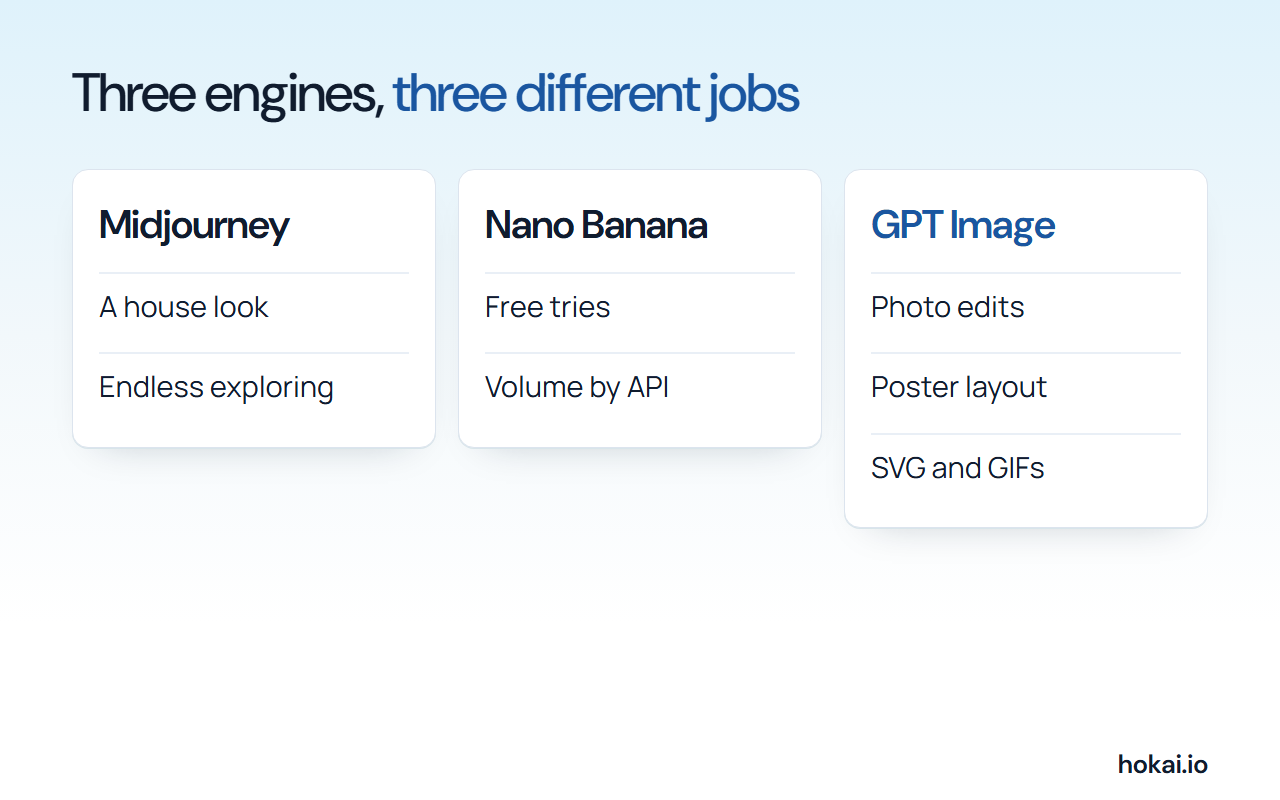 Hokai card mapping each job to the engine with the strongest published evidence, as of 5 November 2026.
If you have not decided, run your own work through Smart Match and compare the stack it suggests against this table. For product photos on white, our product photography guide ranks tools built for that job. For faces, see the guide to pictures of people. For repair and retouching, the photo editing guide goes further.
Two other names come up in this category and sit outside the three: Adobe Firefly and Ideogram. Our image generator roundup covers both and carries the wider price table, which this guide does not repeat. A head-to-head of two smaller rivals is in Adobe Firefly vs Gencraft.
The best argument against trusting the leaderboard
The strongest objection to the verdict above is that a vote on a leaderboard is not your job. Artificial Analysis shows two images side by side and asks which looks better, which is a fair way to measure general appeal but a poor way to learn whether a catalogue photo, a poster with a legal line or a moody album cover will work for your business. Those jobs reward different things.
That objection is right in three ways. First, the board prices the OpenAI models at maximum quality, a setting many people never use. Second, the board lacks Midjourney, so the most style-driven engine is missing from the one test that could rank it. Third, the board runs a version behind OpenAI.
It does not rescue the opposite conclusion either. Nothing public shows Nano Banana or Midjourney beating GPT Image 2.5 on editing, and Nano Banana's lead on price is a number you can read on Google's page. So the right use of the board is to rule out claims, not to crown a winner. If one model leads by 50 points and costs six times more, you can test whether your own work needs that gap in an afternoon.
Rights, data and watermarks: who owns the picture?
Ownership is the clearest difference in the paperwork. It is also where the three are least alike.
OpenAI's terms say that, as between you and OpenAI, you own the output, and that OpenAI assigns you any rights it holds. The same terms warn that output may not be unique and that other users may get similar results. ChatGPT's plan table says content may be used for training, with an opt-out on every plan.
Midjourney's plans page gives general commercial terms to all four plans. A company with more than $1,000,000 in gross revenue a year must buy Pro or Mega. Stealth Mode, which keeps images and videos private, is Pro and Mega only, so on lower plans you should assume your pictures are not private.
Google is the gap. We read Google's terms of service, effective 30 July 2026, and the older generative AI terms that no longer apply, and found no sentence that assigns ownership of Gemini app images to you. That does not mean you cannot use them. It means we could not confirm it from the pages we read, so check the terms before client work. Google's image page adds that images carry an invisible SynthID watermark and a visible one.
For the API, Google's pricing page separates the tiers. Free-tier content is used to improve Google's products, and paid-tier content is not.
What switching costs you
Moving between these is cheap for one picture. It gets costly for a habit built over months of prompts, profiles and saved settings that no other engine reads.
- Midjourney. Your Personalization profile, moodboards and style codes live in one account. V8.2 also replaced Omni Reference and Character Reference with the Edit Model.
- GPT Image. You carry your prompts, not your assets. OpenAI asks API users to complete organization verification before using these models, which adds a setup step.
- Nano Banana. Google retires models on a schedule. The first Nano Banana shuts down on 15 March 2027.
- All three. Old models disappear. OpenAI shut down GPT Image 1 on 23 October 2026.
Plan for that. Store your prompts and the settings used for each result. A pipeline pinned to a model that vanishes breaks in a quiet way: the images still come back, but they look different. Our comparisons of ChatGPT and Gemini, ChatGPT and Claude and Claude and Gemini cover the assistant plans around these models, if you are choosing the bundle rather than the image tool.
Run the six-prompt test yourself
A fair test takes about an hour and costs under $10. Use the same six jobs in each engine, generate three tries each, and score them blind: ask a colleague to pick the best image without knowing which engine made it.
- A realistic photo.
- A product shot on a plain background.
- A poster with a headline and a second line of small text.
- An edit of a photo you uploaded.
- The same character in four scenes.
- An art style you could name.
1. A documentary photo of a baker pulling loaves from a wood oven at 5am, window light, flour dust in the air.
2. A matte black water bottle on a grey concrete plinth, soft studio light, plain background, no text.
3. A poster for a bike repair night. Headline: FIX IT FRIDAY. Second line: Bring a flat tyre.
4. (Upload your own photo) Replace the background with an overcast street. Keep the person, clothes and lighting unchanged.
5. Four panels of the same red-haired courier: at a door, on a bike, in a lift, at a desk. Same face and jacket in every panel.
6. A harbour at dusk as a three-colour linocut print with rough edges.
Save every result with the engine, model and setting. Score each on whether the text is spelled right, whether the edit changed only what you asked, and whether the character stays the same.
What would change this verdict
Four developments could flip the call.
- Midjourney joins a blind board. A V8.2 Elo would end the "no public score" caveat and give the style argument a number.
- Images 2.6 scores differently. If it lands below 2.5 on editing, the lead shrinks.
- Nano Banana 2.1 closes the editing gap. It sits 49 points back at a sixth of the price.
- Google states ownership. One sentence assigning rights would settle our biggest paperwork worry.
- Best published evidence
- GPT Image, first on both Artificial Analysis boards
- Best price and free access
- Nano Banana, free in the Gemini app, $0.0336 per 1K image by API
- Best for a house look
- Midjourney, with no public blind score
- Biggest gap
- Midjourney and Nano Banana 2.1 versus Images 2.6, not yet tested side by side
Watch the next Artificial Analysis refresh. It should be the first one to include Images 2.6, and it will show whether yesterday's launch changes the order.
Frequently asked questions
Which is better, Midjourney, Nano Banana or GPT Image?
It depends on the job. GPT Image 2.5 Sunburst ranks first on both Artificial Analysis boards, at 1225 for text to image and 1200 for editing. Nano Banana 2.1 is fourth on both at a far lower price. Midjourney appears on neither board, so no public blind score ranks it.
How much does each image engine cost?
Midjourney plans run from $10 to $120 a month and bill GPU time, with extra time at $4 an hour. Nano Banana 2.1 costs $0.0336 for a 1K image by API. GPT Image 2 costs $0.006 to $0.211 for a square image depending on quality.
Is there a free option?
Yes, for Nano Banana. Google says image generation is free in the Gemini app, using Nano Banana 2, while paid Google AI plans add 2.1. ChatGPT Free lists limited image creation. The Midjourney plans page lists no free tier.
Can I use the images commercially?
OpenAI's terms say you own the output. Midjourney allows commercial use on all plans, but a company earning over $1,000,000 a year must buy Pro or Mega. We could not find a sentence assigning ownership of Gemini app images in Google's terms, so check before client work.
Which model is newest?
OpenAI released Images 2.6 on 4 November 2026. Midjourney V8.2 became the default on 24 July 2026, and Nano Banana 2.1 reached the Gemini API in October 2026. The Artificial Analysis boards still list GPT Image 2.5, not 2.6.
Covered in this guide
- Midjourney: An independent research lab creating stunning AI-generated images from text prompts
- GPT Image 2: OpenAI's April 2026 image flagship integrates O-series reasoning for 99% text accuracy, natural language inpainting, and 2K resolution via a token-based API.
- Nano Banana 2.1: Google's image generation and editing model in the Gemini API, with 1K to 4K output and multi-image reference mixing, generally available since October 2026.
- Adobe Firefly: Adobe Firefly generates commercially safe AI images and video inside Photoshop and Illustrator, trained exclusively on licensed content for full commercial-use IP indemnification.
- ChatGPT: ChatGPT is OpenAI's AI assistant, with 1.2 billion weekly users by OpenAI's count, the GPT-6 model family and plans that run from a free tier to a premium Pro tier.
- ChatGPT Images 2.5: OpenAI's ChatGPT Images 2.5, released September 8, 2026, adds Sketch reference drawing and comment-based edits across two API snapshots, Flare and Sunburst.
- FLUX.2 dev: FLUX.2 by Black Forest Labs (Nov 2025) is a 32B rectified flow transformer family producing up to 4MP images. Five variants span open-weight klein to grounded [max], with multi-reference editing and hex color control.
- Gemini: Google's multimodal AI assistant and model family, sold as a free app, tiered subscriptions and a pay-per-token API
- Google AI Studio: Free web-based IDE for building, testing, and deploying generative AI applications with Google's Gemini models
- Grok Imagine Image 2.0: xAI's second-gen image model, live in the Grok app since August 7, 2026, with region-precise editing and a #2 global Arena ranking.
- Ideogram: AI image generator that actually gets text right, useful for anything combining words and visuals.
- OpenAI's: OpenAI builds ChatGPT, the GPT-6 family (Astra, Sol, Luna), Codex and the OpenAI API. It reports 1.2B weekly ChatGPT users and an $852B valuation after its March 2026 round.
- OpenArt: OpenArt puts a large catalog of image, video and audio models behind one credit balance, with paid plans from $14 a month and a 7-day free trial.
Sources
Still deciding?
This guide covers a handful of options. Smart Match checks every listing in the directory against how you actually work and what you can spend, then hands you the shortlist and the reason behind each pick.
Find your toolsRelated guides
- Two Kinds of Picture: How Hokai Illustrates Its GuidesInside HokaiHow the directory works, verified in the open
- Adobe Firefly or Gencraft: A 2026 Pricing and Feature ComparisonComparisonHead-to-head, with a verdict
- Adobe Firefly vs Topaz Photo AI: Which Should You Use in 2026?ComparisonHead-to-head, with a verdict
- The AI 80s Photo Trend: How to Make Yours (and Turn It Into a Video) in 2026AnalysisWhat changed and who it affects
- AMD Buys World Labs for $8.2B: What It Means for Marble UsersAnalysisWhat changed and who it affects
- Attio vs HubSpot in 2026: Which CRM for a Startup?ComparisonHead-to-head, with a verdict