41 of 100 HokAI Guides Carry a Screenshot. All 106 Still Load.
Does HokAI use stock photos in its guides? No. Every image is a live capture from a headless browser, manually checked against a banned list that excludes error pages, blank shells, and cookie walls, then stamped with the date it was taken. A same-day recheck of all 100 guides found zero broken or placeholder images among 106 total.
The short version
HokAI's guide images are real screenshots captured live from the page they describe, or charts drawn from HokAI's own verified numbers, never stock photography. A public audit of all 100 published guides on August 26, 2026 found 106 images across 41 guides, every one still resolving, none broken or a placeholder.
Forty-one of the 100 guides published on hokai.io carry at least one image, and all 106 of those images returned a live 200 today, August 26, 2026. This piece re-fetched every one of them from the public API before writing a word about the policy behind them.
That is not a coincidence and it is not automatic. HokAI's guide-image pipeline runs a real screenshot through a script, a human eye-check, and a banned-image list before a single pixel reaches production, and this piece exists because a reader can now check every claim in it against the same public endpoints used to write it. The other 59 guides ship with no images at all, which turns out to be its own kind of discipline, not a gap someone forgot to fill.
Disclosure: HokAI wrote this about HokAI.
Everything below came from two public reads: GET /api/guides?limit=500 for the full list, then GET /api/guides/{slug} for each of the 100, parsed for markdown image tags and re-fetched over HTTPS. Anyone can run the same two calls and get the same 106 URLs, all resolving today, all with real byte weight, none of them a placeholder.
A screenshot only proves something if it can be checked
A 2026 Nielsen Norman Group study found that readers rate AI-generated photography about as trustworthy as stock photography, with no statistically significant gap in a blind test, though ratings dropped once a viewer suspected the image was AI-made. That result complicates the easy version of this argument: it is not that a "real" photo beats a synthetic one on sight. Origin, on its own, is nearly invisible to a reader scrolling past.
What the study did not test is checkability. A stock photo of two people pointing at a laptop asserts nothing a reader can verify. Murf's own pricing page, captured inside a HokAI guide on August 25, 2026, asserts something specific: Creator costs $19 a month, Business costs $66 billed annually or $99 billed monthly, and the annual toggle is what produces the 96-hour usage cap.
A reader can open murf.ai right now and check every one of those numbers against the same page. That gap, checkable against fakeable, is the axis HokAI's image policy is built around. It is also the axis Google's own guidance on helpful content names directly: reviews build trust when they come "accompanied by evidence of the work involved, such as photographs."
The effect is not theoretical. Amsive's analysis of Google's product-reviews update tracked a parenting site that gained 45% more search visibility and an audio-review site that gained 85%, in both cases after adding visible, checkable proof of firsthand testing where there had been none.
How an image earns its place before it ships
A guide image starts as a command, not an upload. capture-shot.mjs drives a real headless Chrome against the live URL the sentence is about, whether that is a vendor's pricing page, a product landing page, or a chart HokAI drew from its own verified numbers. The script renames the output to embed its pixel dimensions, murf-studio-pricing-1280x800.png, so the page can reserve the layout box before the image loads and never shifts content while it does.
That capture is not trusted on its own. The skill that runs it has to open the file and look: no cookie wall standing in for the content, no blank app shell, no half-loaded skeleton, no browser error page pretending to be evidence about someone else's downtime. A capture that fails the eye-check gets thrown away and re-shot, or the claim it was meant to support gets cut from the guide entirely.
Every surviving image gets scp'd to production, git-committed under /pictures/guides/{slug}/, and given a dated, italic caption naming the source and the exact day it was pulled. No caption, no date, no publish.
What the corpus actually looks like today
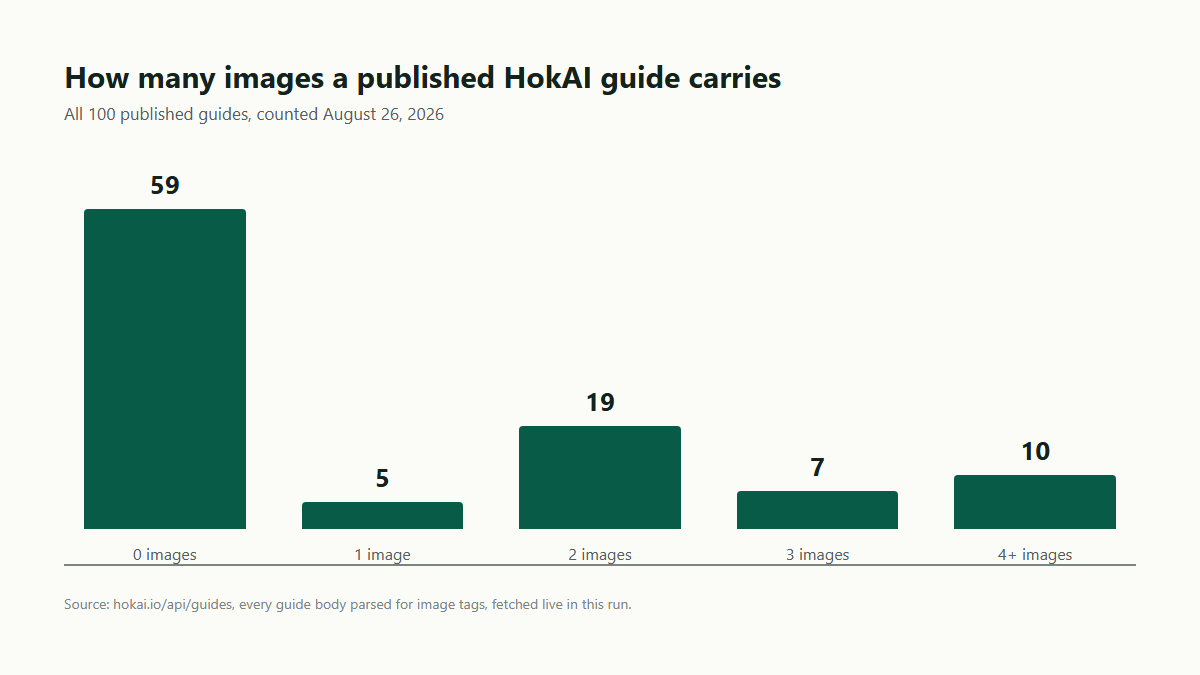 Every published guide, sorted by image count, counted August 26, 2026. Source: hokai.io/api/guides, fetched live in this run.
The spread is not even, and it should not be. Ten guides carry four or more images because their claims are dense with numbers a reader would want to check twice: Clay's pricing at $167 a month for Launch and $446 for Growth, Apollo's four tiers topping out at $119 with a three-seat minimum, PredictLeads' pay-as-you-go rates stepping from $0.04 to $0.01 per credit.
All three of those screenshots sit inside one guide, HokAI's roundup of AI SDR tools, because a shortlist that compares five pricing pages needs five dated proofs, not one.
Nineteen guides carry exactly two, which is the shape a comparison piece takes most often: one screenshot per side. What Murf AI Is Actually For pairs a shot of Murf AI Studio's pricing tiers with a shot of the Falcon 2 landing page announcing sub-100-millisecond synthesis, because the guide's entire argument is that Murf now runs two separate products under one name, and a reader should be able to see both pitches exist rather than take the claim on faith.
The images are not always screenshots of someone else's page. HokAI draws its own charts from its own verified numbers when a statistic needs a picture nobody else owns, like the bar chart above, or the one inside The Quirks Field showing how many documented quirks each of HokAI's 103 model listings carries. Both kinds go through the identical pipeline: real numbers in, eye-check before publish, a dated caption naming the source.
The chokepoint that resists shortcuts
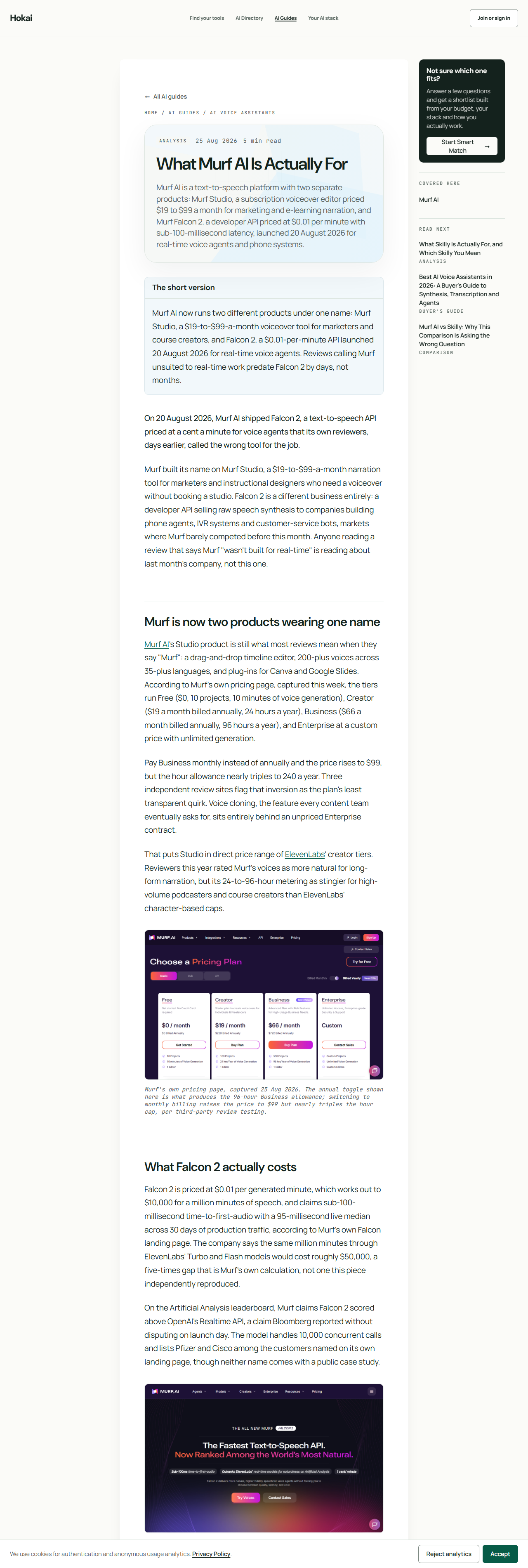 The live guide page at hokai.io/guides/what-murf-ai-is-for, captured August 26, 2026. Both screenshots carry their own capture date in the caption, independent of the guide's own publish date.
Nothing here is expensive to build. Any content operation could point a headless browser at a competitor's pricing page. The part that resists scaling into a content mill is the manual eye-check between capture and publish: a person has to actually open the file, and a banned list rejects error pages, blank shells, and cookie walls before a human ever gets there. That step is slow on purpose, and it is exactly the step an automated pipeline skips when volume is the goal instead of accuracy.
The NN/g finding above is a fair objection to take seriously: if a reader cannot reliably spot the difference between a synthetic image and a real one, why does the manual step matter? Because the study measured whether an image looks plausible, not whether the specific number under it is true. A synthetic photo of a laptop can look exactly as convincing as a real one and still assert nothing.
A screenshot of murf.ai/pricing dated August 25, 2026 can be wrong in only one way: if murf.ai/pricing did not say that on that date, which any reader can check in the next five minutes. Plausibility and falsifiability are different properties, and HokAI's pipeline is built for the second one.
What this screenshot policy doesn't cover
Fifty-nine of the 100 published guides carry zero images, and that number is not a failure to close. A claim sourced from a primary document, a company's own SEC filing, an acquisition announcement quoted directly from a press release, is often stronger cited in prose with a link than captured as a screenshot of a webpage rendering that same document.
HokAI's guide to the Adobe-Topaz acquisition does both: a screenshot of Adobe's newsroom post announcing Adobe Firefly's deal with Topaz Photo AI's parent company, then plain sourced prose for the deal terms that came from wire coverage rather than a single page.
The other honest reason a guide ships with no image: the capture failed and the claim went with it. If Chrome cannot render a target page cleanly, headless or otherwise, the policy is to cut the claim rather than publish a broken capture or fabricate a description of a page nobody actually looked at.
A screenshot that would take more effort to fake convincingly than to simply not include is not a gap in the corpus. It is the corpus working as designed, and a reader deciding whether to trust hokai.io's directory of 461 tools can run the same two API calls this piece did and get the same answer.
Readers who want the shortlist version of this same evidence discipline, rather than the mechanism behind it, are better served starting a Smart Match session, which draws its recommendations only from listings that have already been through this verification, not from a search engine's guess at relevance.
The next batch of image-less guides gets the same test this one just ran: does a screenshot make a specific number checkable, or does it just fill space. Guides that fail that test stay text. The ones that pass get shot, eye-checked, dated, and added to a count anyone can re-run.
Frequently asked questions
Does HokAI use AI-generated or stock images in its guides?
No. Every image in a HokAI guide is a real screenshot captured from the live page the sentence describes, or a chart HokAI draws from its own verified numbers. Stock photography and AI-generated imagery are excluded from the guide-image pipeline entirely.
How does HokAI verify a guide screenshot before it publishes?
A script captures the page with a real headless browser, then a person opens the resulting file and checks it against a banned list that excludes error pages, blank shells, and cookie walls. A capture that fails that check is re-shot, or its claim is cut from the guide.
Why do some HokAI guides have no images at all?
As of August 26, 2026, 59 of HokAI's 100 published guides carry no images. That is usually because the claim is sourced from a primary document better cited in prose than screenshotted, or because a Chrome capture failed and the claim was cut rather than faked.
What happens if HokAI can't capture a real screenshot for a claim?
The claim is cut from the guide rather than published without evidence. HokAI's policy treats a missing screenshot as acceptable and a fabricated or unverified one as not, so a failed capture never becomes a stock-photo stand-in.
Does HokAI publish charts as well as screenshots?
Yes. When a statistic needs a picture nobody else owns, HokAI draws it from its own verified numbers, such as a bar chart of quirk counts across its model listings. Owned charts go through the same capture, eye-check, and dated-caption pipeline as page screenshots.
Covered in this guide
- HokAI: HokAI is an editor-curated, AI-only directory at hokai.io. Listing requires a flat submission fee; rankings cannot be bought. Every Pulse update is verified against a primary source.
- Adobe Firefly: Adobe Firefly generates commercially safe AI images and video inside Photoshop and Illustrator, trained exclusively on licensed content for full commercial-use IP indemnification.
- Clay: AI go-to-market platform with waterfall data enrichment and Claygent AI research agents, with plans from free to enterprise.
- Murf AI: Ultra-realistic AI Voice Generator with fastest text-to-speech API for voice agents and creators
- Topaz Photo AI: Topaz Photo AI sharpens, denoises, and upscales images up to 16x. Trusted by 1.5M+ photographers at Apple and NASA. Annual plans from $199, no free tier.
Sources
Still deciding?
This guide covers a handful of options. Smart Match checks every listing in the directory against how you actually work and what you can spend, then hands you the shortlist and the reason behind each pick.
Start Smart MatchRelated guides
- Adobe Firefly or Gencraft: A 2026 Pricing and Feature ComparisonComparisonHead-to-head, with a verdict
- Adobe Firefly vs Topaz Photo AI: Which Should You Use in 2026?ComparisonHead-to-head, with a verdict
- Apollo vs Clay: Which One Should You Buy First?ComparisonHead-to-head, with a verdict
- Bardeen vs Browse AI: Same Comparison, Different Products NowComparisonHead-to-head, with a verdict
- Best AI Tools for Graphic Designers in 2026Buyer's guideHow to pick, across a category
- Best AI for Creating Logos in 2026: Tested Picks & VerdictBuyer's guideHow to pick, across a category