What Murf AI Is Actually For
Murf AI is a text-to-speech platform with two separate products: Murf Studio, a subscription voiceover editor priced $19 to $99 a month for marketing and e-learning narration, and Murf Falcon 2, a developer API priced at $0.01 per minute with sub-100-millisecond latency, launched 20 August 2026 for real-time voice agents and phone systems.
The short version
Murf AI now runs two different products under one name: Murf Studio, a $19-to-$99-a-month voiceover tool for marketers and course creators, and Falcon 2, a $0.01-per-minute API launched 20 August 2026 for real-time voice agents. Reviews calling Murf unsuited to real-time work predate Falcon 2 by days, not months.
On 20 August 2026, Murf AI shipped Falcon 2, a text-to-speech API priced at a cent a minute for voice agents that its own reviewers, days earlier, called the wrong tool for the job.
Murf built its name on Murf Studio, a $19-to-$99-a-month narration tool for marketers and instructional designers who need a voiceover without booking a studio. Falcon 2 is a different business entirely: a developer API selling raw speech synthesis to companies building phone agents, IVR systems and customer-service bots, markets where Murf barely competed before this month. Anyone reading a review that says Murf "wasn't built for real-time" is reading about last month's company, not this one.
Murf is now two products wearing one name
Murf AI's Studio product is still what most reviews mean when they say "Murf": a drag-and-drop timeline editor, 200-plus voices across 35-plus languages, and plug-ins for Canva and Google Slides. According to Murf's own pricing page, captured this week, the tiers run Free ($0, 10 projects, 10 minutes of voice generation), Creator ($19 a month billed annually, 24 hours a year), Business ($66 a month billed annually, 96 hours a year), and Enterprise at a custom price with unlimited generation.
Pay Business monthly instead of annually and the price rises to $99, but the hour allowance nearly triples to 240 a year. Three independent review sites flag that inversion as the plan's least transparent quirk. Voice cloning, the feature every content team eventually asks for, sits entirely behind an unpriced Enterprise contract.
That puts Studio in direct price range of ElevenLabs' creator tiers. Reviewers this year rated Murf's voices as more natural for long-form narration, but its 24-to-96-hour metering as stingier for high-volume podcasters and course creators than ElevenLabs' character-based caps.
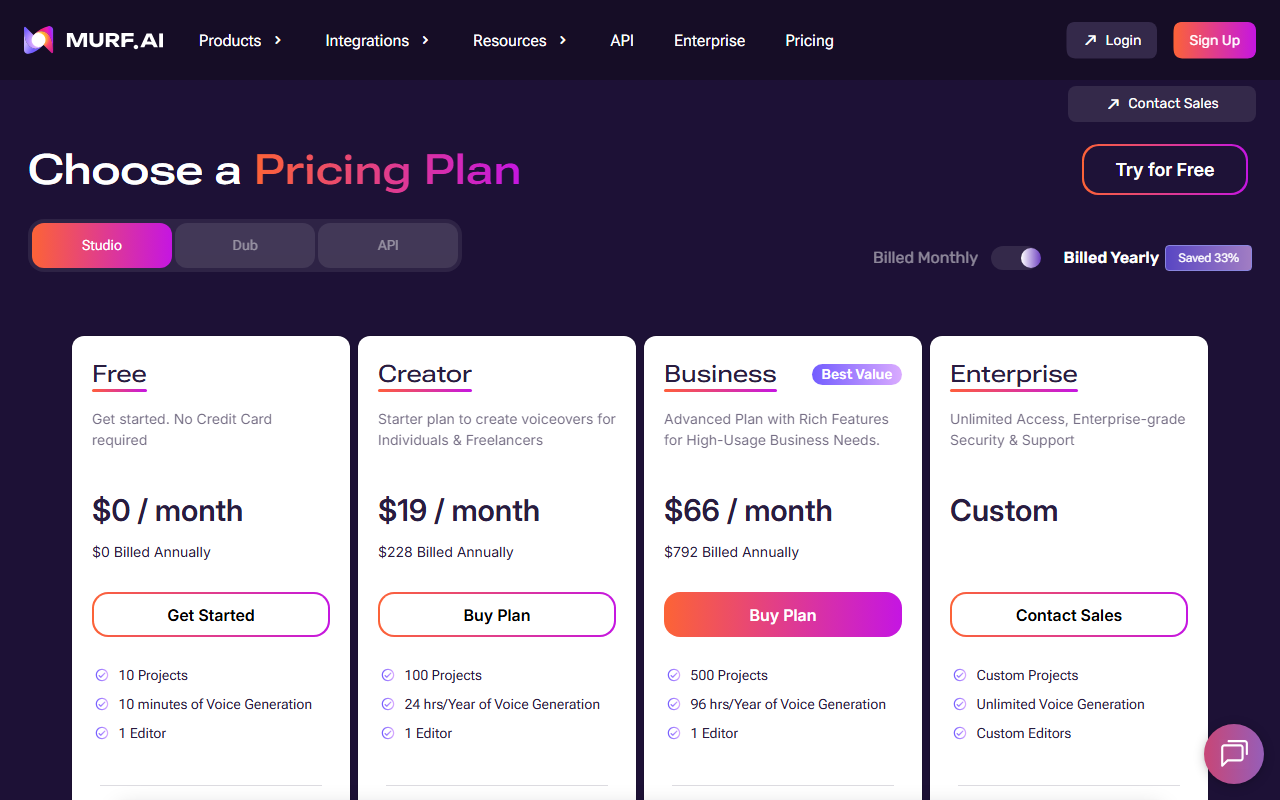 Murf's own pricing page, captured 25 Aug 2026. The annual toggle shown here is what produces the 96-hour Business allowance; switching to monthly billing raises the price to $99 but nearly triples the hour cap, per third-party review testing.
What Falcon 2 actually costs
Falcon 2 is priced at $0.01 per generated minute, which works out to $10,000 for a million minutes of speech, and claims sub-100-millisecond time-to-first-audio with a 95-millisecond live median across 30 days of production traffic, according to Murf's own Falcon landing page. The company says the same million minutes through ElevenLabs' Turbo and Flash models would cost roughly $50,000, a five-times gap that is Murf's own calculation, not one this piece independently reproduced.
On the Artificial Analysis leaderboard, Murf claims Falcon 2 scored above OpenAI's Realtime API, a claim Bloomberg reported without disputing on launch day. The model handles 10,000 concurrent calls and lists Pfizer and Cisco among the customers named on its own landing page, though neither name comes with a public case study.
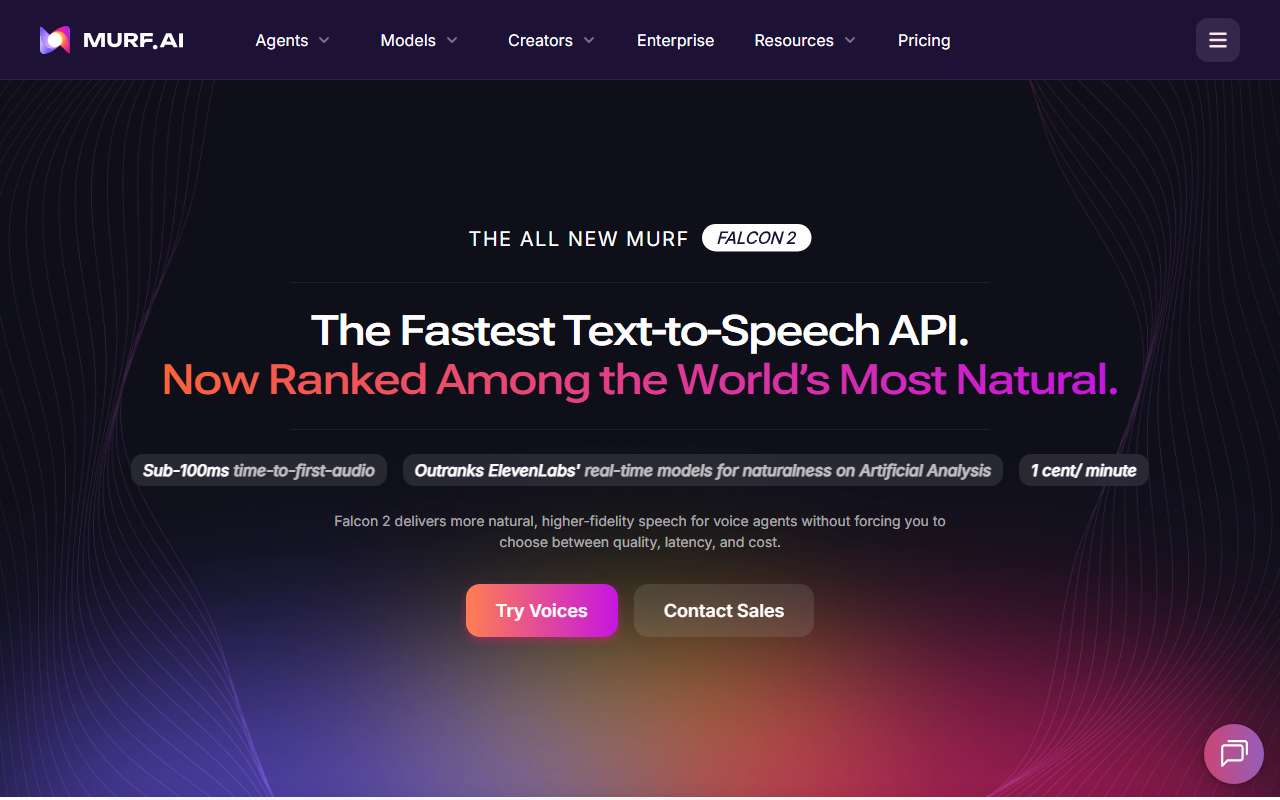 Murf's Falcon 2 launch page, captured 25 Aug 2026. The ElevenLabs comparison and the Artificial Analysis ranking are both Murf's own claims, not independently reproduced here.
Whichever job you are actually hiring Murf for, working that fit out by hand against ElevenLabs, Deepgram and a dozen smaller APIs eats an afternoon. HokAI's Smart Match narrows that list to what fits your stack and budget in a couple of minutes instead.
Who Studio is actually for
Studio's real customer is the marketing or L&D team that needs narration and does not want to book a voice actor: explainer videos, e-learning modules, product demos, social clips. G2 reviewers this year praised the voices for health content and multilingual delivery, and one reviewer specifically used Murf for outbound call-routing prompts, pre-recorded lines dropped into an IVR menu, not the live conversational work Falcon 2 targets.
The recurring complaint across that same review set is the Studio editor itself: users describe syncing text-to-speech blocks with video as laggy, a production problem no pricing change fixes.
Who Falcon 2 puts on notice
Falcon 2's price undercuts the real-time field it just entered. Deepgram, which built its reputation on sub-300-millisecond speech-to-text and TTS for 200,000-plus developers, now has a rival claiming faster synthesis at a fraction of typical enterprise pricing. PlayHT, which sells its own low-latency voices to the same builder audience, faces the identical problem.
The sharper threat may be Kugelaudio, a GDPR-based European TTS API that already claims 39-millisecond first-audio latency, undercutting even Falcon 2 on raw speed, though with far less brand recognition and no comparable customer-logo list. None of the three had published a public response to Falcon 2 as of this week.
The best case against Falcon 2's numbers
The obvious rebuttal: a leaderboard score and a vendor's own cost comparison are marketing, not due diligence. Retell AI, which already runs 50 million-plus monthly calls on a 600-millisecond latency budget for HIPAA and SOC 2-compliant phone agents, picked its current voice stack after testing uptime under real call volume, not a launch-week benchmark. Murf has not published an SLA, a telephony-integration list, or a single named production customer for Falcon 2 beyond the logos on its own page.
For a team already committed to a voice stack, that maturity gap matters more than five-times-cheaper generation. For a team building from zero next quarter, the price alone is cheap enough to justify a pilot regardless.
Voice cloning is the other asterisk. Resemble AI sells self-serve cloning as a core product; Murf still gates it behind the same unpriced Enterprise contract that governed Studio, and Falcon 2's own page says nothing about changing that.
What to watch
The number worth tracking is not the benchmark score. It is whether Murf names a real production customer for Falcon 2, not just a logo, before the end of 2026. A launch with six client names and zero case studies five days in is normal. The same gap six months out would mean the price war got more attention than the product did.
Murf spent five years building a narration tool nobody confused with a phone system. Falcon 2 is betting that gap closes faster than Deepgram, PlayHT or Kugelaudio can defend it.
Frequently asked questions
What is Murf AI used for?
Murf AI covers two different jobs. Murf Studio is a subscription voiceover tool for marketers, instructional designers and podcasters who need narration for videos, e-learning modules and demos. Murf Falcon 2, launched 20 August 2026, is a separate developer API for building real-time voice agents, IVR systems and phone bots.
Is Murf AI good for real-time voice agents?
Murf Studio was not built for that job, which is why older reviews call Murf unsuited to real-time work. Falcon 2 is the answer to that gap: it claims sub-100-millisecond time-to-first-audio and handles 10,000 concurrent calls, but it launched only days before most comparison content was written and has no published SLA or named production customer yet.
How much does Murf AI cost?
Murf Studio runs Free, Creator at $19 a month billed annually, Business at $66 a month billed annually (rising to $99 on monthly billing), and a custom Enterprise tier, according to Murf's own pricing page. Falcon 2 is billed separately at $0.01 per minute of generated speech, roughly $10,000 per million minutes.
What is Murf Falcon 2?
Falcon 2 is Murf's real-time text-to-speech API, launched 20 August 2026. Murf says it scores above OpenAI's Realtime API on the Artificial Analysis leaderboard and undercuts ElevenLabs' Turbo and Flash pricing by roughly five times, though both comparisons are the vendor's own figures rather than independently reproduced ones.
Is Murf AI free?
Murf Studio has a free tier limited to 10 minutes of voice generation across 10 projects, with no downloads or commercial usage rights beyond that cap. Falcon 2 has no free tier; it is billed per minute from the first call.
Covered in this guide
- Murf AI: Ultra-realistic AI Voice Generator with fastest text-to-speech API for voice agents and creators
- Deepgram: Real-time voice AI APIs for developers: speech-to-text under 300ms, TTS, and voice agents. Used by 200,000+ developers.
- ElevenLabs: The leading AI voice platform for text-to-speech, voice cloning, and conversational AI agents
- Kugelaudio: European TTS API with fast first-audio latency across dozens of languages, GDPR-compliant EU hosting with zero data retention, and a 78% human-preference win rate over ElevenLabs on German-language tests. Billed per minute, no card required to start.
- PlayHT: [DISCONTINUED] Play.ht was an AI text-to-speech platform with 900+ voices in 142 languages. Meta acquired the company in 2025 and shut it down completely by year's end. See TechCrunch and Meta's official announcement for proof.
- Resemble AI: Generative voice AI and deepfake detection for enterprise trust
- Retell AI: Retell AI builds and deploys realistic AI phone agents with 600ms latency, handling 50M+ monthly calls, and HIPAA/SOC 2 compliance. Rated 4.8/5 on G2 by 1,414 teams.
Sources
Still deciding?
This guide covers a handful of options. Smart Match checks every listing in the directory against how you actually work and what you can spend, then hands you the shortlist and the reason behind each pick.
Start Smart MatchRelated guides
- 41 of 100 HokAI Guides Carry a Screenshot. All 106 Still Load.Inside HokAIHow the directory works, verified in the open
- Best AI Dubbing and Video Translation Tools in 2026Buyer's guideHow to pick, across a category
- Best AI for Creating YouTube Videos in 2026: A Buyer's GuideBuyer's guideHow to pick, across a category
- Best AI Text to Speech in 2026: What an Hour of Audio Really CostsBuyer's guideHow to pick, across a category
- Best AI Voice Assistants in 2026: A Buyer's Guide to Synthesis, Transcription and AgentsBuyer's guideHow to pick, across a category
- HokAI vs Insidr.ai: The Sponsorship Price Insidr Never PublishesInside HokAIHow the directory works, verified in the open