Best AI SDR Tools in 2026: The Data Layer, Not the Autonomous Agent
The term "AI SDR" covers two unrelated products: autonomous agents like Artisan and 11x that write and send outreach themselves, and data platforms, the kind HokAI lists, that supply the contacts and signals behind any outbound program. Buyers searching that phrase should confirm which product tier they actually need before comparing prices.
The short version
HokAI's "AI SDRs" category lists five tools worth comparing: Apollo, Clay, Crunchbase, PredictLeads and Signalbase. All five sell company or contact data, not autonomous outreach. Apollo suits fast, broad prospecting from $49 a month; Clay suits row-by-row research from $167 a month. Neither one sends the message for you.
Apollo.io says 600,000 companies use its contact database, and none of them are using it to send an email by itself.
That matters because "AI SDR" now describes two different products that share almost nothing but a name. One kind is a fully autonomous agent that researches a prospect, writes the message and sends it: Artisan's Ava, 11x's Alice, AiSDR. The other kind is the data and signal infrastructure that any outbound program, human or automated, actually runs on. HokAI lists seven tools under "AI SDRs," and every one of them is the second kind, not the first.
"AI SDR" Means Two Different Products, and HokAI Lists One of Them
Searchers typing "best AI SDR tools" are usually picturing an AI worker with a name: something that opens LinkedIn, finds a prospect, drafts a cold email, and books the meeting without a human touching it. Coverage of that category this year, including a 2026 roundup from Unify GTM, groups Artisan, 11x and AiSDR together as the "fully autonomous" tier and contrasts them against "augmented" platforms that hand a prepared draft to a human rep. Amplemarket's own comparison piece runs the same split.
None of those three autonomous-agent vendors are listed on HokAI. What HokAI calls "AI SDRs" instead is a small group of tools that find, verify and enrich company and contact data, sometimes with a sequencing feature bolted on, but none of them built around an autonomous persona that decides what to send: Apollo, Clay, Crunchbase, PredictLeads and Signalbase are the five worth comparing in depth.
If your actual problem is "I want an AI that replaces a junior SDR's outbound queue," this guide will not solve it, and you should look at the autonomous tier instead. If your problem is "I need the data an SDR, human or AI, actually prospects from," keep reading, because that is what these tools sell. The honest way to pick between them is to run your situation through Smart Match rather than guess from a features list.
This is not a naming quirk unique to HokAI. Search results for "AI SDR" mix both product tiers together constantly, because both tiers are chasing the same buyer and the same budget line. A revenue leader shopping under that term this quarter needs to know which shelf they are standing in front of before they compare two prices, because a $49-a-month seat on a data platform and a monthly retainer for an autonomous agent are not competing for the same job, and neither vendor's homepage volunteers that distinction.
Five Questions That Actually Separate These Tools
Before the shortlist, five questions do most of the work of choosing:
- Is the data live or static? Signalbase markets real-time event detection (funding, hiring, M&A) within roughly a minute of a public trigger. Apollo and Crunchbase are closer to a large, periodically refreshed database you search against.
- Does pricing scale by seat or by usage? Apollo and Clay charge per user per month. PredictLeads and Signalbase charge per API call or credit, with no seat count at all, which matters if three people share one integration.
- Does it ship its own outreach, or is it enrichment only? Clay's free plan already includes a Sequencer for sending email; Apollo's navigation includes an "Automate Your Outbound" section. Crunchbase and PredictLeads do not send anything: they are pure research and API layers you plug into whatever sends your mail.
- Can an agent query it directly? Signalbase's own site markets MCP and webhook access specifically for "AI agent builders needing real-time triggers." That is a narrower audience than the other five tools, most of which assume a human working a dashboard.
- What does a credit actually buy? This is the question every pricing page tries hardest to obscure. PredictLeads is explicit: a credit is one API call. Clay is not.
A basic contact enrichment on Clay costs 14 credits, a full contact costs 34, a company costs 41, and a full contact plus company costs 75, all from the same monthly allotment. Read the fine print before comparing two "credits" as if they were the same unit.
None of these five questions has a universally right answer. They just narrow five options down to two or three fast, and they work whether the buyer ends up on this list or on the autonomous-agent tier this guide does not cover.
The Shortlist: Five Tools, Ranked by the Job They Solve
Prices below came from each vendor's own pricing page, checked on 25 August 2026. Two of them had moved since HokAI last recorded them: Clay's Launch plan is $167 a month now, not $185, and its Growth plan is $446, not $495. That kind of drift is normal for usage-based SaaS pricing and is exactly why a guide like this needs a live check, not a database lookup.
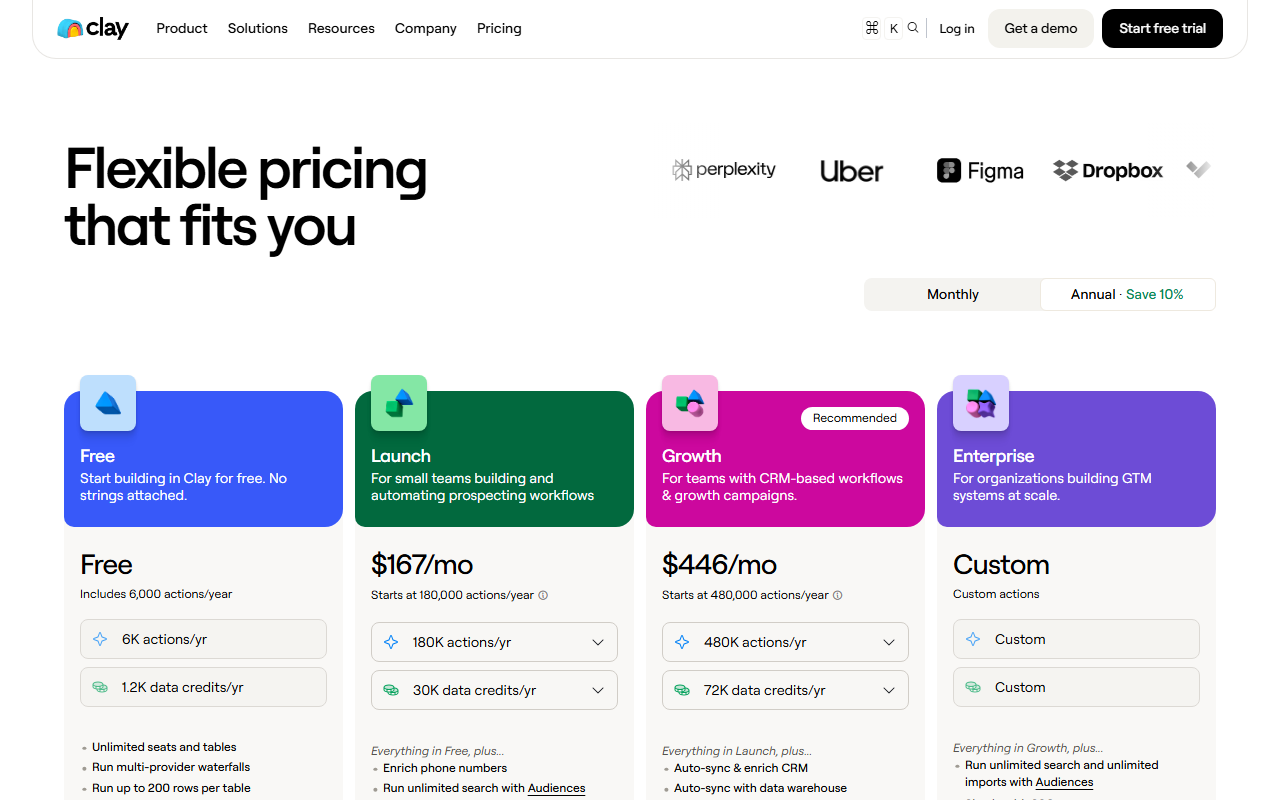 Clay's pricing page as it read on 25 August 2026. The Launch and Growth prices here are lower than the figures still circulating in older comparisons.
| If your bottleneck is | Pick | Starting price | The one caveat |
|---|---|---|---|
| A large contact database, fast | Apollo | $49/user/month (Basic) | Phone number reveals cost credits on top of the seat price |
| Row-level AI research and enrichment | Clay | $167/month (Launch, or $150 billed annually) | A full contact-plus-company enrichment burns 75 data credits at once |
| Brand-name investor and company profiles | Crunchbase | Not publicly listed | Its pricing page sits behind a bot-verification wall; budget for a sales call |
| Pay-per-call API access, no seats | PredictLeads | $0.04/credit, 101-5,000 calls | A $40/month minimum applies even to light usage |
| Real-time signals an agent can query | Signalbase | €200/month (Pro, 2,000 credits) | Priced in euros; the Data Partner tier jumps to €3,000/month |
What Each of the Five Actually Does
Apollo pairs a 240 million-plus contact database with a genuinely free tier: no card required, 900 credits per seat per year, and Basic starting at $49 a month per seat, billed annually, once you outgrow it. A fourth tier above Professional, Organization, starts at $119 a seat with a three-seat minimum, which its own pricing page shows but its own homepage does not mention.
Clay is the one built for people who want an AI agent, Claygent, to research each row of a spreadsheet before an email goes out; the free plan caps tables at 200 rows, which is enough to test the workflow and not much more.
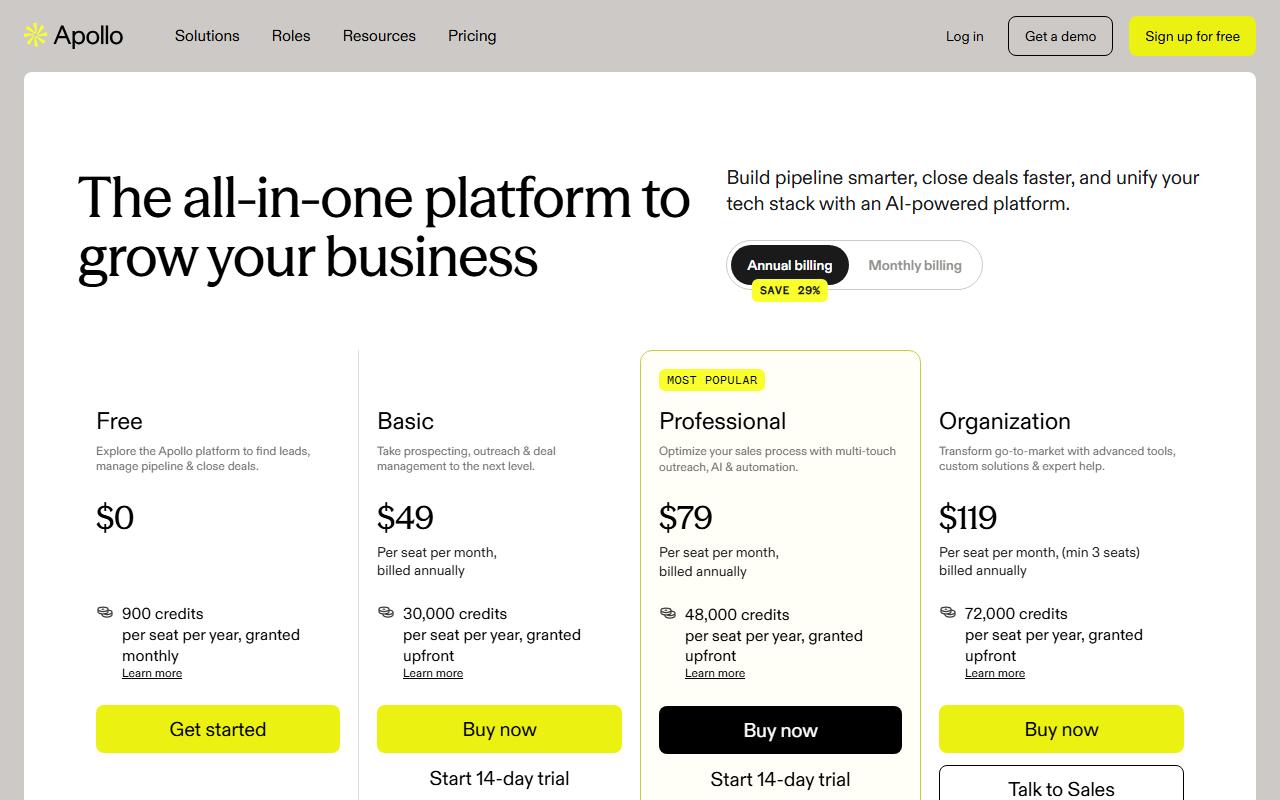 Apollo's pricing page with annual billing selected, screenshot dated 25 August 2026. The credit allotment climbs from 900 a year on the free plan to 72,000 on Organization.
Crunchbase is the name most non-sales-tech people recognize, useful when a deal needs a company profile a prospect will also trust, but checking its current price took running into a "one moment please" verification screen rather than a plan comparison. PredictLeads is the cleanest of the five on pricing transparency: a straight per-call rate that drops as volume climbs, delivered via API, flat file, or MCP.
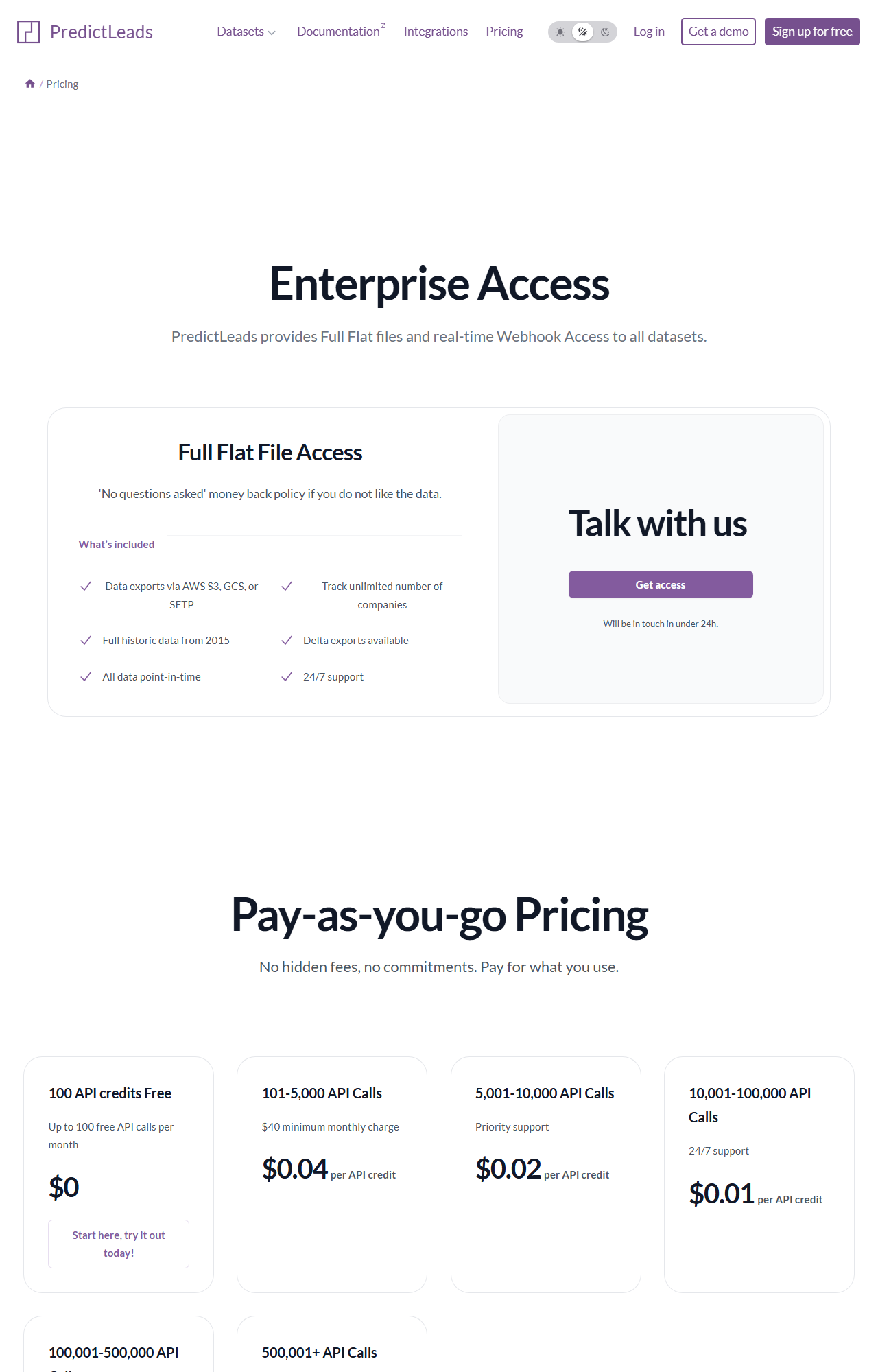 PredictLeads' own pricing page, captured 25 August 2026. The rate keeps stepping down at higher volumes, down to $0.002 a credit above 500,000 calls a month.
Signalbase is the newest and narrowest of the five: it does not sell a contact database at all, only event signals, and it says so plainly on its own homepage.
One Listing Is Worth a Warning, Not a Recommendation
HokAI's directory lists two further tools under this category that are not in the table above. Veethi's own site, veethi.so, returned a dead Vercel deployment when checked for this guide on 25 August 2026, so it is left out rather than recommended sight unseen. That is the kind of thing a listicle built from a spreadsheet of vendor names would never catch, because nobody clicked through on publish day, let alone months later.
None of the five carry every certification a regulated buyer needs by default. HokAI's own directory filters compliance claims live, so checking which of these five currently list SOC2, GDPR or ISO27001 before a security review is faster on the AI SDRs category page than in a static table that will be out of date within a quarter.
Apollo and Clay Are the Two Real Contenders Here
Most teams comparing this list end up choosing between Apollo's database and Clay's enrichment engine, because they are the two with public, per-seat pricing and the two most other tools on this list get compared against. Apollo wins on raw reach: 30 million-plus companies and a free tier that does not expire.
Clay wins on precision: instead of searching a static database, it runs a waterfall across multiple data providers row by row and lets Claygent fill gaps a static database would leave blank, at the cost of a steeper price curve once the free 500 monthly actions run out.
The practical split is team size and workflow. A five-person team doing straightforward prospecting against a known industry list gets more out of Apollo's flat seat price than Clay's credit meter. A team building a bespoke, high-touch outbound motion where each account gets researched individually is paying for exactly what Clay charges more for. Buying both is common; buying neither and going straight to an autonomous agent is also common, and it is a different decision than this one.
There is a third answer worth naming: some teams buy Apollo for the database and route its export straight into Clay for the enrichment pass, treating the two as a pipeline rather than a choice. That doubles the monthly bill, so it only makes sense once a team has already proven the workflow converts and is scaling it, not while still testing whether outbound works for the product at all.
Skip This Category Entirely If You Want an Agent, Not a Database
None of the five tools above will draft a cold email and send it without a human approving the send, at least not as their core product. If that autonomy is the actual requirement, the vendors worth researching are the ones the autonomous-agent coverage keeps naming: Artisan, 11x and AiSDR.
HokAI does not carry listings for any of the three as of this guide, and this piece is not reviewing them, because nobody on this team has verified their current pricing or capability claims against a primary source today. That gap is worth naming rather than papering over with a vendor's own marketing copy.
There is a smaller group who should also skip this whole page: anyone who already has a CRM-native enrichment feature and is not hitting its limits. Buying a standalone data tool to solve a problem a CRM add-on already handles is a common overspend, and it is worth checking your existing stack before adding a seventh line item to the sales budget.
A third group sits in between and gets ignored by roundups like this one: teams that need the signals but not a new tool at all, because they already pay for one of these five and are underusing it. Every vendor here sells more of its own product before it tells a prospect to use less of what they already bought. Checking actual monthly usage against the plan's limits, before shopping for a replacement, is free and takes ten minutes.
The Turn: Does the Split Even Matter to a Buyer?
The obvious objection to all of the above: does it actually matter whether a tool is "signals" or "autonomous," if the buyer's real question is just "will this get me more meetings"? For a five-figure annual budget, no, not really. Pick whichever tool's free trial produces qualified meetings in your first two weeks and worry about taxonomy later.
It matters at the moment of the search itself. A buyer who types "best AI SDR tools," lands on a roundup of Apollo and Clay, and walks away thinking they have evaluated the category has not: they have evaluated one half of it.
The other half costs more, behaves differently (it sends messages on your behalf, with your name on them), and carries different risk. Conflating the two does not save the buyer money. It just means the actual autonomous-agent decision gets made later, under more time pressure, with less research behind it.
What Changes This by Next Quarter
Watch whether any of the five data-layer vendors here adds a genuinely autonomous send-and-book feature rather than a sequencer bolted onto enrichment. Clay's Sequencer is the closest thing on this list to a first step in that direction. If it, or Apollo's outbound automation, starts making send decisions without a human in the loop, the two categories this guide separates will have started to merge, and a piece written five months from now would need a different shortlist entirely.
Frequently asked questions
What's the difference between an AI SDR and a sales intelligence platform?
In practice they are often the same product wearing different marketing. The five tools HokAI lists as AI SDRs, Apollo, Clay, Crunchbase, PredictLeads and Signalbase, all sell company or contact data rather than an agent that writes and sends outreach on its own. A separate, smaller group of vendors, including Artisan and 11x, sell the fully autonomous version.
Is Apollo.io free to use?
Yes. Apollo's free plan includes access to its contact database and fair-use email sending with no card required, according to its own pricing page checked on 25 August 2026. Paid plans start at $49 a month for the Basic tier once a team outgrows the free limits.
How much does Clay cost in 2026?
Clay's free plan covers 500 monthly actions and 100 data credits with unlimited seats, per its own pricing page checked on 25 August 2026. The paid Launch plan starts at $167 a month, or $150 a month billed annually, and the Growth plan starts at $446 a month.
Do any of HokAI's listed AI SDR tools send outreach automatically?
Some do, partially. Clay ships a Sequencer for sending email alongside its enrichment features, and Apollo markets outbound automation in its own navigation. Neither positions itself as a fully autonomous agent that decides what to send without a human reviewing it first.
What should I use instead if I want a fully autonomous AI SDR agent?
Look at vendors built specifically around that autonomy, such as Artisan, 11x and AiSDR, which industry coverage groups together as the fully autonomous tier. HokAI does not currently list any of the three, so verify their pricing and capability claims directly on their own sites before buying.
Covered in this guide
- Apollo: Apollo.io is a sales intelligence platform with a searchable B2B contact database, used by 500,000+ companies for prospecting and outreach.
- Clay: AI go-to-market platform with waterfall data enrichment and Claygent AI research agents, with plans from free to enterprise.
- Crunchbase: Crunchbase is a company and investor database used by GTM and VC teams, rated 4.4/5 across 409 G2 reviews, with an AI Scout Agent for deal sourcing.
- PredictLeads: PredictLeads is a company-intelligence API covering 120M+ companies, tracking funding, hiring, and technology signals via API, flat files, webhooks, or MCP.
- Signalbase: Signalbase is a GTM signals API that detects funding, hiring, and M&A events within 60 seconds for sales teams, RevOps, and AI agents via MCP.
- Veethi: AI-powered outbound platform that automates LinkedIn and email sequences from prospect discovery to meeting booking, used by hundreds of sales teams.
Sources
Still deciding?
This guide covers a handful of options. Smart Match checks every listing in the directory against how you actually work and what you can spend, then hands you the shortlist and the reason behind each pick.
Start Smart MatchRelated guides
- 41 of 100 HokAI Guides Carry a Screenshot. All 106 Still Load.Inside HokAIHow the directory works, verified in the open
- Apollo vs Clay: Which One Should You Buy First?ComparisonHead-to-head, with a verdict
- Bardeen vs Browse AI: Same Comparison, Different Products NowComparisonHead-to-head, with a verdict
- CometAPI vs Orthogonal: Same Gateway Label, Two Different JobsComparisonHead-to-head, with a verdict
- HubSpot AI Alternatives: What Breeze Actually Covers (and What It Doesn't)AnalysisWhat changed and who it affects
- What Clay Is Actually For, After a $5 Billion Valuation and a Pricing FightAnalysisWhat changed and who it affects