Apollo.io Alternatives in 2026: Pick by the Job You Hired Apollo For
The best Apollo.io alternative depends on which job failed. For data, Lusha starts at $37.45 a month billed yearly and Clay at $167 annual. For sending, Smartlead starts at $39. HubSpot Sales Hub Professional adds sequences at $90 a seat. Revnu Pro runs outbound for $99 a month plus ad spend.
The short version
Apollo is cheap per credit, about 2 cents on annual Basic, so leave it only for the job it does badly. Bad data points to Lusha or Clay, emails not landing to Smartlead or Instantly, a CRM you own to HubSpot Sales Hub, and nobody running outbound to Revnu at $99. A solo seller should usually stay.
Want this decided for your own case? Find your tools with Smart Match, starting from this guide's question.
Apollo's Basic plan works out to about 2 cents per credit on annual billing, and almost nothing you would replace it with is cheaper per lookup. That is the awkward fact under every "Apollo alternatives" search.
People rarely leave Apollo because the credits cost too much. They leave because one of the four jobs it bundles is failing them: the data, the sending, the CRM, or the hours it takes to run outbound at all. If you are a founder or first sales hire paying for one to three seats, the right replacement depends on which of those four broke, and the wrong one can double your monthly bill while fixing nothing.
This guide is about Apollo.io, the sales platform, not the Apollo Aligned Alternatives fund that shares the search. Prices are in USD and come from each vendor, checked on 19 October 2026.
The short answer: four jobs, four picks
Pick by the job, then check the price column. The table is the whole guide in one place, and the sections below defend each row.
| Job Apollo did badly | Pick | Monthly at list | The catch |
|---|---|---|---|
| Data quality or coverage | Lusha or Clay | $37.45 or $167 | Lusha bills yearly; Clay has no database |
| Sending that lands | Smartlead | $39 to $379 | No CRM or API on Base |
| CRM you already own | HubSpot Sales Hub | $90 a seat | $1,500 onboarding fee |
| Nobody to run outbound | Revnu Pro | $99 plus ad spend | New and unproven at scale |
If none of those four is your problem, stay where you are. A single seller doing light prospecting gets more from Apollo's $49 seat than from any two-tool replacement, and the section on staying explains why.
How to choose: name the job you hired Apollo for
Most comparison pages list twenty vendors and let you sort it out. A shorter route is to answer four questions about your own account first. Each one points at a different category of tool.
- Do your emails bounce, or do they land and get ignored? Bounces point at data. Landing in spam points at sending. Silence after delivery is a copy or targeting problem no tool on this page fixes.
- Where do your deals actually live? If the answer is a CRM you already pay for, the cheapest move is often to switch on that CRM's own sequences rather than add anything.
- How many lookups do you run a month? Under a few hundred, free tiers cover you. In the thousands, per-credit price starts to matter more than plan price.
- Who writes and sends the outreach today? If the honest answer is nobody, a better database will sit unused. That buyer needs an operator, human or software.
Write the answers down before you open a single trial. The criteria hold even if you ignore every pick below.
What Apollo costs now, and why price alone is a bad reason to leave
Apollo's pricing page lists four plans. Annual billing saves 24 percent, and the Organization plan is annual only with a three-seat minimum, which puts its floor at $357 a month.
| Plan | Annual, per seat | Monthly, per seat | Credits per seat a year |
|---|---|---|---|
| Free | $0 | $0 | 900, granted monthly |
| Basic | $49 | $65 | 30,000 |
| Professional | $79 | $99 | 48,000 |
| Organization | $119 | Annual only | 72,000 |
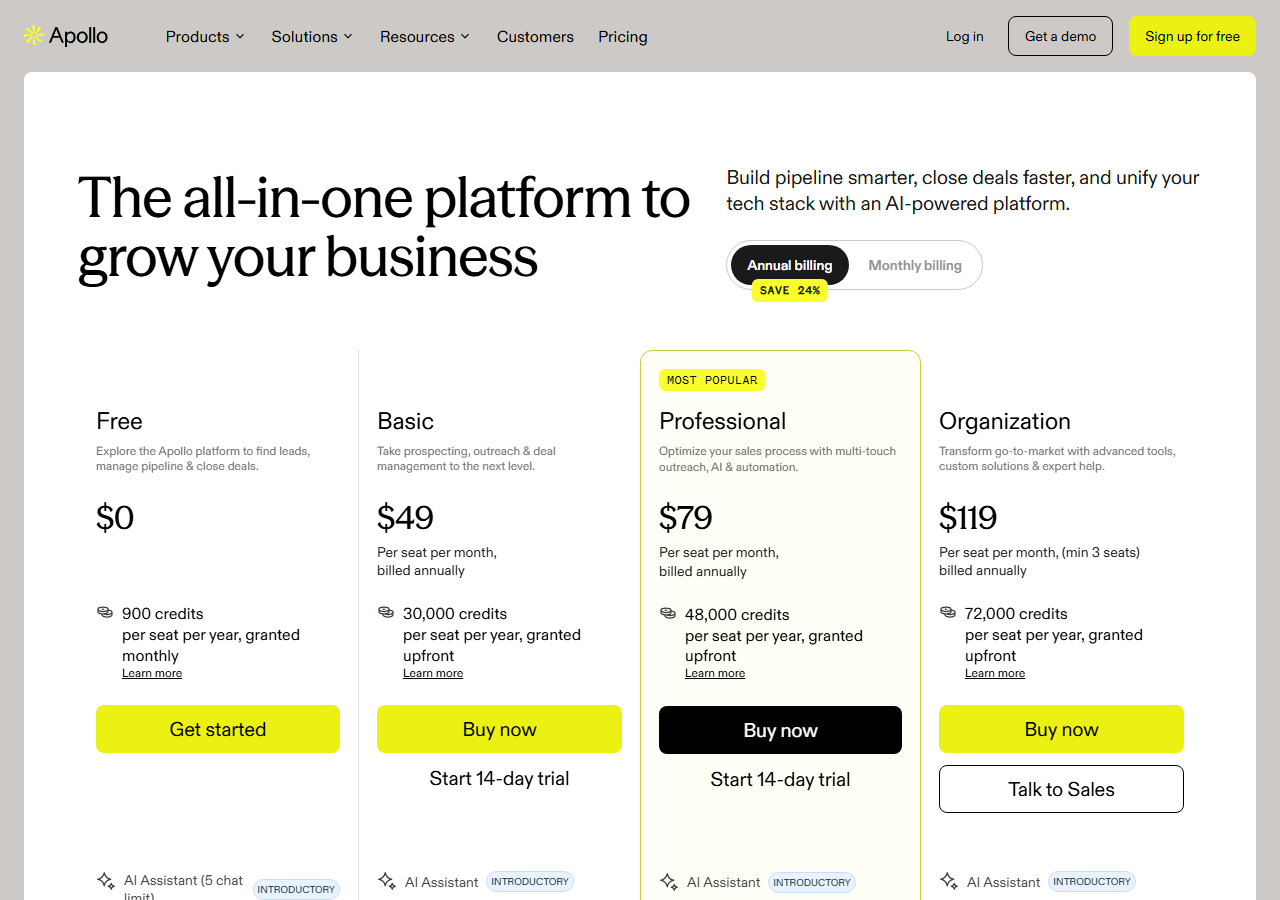 Apollo's plan cards on annual billing, captured 19 Oct 2026. Monthly Basic now lists $65.
Divide the annual price by the credits and every paid tier lands near 2 cents a credit: $588 a year for 30,000 on Basic, $948 for 48,000 on Professional. An email costs 1 credit and a phone number costs 8, so a mobile number runs about 16 cents. For comparison, Lusha's cheapest paid plan works out near 9 cents a credit and charges 5 credits for a phone, which HokAI's arithmetic puts at 44 to 47 cents a number.
So what does hurt? Three terms on the same page. Credits do not roll over, including add-on credits you bought mid-cycle. Add-on credits renew automatically until you drag the slider back to zero. And an annual plan cannot be downgraded mid-cycle, so a team that over-bought seats in January carries them to renewal.
Those are the costs worth comparing, and Apollo's plan details on HokAI track them as they change. A replacement that charges more per credit but lets credits roll over can still be the cheaper choice if your usage is lumpy.
Job one: the data was the problem
If your bounce rate is the complaint, you need a different source of records, not a different sender. The data tools split three ways, and they are not interchangeable.
| Tool | Free start | Paid from | Built for |
|---|---|---|---|
| Lusha | 40 credits a month | $37.45 a month, billed yearly | Quick lookups by one seller |
| Clay | 100 data credits a month | $167 a month annual | Enrichment workflows on your list |
| ZoomInfo | 1,000 credits once | Quote only | Enterprise data contracts |
| Unify | Up to 3 seats | $20 a seat | Signal-led prospecting |
Clay is the one people misread. It is not a database you search like Apollo; it runs enrichment across many providers against a list you bring. Its pricing changed shape this year: you now buy actions and data credits separately on two sliders. Launch starts at $167 a month on annual billing (180,000 actions and 30,000 data credits a year) or $185 paid monthly.
That is roughly 4.5 to 5 cents a data credit, though Clay prices a credit rather than a found email, so treat the comparison as approximate. Our guide to what Clay is for walks through when the waterfall earns its price, and the Apollo vs Clay head-to-head covers the buy-one-or-both question in detail.
Lusha and ZoomInfo sit at opposite ends of the data market
ZoomInfo publishes no list price for its core packages. Its GTM.AI route is the exception: a new account gets 1,000 data credits and 1,000 AI credits once, which expire 12 months after they are granted. The vendor's own worked example enriches 500 CRM leads for $215, about 43 cents a record. For the quote-only packages, Vendr's anonymised contract data puts the median buyer near $33,500 a year. That is a third-party estimate, not a list price, and it tells you who ZoomInfo is for.
Lusha is the opposite end. Starter is $37.45 a month for 4,800 credits a year with every credit granted upfront, and Pro at $52.45 adds a second free seat. If you mainly need a verified email for the person you are about to call, it is the smallest bill on this page.
Seamless.AI is the gap in this section. Its pricing page now redirects to an inquiry form that asks how many contacts you need a month, so there is no list price to compare. We have left it out of the table for that reason; the Seamless.AI profile keeps what was last published.
Job two: the emails did not land
Deliverability is a sending problem. A cleaner list helps, but mailbox setup, warm-up and volume caps decide whether you reach the inbox. Apollo bundles a deliverability suite on paid plans; dedicated senders go further and price by volume.
| Sender | Entry price | What sets the price | Free path |
|---|---|---|---|
| Smartlead | $39 a month | Sends and stored contacts | Trial only |
| Instantly | $47 a month | Emails and contacts, data sold apart | 14-day trial |
| lemlist | $69 a month | Monthly send volume | 14-day trial |
| Reply.io | $59 a user | Active contacts a month | 14-day trial |
Smartlead is the volume pick. Base covers 6,000 sends and 2,000 stored contacts, Pro jumps to 90,000 sends, and Unlimited Prime reaches 500,000. Per 1,000 sends at list price, Pro lands near $1.04 against about $6.50 on Base, which makes Base the worst value on its own price sheet. The catch is that Base has no CRM sync, API or webhooks, and HokAI found no SOC 2 or ISO 27001 report on the vendor's site.
Instantly splits sending from lead data. Outreach Growth is $47 a month, and lead data comes from a separate credit subscription starting at $9 for 150 credits. Its AI Sales Agent charges 5 credits per lead, so a 1,500-credit pack covers at most 300 agent-generated leads. One oddity: the Hypergrowth card lists 125,000 emails a month while the comparison table on the same page says 100,000. Confirm before you buy.
lemlist is the pick when outreach runs across email, LinkedIn and calls. Its Email plan prices by volume with unlimited users, starting at 50,000 emails, while Multichannel is $109 a user, so five reps pay $545 a month before data add-ons. Unlike Apollo, its enrichment credits roll over while the subscription stays active.
Reply.io prices by active contacts rather than seats above a threshold. From 10,000 contacts one price covers unlimited users, which means two seats on the 5,000-contact plan ($178 a month annually) cost more than the 10,000-contact plan ($159). Team size, not volume, decides which step is cheaper.
Job three: you already pay for a CRM
If your team lives in HubSpot, adding a second engagement tool often duplicates what you already own. The question is whether your HubSpot tier includes sequences.
On HubSpot's sales pricing page, the free CRM now covers up to 2 users, not the five some older reviews quote. Starter runs $20 a seat paid monthly.
Sequences arrive with Sales Hub Professional at $90 a seat a month billed annually, capped at 500 sends per user per day, and that tier carries a required one-time onboarding fee of $1,500. LinkedIn steps inside sequences need a separate Sales Navigator subscription.
So the honest math for a two-person team is $180 a month plus $1,500 once, before any data source. HubSpot's Sales Hub wins this job only when the CRM is already the system of record. If it is not, you are buying a CRM to replace a prospecting tool, which is a bigger project than this guide covers.
Most HubSpot teams who leave Apollo keep a lookup tool next to it. Lusha's Pro plan at $52.45 covers two seats, which keeps the pair under $235 a month.
Job four: nobody is running outbound
This is the case the vendor roundups skip, because none of them sells it. Plenty of small teams buy Apollo, build a list, and then stall because nobody has the hours to write, send and answer replies. A better database will not fix that.
Revnu is the newest answer to that buyer. Its Pro plan is a published $99 a month with no contract, and the first day costs nothing. According to Revnu's site, it finds fit-scored accounts with buying signals, writes and sends outreach, runs ads on Google, LinkedIn, Reddit, X and Microsoft, and builds search pages tracked in Google, ChatGPT, Claude and Perplexity. Ad spend is billed to your own ad accounts, not marked up.
Approvals and reports arrive in Slack or iMessage. A Managed plan adds a forward-deployed growth engineer and is quoted on a call.
Be clear-eyed about what is not known. PXN Ventures led the $3M round Revnu announced on 1 October 2026 (Y Combinator also invested), and the company's homepage campaign table and revenue messages are illustrative demo content, not customer results.
HokAI's Agent Benchmark rates it 3.0 out of 10, mainly for the lack of public customer evidence. It is new and unproven at scale. What limits the downside is the approval model: nothing goes out or gets spent without a yes in your chat app, and Pro cancels in one click.
The older names in this lane sell to bigger teams. Artisan no longer lists prices; its plans are scoped on a call by leads contacted, from about 2,500 a month on Team to about 6,000 on Scale, and its agent sends autonomously by default with approvals as an option. 11x publishes no price list either. For the wider field, our roundup of AI marketing agents and the Revnu vs Muse for Small Business comparison cover the permission question in depth.
The signal-led middle: Unify and Amplemarket
Between a database and a hands-off agent sits a third option: tools that watch for buying signals (job changes, site visits, hiring) and queue outreach when they fire. You still run the campaigns, but the tool picks the timing.
Unify sells by seat with credits attached. Base is $20 a seat for 800 credits, and Pro triples both the price and the credits, so every paid seat pays the same 2.5 cents a credit, and a hard cap pauses spending instead of billing overage. At the vendor's average of 1 credit per email enrichment, one Base seat covers roughly 800 a month.
Amplemarket publishes one price: Startup at $600 a month on an annual term, which is $7,200 a year for 2 users. Its terms allow usage charges above the order form and treat payments as non-refundable, so read them before signing. It suits a funded team replacing Apollo plus a sender plus a signal tool with one contract.
The free options the Reddit threads ask about
The most common follow-up search is "Apollo alternatives free". Here is what each free tier actually gives you, read from the pricing pages.
| Tool | Free allowance | The catch |
|---|---|---|
| Apollo Free | 900 credits a seat a year, 2 sequences | Gmail only for sending |
| Clay Free | 100 data credits and 500 actions a month | No phone enrichment |
| Lusha Free | 40 credits a month, 1 seat | A phone costs 5 credits |
| ZoomInfo GTM.AI | 1,000 data credits once | Expires after 12 months |
| HubSpot Free CRM | Up to 2 users | No sequences |
Two things stand out. Clay's free tier suits testing a workflow, not running one. Apollo's own free plan is still one of the larger allowances, at 75 credits a month per seat. And no sender on this page has a permanent free plan: Instantly, lemlist, Smartlead and Reply.io all run trials, typically 14 days.
So the free answer to "replace Apollo" is a pairing, not a product. Apollo Free or Lusha Free for lookups, a CRM's free tier for tracking, and your own Gmail for low-volume sends. Past a few hundred emails a week, you will be paying for a sender.
What three real replacement stacks cost a month
Here are three common stacks priced at list, against the Apollo plan each replaces. Prices assume the billing period each vendor headlines.
| Stack | Parts | Monthly at list | Apollo equivalent |
|---|---|---|---|
| Solo, data plus sending | Lusha Starter + Smartlead Base | $76.45 | Basic at $49 |
| Team of 3, enrichment-led | Clay Launch + Instantly Hypergrowth | $264 | 3 Professional seats at $237 |
| HubSpot team of 2 | Sales Hub Pro + Lusha Pro | $232.45 plus $1,500 once | 2 Professional seats at $158 |
| No operator | Revnu Pro | $99 plus ad spend | Basic plus your hours |
Every unbundled stack costs more than the Apollo seats it replaces. That is the point of naming the job first: you pay the premium only where the job justified it. The no-operator row is the only one where the comparison is not like for like, because the alternative is paying in your own time.
The case for staying on Apollo
The strongest argument against this whole guide is that Apollo already does all four jobs for $49 to $79 a seat. Splitting it means two or three logins, two bills, a sync to maintain and a second vendor's terms to read. For a solo seller doing a few thousand lookups a year, that overhead outweighs any gain in data quality.
That objection is right, and it is why the first table ends with "stay where you are". Apollo also keeps shipping: its 2026 product pages list an MCP connector, an AI Assistant and waterfall enrichment on paid plans. Stay if your bounce rate is acceptable, your sends land, and someone on the team actually runs the sequences. Leave only the job that is broken, and keep Apollo for the rest if the remaining parts still pay their way.
Where your prospect data goes
Prospect data is personal data in most markets, so the vendor's security posture belongs in the decision. Here is what each lists, as recorded on its HokAI profile from the vendor's own trust or security pages.
| Tool | Listed certifications | Worth knowing |
|---|---|---|
| Apollo | SOC 2 Type II, ISO 27001 | Data is for internal use only |
| ZoomInfo | SOC 2 Type II, ISO 27001, ISO 42001 | Broadest list here |
| Lusha | SOC 2 Type II, ISO 27001 | GDPR processing agreement |
| lemlist | SOC 2 Type II | Data held in France |
| Smartlead | GDPR addendum | No SOC 2 report found |
| Revnu | SOC 2 Type II in progress | Uses third-party AI models |
Apollo's pricing FAQ adds a term agencies should note: its standard plans forbid using Apollo data to power products for customers or resale. If you run outbound for clients, that alone can force a move.
What switching off Apollo actually involves
The work is mostly in the timing. A clean move looks like this:
- Time it to renewal. Annual plans cannot be downgraded mid-cycle and cancellation takes effect at the end of the term, so plan the cut-over for that date.
- Spend your credits first. Unused credits expire at the end of each billing cycle, add-ons included. Export everything you saved before the last day.
- Export the suppression list. Unsubscribes and bounced addresses must follow you, or the new sender mails people who opted out.
- Warm the new mailboxes before you send. Instantly sells done-for-you domains at $15 a year and Google mailboxes at $5 a month, or $10 pre-warmed.
- Re-map the CRM sync. Decide which tool owns contact records, and switch off Apollo's sync before turning on the new one so you do not create duplicates.
If you want a second opinion on which pieces fit your stack, describe it to HokAI's Smart Match and it will shortlist tools from the AI SDR directory against your constraints.
What would change these picks
Three things would move the verdicts here. If Apollo raised its per-credit price meaningfully, the "stay" advice weakens for heavy users. If Revnu or Artisan published verifiable customer results, the no-operator job would get a confident pick instead of a cautious one. And if Seamless.AI went back to a public price list, it would re-enter the data table.
For the data-layer view of this market, the AI SDR tools guide and our sales assistant roundup take different cuts at the same vendors. The agentic AI directory tracks the operator tools as they ship.
The one to watch is Apollo itself. Sacra, an equity research firm, reports that Apollo is testing a spreadsheet-style product called Sheets this October. If that ships as an enrichment workbench, the smallest teams on this page may find the Clay half of their stack folding back into the Apollo seat they never cancelled.
Frequently asked questions
What is the best free alternative to Apollo.io?
There is no single free replacement. Apollo's own Free plan (900 credits a seat a year) is still one of the larger allowances; Lusha Free gives 40 credits a month and Clay Free 100 data credits a month. No dedicated sender on this list has a permanent free plan, only trials of about 14 days.
Is Apollo.io cheaper than Lusha or ZoomInfo?
Per credit, yes. Annual Basic works out to about 2 cents a credit, against roughly 9 cents on Lusha's paid plans. ZoomInfo's core packages are quote-only; Vendr's anonymised data puts the median contract near $33,500 a year.
Should I replace Apollo with Clay?
Only if your problem is enrichment on a list you already have. Clay is not a searchable database like Apollo; it runs enrichment across many providers. Launch costs $167 a month on annual billing, and many teams run it alongside Apollo rather than instead of it.
What is the best Apollo alternative for cold email deliverability?
A dedicated sender. Smartlead prices by send volume from $39 a month, Instantly from $47 with lead data sold separately, and lemlist from $69 for 50,000 emails. Mailbox warm-up and volume caps matter more than the database.
Can an AI agent replace Apollo for a team with no salesperson?
Possibly, with caution. Revnu Pro at $99 a month finds accounts, writes and sends outreach and runs ads with approvals in Slack or iMessage, but it is new and has little public customer evidence. Artisan and 11x quote prices on a call.
Covered in this guide
- Apollo: Apollo.io is a sales intelligence platform with a searchable B2B contact database, used by 500,000+ companies for prospecting and outreach.
- 11x: Alice runs outbound across 3 channels and Julian qualifies inbound leads by phone and chat, with both logging activity back to your CRM.
- Amplemarket: Outbound platform that combines a B2B database, Duo AI buying signals, multichannel sequences, a dialer and email warmup in 3 plans.
- Artisan: Ava, Artisan's AI BDR, works 24/7 to autonomously find leads, write outreach, handle replies, and book meetings on a rep's calendar.
- Clay: AI go-to-market platform with waterfall data enrichment and Claygent AI research agents, with plans from free to enterprise.
- HubSpot's Sales Hub: HubSpot is an all-in-one CRM and marketing platform used by 288,706 customers, now with Breeze AI agents for prospecting, content, and customer support.
- Instantly: Cold email platform with built-in warmup, a B2B lead database and credit-metered AI agents, priced by sending volume rather than per mailbox.
- lemlist: Multichannel outreach platform covering email, LinkedIn, calls and SMS, with a built-in lead database, lemwarm warmup and a lemAgent campaign builder.
- Lusha's cheapest paid plan: Contact data sold by the credit: 1 for an email, 5 for a phone number, with a free plan, a Chrome extension and an MCP server.
- Reply.io: Sales engagement platform for email, LinkedIn, calls and SMS, with a live B2B database, an AI SDR agent and a documented MCP server.
- Revnu: Y Combinator-backed AI growth agent that runs outbound, ads on Google, LinkedIn, Reddit, X and Microsoft, and SEO pages for software startups, with drafts held for approval.
- Seamless.AI profile: Seamless AI is a real-time B2B lead database with 1.7B+ verified contacts, job change alerts, and buyer intent data. Plans from $147/month for 250 credits.
- Smartlead: Cold email platform that connects unlimited mailboxes and bills by send volume, from 6,000 to 500,000 emails a month, with no per-seat fee.
- Unify: Chat agent with 50+ built-in skills that builds prospect lists, enriches contacts and runs email, call and social outbound sequences.
- ZoomInfo: Go-to-market intelligence platform with B2B contact and company data, intent signals and a GTM.AI API, CLI and MCP server with free starter credits.
Sources
Still deciding?
This guide covers a handful of options. Smart Match checks every listing in the directory against how you actually work and what you can spend, then hands you the shortlist and the reason behind each pick.
Find your toolsRelated guides
- 41 of 100 HokAI Guides Carry a Screenshot. All 106 Still Load.Inside HokAIHow the directory works, verified in the open
- Apollo vs Clay: Which One Should You Buy First?ComparisonHead-to-head, with a verdict
- Bardeen vs Browse AI: Same Comparison, Different Products NowComparisonHead-to-head, with a verdict
- Best Agentic AI in 2026: Pick the Job, Not the GeneralistBuyer's guideHow to pick, across a category
- Best AI Agents in 2026: Autonomy Level Matters More Than BenchmarksBuyer's guideHow to pick, across a category
- Best AI Marketing Agents in 2026: The Ones That Do the Work, Not Just Draft ItBuyer's guideHow to pick, across a category