Best AI Marketing Agents in 2026: The Ones That Do the Work, Not Just Draft It
An AI marketing agent is software that plans and carries out marketing work, such as launching ads, sending outreach or publishing pages, rather than only drafting copy. The useful way to compare them is permission: what each may publish or spend without a person approving it, and whose accounts the money flows through.
The short version
For a software founder with no marketer, Revnu runs ads, outbound and SEO pages for $99 a month behind an approval queue, but it is new and unproven. Shops selling on Instagram should start with free Muse for Small Business in the US or Canada. HubSpot teams should use Breeze agents.
Want this decided for your own case? Find your tools with Smart Match, starting from this guide's question.
Tom Mulholland owns a grocery in Malvern, Iowa, and told Meta in September 2026 that he works about 65 hours a week, with too many jobs that only he can do. He is the buyer every AI marketing agent now says it was built for.
The category split three ways in the six weeks to 19 October 2026. Some tools draft copy for a person to post, some agents work inside one software suite, and a newer group launches campaigns and spends your ad budget from behind an approval queue. For an owner with no marketer, the question that matters is no longer which tool writes best. It is what each agent is allowed to do while you are cutting steaks.
This guide sorts six options by that permission line: who approves, whose money moves, which channels the agent can touch, and what you have to connect first. The two newest entries, Revnu and Meta's Muse for Small Business, are missing from most "best of" lists we read, which are largely written by vendors ranking their own product first.
The shortlist if nobody on your team owns marketing
Most readers can stop after this section. The rest of the guide shows the evidence behind each line.
- A software startup with no growth hire: Revnu. It runs search and social ads, outbound email and SEO pages itself, and holds every launch for your approval. It is also new and unproven at scale, which we cover below.
- A shop already selling through Instagram and Facebook: Muse for Small Business. It starts free and reads your Meta ad and page data directly, but only in the US and Canada.
- A team whose pipeline already lives in HubSpot: the Breeze agents inside it, covered in depth in our HubSpot AI alternatives guide.
- You only need words, and a person will post them: a drafting tool such as Copy.ai's chat plan.
- You want one narrow job automated your way: Lindy, which you configure yourself.
| Agent | Who approves | Whose money it spends | Price to start |
|---|---|---|---|
| Revnu | You, per launch and budget rise | Your own ad accounts | $99 a month |
| Muse for Small Business | You, for publish, send or spend | Your Meta ad account | Free tier |
| HubSpot Breeze agents | Your guardrails in HubSpot | HubSpot Credits | From $7 a month |
| Copy.ai Chat | A person posts everything | None | $29 a month |
| Lindy | Rules you write | Credits only | Free credits, 7 days |
Read the second column first. An agent that can only draft costs you time when it is wrong; an agent that can spend costs you money. The next table shows where each one can actually act.
| Agent | Channels it can act on | Best for |
|---|---|---|
| Revnu | Google, LinkedIn, Reddit, X, Microsoft ads; email; SEO pages | SaaS founder, no marketer |
| Muse for Small Business | Instagram, Facebook Pages, Meta ads, connected apps | Local or online shop |
| HubSpot Breeze agents | Your HubSpot CRM and workflows | Team already on HubSpot |
| Copy.ai Chat | None, it drafts | Copy volume, human posting |
| Lindy | Email, meetings, connected apps | One custom workflow |
How to choose an AI marketing agent: five questions to ask
These questions work even if you ignore our shortlist entirely. Ask them on any vendor's demo call, and walk away from any answer that stays vague.
- What can it touch, and can it write or only read? An agent that reads your analytics is a report. One that can publish, send or launch is an employee.
- Whose money does it spend? Ad spend should run through accounts you own and can switch off. A fee that bundles media spend hides what the media cost.
- Who approves, and how fine-grained is the approval? "Approve every action" sounds safe and fails in practice, as the autonomy section below explains.
- What must you connect before it is useful? Ad accounts, a CRM, a Stripe login or a GitHub repo each widen what can go wrong.
- What evidence exists that the vendor did not write? Independent reviews, a public customer you can call, or your own one-month test.
The fourth question is where the cheap options get expensive. An agent with no access to your sales data can only guess at what worked, so it guesses with your budget.
Questions two and three carry most of the risk, and they are the two the enterprise roundups skip. They tend to cover brand voice and content approval at length, then say little about who pays when a campaign goes wrong.
Revnu runs the channels itself, behind a paused-by-default rule
Revnu's agent is pitched as a growth hire for software startups: one agent that runs paid ads, finds and writes to prospects until a meeting is booked, and publishes pages built to rank in Google and in AI answers. Its pricing page lists a Pro plan at $99 a month, billed monthly, with the first day free and no card needed to start. A Managed plan adds a growth engineer from Revnu's team and is priced on a call.
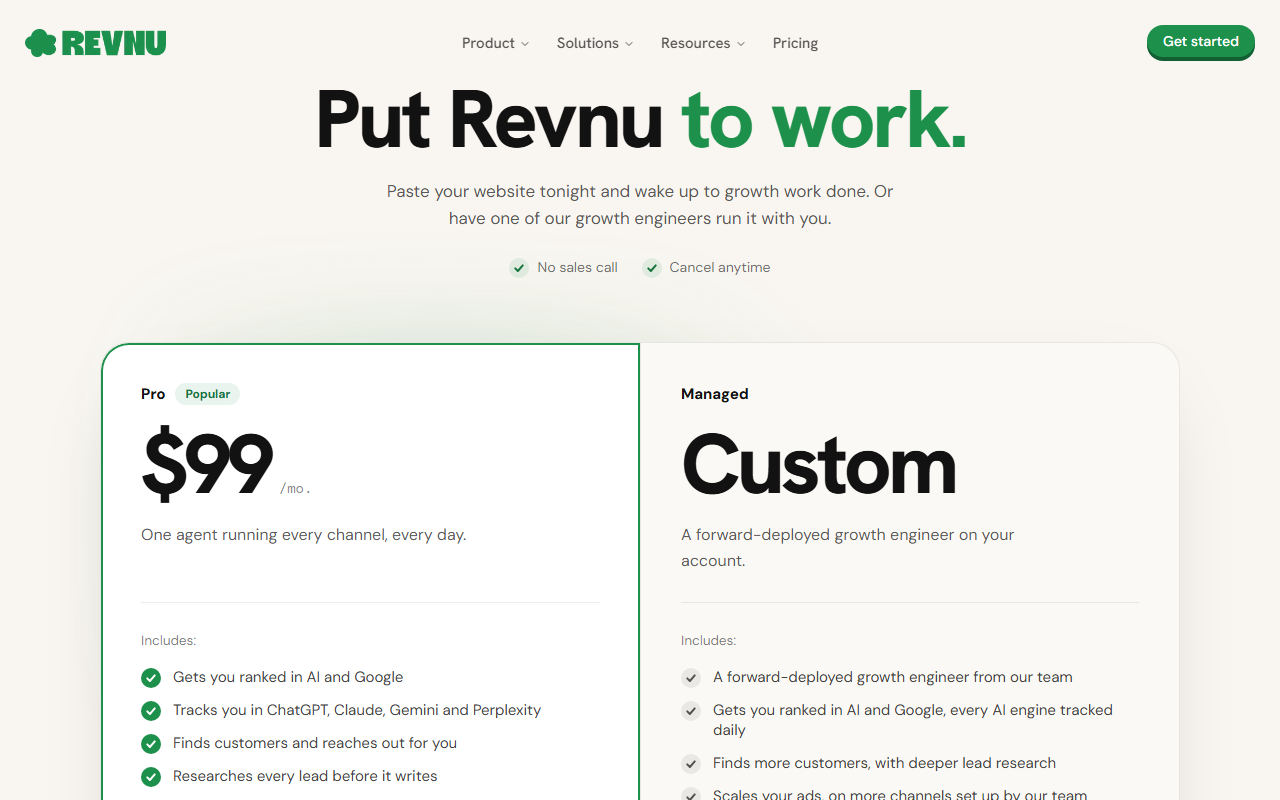 Revnu's pricing page, captured 19 Oct 2026. Ad spend is not in either price; each platform bills you directly.
On ads, Revnu's own page lists Google, LinkedIn, Reddit, X and Microsoft. You connect Google and Reddit yourself; Revnu's team connects LinkedIn, X and Microsoft. Meta ads are listed as coming next and TikTok is not supported, which rules it out for a shop whose customers live on Instagram.
The approval model is why it tops this list. Not the features. Per the paid-ads page, every campaign is built paused, and launching one, raising the monthly budget or raising daily spend all wait for you. Once you approve a test budget, it can launch replacement tests inside that budget without asking again.
Two details are buried in that page's FAQ and matter more than the headline features:
- The cap is soft. Spend pauses when reported spend reaches your monthly budget, but platforms report late and Google and Microsoft can overdeliver on a given day, so the bill "can land a little over the cap."
- It kills losers on a rule. A campaign that has run 7 days with working tracking and no qualified result, after spending twice its target cost, gets paused. With no target set, the trigger is a full week of budget.
It also says plainly what it will not do: no video, no retargeting audiences built from scratch, no tracking pixels, and no Shopping or app campaigns. Reports arrive in Slack or iMessage, and its visibility tracking covers ChatGPT, Claude, Gemini and Perplexity.
Revnu's weak spot is evidence, not features
The honest caveat is age. Revnu came through Y Combinator and announced a $3M round led by PXN Ventures on 1 October 2026, and its founders now build it from Manchester, UK. When HokAI checked on 18 October 2026 it had no G2, Trustpilot or Product Hunt reviews, so every result on its site is self-reported. The demo campaign tables on its homepage are illustrations, not customer outcomes. The approval queue is what limits your downside while the evidence catches up.
Muse for Small Business is the free start for shops on Instagram and Facebook
Meta added Muse for Small Business on 29 September 2026, three weeks after Muse itself launched. It is not a separate app. It is a set of skills and connectors inside the same agent, which runs on Meta's own Muse Spark model.
The draw is context. Meta says Muse connects Instagram professional analytics, Facebook Pages and Meta ad accounts in a few clicks, plus Shopify, Klaviyo, Stripe, QuickBooks, HighLevel, Slack, Canva and a list of other tools. Meta's suggested prompts include a growth plan built from a year of sales, campaigns and social, and a draft campaign for next week based on what is trending.
The approval line is clear and written by Meta: "nothing publishes, sends, or spends without your approval." Its business page adds an audit trail of everything the agent did and plans to do.
Price is vague. Meta's announcement says Muse "is free for most of what people need" and offers subscription plans without naming a price. Axios reported two paid tiers at launch, $20 and $100 a month, and quoted Meta's chief AI officer saying most people should stay on free. Meta has not published what the free tier allows, so heavy use is a guess until you hit a limit.
Two limits decide whether it is even on your list. It is available in the US and Canada only. And it does not run search ads, cold email or SEO pages, so a software company selling to other businesses gets little from it. For that buyer the head-to-head with Revnu is short: Muse if your customers find you on Meta's apps, Revnu if they find you on Google, LinkedIn or in their inbox.
HubSpot Breeze agents fit when your pipeline already lives there
HubSpot has gone the suite route. Its agent page says Agent Hub, with the agent builder formerly called Breeze Studio, is included in the Starter, Professional and Enterprise editions, with a "Buy now for $7/mo" entry point. The ready-made agents it listed on 19 October 2026 were a customer agent, a prospecting agent and a data agent, alongside custom agents you describe in plain language.
Cost is murkier. Custom agents consume HubSpot Credits every time they run, measured in "action units," and the work per run varies. HubSpot sells credits in packs or pay-as-you-go. We could not read a per-credit price on HubSpot's own credits page on 19 October 2026, so we are not printing one; check the catalog in your account before you scale an agent up.
The argument for Breeze is the data, not the agent. It already sees every contact, deal and conversation in your CRM, which no outside agent does. The argument against is everything else: you are buying a suite to get an agent, and the agent can only act inside that suite. Our guide to HubSpot AI alternatives covers when a team should leave, and HokAI's Revnu record notes that Revnu lists no CRM among its connections.
Copy.ai and the drafting tools are cheaper because a person still presses publish
A drafting tool never touches your ad account. That is its whole safety model. For many small teams it is the right one.
Copy.ai is the interesting case because it no longer calls itself a writing tool; our piece on Copy.ai's move into go-to-market workflows tracks that shift. Its pricing page on 19 October 2026 shows two very different products.
| Copy.ai plan | Monthly price | Seats | Workflow credits |
|---|---|---|---|
| Chat | $29 ($24 billed yearly) | 5 | None listed |
| Growth | $1,000 | 75 | 20,000 a month |
| Next tier | $2,000 | 150 | 45,000 a month |
| Top listed tier | $3,000 | 200 | 75,000 a month |
The gap between those first two rows is the category in miniature. At the chat price a person reads every word and posts it. At the workflow price you are buying automation for a sales and marketing team, which is a different purchase with a different buyer.
Jasper sits in the same drafting camp for brand-voice copy at volume, and more writing tools sit in the AI writing assistant directory. Pick from this group when the bottleneck is words, not hours of campaign work.
Lindy lets you build the narrow agent yourself
Some owners do not want a growth hire. They want one job gone: replying to every inbound lead the same hour, or turning every booked call into a follow-up email.
Lindy's pricing page on 19 October 2026 starts with $50 in free credits, no card required, and those credits last 7 days. Paid use starts at $29.99 a month for 3,000 credits pooled across a team.
Top-ups cost $10 per 1,000 credits once that runs out. You write the rules, so you also own the mistakes.
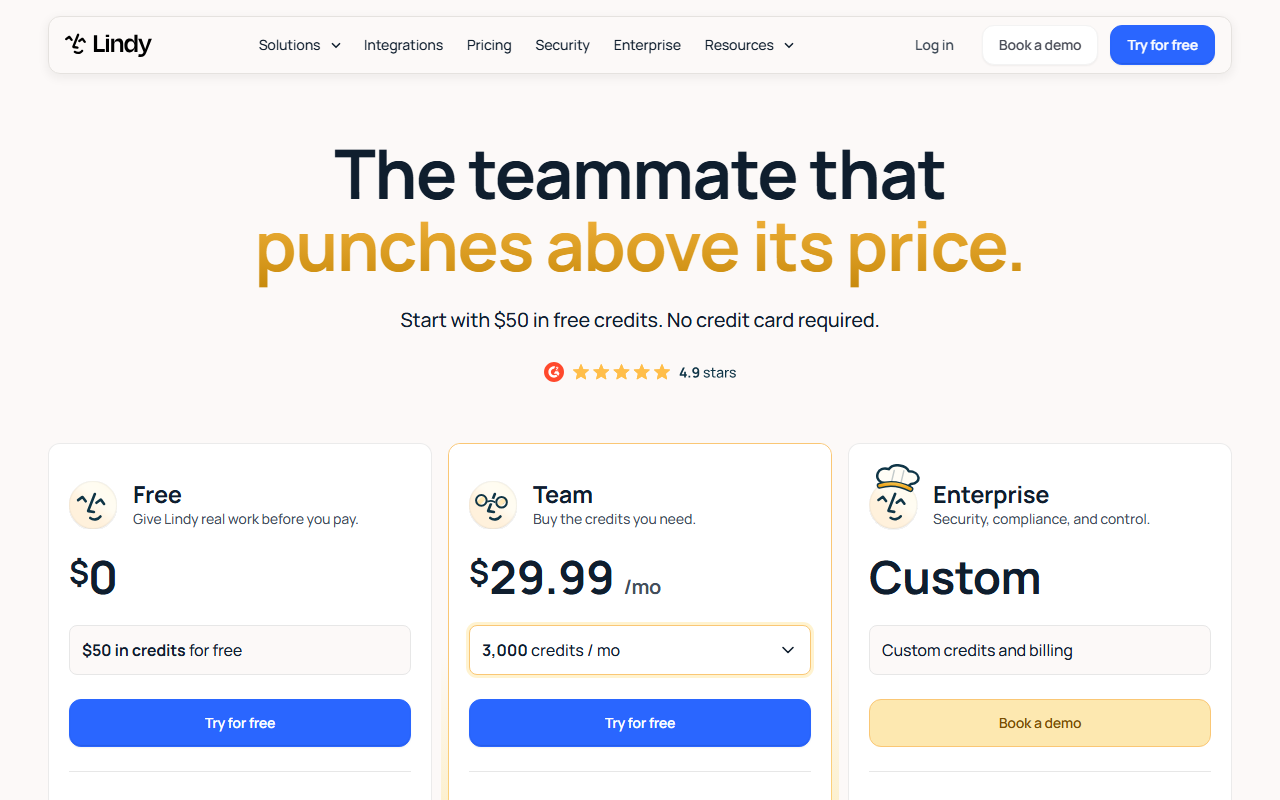 Lindy's pricing page, captured 19 Oct 2026. The free credits expire after 7 days, so treat the free plan as a trial.
That trade suits one reader. A technical founder who already knows the workflow. It does not suit someone hoping an agent will work out what marketing to do. For more tools in this camp, the AI agent builders directory lists the alternatives, and our agentic AI roundup covers general-purpose agents such as Manus.
Outbound-only agents cover one channel deeply
If the job is purely outbound sales email, a full marketing agent is more than you need. Two kinds of tool split this job.
- AI SDR agents prospect and write for you. 11x runs an outbound agent called Alice alongside an inbound qualifier, and Artisan's Ava finds leads, writes outreach and books meetings.
- Cold email platforms send at volume with your own copy. Instantly bundles warmup and a lead database; Smartlead connects unlimited mailboxes and bills by send volume.
Our ranking of AI SDRs compares the first group, and the Apollo vs Clay comparison covers the data layer underneath both. The same logic applies to search: if you only want to know whether ChatGPT mentions you, Peec AI or Semrush track that without publishing anything, as our AI search visibility guide explains.
What AI marketing agents cost, and what the fee leaves out
Subscription prices in this category are small next to the money an agent can move. The fee buys labour; the ad budget is separate, and it is the number to watch.
| Option | Monthly fee | Ad spend billed by | What the fee excludes |
|---|---|---|---|
| Revnu Pro | $99 | Each ad platform | Video, Meta ads for now |
| Revnu Managed | Quoted on a call | Each ad platform | Unpublished |
| Muse | Free, or $20 or $100 | Meta | Published limits |
| HubSpot agents | From $7, plus credits | Not an ad buyer | Per-credit rate unconfirmed |
| Copy.ai Chat | $29 | Not an ad buyer | Any automation |
| Lindy | $29.99 for 3,000 credits | Not an ad buyer | Strategy |
Revnu's pricing page states that ad spend "is paid to the ad platform directly," so the $99 never grows with your budget. That is the structure you want: a fee that does not reward the agent for spending more.
A realistic first-month budget is the agent's fee plus whatever ad budget you would have tested by hand anyway. Set the cap below what you can afford to lose, because a soft cap can still land a little over it.
Can an AI marketing agent run autonomously?
Yes, inside limits you set, and the vendors themselves argue against removing the limits entirely.
Meta's own executives told Axios that asking people to approve every small action leads them to approve requests reflexively, which undermines the safety it was meant to provide. Muse's answer is a separate system called Sentinel that decides whether each action is allowed, blocked or sent to you, with permissions scoped by task, service, transaction or time.
Revnu reaches the same place from the other side. Launches and budget increases need you; tests inside an approved budget do not; a losing campaign is paused on a fixed rule. Neither agent offers a credible "set it and forget it" mode, and a buyer searching for an AI marketing agent that runs autonomously should read that as good news.
- Give autonomy to: reversible, low-cost actions inside a capped budget.
- Keep approval on: new campaigns, budget increases, anything sent to a new list, anything published under your name.
- Never delegate: deleting campaigns or data, which Revnu leaves as your call anyway.
What happens to your data when you connect an agent
Every connector is a grant of access. Read the terms.
- Revnu: on the self-serve plan, its pricing FAQ says lessons from how agents perform across accounts become "improvements for everyone," while nobody sees your content, contacts or results. On Managed, your data stays with your account only.
- Muse: Axios reported that queries to Meta's models can be used by Meta by default, with an option to switch that off. Meta was aiming to ship a confidential version it cannot see inside before the end of 2026.
- HubSpot: agents are built on what is already in your CRM, so no new party gains access, but the agent's reach is your whole contact database.
The practical rule is to connect read-only access first, give write access to a single channel once you have watched a week of proposals, and switch on every training opt-out before the agent runs for the first time rather than after it has already read your customer list.
Is there a free AI marketing agent worth using?
Two. Both have conditions. Muse has a free tier that runs the same business connectors, if you are in the US or Canada. Lindy gives $50 of credits for 7 days, which is a trial rather than a plan.
Revnu offers its first day free with no card, enough to watch it research your site and propose work, not enough to judge results. HubSpot's free CRM is not the same as its agent tier. A "free" agent that spends real ad money is free only in its own fee, so cap the ad budget either way.
Who should skip AI marketing agents for now
Some should wait.
- Shops outside the US and Canada that sell on Instagram have no Muse, and Revnu does not run Meta ads yet.
- Businesses with no tracking in place. Revnu's own rule pauses campaigns only when tracking works; without it, it tells you what to fix. Fix tracking first.
- Teams with a capable marketer already. A drafting tool or HubSpot's built-in agents will add more than a second operator would.
- Anyone who will not check an approval queue every working day. The queue is the safety model; skipping it removes the safety.
If none of those apply and you still are not sure, Smart Match asks about your stack and budget and points to a shortlist from the full catalog.
The case against letting an agent run your marketing
The strongest objection is simple, and we cannot fully answer it yet: none of these agents has publicly proved that it beats a competent human marketer working with the same budget, the same accounts and the same month. Revnu's results are self-reported and weeks old, Muse's business skills have no independent reviews yet, and HubSpot's marketing agents are still being priced. An owner who hands over a four-figure ad budget is, in effect, paying for the vendor's experiment.
That is true, and it is why this guide ranks on permission rather than promised results. The approval queue turns the experiment into a capped one: you see every launch, the budget stops near a number you chose, and losers are cut on a published rule. The alternative for most small businesses is not a human marketer; it is no marketing at all, which has its own cost.
What would change these picks before 2027
Evidence first. Independent customer evidence for Revnu, good or bad, would settle the "unproven" caveat in either direction. Meta extending Muse beyond two countries or adding Google and email channels would make it a contender for software companies too. And HubSpot publishing per-agent credit costs would show whether the suite route is cheap or merely convenient.
Watch for one more signal before the end of 2026, because it would change the advice for the largest group of small businesses reading this: Revnu has listed Meta ads as coming next. The day it can spend on Instagram, the line between these two picks gets thin, and small shops get a real choice.
Frequently asked questions
What is the best AI marketing agent for a small business?
It depends on where your customers find you. A software startup with no marketer gets the most from Revnu, which runs search and social ads, outbound email and SEO pages for $99 a month. A shop selling through Instagram and Facebook should start with Muse for Small Business, which is free to begin in the US and Canada.
Is there a free AI marketing agent?
Muse for Small Business has a free tier with the same business connectors, but only in the US and Canada, and Meta has not published its limits. Lindy gives $50 in credits for 7 days, and Revnu gives its first day free with no card. Ad spend is never free, so cap it either way.
Can an AI marketing agent run ads on its own?
Some can, inside limits you approve. Revnu builds every campaign paused and needs your approval to launch or raise a budget, then pauses losers on a fixed rule. Muse will not publish, send or spend without your approval. Pure drafting tools such as Copy.ai Chat never touch an ad account.
Who pays the ad spend when an AI agent runs my ads?
You do, directly. Revnu says ad spend is paid to the ad platform, and Muse uses your own Meta ad account. The agent fee covers the work, not the media, so the number to control is the monthly ad budget you set.
Do AI marketing agents use my business data for training?
Terms differ. Revnu says self-serve accounts feed cross-account improvements while nobody sees your content, and Managed accounts stay isolated. Axios reported Meta can use queries to its models by default, with an opt-out. Turn opt-outs on before the first run.
Covered in this guide
- Meta's Muse for Small Business: Meta's AI agent runs tasks in its own cloud computer; since 29 Sept 2026 it connects Shopify, QuickBooks, Meta ads and more for small businesses in the US and Canada.
- Revnu: Y Combinator-backed AI growth agent that runs outbound, ads on Google, LinkedIn, Reddit, X and Microsoft, and SEO pages for software startups, with drafts held for approval.
- 11x: Alice runs outbound across 3 channels and Julian qualifies inbound leads by phone and chat, with both logging activity back to your CRM.
- Artisan's Ava: Ava, Artisan's AI BDR, works 24/7 to autonomously find leads, write outreach, handle replies, and book meetings on a rep's calendar.
- Canva: Helps everyone design anything and publish it anywhere
- ChatGPT: ChatGPT is OpenAI's AI assistant, with 1.2 billion weekly users by OpenAI's count, the GPT-6 model family and plans that run from a free tier to a premium Pro tier.
- Copy.ai's chat plan: The first AI-native GTM platform for go-to-market teams
- Instantly: Cold email platform with built-in warmup, a B2B lead database and credit-metered AI agents, priced by sending volume rather than per mailbox.
- Lindy: AI teammate that handles email, meetings and workflows across 1,000+ apps; no free plan, just a 7-day trial then per-seat billing.
- Manus: Autonomous AI agent that plans and executes multi-step work from one prompt: research, documents, apps and video. The September 2026 release adds Cascade, Automations and Studio. Free tier available.
- Meta: Meta AI ships open-weight Llama (1B+ downloads) and the closed Muse models, led by Muse Wonder with a 1M-token context window.
- Muse Spark model: Muse Spark 1.3, released September 2, 2026 by Meta AI Research, is an agentic model for long coding, long documents and tool-heavy work, with max reasoning on the Standard API tier.
- Peec AI: Daily AI search tracker scoring brand visibility, position and sentiment across ChatGPT, Gemini and Copilot; Peec lists 3,500+ brands and agencies.
- Semrush: Adobe-owned SEO suite: keyword, backlink and rank data plus AI visibility tracking across 4 AI engines; a Free plan is available.
- Smartlead: Cold email platform that connects unlimited mailboxes and bills by send volume, from 6,000 to 500,000 emails a month, with no per-seat fee.
Sources
Still deciding?
This guide covers a handful of options. Smart Match checks every listing in the directory against how you actually work and what you can spend, then hands you the shortlist and the reason behind each pick.
Find your toolsRelated guides
- The AI 80s Photo Trend: How to Make Yours (and Turn It Into a Video) in 2026AnalysisWhat changed and who it affects
- Apollo.io Alternatives in 2026: Pick by the Job You Hired Apollo ForBuyer's guideHow to pick, across a category
- Best Agentic AI in 2026: Pick the Job, Not the GeneralistBuyer's guideHow to pick, across a category
- Best AI Agent Builders in 2026: Automate, Build or Self-HostBuyer's guideHow to pick, across a category
- Best AI Agents in 2026: Autonomy Level Matters More Than BenchmarksBuyer's guideHow to pick, across a category
- Best AI Assistant Apps for Android in 2026, Now That Google Assistant Is DeadBuyer's guideHow to pick, across a category