HubSpot AI Alternatives: What Agent Hub and Breeze Cover (and What They Don't)
HubSpot's AI has two parts. Breeze Assistant, a chat sidebar, is included with every subscription. Agent Hub runs seven named agents that spend HubSpot Credits at $0.01 each, from a monthly pool of 500 credits on Starter to 5,000 on Enterprise. Unused credits expire at month end and never roll over.
The short version
HubSpot's agents now run on a published rate card: 50 credits ($0.50) per resolved support chat, 100 per prospecting lead, from a monthly pool that expires. Breeze Assistant stays free. Specialists still win single jobs, Revnu suits a company with no marketer, and Muse fits shops selling on Meta.
Want this decided for your own case? Find your tools with Smart Match, starting from this guide's question.
HubSpot's AI now has a price list, and the cheapest useful line on it is 50 credits, or 50 cents, for one support conversation an agent closes alone.
That rate card is the real product. On 19 October 2026 the vendor's own credits page lists eight agent rates, from 10 credits for a data answer to 1,000 for one piece of content. Every paid plan gets a monthly pool, and the pool expires at month end.
For a marketing or revops lead already paying for HubSpot, the useful question is no longer whether its AI is good. It's which jobs are worth running on that meter, and which ones a specialist, or a different kind of tool entirely, now does better.
What changed since 8 September
We first published this guide on 8 September 2026. We re-checked every pick and every price on 19 October 2026. Here is what moved.
- The agent layer has a new name. The vendor's AI product page is now titled "Agent Hub". Breeze survives as the assistant's name. The agent list grew from four to seven, plus a builder.
- The rate card got specific. The credits page now prices each agent action. One prospecting lead costs 100 credits, or $1.00.
- The grace periods are over. A partner agency lists the cut-off dates: some early users of the prospecting agent kept free access until 3 March 2026. Now everyone pays.
- Four picks added. Revnu for a company with no marketer, Muse for Small Business for shops that sell through Meta, Intercom's Fin for mid-size support, and Attio for teams that want out of the CRM.
- Five picks kept. All five originals are live. Nothing we found knocks one out of its slot.
- One line cut. The first version said that agency warned about an automatic upgrade. Its article does not say so. The claim is gone.
What HubSpot's AI layer is now
There are two parts, and they bill differently.
- Breeze Assistant. A chat sidebar inside the CRM that drafts, summarises records and answers questions about your data. HubSpot's assistant page says it is included with every subscription at no additional cost.
- Agent Hub. The agents that do work on their own, plus Agent Builder for custom ones. HubSpot's AI page says Agent Hub ships in every Starter, Professional and Enterprise edition, and that many agents run on credits.
The split matters. A lot. Asking the assistant to summarise a deal before a call costs nothing extra. Letting the Customer agent close a ticket draws from the pool.
HubSpot's pitch is that agents run "on your live CRM data from day one", with no setup. That is the vendor's claim. The consultancy Pedowitz Group, reviewing the tools in 2026, found the opposite on two of them. Its review says the Customer agent gives generic answers without a well-built knowledge base. It also says the Prospecting agent needs ICP criteria, firmographic filters and exclusion rules, typically 15 to 20 hours of setup, before it surfaces anything but noise.
What it costs, in credits rather than dollars
A credit costs $0.01. Extra credits come in packs of 1,000 for $10, or on pay-as-you-go once the pool runs dry. Unused credits do not carry over. Here are the rates HubSpot publishes for its agents:
| Agent | Credits | Cost | Charged per |
|---|---|---|---|
| Customer | 50 | $0.50 | resolution |
| Prospecting | 100 | $1.00 | lead |
| Content | 1,000 | $10.00 | piece |
| Knowledge base | 200 | $2.00 | article |
| Revenue | 500 | $5.00 | invoice |
| Data | 10 | $0.10 | response |
| Nurture | 10 | $0.10 |
The Customer agent can also bill 50 credits per minute, so check which unit your channel uses.
Now set that against the pools. The Marketing Hub pricing page lists these, checked 19 October 2026:
| Plan | Monthly price | Credits | Onboarding |
|---|---|---|---|
| Starter | $7 to $20 a seat | 500 | none listed |
| Professional | $800 to $890 | 3,000 | $3,000 once |
| Enterprise | $3,600 | 5,000 | $7,000 once |
The Starter low end is a limited-time offer for new customers that the page says saves up to 65% against the list price, so budget on the higher figure if you plan to stay past the first term. The Professional range depends on billing term.
Do the division. The pools look small. Starter's 500 credits buy 5 prospecting leads, or 10 resolved conversations. Professional's 3,000 buy 30 leads, 60 resolutions, or 3 pieces of content. Enterprise's 5,000 buy 50 leads or 100 resolutions. Every agent drinks from the same pool, which means that a month with a big content push, a lead-research sprint and an unexpected support spike all at once will drain it faster than any single line on the rate card suggests.
One safety net exists. If you buy extra credits, HubSpot sets an account limit up to 50% above your monthly total, and you can cap any single feature. Set those caps on day one.
How to size the bill before you switch anything on
The vendor's own estimator rounds up to the nearest 1,000 credits, which hides the small numbers that decide whether this is cheap. Do it by hand instead. It takes ten minutes.
- Count last month's volume for each job you would hand over: support conversations closed, new leads researched, blog posts drafted, invoices chased.
- Multiply each by its rate from the table above. Two hundred leads is 20,000 credits. Three hundred closed chats is 15,000.
- Add the totals and subtract your plan's pool. On Professional that pool is 3,000, so the example above leaves 32,000 credits, about $320 a month, to buy.
- Add a margin of a fifth for retries and test runs. An agency that tests these features for clients warns that live testing burns real credits.
- Compare the result with the specialist's price for the same volume, not with zero.
Teams skip that last step, usually because the word included on the invoice makes the AI line feel like money already spent, when past the pool every extra action is a fresh charge at the full marginal rate.
"Included" is not free once you are past the pool, and a specialist at a flat monthly price can come out cheaper at very ordinary volumes. It can also come out dearer. Much dearer. Three hundred chats on Fin at $0.99 is $297, roughly double the credit cost for the same work, before seat fees on either side. The arithmetic decides, not the brand.
If your numbers land well inside the pool, stop reading and turn the agents on. The rest of this guide is for the teams whose numbers do not.
Who this hits, and who it helps
It helps the small team that lives inside HubSpot and mostly uses the assistant. One login, no new data sync, and the most-used AI feature costs nothing extra.
It hurts three groups. Hard.
- Starter accounts that try the agents. Five leads a month is a demo, not a pipeline.
- Support teams at volume. At 50 cents a resolution, 2,000 closed conversations a month is 100,000 credits, about $1,000, against a Professional pool of 3,000.
- Teams with nobody to configure it. Pedowitz's 15 to 20 hours of prospecting setup is a project for a person, and a team with no marketer has no person.
That third group is where the newer alternatives come in.
What to do: pick the job, then the tool
Start from the job, not the brand. The wider revenue AI category holds dozens of options; this is the shortlist as of 19 October 2026:
| Job | Pick | Free plan? | Billed by |
|---|---|---|---|
| Support, small site | Chatwit | yes | monthly plan |
| Support, mid-size | Intercom Fin | trial only | seat + outcome |
| Support, enterprise | Sierra | no | contract |
| Contact data | Apollo | yes | user |
| Lead research | Bardeen | yes | credits |
| Custom agents | Cassidy | yes | quote |
| Growth, no marketer | Revnu | first day | $99 flat |
| Selling on Meta | Muse | yes | subscription |
| Replace the CRM | Attio | yes | user |
Support. Chatwit crawls your site and trains itself on what it finds, the knowledge-base work Pedowitz says the Customer agent needs first. Intercom prices Fin at $0.99 per outcome on its pricing page, against HubSpot's 50 cents, but bills it once per conversation and includes it on every plan. Sierra sells outcome-priced contracts to large companies and publishes no list price. The support category lists the rest.
Prospecting. Apollo is the contact database most teams weigh against the Prospecting agent; our Apollo alternatives guide covers where it falls short. Bardeen runs lead research as a browser extension, billed in its own credits rather than HubSpot's shared pool. For heavier data work, Clay and the ZoomInfo alternatives piece go further, and the AI SDR category lists agents that run the whole outreach loop.
Custom agents. Cassidy builds agents that read your own documents and CRM data, HubSpot's included, without spending HubSpot credits on every step. Its Starter plan is free; Business is quoted after a demo. More builders sit in the agent builders category.
If the right row isn't obvious for your stack, tell Smart Match your stack and budget and let it return a matched shortlist instead of building the credit spreadsheet yourself.
Revnu: the work done, not a CRM
Revnu is a different kind of answer. It does not replace a hub inside HubSpot, or any software a marketer would log into each morning, because what it is trying to replace is the marketer the company never hired. That is the pitch.
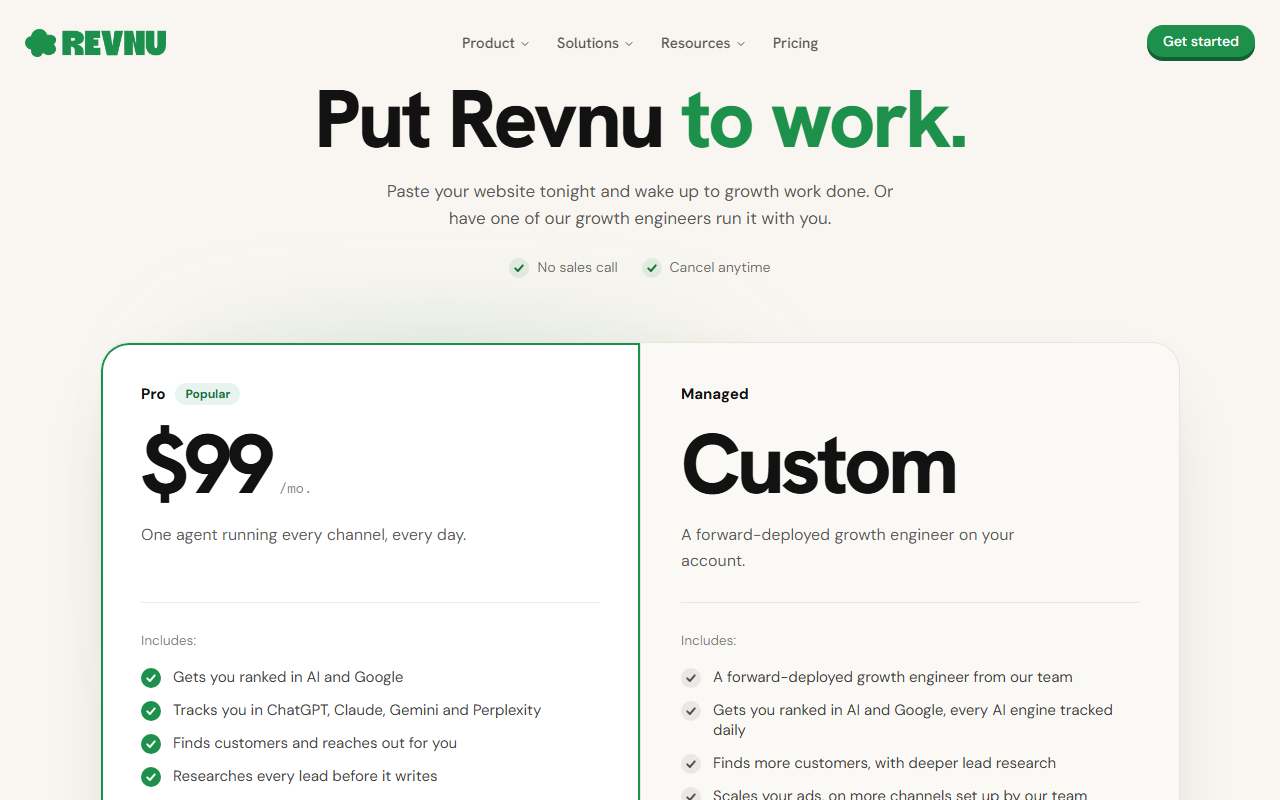 Pro and Managed on the Revnu pricing page, captured 19 Oct 2026. Ad networks bill the spend directly.
The Pro plan is $99 a month with the first day free. A Managed plan is quoted on a call and adds a forward-deployed growth engineer from Revnu's team. For that, one agent does three jobs:
- Paid ads across five networks, Google, LinkedIn, Reddit, X and Microsoft. It tests creative, kills what does not convert and moves the budget to what does, all inside your own ad accounts.
- Outbound email, sent only to companies that look like a fit and show signs of buying soon. Our Instantly, Smartlead and lemlist comparison covers the do-it-yourself version of that job.
- SEO and GEO pages, with tracking for how the brand shows up in Google, ChatGPT, Claude and Perplexity. Our guide to getting recommended by ChatGPT covers that job in depth.
Every draft lands as a card in Slack or iMessage. Nothing goes out until someone taps approve.
Where Revnu is weak
Two caveats belong next to the price.
First, it lists no CRM connection. Pipeline records stay wherever you keep them now, in HubSpot or a spreadsheet, and someone has to copy the wins across.
Second, it is new. Its funding post from 1 October 2026 reports $3M led by PXN Ventures, with Y Combinator among the backers, and a team back home in Manchester, UK. An independent ranking site, The Agent Benchmark, scores it 3.0 of 10 as of 3 October. The reason is blunt: no public claims of customers or revenue yet. The campaign table and revenue messages on the homepage are demo content, not results.
So Revnu is unproven at scale. The approval queue is what limits the downside: a bad draft costs a tap, not a send. For how it ranks against other agents, see the AI marketing agents roundup.
Muse for Small Business, for shops already on Meta
Meta added business skills to its Muse agent on 29 September 2026. Its announcement lists connectors for Shopify, Stripe, QuickBooks, Klaviyo, HighLevel, Slack, Canva, Notion and others, plus Instagram analytics, Facebook Pages and Meta ad accounts.
The fit is narrow. Inside it, strong. A shop that sells and advertises on Instagram gets an agent that reads sales, books and ad results together, then drafts the next campaign. Meta says nothing publishes, sends or spends without approval.
Three limits:
- Only people in the US and Canada can use it today.
- HubSpot is not on Meta's named connector list. HighLevel, a rival CRM, is. Custom connectors exist for the gap.
- Meta calls the free version enough for most needs and sells subscriptions on top, yet publishes no usage allowance. Axios reported $20 and $100 monthly tiers at the September launch.
Muse runs on Meta's own Muse Spark model. For the head-to-head, read Revnu vs Muse for Small Business.
Where your data goes in each case
Price is half the decision. The other half is who ends up holding your customer data, and the three routes differ.
- Staying inside HubSpot. The agents read the CRM you already pay for. No new copy of your contacts leaves the building, which is the single best argument for the bundle.
- Adding a specialist. Every tool in the job table needs a sync or an export. Each sync is one more vendor holding contact records, one more privacy policy to read, and one more place a stale record can live.
- Revnu. Ad spend runs through your own ad accounts, so the money and the campaign history stay yours if you leave. Lead lists and drafts live with the vendor.
- Muse. By default, Axios reported at launch, Meta may use what you ask its models unless you opt out; a confidential mode was promised for later. Find that switch before connecting your books. Then flip it.
None of this rules a route out. It does mean the cheapest option on the credit maths can be the most expensive one to unwind.
The case for staying bundled
The strongest argument against this guide is that it overrates the meter. A team inside HubSpot isn't choosing between Breeze and a specialist on raw capability. It is choosing between one login with imperfect AI and four new logins, four data syncs and four invoices. Below a certain size, good enough and already there beats better and one more tool to run.
That holds for a small team that touches CRM data lightly and leans on the free assistant. It weakens with volume. At 3,000 credits a month, Professional covers 60 resolutions; a support desk closing 500 a month pays for the other 440 at the marginal rate. And Attio, with a free plan for up to 3 seats, makes leaving cheaper than it was. A team ready to reconsider the CRM itself should read our best AI SDRs guide and compare Outreach and Salesloft before it renews.
What to watch next
Watch the rate card. HubSpot's credits page sends you to a separate rate sheet for anything beyond the headline agents, and its per-agent list is already longer than the one this guide first quoted. If the 50-credit resolution or the 100-credit lead moves at your next renewal, redo the division above before you sign.
On the other side, watch whether Revnu publishes its first named customer results, and whether Meta publishes the Muse allowance. Either one would change who belongs in that table by the next time we check it, in January 2027.
Frequently asked questions
What is HubSpot Breeze now?
Breeze is now the name of HubSpot's assistant, Breeze Assistant, a chat sidebar included with every subscription at no extra cost. The autonomous agents sit in Agent Hub: Campaign, Content, Nurture, Prospecting, Customer, Data and Revenue, plus Agent Builder for custom ones. The agents spend HubSpot Credits.
How much do HubSpot AI credits cost?
One credit costs $0.01, and extra packs are 1,000 credits for $10. As of 19 October 2026 a resolved Customer agent conversation costs 50 credits, a Prospecting agent lead 100, and a piece of content 1,000. Unused credits expire at the end of each month.
How many credits come with each HubSpot plan?
Marketing Hub Starter includes 500 credits a month, Professional 3,000 and Enterprise 5,000. At 100 credits a lead that is 5, 30 and 50 prospecting leads. Pay-as-you-go or credit packs cover anything beyond the pool.
What are the best HubSpot AI alternatives?
Pick by job. Chatwit, Intercom Fin and Sierra cover support at small, mid and enterprise scale. Apollo and Bardeen cover prospecting, and Cassidy builds custom agents. Revnu suits a company with no marketer, Muse for Small Business suits shops selling through Meta, and Attio replaces the CRM itself.
Is Revnu a HubSpot alternative?
Only for part of the job. Revnu runs ads, outbound and SEO pages for $99 a month and asks approval in Slack or iMessage, but it lists no CRM connection, so pipeline records stay where they are. It is new, with no public customer evidence yet.
Covered in this guide
- HubSpot: HubSpot is an all-in-one CRM and marketing platform used by 288,706 customers, now with Breeze AI agents for prospecting, content, and customer support.
- Apollo: Apollo.io is a sales intelligence platform with a searchable B2B contact database, built for prospecting and outreach with sequencing and a dialer attached.
- Attio: AI-native CRM with a free plan for up to 3 seats, a hosted MCP server and per-user paid plans; Pro adds call recording and sequences.
- Bardeen: Find and reach leads no one else can with agentic web scraping, AI qualification, and contact enrichment.
- Cassidy: No-code AI automation platform for business teams: build agents and multi-step workflows grounded in company documents and CRM data, free to start on the Starter plan.
- Chatwit: No-code AI chatbot that trains itself on your website content and answers visitors 24/7, with a free tier and paid plans available.
- Clay: AI go-to-market platform with waterfall data enrichment and Claygent AI research agents, with plans from free to enterprise.
- Intercom: Customer service platform for SaaS teams: the Fin AI agent resolves most incoming queries automatically, and Intercom serves more than 30,000 organizations worldwide.
- Meta: Meta AI ships open-weight Llama (1B+ downloads) and the closed Muse models, led by Muse Wonder with a 1M-token context window.
- Muse for Small Business: Meta's AI agent runs tasks in its own cloud computer; since 29 Sept 2026 it connects Shopify, QuickBooks, Meta ads and more for small businesses in the US and Canada.
- Muse Spark: Muse Spark 1.3, released September 2, 2026 by Meta AI Research, is an agentic model for long coding, long documents and tool-heavy work, with max reasoning on the Standard API tier.
- Revnu: Y Combinator-backed AI growth agent that runs outbound, ads on Google, LinkedIn, Reddit, X and Microsoft, and SEO pages for software startups, with drafts held for approval.
- Sierra: Enterprise AI agent platform from Bret Taylor valued at $15.8B in 2026, used by 40% of the Fortune 50 for customer service across chat, voice, and email.
Sources
Still deciding?
This guide covers a handful of options. Smart Match checks every listing in the directory against how you actually work and what you can spend, then hands you the shortlist and the reason behind each pick.
Find your toolsRelated guides
- 41 of 100 HokAI Guides Carry a Screenshot. All 106 Still Load.Inside HokAIHow the directory works, verified in the open
- Apollo.io Alternatives in 2026: Pick by the Job You Hired Apollo ForBuyer's guideHow to pick, across a category
- Apollo vs Clay: Which One Should You Buy First?ComparisonHead-to-head, with a verdict
- Attio vs HubSpot in 2026: Which CRM for a Startup?ComparisonHead-to-head, with a verdict
- Bardeen vs Browse AI: Same Comparison, Different Products NowComparisonHead-to-head, with a verdict
- Best Agentic AI in 2026: Pick the Job, Not the GeneralistBuyer's guideHow to pick, across a category