How to Get Your Business Recommended by ChatGPT: A 30-Day Playbook
To get a business recommended by ChatGPT, let OAI-SearchBot crawl the site, since OpenAI excludes opted-out sites from ChatGPT search answers. Then publish pages that answer specific buyer questions, earn mentions on independent roundups and review sites, and track a fixed prompt set over 30 days.
The short version
ChatGPT recommendations cannot be bought. Allow OAI-SearchBot so ChatGPT search can show your site, answer real buyer questions on pages that fit the intent, get onto neutral third-party lists, and measure with more than one signal. Trackers start at $29 a month; test by hand for two weeks first.
Want this decided for your own case? Find your tools with Smart Match, starting from this guide's question.
OpenAI's crawler documentation says a site that blocks OAI-SearchBot will not be shown in ChatGPT search answers, and there is no form, fee or partner program that buys a place in them.
That one rule is the floor. Everything above it is earned the slow way: the questions buyers type into ChatGPT, the pages an answer engine quotes, and the third-party lists it trusts more than your own site. This playbook turns that into 30 days of work for a founder or a one-person marketing team at a small B2B company, and it says plainly where a paid tracker or an agent helps and where a spreadsheet is enough.
What a ChatGPT recommendation is, and what decides it
A recommendation shows up in two ways. Sometimes the model answers from what it learned in training. More often, for "best tool for X" or "who does Y near me" questions, ChatGPT search fetches live pages and cites them, and that is the part you can influence this month.
OpenAI's documentation splits its robots into three jobs. OAI-SearchBot surfaces sites in ChatGPT's search features. GPTBot collects pages that may train future models. ChatGPT-User fetches a page when a person asks for it, and OpenAI says robots.txt rules may not apply to it because the visit is user-initiated.
The settings are independent. You can allow search and refuse training, which is what most businesses want. OpenAI adds that a robots.txt change takes roughly 24 hours to reach its search systems.
Google works the same way for AI Overviews and AI Mode. Its AI features page says a page must be indexed and eligible to show with a snippet, and that "there are no additional technical requirements." So the work below helps you in Gemini and Google's AI answers too, not only in ChatGPT.
Days 1 to 3: decide which buyer questions count
Start with questions, not tools. Write down 15 to 25 prompts a real buyer would type before choosing a business like yours. Pull them from sales calls, support tickets, the search terms in your analytics, and the wording customers use in reviews.
Sort them by intent, because the intent decides which kind of page gets cited:
- Informational: "how do I stop churn in a SaaS trial"
- Commercial: "best outbound tool for a 3-person startup"
- Navigational or local: "accountant for Shopify sellers in Manchester"
- Transactional: "Otterly pricing" or "book a demo with X"
Commercial prompts matter most for recommendations. They are also where your own pages count least, as the data in the next sections shows.
Keep the list small. Fifteen well-chosen prompts tell you more than 300 scraped keywords, and every tracker below charges by the prompt.
Days 4 to 7: test where you appear today, by hand first
Open a logged-out browser window, turn on search in ChatGPT, and run each prompt. A paid seat is not needed for this; our ChatGPT plans comparison lists what each tier adds. Then run the same set in Claude, Gemini and Copilot if your buyers use them. Perplexity belongs on the list for technical and research-heavy audiences.
Record four things per answer. A shared sheet with these columns is enough:
date | engine | prompt | named? (y/n) | position in answer | competitors named | pages cited (URLs)The last column is the valuable one. The cited URLs are the shortlist of pages you need to appear on or to beat. If a G2 category page, a Reddit thread and two "best X" articles from industry blogs keep showing up, that is your target list for days 11 to 30.
Answers vary from run to run, so repeat each prompt twice on different days before you trust a result. A single "not mentioned" is weather. Three in a row is climate.
Days 8 to 10: make sure ChatGPT can read your site at all
This is the cheapest step and the one most often broken by a security plugin or a CDN bot rule. Check your robots.txt for a blanket block, then make the search crawler's permission explicit:
User-agent: OAI-SearchBot
Allow: /

User-agent: GPTBot
Disallow: /
The second block is optional. It refuses training while keeping search, and OpenAI states the two are handled separately. If your firewall blocks unknown bots, allow the IP ranges OpenAI publishes for its crawlers; the docs link them from the same page.
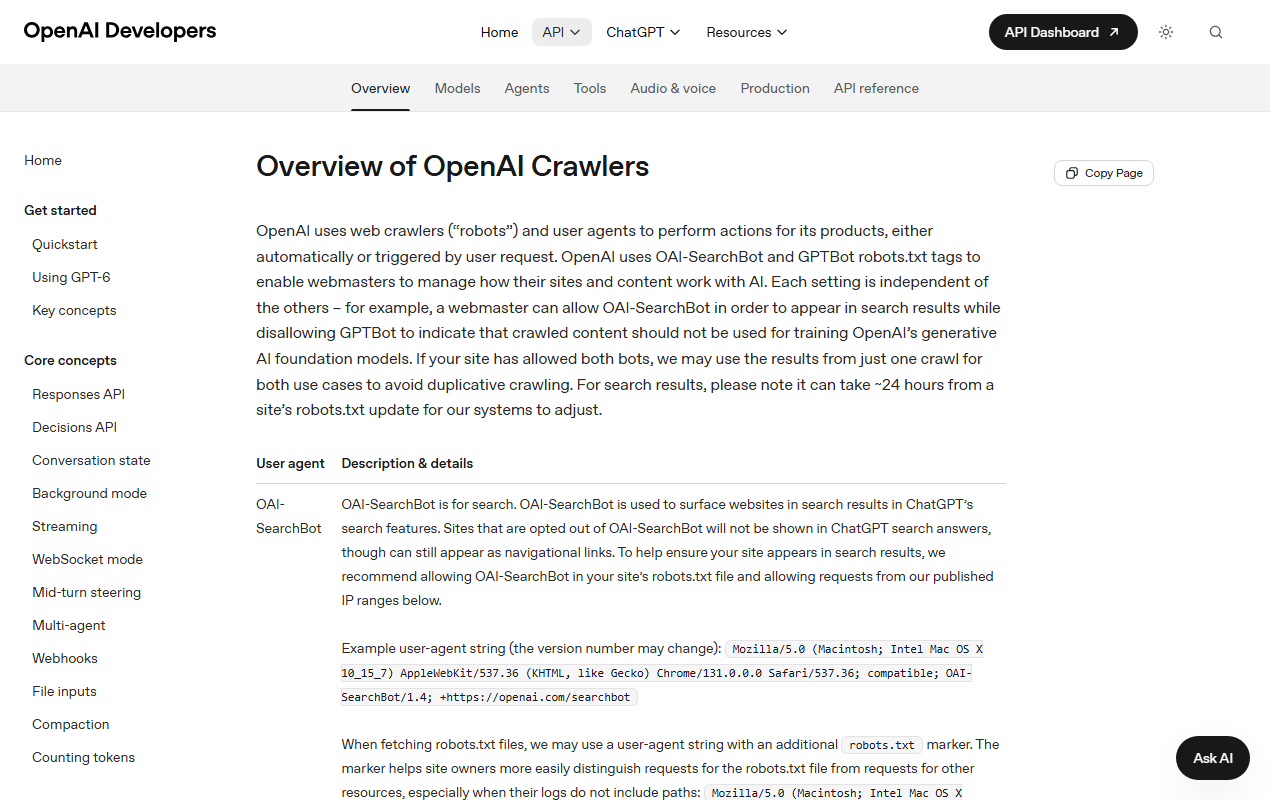 OpenAI's own description of OAI-SearchBot, captured 19 Oct 2026. Sites opted out of it are not shown in ChatGPT search answers.
Then check the boring things that stop any crawler: pages rendered only after a login, prices loaded by a script that fails without JavaScript, and service pages that exist only as a PDF. Google's guide notes it can process JavaScript "as long as it isn't blocked", but other crawlers are less forgiving, so the core facts should sit in the HTML.
Days 11 to 20: fix the pages that answer the questions
Now give each priority question a page that answers it in the first two sentences, with the facts a model can lift: who it is for, what it costs, where you operate, and what makes you different, in plain words.
Match the page type to the intent. A study by the Wix Studio AI Search Lab, with researchers from Peec AI, looked at 75,000 AI answers and 1,056,727 citations from ChatGPT, Google AI Mode and Perplexity. Its split by intent is the most practical map published so far:
| Prompt intent | Most-cited page type | Share of citations |
|---|---|---|
| Informational | Articles | 45.48% |
| Commercial | Listicles | 40.86% |
| Navigational | Product and category pages | Leading type |
| Transactional | Product pages | 24.88% |
Two findings change what you build. Across all intents, product alternative and comparison pages drew under 3% of citations. And listicles, articles and product pages together made up 52%.
So a "Us vs Competitor" page is a weak bet for ChatGPT, whatever it does for Google. A clear pricing page, a specific service page per offer, and a genuinely useful explainer for the informational questions are stronger. Our roundup of AI search engines covers how the main engines differ for buyers.
Days 11 to 30: earn the third-party mentions that carry buying questions
This is the step that decides commercial prompts, and you cannot do it on your own domain. In the same study, the researchers took the 1,000 most-cited URLs in professional services, the industry with the highest listicle rate, and found that 80.9% of listicle citations came from third-party sites and 19.1% from brands ranking themselves.
In practice, that means:
- Contact the editors of the roundups your sheet keeps citing. Offer facts, a trial or a customer to quote.
- Complete your review-site and directory profiles, with one name, description and price everywhere.
- Answer real questions where your buyers talk. The study found 17% of Perplexity's citations came from discussions, over double the other models.
- Get listed on partner and integration pages, which read as independent confirmation.
Google draws a line here that applies to every engine. Its guide on generative AI search says seeking inauthentic "mentions" across the web "isn't as helpful as it might seem", because its spam systems sit under its AI features. Paid placements dressed as reviews and seeded forum posts are the fastest way to lose the trust you are trying to borrow.
The tracker shortlist: what each one is for
After two weeks of manual checks you will know whether you need software. A tracker earns its fee once you have more prompts and engines than you can rerun by hand each week. All prices below were read from each vendor's pricing page on 19 October 2026, in USD.
| Tracker | Entry plan | Prompts on entry plan | Best for |
|---|---|---|---|
| Otterly | $29/mo | 15 | Cheapest daily tracking |
| Peec AI | $95/mo | 50 | Small teams, 3 engines |
| CiteLens | Free, then $79/mo | 10, then 25 | Testing before paying |
| Semrush | $139/mo SEO plan | Not stated | Teams already on Semrush |
| Ahrefs Brand Radar | From $50/mo | Custom prompts | Market-wide index data |
| Profound | Free 7-day trial | 50 | Enterprise, many engines |
| Palmata | Free sample report | Report-based | One-off audit |
| Writesonic | $79/mo | 50 | Tracking plus content |
Otterly is the cheapest way in: Lite tracks 15 prompts daily across ChatGPT, Google AI Overviews, Perplexity and Microsoft Copilot, and extra blocks of 100 prompts cost $99 a month on the higher plans. Peec AI's plans all include three models of your choice and unlimited users, with 15% off for annual billing.
CiteLens is the safest test, since its free plan covers 10 prompts and three engines and its paid trial runs 14 days with no card. Palmata is different in kind: a free sample report on how AI search describes your company, then $600 a month for Growth. The trade-offs between those two are in our CiteLens vs Palmata comparison.
For bigger teams, Semrush now puts AI search tracking and custom prompt monitoring into its $139 SEO plan, so a team already paying for it may not need a second tool.
Ahrefs' Brand Radar starts custom prompts at $50 a month and its AI Visibility Index at $199, built on what Ahrefs calls 481 million prompts modelled from real searches. Profound offers a one-week trial of 50 prompts on ChatGPT, Gemini and Google AI Overviews, then custom-priced Enterprise plans covering up to nine engines.
Writesonic and Surfer sit between trackers and writing tools: both bundle prompt tracking with content creation, which suits a team that wants one subscription for the fix as well as the measurement. The full field is in the AI search and discovery directory.
What tracking costs per answer checked
Entry prices hide the real difference, which is how many answers each plan actually checks. Peec explains its own counting: prompts times models times days, so 25 prompts on 3 models for 30 days is 2,250 answers. Applying that rule to each entry plan:
| Plan | Monthly price | Answers checked per month | Cost per answer |
|---|---|---|---|
| Surfer AI Search Analytics | $82 (billed yearly) | 50 x 5 engines x 30 = 7,500 | about $0.011 |
| Otterly Lite | $29 | 15 x 4 x 30 = 1,800 | about $0.016 |
| Peec AI Starter | $95 | 50 x 3 x 30 = 4,500 | about $0.021 |
| Writesonic entry | $79 | 50 answers x 30 = 1,500 | about $0.053 |
| CiteLens Starter | $79 | 1,100 engine calls | about $0.072 |
Three caveats keep this honest. The Surfer figure assumes all five listed engines run on every prompt, which its page states ("simultaneously across all models"), but it is the yearly-billed price. Writesonic counts 50 answers a day, not 50 per engine. And CiteLens sells engine calls rather than daily runs, so its prompts can be checked less often to stretch the budget.
The cheapest answer is not automatically the best buy. Daily runs on fewer prompts beat weekly runs on many, because ChatGPT's answers move from day to day.
The done-for-you option: what Revnu does, and what it has not proven
Some teams do not want a tracker. They want someone to do steps 3 to 6. That is the pitch of AI growth agents, and Revnu is the clearest example aimed at small companies.
According to its homepage, Revnu finds what buyers search and ask, publishes pages, and tracks where a company appears in Google, ChatGPT, Claude and Perplexity. Beyond search, it buys and tests paid ads across five networks, from Google and LinkedIn to Reddit, X and Microsoft, and runs outbound to accounts it scores for fit and buying signals. Work arrives as approve, dismiss or snooze cards in Slack or iMessage.
The Pro plan costs $99 a month, billed monthly, with a free first day, no card to start and no sales call, according to Revnu's pricing. The higher Managed tier has no list price; it is quoted on a call and puts one of Revnu's growth engineers on the account. Ad spend is paid to the ad platforms directly. The company announced a $3M round on 1 October 2026, led by PXN Ventures with Y Combinator, identity.vc and InvestorX, and is now building in Manchester, UK.
Be clear about what is not known. The Agent Benchmark scored Revnu 3.0 out of 10 on data as of 3 October 2026, noting "no public claims of customers or revenue yet". Revnu is new and unproven at scale. The campaign tables and revenue messages on its homepage are demo content, not customer results.
Two design choices cap the risk. Every page, ad and email waits for your approval, and the ad money never leaves accounts you control. Meta's Muse assistant for small businesses is the free alternative many owners will try first. For how the two compare with Meta's free assistant for small businesses, see our Revnu vs Muse for Small Business comparison, and the wider field is in our AI marketing agents roundup.
Days 21 to 30: measure, and never trust one tag
Visibility is not customers. The objection to this whole playbook is that you can raise your mention share and still book no extra calls, and it is a fair one. The answer is to measure at the customer end, with more than one signal.
October showed why. Search Engine Roundtable reported on 14 October 2026 that ChatGPT appeared to have stopped adding its utm_source=chatgpt.com tag after GPT-6 shipped. Cedric Huesler of Adobe found links opening with no tag and no referrer, so analytics filed the visits as direct. On roughly 500 pages, he counted 31,000 fewer ChatGPT visits a day and 26,000 more direct visits.
The drop was not universal or permanent. On 15 October Huesler updated his post: "It was a bug. ChatGPT is tagging its links with utm_source=chatgpt.com again." OpenAI has not said what happened. Search Engine Land also covered the drop; its page sat behind a bot check when we tried to read it.
So build measurement that survives the next bug:
- A referrer filter for AI sources in your analytics, as a custom channel or segment
- A "how did you hear about us" field on demo and signup forms, with "ChatGPT or another AI assistant" as an option
- Direct traffic to deep pages, watched weekly, since a jump on a service page nobody types by hand often means an untagged AI referral
- The same prompt set, rerun on day 30, compared with your day 4 to 7 sheet
A starting regex for the referrer filter, to adjust for the engines your buyers use:
chatgpt\.com|chat\.openai\.com|perplexity\.ai|gemini\.google\.com|claude\.ai|copilot\.microsoft\.comIf you buy ads inside ChatGPT, keep that spend separate in reporting. Our explainer on how ChatGPT ads work covers what is sold there; it does not touch organic answers.
Myths to skip: llms.txt, special markup and chunking
Google published a mythbusting list in its guide on optimizing for generative AI, last updated 10 July 2026. It says you do not need llms.txt or other "special" machine-readable files, do not need to chunk content into tiny pieces, do not need to rewrite for AI, and need no special schema.org markup for AI answers.
OpenAI's documentation names no special file either: the published lever is OAI-SearchBot access. Time spent on an llms.txt file is time not spent on the third-party lists that actually carry commercial prompts.
Who should skip trackers and stay with a spreadsheet
Not every business needs a tool, and the case for staying manual is strong for many readers. A local service firm with ten real prompts can rerun them by hand every Monday in 30 minutes, and no tracker's daily chart will change what it does next: fix the listings, earn the reviews, ask the roundups.
Skip paid tracking too if you have not done days 8 to 20. A dashboard that tells you, daily, that you are invisible is not progress. And skip an agent like Revnu if nobody on the team will read its approval cards each day, since the approval step is the safety mechanism. If you cannot tell whether a tracker, an SEO suite or an agent fits your team, Smart Match compares the options against the tools you already run.
Data handling: what you hand a tracker or an agent
A tracker needs little: your brand names, competitors and prompts. An agent needs much more, often your ad accounts, CRM, inbox and website. Read the data terms before connecting anything.
Revnu's pricing FAQ says self-serve accounts feed cross-account lessons back into the product, though no other customer sees your content, contacts or results; on Managed, data stays with your account only. Profound lists SSO/SAML and SOC 2 compliance on its pricing page, and Peec AI lists single sign-on, which matters once a larger company's security team is involved.
Two rules hold for any vendor. Give the narrowest permission each connection allows, and keep ad billing on accounts you own. For a wider view of the tools that sit in this category, our AI search visibility roundup compares the trackers side by side.
What would change this playbook
Three things would flip the order of these steps. If OpenAI opened a paid or partner placement inside organic answers, step 6 would become a budget line. If tracker data began to show owned comparison pages beating third-party lists on buying questions, the 11-to-20 and 11-to-30 work would swap priority. And if engines stopped citing pages altogether, measurement would have to move entirely to self-reported attribution.
Watch the next model release, too. GPT-6 broke tagging for about a week; the next update could change which crawler fetches pages, so reread OpenAI's bot documentation after each launch.
On day 30, rerun the same 20 prompts you wrote on day 1, and again on day 60. If the lists you joined start appearing in the cited sources, the work is compounding, and that is the point to decide whether a tracker or an agent is worth paying for.
Frequently asked questions
Can I pay to be recommended by ChatGPT?
No. OpenAI documents no paid or partner route into organic ChatGPT answers. Ads inside ChatGPT are a separate, labelled product, and they do not change which businesses the answer itself names.
How long does it take to show up in ChatGPT?
A robots.txt change reaches ChatGPT search in about 24 hours, according to OpenAI. Being cited is slower: new pages and third-party mentions usually need weeks before they appear in answers, so judge progress on a fixed prompt set at day 30 and day 60.
Do I need an llms.txt file to appear in AI answers?
No. Google says llms.txt and other special files are not needed for its AI features, and OpenAI's documented lever is allowing OAI-SearchBot. An llms.txt file does no harm, but it is not where recommendations come from.
Which AI visibility tracker should a small business start with?
Start by hand for two weeks. If you then need daily tracking, Otterly Lite at $29 a month for 15 prompts or Peec AI Starter at $95 for 50 prompts covers most small teams, and CiteLens has a free plan for 10 prompts.
Why does ChatGPT traffic show up as direct in my analytics?
ChatGPT normally tags links with utm_source=chatgpt.com, but in October 2026 a bug after GPT-6 briefly removed the tag and the referrer, so visits landed in direct. Add a "how did you hear about us" field and watch direct traffic to deep pages as a backup signal.
Covered in this guide
- ChatGPT: ChatGPT is OpenAI's AI assistant, with 1.2 billion weekly users by OpenAI's count, the GPT-6 model family and plans that run from a free tier to a premium Pro tier.
- Ahrefs' Brand Radar: Own-crawler SEO platform (AhrefsBot since 2013) covering backlinks, keywords, rank tracking and AI-answer visibility, with a free tier for verified sites.
- CiteLens: CiteLens tracks brand and site citations across ChatGPT, Perplexity, Claude and Gemini, from a free-forever plan up to its top Agency tier.
- Claude: Claude is Anthropic's AI assistant, with a free tier, paid personal plans, and Team and Enterprise seats. Opus access starts at the first paid plan.
- Gemini: Google's multimodal AI assistant and model family, sold as a free app, tiered subscriptions and a pay-per-token API
- Copilot: Your everyday AI companion powered by GPT-5.6 (preferred model July 2026), GPT-4o, and GPT-5 for productivity, creativity, and intelligent assistance
- Muse assistant for small businesses: Meta's AI agent runs tasks in its own cloud computer; since 29 Sept 2026 it connects Shopify, QuickBooks, Meta ads and more for small businesses in the US and Canada.
- OpenAI's documentation: OpenAI builds ChatGPT, the GPT-6 family (Astra, Sol, Luna), Codex and the OpenAI API. It reports 1.2B weekly ChatGPT users and an $852B valuation after its March 2026 round.
- Otterly: AI search monitoring tool that tracks brand mentions and citations on four engines by default, with three more as paid add-ons.
- Palmata: Palmata is Contentful's AEO platform, built around a proprietary research agent that investigates why AI answer engines characterize a brand a certain way and recommends the content changes most likely to shift it.
- Peec AI: Daily AI search tracker scoring brand visibility, position and sentiment across ChatGPT, Gemini and Copilot; Peec lists 3,500+ brands and agencies.
- Profound: Enterprise AI search visibility platform that tracks brand mentions in up to nine answer engines and adds agents to act on the gaps.
- Revnu: Y Combinator-backed AI growth agent that runs outbound, ads on Google, LinkedIn, Reddit, X and Microsoft, and SEO pages for software startups, with drafts held for approval.
- Semrush: Adobe-owned SEO suite: keyword, backlink and rank data plus AI visibility tracking across 4 AI engines; a Free plan is available.
- Writesonic: Track and grow your brand's presence in ChatGPT, Gemini, and Perplexity with Writesonic's GEO platform. No free plan; paid tiers only.
Sources
Still deciding?
This guide covers a handful of options. Smart Match checks every listing in the directory against how you actually work and what you can spend, then hands you the shortlist and the reason behind each pick.
Find your toolsRelated guides
- The AI 80s Photo Trend: How to Make Yours (and Turn It Into a Video) in 2026AnalysisWhat changed and who it affects
- The AI Tools That Do One Microsoft Copilot Job, CheaperBuyer's guideHow to pick, across a category
- Apollo.io Alternatives in 2026: Pick by the Job You Hired Apollo ForBuyer's guideHow to pick, across a category
- Best Agentic AI in 2026: Pick the Job, Not the GeneralistBuyer's guideHow to pick, across a category
- Best AI Agent Builders in 2026: Automate, Build or Self-HostBuyer's guideHow to pick, across a category
- Best AI Assistant Apps for Android in 2026, Now That Google Assistant Is DeadBuyer's guideHow to pick, across a category