Best AI Search Engines in 2026: 6 Free Alternatives to Google
Six AI search engines worth switching to in 2026: Perplexity for cited web answers, Bing Copilot for unlimited free use, Komo AI for automated recurring research, Andi Search for a fully ad-free experience, Consensus for peer-reviewed academic literature, and Google Lens for visual, photo-based search queries.
The short version
Bing Copilot is the only fully unlimited free AI search engine, subsidized by Microsoft revenue elsewhere. Perplexity leads on cited answers but caps free Pro Search at five queries a day. Komo AI automates repeat research, Andi Search skips ads and tracking, Consensus specializes in peer-reviewed papers, and Google Lens searches from a photo instead of text.
Why AI Search Engines Are Taking Google's Traffic in 2026
Google still handles most searches on the open web. But a growing share of people searching for something commercial or research-heavy now open a different tab first. AI Overviews turned the top of a Google results page into a wall of hedged summaries, and the ten blue links dropped further down the screen than they used to sit.
That pushed a real number of searchers toward tools built to answer the question directly, cite where the answer came from, and stop there. None of the six tools below are trying to replace Google for every search. Typing a store's address or checking a score is still faster in a plain search box.
What they replace is the research query. The "compare these three options," "what does the data actually say," or "find me the source" kind of search that used to mean opening eight tabs and reading none of them fully.
How to Choose an AI Search Engine
Before the shortlist, four questions actually separate these tools from each other.
- Does it cite sources you can click through to, or just assert an answer? A tool that shows its work lets you catch a wrong answer before you act on it.
- What happens when the free tier runs out? Some tools throttle you back to plain web results with no AI layer. Others meter one feature, like deep research, and leave everyday answers unlimited.
- Does it specialize, or try to do everything? A generalist answers more questions passably. A specialist answers fewer questions well, with sourcing a generalist can't match in that one lane.
- What does it do with your query afterward? This matters more for anything you wouldn't want screenshotted: health questions, legal questions, salary research, anything work-related you'd rather your employer not see logged.
Score each tool you're considering against those four before you look at price. Price is the tiebreaker, not the filter.
The Shortlist: Six AI Search Engines Worth Switching To
These six cover the real range: a generalist with citations, the one truly unlimited free option, an automation-first tool, a privacy-first tool with no paid tier at all, an academic specialist, and a visual specialist.
| Search Engine | Free Tier Limit | Paid Plan | Best For |
|---|---|---|---|
| Perplexity | Unlimited basic search, 5 Pro Searches a day | $20/mo Pro, $200/mo Max | Cited answers across the open web |
| Bing Copilot | Unlimited, no daily cap | $20/mo Copilot Pro (optional) | Free with no catch |
| Komo AI | Free tier, daily credits, three ad-free modes | $15/mo Basic, $30/mo Premium | Automating a repeat search |
| Andi Search | Unlimited, no paid tier sold | None | No ads, no tracking, no paywall |
| Consensus | Free tier, capped AI summaries | $6.99-$9.99/mo Premium | 200 million peer-reviewed papers |
| Google Lens | Unlimited, free everywhere | Free (bundled in Google apps) | Searching from a photo, not text |
Perplexity: The Default, With a Catch
Perplexity is the tool most people mean when they say "AI search engine," used by more than 45 million people a month as of 2026. It searches the live web, then answers in a few paragraphs with numbered citations you can click through, rather than one confident paragraph with no way to check it. For a "what's the current state of X" query, its citations are usually the fastest route from question to a source you can trust.
The catch is the free tier's cap. Basic search is unlimited, but Pro Search, the mode that pulls from more sources and reasons across them, is capped at 5 queries a day on the free plan. Hit that limit doing real research on a Tuesday afternoon and you're either waiting until tomorrow or upgrading.
Pro costs $20 a month and unlocks image generation plus a daily allotment of around 20 Deep Research queries. A Max plan above that adds higher usage ceilings and priority access to frontier models, aimed at people who'd otherwise juggle several separate AI subscriptions.
Perplexity AI built its own inference stack around Sonar, its retrieval-augmented model, rather than only rerouting queries to a third-party model with a search layer bolted on. That's part of why its citations tend to hold up under a manual check: the model searches first, then reasons over what it found, instead of reasoning first and filling in a citation afterward.
Bing Copilot: The Only Genuinely Unlimited Free Option
Bing doesn't have a free-tier problem because Microsoft doesn't meter it. Copilot Search is grounded in Bing's own index, answers in natural language with cited sources, and runs on the same subscription revenue and Windows and Edge distribution that funds the rest of Microsoft. That's the practical difference between "free" and "free until you're a real user."
The underlying model has moved fast. Copilot Search launched on OpenAI's GPT-5, moved to GPT-5.5 during 2026, and added Anthropic's Claude for commercial customers starting January 7, 2026, giving Microsoft two model families to route between instead of one. Copilot Pro, at $20 a month, layers on priority access and integration with Word, Excel, PowerPoint and Outlook. None of that is required for search itself, which stays free and uncapped whether you're checking one fact or running fifty queries in an afternoon.
The tradeoff is interface, not limits. Bing's answer format sits closer to a traditional results page with an AI summary on top, not a chat-first experience. If you want to type a follow-up the way you'd text a person, Perplexity and Komo AI feel more natural. If you want an answer without opening a chat window, Bing gets there faster.
Komo AI: Built for Repeat Research, Not One-Off Queries
Most AI search tools are built for a single query: ask, get an answer, move on. Komo AI is built for the search you run every week.
Its Persona system lets you save a research configuration, an Equity Researcher persona pulling from financial filings, a Copy Writer persona pulling from marketing case studies, and reuse it instead of rebuilding context each time. Configurable Data Corpora scope a search to academic, news, social, blog or video sources, which makes Komo function less like a search box and more like a saved research workflow.
The free tier includes ad-free search across 3 modes with no tracking, a real distinction in a category where most tools quietly serve ads against your query history. Paid tiers start around $15 a month for higher limits and $30 a month for newer underlying models.
Above those two sits a Business plan and custom Enterprise pricing, aimed at teams that need shared personas rather than one person's saved research setup.
Where Komo loses to Perplexity is raw citation density on one hard question. Where it wins is anything you'd otherwise run 3 or 4 times a week with slightly different inputs, a job search, a competitor watch, a weekly literature scan, where automation pays for itself after the second use.
Andi Search: No Ads, No Tracking, No Paid Tier At All
Andi Search has stayed free with no ads and no paywalled tier for 3 years running. PCMag gave it a top free-search award for the 3rd straight year in March 2026, a streak most funded competitors can't match once venture money runs out.
That's unusual in a category where funding eventually pushes every free tool toward a subscription wall. Andi's answer has been to build its own semantic search index instead of only reselling Google or Bing results, which keeps its cost structure different from a tool paying another company for every query it answers.
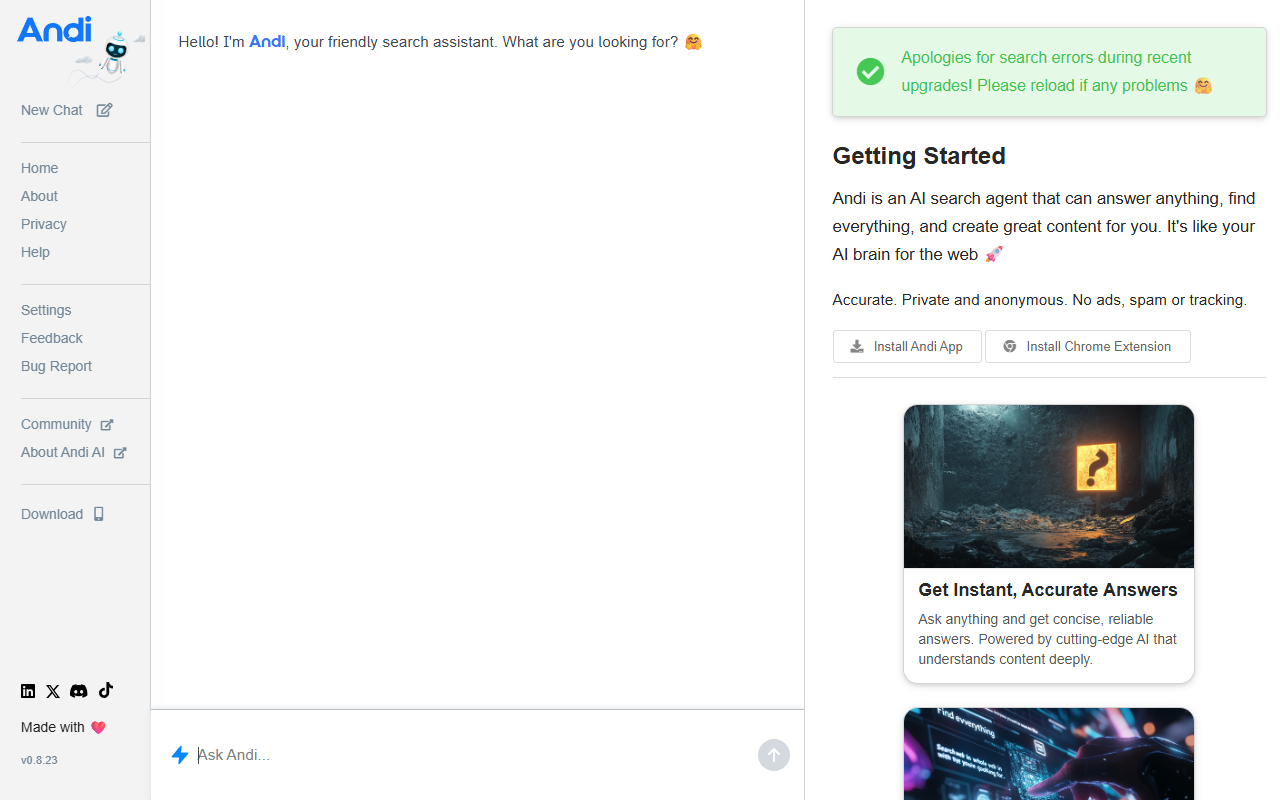 Andi Search's homepage, captured 17 Sep 2026. The privacy pitch sits above the fold, not buried in a settings page.
The product itself is deliberately plain: type a question, get a direct cited answer, with a toggle for academic or general search focus. There's no persona system, no automation layer, no enterprise tier. For anyone who wants the simplest possible upgrade over a Google search box, without a business model that eventually asks for a card, Andi is the safest bet on this list specifically because it has resisted adding the features that usually precede a paywall.
Consensus: When the Query Is a Research Question
Consensus searches over 200 million peer-reviewed papers and summarizes what they collectively say about a claim, with citations back to the actual studies. Ask "does creatine improve cognitive performance" and Consensus returns a synthesis of what the published research says, not one blog post's interpretation of one study.
The free tier gets you search and a limited number of AI-generated summaries a month. Premium, priced between $6.99 and $9.99 a month depending on billing term, removes that cap and adds a "Consensus Meter" showing at a glance whether the research on a claim leans for, against, or is mixed. Students get roughly 40% off on top of that.
For anyone whose search is actually a literature review, a student, a journalist checking a claim, someone deciding whether a supplement has real evidence behind it, Consensus answers a question the other 5 tools here aren't built to answer well. They search the open web. This searches a curated corpus of peer-reviewed work instead. Best AI for Research in 2026 compares Consensus against a wider field of research tools if academic search is your primary use case, not a secondary one.
Google Lens: When the Query Is a Photo
Not every search starts with words. Google Lens is Google's answer to the searches that start with a camera: point it at a plant, a piece of furniture, or a math problem you can't parse into text, and it returns an answer without you describing what you're looking at first. It's free across four apps, the main Google app, Google Photos, Chrome, and the native camera app on select Android devices, plus a Windows desktop version that shipped in 2026.
Lens also does real-time translation across more than 100 languages and can copy text straight out of an image to paste elsewhere. That makes it the closest thing on this list to a genuine Google Search replacement for one specific, common case: standing somewhere with a sign, a menu or a label you can't read, and typing isn't an option. None of the other 5 tools here compete with it on that, because none of them start from a photo.
What These Tools Actually Cost Once You Outgrow Free
Four of the six eventually ask for money if you use them heavily enough. Bing Copilot and Andi Search don't, for different reasons: Microsoft subsidizes Bing with revenue from elsewhere, and Andi has simply chosen not to build a paid tier yet. For the other four, the real cost isn't the sticker price. It's how fast you hit the ceiling.
- Perplexity's $20-a-month Pro plan becomes worth it the moment you're hitting the five-Pro-Search daily cap more than occasionally, which happens fast if you use it for work.
- Komo AI's $15 Basic tier suits someone running the same research persona daily, not occasionally.
- Consensus's under-$10 Premium tier is cheap relative to what a single paywalled journal article costs directly.
- None of these four prices to compete with a $20-a-month ChatGPT or Claude subscription on breadth. They're priced to be the second subscription, not the only one.
What Happens to Your Queries (Data Handling)
Every tool on this list logs your queries to some degree, because that's how the underlying model improves and how the company measures usage against its infrastructure costs. Where they differ is what happens next.
Andi Search markets no tracking and no ad targeting as its core differentiator, the strongest privacy stance of the six specifically because the company has no ad business to fund with your query history. Komo AI makes a similar claim across its 3 search modes. Perplexity and Bing both retain query history by default, tied to your account if you're signed in, with settings to disable personalization or delete history manually. Neither publishes a default retention window as short as a privacy-first tool would.
Consensus and Google Lens sit in between. Consensus's query data is mostly academic search terms with limited sensitivity, while Google Lens queries, often a photo of something in your home or a document, arguably carry more personal information than a typed search string, even though Google's stated retention and deletion controls are the same ones that apply across its other products.
If your search is ever anything you wouldn't want in a company's training data or an ad platform's targeting profile, treat that as a real filter, not a hypothetical one. It's the fourth question from the How to Choose section for a reason.
Who Should Skip AI Search Engines Entirely
Not every searcher benefits from switching. If most of your searches are navigational, going to a specific website you already know, checking today's weather, finding a store's hours, an AI layer adds a step with no payoff. Plain search or a bookmark gets there faster, and none of the citation or synthesis features these tools compete on matter for a query with exactly one correct, unambiguous answer.
The other group that should stay put: anyone whose work requires an answer they can cite back to a specific, verifiable primary source in a regulated context. Legal research, medical dosing, financial compliance, places where an AI-synthesized summary, however well-cited, isn't an acceptable substitute for reading the actual regulation or study yourself. These tools speed up finding the source. They don't replace reading it.
The same test applies to the best AI assistant apps on Android: a general assistant answering from memory is a different risk profile than a search tool citing a live source, and the two shouldn't be trusted the same way.
The Search Behind the Search: Why Brands Are Paying to Get Cited
There's a second market that's grown up directly because of the tools on this list, and it's aimed at the businesses these engines search, not at the people searching. When Perplexity, Bing Copilot or Consensus decide which page to cite for a given answer, that citation now functions like a ranking position used to. A small industry has formed around making sure a brand's own facts are the ones that get cited correctly.
Senso, backed by Y Combinator's 2024 winter batch, gives companies a way to publish a verified source layer specifically so that ChatGPT, Gemini and Perplexity cite the company's own numbers instead of a stale or wrong third-party summary. AI Search Lift, built by the research firm DISQO and launched July 1, 2026, measures whether a brand's advertising spend is actually increasing how often it gets mentioned inside AI answer engines, treating a citation as a measurable outcome the way a search ranking used to be tracked.
Palmata, Contentful's answer-engine optimization platform, runs a research agent that investigates why an AI engine characterizes a brand a certain way and recommends specific content changes to shift that characterization.
Browse the wider AI search visibility category if that side of the market is what you're actually researching, not the consumer tools above it. None of it changes how you use the six search engines in this piece. But it explains why their answers keep getting more accurate for well-known brands: someone on the other end is now actively working to make sure that's the case, in a way nobody was doing three years ago.
What Would Change This Verdict
This shortlist assumes Perplexity's five-Pro-Search daily cap, Bing's zero-cost model, and Andi's no-paid-tier stance all stay roughly where they are. Any of those could move.
If Perplexity tightens its free tier further, the case for starting with Bing Copilot instead gets stronger for anyone not willing to pay. If Google ships its own AI Mode broadly with citation quality that matches Perplexity's, the argument for switching away from Google at all weakens, since the switching cost of a new habit is real and Google's default distribution is hard to beat on convenience alone.
That's roughly the argument Gemini's own billion-user milestone already tested from the assistant side rather than the search side. And if Andi Search introduces a paid tier, as its still-unpriced "Andi Plus" announcement suggests it might, the "completely free forever" argument for picking it, covered in more depth in why Andi Search stays free, would need a second look.
None of that has happened yet as of this writing. Until it does, the six tools above, and the wider AI search and discovery category they sit in, are worth testing against your own actual searches, not just against a list like this one. If you're evaluating AI tools more broadly than just search, Smart Match walks through the same tradeoff, cost against capability against how a tool handles your data, for whatever category you're comparing next.
Frequently asked questions
What is the best free AI search engine in 2026?
Bing Copilot is the only one of the six with no daily query cap or hidden paid tier, because Microsoft funds it with revenue from elsewhere. Andi Search is the best fully ad-free option with no paid tier at all. Perplexity is the most capable on citations but limits free users to five Pro Searches a day.
Is Perplexity actually free?
Basic search on Perplexity is unlimited and free. Pro Search, the deeper research mode, is capped at five queries a day on the free plan; going over that requires the $20-a-month Pro subscription.
What's the difference between an AI search engine and a chatbot like ChatGPT?
An AI search engine like Perplexity or Bing Copilot is built to search the live web first and cite its sources for every answer. A general chatbot answers from its training data by default and may not search the web or cite a source unless you explicitly ask it to.
Do AI search engines track what you search for?
Most of them do to some degree, tied to your account if you're signed in. Andi Search and Komo AI both market no ad-based tracking as a core feature, which is the strongest privacy stance among the six covered here.
Which AI search engine is best for academic research?
Consensus, which searches over 200 million peer-reviewed papers and summarizes what they collectively say about a claim, with citations back to the actual studies. It's a narrower tool than Perplexity or Bing, built specifically for that one job.
Covered in this guide
- Bing: Microsoft's AI-powered search engine with Copilot integration, multi-turn search, and enterprise capabilities. Free consumer search; Copilot Search powered by OpenAI's Prometheus model. Enterprise Bing Chat is also available for teams.
- Perplexity: Perplexity AI searches the live web and returns cited, source-backed answers, used by 45 million monthly users with plans starting free.
- AI Search Lift: DISQO AI Search Lift measures whether advertising drives incremental brand mentions inside ChatGPT, Gemini and Perplexity, launched July 1, 2026.
- Andi Search: AI search for the next generation: answers, not just links
- ChatGPT: ChatGPT is OpenAI's AI assistant with 900 million weekly users and GPT-5.6 Sol, covering writing, coding, image generation, and web search with a free plan and Plus at $20/month.
- Consensus: AI-powered search engine for peer-reviewed research literature
- Google Lens: Google's AI-powered visual search tool that identifies objects, translates text in 100+ languages, matches products against the Shopping Graph, and provides homework help. Free on Android, iOS, and Chrome, with a Windows desktop app that launched in 2026.
- Komo AI: AI search and workflow platform that returns sourced answers and lets you automate repeating research tasks.
- Palmata: Palmata is Contentful's AEO platform, built around a proprietary research agent that investigates why AI answer engines characterize a brand a certain way and recommends the content changes most likely to shift it.
- Perplexity AI: Perplexity AI is an AI-powered search engine using retrieval-augmented generation to provide accurate, cited answers to questions. Founded by former OpenAI researchers, the company reimagines search through conversational AI.
- Senso: Senso is a YC-backed (W24) context layer that lets enterprises publish verified sources so ChatGPT, Gemini and Perplexity cite them correctly.
Sources
Still deciding?
This guide covers a handful of options. Smart Match checks every listing in the directory against how you actually work and what you can spend, then hands you the shortlist and the reason behind each pick.
Start Smart MatchRelated guides
- Algolia and You.com Both Call Themselves AI Search Infrastructure. They Aren't Rivals.ComparisonHead-to-head, with a verdict
- Arc Browser Hasn't Shipped a Feature in 449 Days. Cloudflare Just Showed Why.AnalysisWhat changed and who it affects
- Best AI Assistant Apps for Android in 2026, Now That Google Assistant Is DeadBuyer's guideHow to pick, across a category
- Best AI Chatbots in 2026: Pick by the Job, Not the LeaderboardBuyer's guideHow to pick, across a category
- Best AI Tools for Writing a Recommendation Letter in 2026Buyer's guideHow to pick, across a category
- The Best AI for Research in 2026 Depends on the JobBuyer's guideHow to pick, across a category