Arc Browser Hasn't Shipped a Feature in 449 Days. Cloudflare Just Showed Why.
Arc Browser is a free Chromium browser from The Browser Company that entered maintenance mode on May 27, 2025, receiving only Chromium security patches since. Atlassian acquired The Browser Company for about 610 million dollars in September 2025 and now develops Dia, an AI-native browser, instead of adding new features to Arc.
The short version
Arc Browser has been frozen since May 2025, when The Browser Company shifted its bet to Dia. In August 2026, Cloudflare's open-source Cloudflare OS and Almanac's browser-driving agents proved that bet right, just not through Arc. Keep Arc if you already use it, but do not expect anything new from it.
Arc Browser has not shipped a new feature in 449 days, and on August 5, 2026, Cloudflare showed exactly what that freeze was making room for.
The Browser Company put Arc into maintenance mode on May 27, 2025, telling users the product had "fallen short" of mainstream adoption and that its real bet was an AI-native browser called Dia instead.
Fifteen months later, the clearest proof of that bet did not come from that newer browser. It came from an open-source AI agent workspace that thousands of employees now use daily in place of a normal tab bar. For anyone still running Arc, the question is no longer whether it is dead. It is whether the thing that replaced it is coming for your browser too.
What Actually Changed
CEO Josh Miller's May 2025 announcement, reported by The Register at the time, said Arc "fell short" of becoming a widely used Chrome alternative because it asked people to learn "too many new things...for too little reward." Since then, Arc has received security patches and nothing else. No new features, no public roadmap, no announced end date. A larger software company completed a deal to acquire the browser's maker for roughly $610 million that September, betting on the newer product rather than on reviving this one.
Cloudflare OS went open source on August 5, 2026 under an Apache 2.0 license. By August 19, its repository had passed 8,600 stars and 696 commits. The announcement said the workspace already runs thousands of staff across every team, daily, coordinated through what it calls Gatekeepers: connectors that mediate every read and write an agent makes into a company's other systems. The framing from its maker was blunt: AI "can't live in a silo or behind a developer bottleneck."
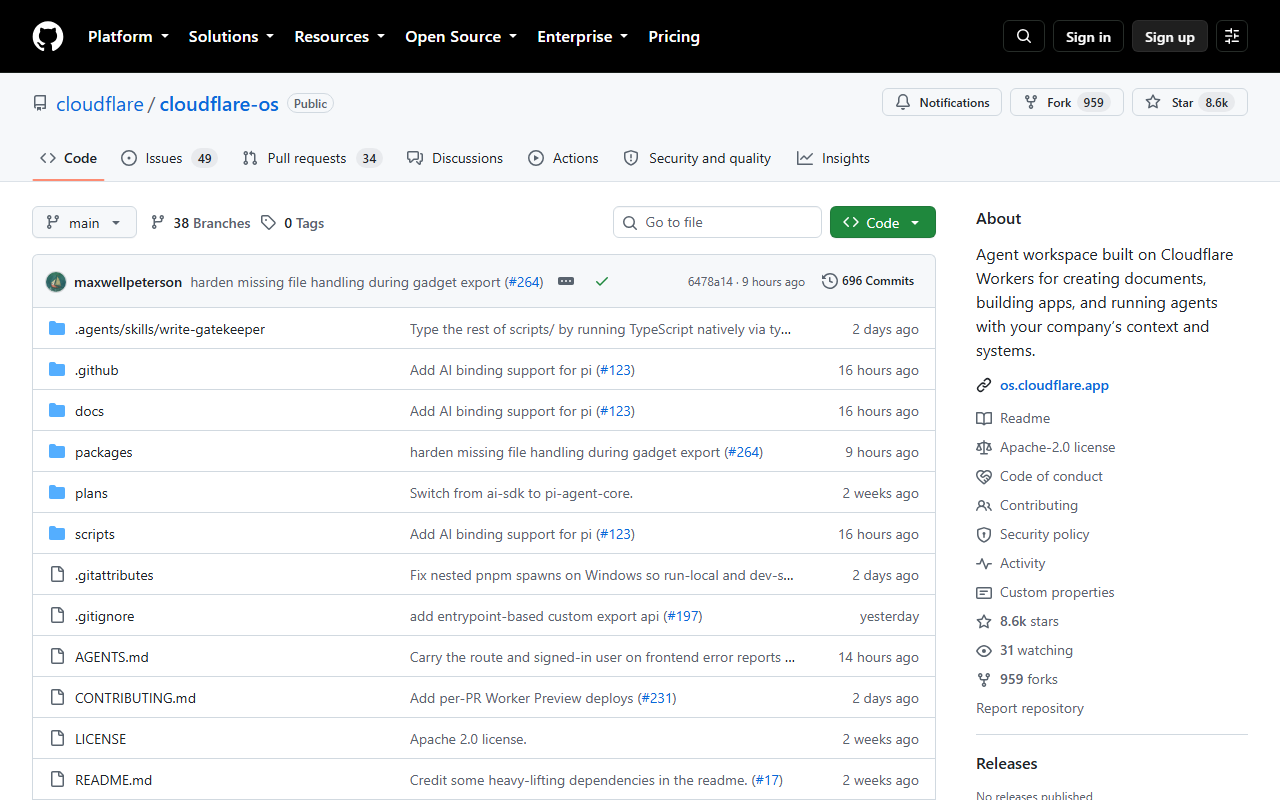 Cloudflare's cloudflare-os repository, captured 19 Aug 2026. The star and commit counts cited above come straight from this page.
Who This Helps
Enterprise IT teams are the most immediate winners. The new workspace is free to self-host, with paid implementation partners lined up for teams that want a supported rollout instead of a raw repository checkout.
A smaller team has a more direct option in Almanac, a 2026-founded startup whose entire product is an agent that runs "on a dedicated machine with a real browser and terminal, so it can sign into tools" on a worker's behalf. Its pricing page lists a $30-per-seat starter tier, a $100 mid tier with five times the usage, and a $200 top tier with twenty times the usage and four times the browser minutes.
Anyone who just wants the browsing part, without the enterprise wiring, already has it. Perplexity built exactly that into Comet, shipping inside a product public reporting puts at roughly 45 million monthly users. Comet does the tab-replacing job the newer browser was built for, and it did it first.
Who It Hurts
Arc's own remaining users get nothing from any of this. Arc still works. It has simply stopped growing. The browser still opens, still renders pages, and still groups tabs into its Spaces the way it always has, every one of those features frozen exactly as they were on the day the freeze began.
Nobody building around agents is standing still while that happens. Genspark, which routes tasks across more than 80 tools instead of building a browser at all, has kept shipping through the same window Arc has been idle in.
The people this hurts most are the ones who bought into the original pitch: that a vertical sidebar and named tab groups were the future of the browser itself. They watched the company behind it decide the browser chrome was the wrong layer to bet on, then hand the winning version of that bet to a security company that had never shipped a browser at all.
The Turn
The obvious objection is that none of this has touched how most people actually browse. Three incumbents together held 87.39% of desktop browser share as of July 2026, according to StatCounter, and neither of the newer entrants has made a visible dent in that.
The AI-native pick spent over a year limited to one operating system and one chip family before its maker confirmed, in its own release notes, that a broader release is "officially coming" this fall, with no exact date set. Calling an open-source repository a replacement for a browser most people will never install is a real stretch.
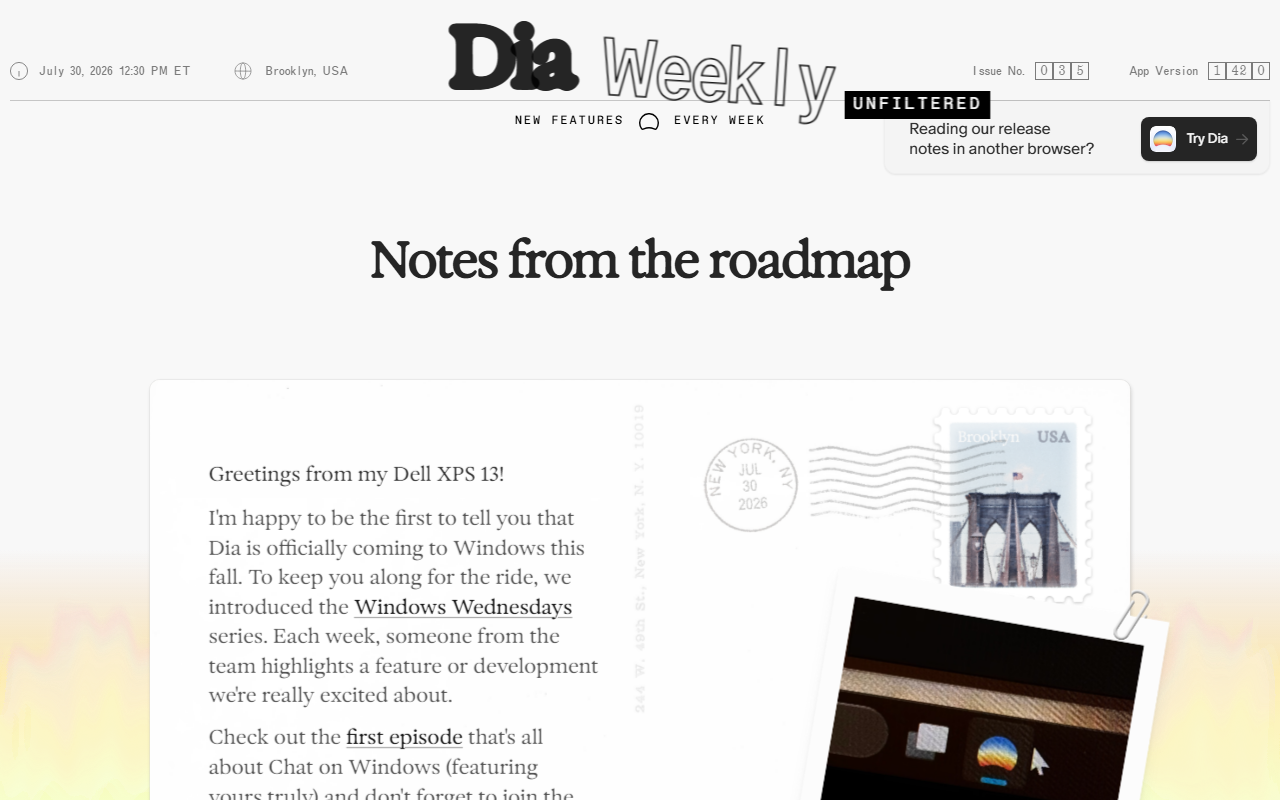 The Browser Company's own "Windows Wednesdays" release notes, captured 19 Aug 2026 (post dated 30 Jul 2026). This is the primary source for the fall Windows commitment.
That is fair. It is exactly why this is a story about where the investment is going, not about where usage already sits. Nothing from the market leaders resembles this Gatekeeper model or Comet's cited answers. Every company with browser ambitions this year is converging on one thesis, that the browser becomes an AI interface, not on a faster tab bar. Arc's freeze is what it looks like when a company makes that bet, loses the specific product, and watches the underlying idea keep winning somewhere else.
What to Watch
Two dates will test whether that holds. Dia is committed, on the record, to a Windows build sometime this fall, its first real shot at share beyond a single chip family. A managed version of Cloudflare OS, reachable from a dashboard without a repository checkout, is also coming, though no date has been set for that either.
A small team weighing Almanac's per-seat pricing against a free, self-hosted deployment will have a real choice to make once that dashboard exists. Whichever ships a usable product to ordinary desktops first will have done more for the "browser becomes an agent" thesis in one release than either managed in the fifteen months since Arc went quiet.
That managed dashboard is still unshipped. When it lands, it will be the first time a mainstream vendor sells, as a finished product, the exact idea Arc could not give away for free.
Frequently asked questions
Is Arc Browser dead?
No. Arc still runs, still receives Chromium security patches, and remains free to download on Mac and Windows. It has not received a new feature since The Browser Company put it into maintenance mode on May 27, 2025, and the company has not announced an end-of-life date.
Why did The Browser Company stop updating Arc?
CEO Josh Miller said in his May 2025 announcement that Arc "fell short" of becoming a widely used Chrome alternative because it asked people to learn too much for too little reward. The company redirected its engineering effort to Dia, an AI-native browser it now considers its real bet on the future of browsing.
What is Cloudflare OS, and how does it relate to Arc?
Cloudflare OS is an open-source AI agent workspace that Cloudflare released on August 5, 2026 under an Apache 2.0 license. It lets employees run AI agents inside a browser-based workspace instead of a normal browser tab, the same shift in what a browser is for that led The Browser Company to freeze Arc and build Dia.
Is Dia available on Windows yet?
Not as of August 19, 2026. Dia has run on macOS with Apple Silicon chips only since its release, and The Browser Company's own release notes say a Windows version is "officially coming" in fall 2026, without a specific date.
Should I switch away from Arc?
If Arc already works for how you browse, there is no urgent reason to leave, since it remains free and functional. If you were hoping for new features, that flow has stopped, and the investment now goes to AI-agent products like Cloudflare OS, Almanac, and Perplexity's Comet rather than a new version of Arc itself.
Covered in this guide
- Arc: A Chromium browser with a vertical sidebar that organizes tabs, apps, and bookmarks into separate Spaces.
- Cloudflare OS: Cloudflare OS is Cloudflare's open-source, self-hosted AI agent workspace that passed 6,000 GitHub stars within 2 days of its August 2026 launch.
- Almanac: An AI agent with its own computer, browser and terminal that compiles 9 workplace tools, including Gmail, Slack and GitHub, into one self-updating wiki.
- Genspark: Genspark is an AI super agent that runs 8+ LLMs and 80+ tools to build slides, research reports, and apps, with a free daily-credit tier and paid Plus/Pro plans.
- Perplexity: Perplexity AI searches the live web and returns cited, source-backed answers, used by 45 million monthly users with plans starting free.
Sources
Still deciding?
This guide covers a handful of options. Smart Match checks every listing in the directory against how you actually work and what you can spend, then hands you the shortlist and the reason behind each pick.
Start Smart MatchRelated guides
- Algolia and You.com Both Call Themselves AI Search Infrastructure. They Aren't Rivals.ComparisonHead-to-head, with a verdict
- Best Agentic AI in 2026: Pick the Job, Not the GeneralistBuyer's guideHow to pick, across a category
- Best AI Assistant Apps for Android in 2026, Now That Google Assistant Is DeadBuyer's guideHow to pick, across a category
- Best AI for Deep Research in 2026: What Each One Can Actually SeeBuyer's guideHow to pick, across a category
- The Best AI for Research in 2026 Depends on the JobBuyer's guideHow to pick, across a category
- Best AI Search Engines in 2026: 6 Free Alternatives to GoogleBuyer's guideHow to pick, across a category