Best Agentic AI in 2026: Pick the Job, Not the Generalist
Agentic AI in 2026 covers two distinct product types: general-purpose autonomous agents such as Manus, Genspark and HappyCapy that plan and execute open-ended tasks end to end, and vertical agents built for a single job, such as coding (Verdent), scraping (Prometheus) or growth operations (Revnu), rather than one unified category.
The short version
Agentic AI in 2026 splits into computer-use generalists like Manus, Genspark and now OpenAI's dots, and narrow vertical agents built for one job. Manus leads on GAIA accuracy but burns credits unpredictably. Most teams need one generalist plus one vertical pick, such as Verdent for coding, not an all-in-one platform.
Meta agreed to pay more than $2 billion for Manus in early 2026. China's National Development and Reform Commission blocked the deal on 28 April, and on 11 August, CNBC reported that Manus is back to operating as an independent company. The AI agent almost every "best agentic AI" list treats as a settled pick spent four months as a regulatory unknown, and most of those lists never mentioned it.
That is the smaller problem with agentic AI shortlists in 2026. The bigger one is that they are still listing 2024's category. Roundups from outlets like Gumloop and TrueFoundry name workflow builders such as n8n, Zapier and CrewAI as "agentic AI," which was accurate two years ago and misses what actually shipped this year.
Two different things now share the name.
Computer-use generalists plan and execute open-ended tasks end to end, watching a screen or a browser the way a person would. Narrow vertical agents do exactly one job, coding or scraping or growth ops, and nothing else. HokAI's directory carries nine of these under the agentic AI category, and OpenAI's September launches add more to weigh, and picking between them is a different decision than picking a workflow builder. This guide is about that decision, not a rebrand of the old one.
How to choose: four questions that separate these platforms
Do you know which task is the bottleneck, or are you still finding out? If you cannot name the repeated task that is costing your team hours, you need a generalist that explores the problem for you. If you can name it (writing scrapers, shipping code, running outbound), a vertical agent built for that one job will usually beat a generalist at it.
Can you see the cost before you run the task? Neither of the two leading generalists shows you a price before you commit. Manus's own users report that a single complex task can burn 500 to 900 credits with no cost preview, and unused monthly credits do not roll over. Genspark's Call For Me voice feature charges 1 credit per second of call time, so a 3-minute phone call costs 180 credits against a Plus plan's 10,000-credit monthly allowance. Budget for the unpredictable case, not the average one.
Is the agent's intelligence borrowed or owned? Manus and HappyCapy both reason on Anthropic's Claude Sonnet 4 and Opus 4.x line, so a pricing or capability change at Anthropic flows straight through to what you pay and what the agent can do. That is not a flaw, but it is a dependency worth knowing about before you build a workflow around it.
Two more questions before you commit
How much runway does the vendor actually have? Manus reached $100 million in annual recurring revenue within eight months of its March 2025 launch, according to Manus's own blog post on the milestone. Genspark has raised $545 million total. Revnu and Hyper are two-person, pre-seed teams with no published funding at all. That gap is not a reason to avoid the smaller vendors, but it is a reason to ask what happens to your workflow if one of them shuts down.
Can you finish one real task on the free tier, or is it a demo? Manus's free tier refreshes daily credits but caps them at 1,500 a month, according to Manus's help center (18 June 2026), so check the allowance shown in the app before planning a real task around it. HappyCapy offers unlimited chat and a real starter set of skills with no card required.
Genspark's free tier needs no card either, and HokAI's own review of the platform calls its daily credit allowance one of the most generous in the category. Test with it before you commit to a subscription tier none of these vendors publish a per-task cost for.
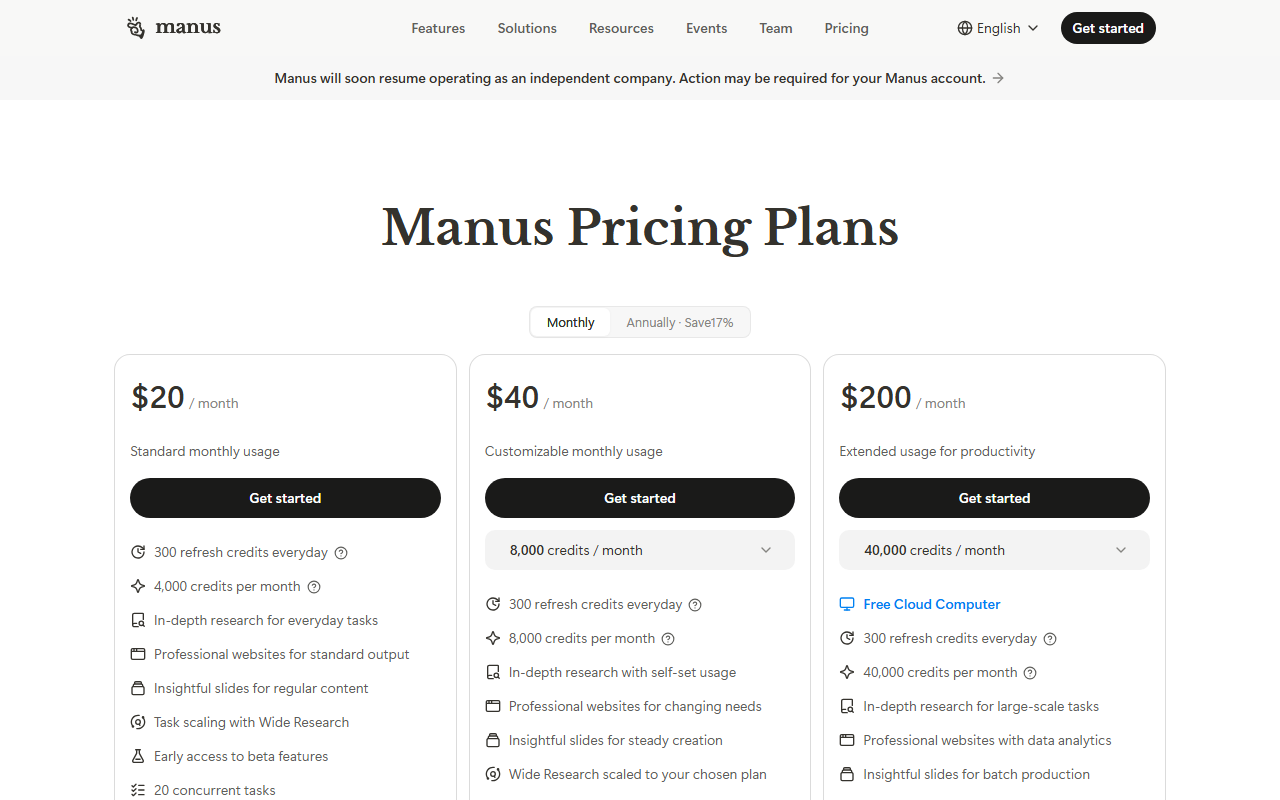 Manus's live pricing page, captured 19 August 2026. The banner at the top confirms the independence announcement CNBC reported on 11 August.
The shortlist: nine agents, sorted by job, not size
| Your bottleneck | Pick | Price | The one caveat |
|---|---|---|---|
| Open-ended research and building, need the strongest benchmark record | Manus | Free (capped refresh credits) to Pro Extended $200/mo | Credit burn is unpredictable and does not roll over |
| Model flexibility on a genuinely usable free tier | HappyCapy | Free to Pro $20/mo to Max $200/mo | Live browser view lags on long unattended runs |
| Fast multimedia output (slides, apps, voice), higher tolerance for cost | Genspark | Free to Plus $24.99/mo to Pro $249.99/mo | Call For Me bills per second; Trustpilot 1.9/5 (49 reviews) |
| Screen-based automation of legacy software with no API | Skygen | Enterprise, contact sales | No published pricing to plan against |
| Coding is the actual bottleneck, not research | Verdent | $19/mo flat | Feature parity with established coding agents is still developing |
| Growth ops (SEO, paid ads, outbound) need to run without a hire | Revnu | Custom, demo required | A/B testing requires merging a GitHub PR, blocking non-technical teams |
| Repeated data collection or scraping | Prometheus | Free to $599/mo, billed through Firecrawl credits | Tied entirely to Firecrawl's own credit system |
| A screen-aware assistant on your own machine, not a cloud agent | HeyClicky | Free to Pro (150 agent messages/mo) | macOS only, no Windows or Linux |
| Every AI tool should already know your company context | Hyper | Not yet announced, pre-seed | Broad read access to email, Slack and CRM raises real privacy questions |
Prices above were captured on 19 August 2026 and re-checked against HokAI's verified listings on 2 October 2026. Three of the nine, Skygen, Revnu and Hyper, publish no number at all, which is its own signal: a startup that will not put a price on its website is either still deciding its model or expects you to negotiate one that varies by customer. Budget accordingly and get the number in writing before you build a workflow around any of the three.
Manus vs. Genspark: the two generalists most people are choosing between
Both are free to start, both are venture-backed at scale, and both promise to take a goal and finish it without step-by-step prompting. The similarity ends at how they get there.
Manus leads on raw accuracy. Independent GAIA benchmark testing puts Manus at 86.5% on Level 1 tasks, ahead of OpenAI's comparable agent by more than 12 percentage points across all three difficulty tiers, according to figures Manus has published and multiple outlets have since verified. Its Wide Research mode runs parallel searches across dozens of sources and produces cited reports; its My Computer desktop app, launched 16 March 2026, lets the agent run terminal commands on your own machine with every command requiring explicit approval first.
Genspark moves faster on anything visual. It orchestrates more than 80 tools and 8 large language models to build slides, apps and research reports, and it demonstrably produces multimedia output quicker than Manus does, according to HokAI's product review. Genspark Claw, its "AI employee" feature launched in March 2026, can chain a report, an email and a meeting booking from one instruction with no confirmations in between.
The company has raised $545 million total, reaching a $1.6 billion valuation in a March 2026 Series B extension, according to TheSaaSNews's coverage of the round.
The gap that matters is reliability, not capability. Genspark carries a 1.9 out of 5 Trustpilot score from 49 reviews, according to HokAI's own research into the platform, with recurring complaints about non-consensual annual billing and credits charged on failed tasks. Manus has its own list of complaints, chiefly server instability under peak load and code output that needs real revision before it ships, but nothing at that severity in public reviews.
For a team choosing a generalist to trust with unattended, multi-hour tasks, that difference should weigh more than either company's funding round.
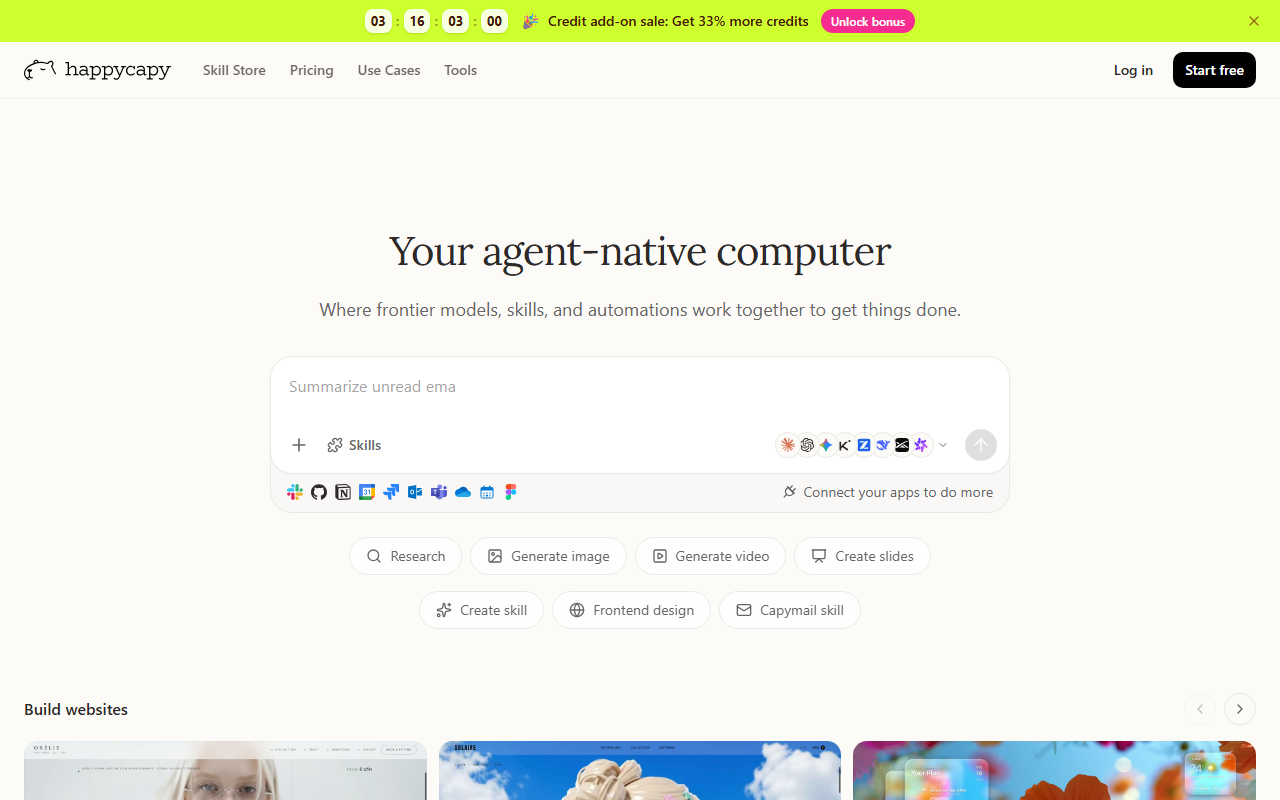 HappyCapy's product interface, captured 19 August 2026. The skill toggles across the top switch which model and integration handle a given task.
What OpenAI added in September: dots and the generalist shelf
Between 10 and 29 September 2026, OpenAI shipped four things that sit on this shelf. Only one is a standalone agent in the sense Manus is. The other three are a developer runtime, an existing coding agent and an AWS-hosted version, and each answers a different question.
| Launch | What it is | Who can use it |
|---|---|---|
| OpenAI dots | Always-on ChatGPT agent | Pro, Business Premium |
| Agents API | Hosted agent runtime | All developers, in beta |
| Codex | Cloud coding agent | Any ChatGPT plan |
| Bedrock Managed Agents | OpenAI agents inside AWS | Preview |
OpenAI dots launched on 29 September. OpenAI's announcement describes agents that run on GPT-6 Astra with their own cloud computer, reachable from ChatGPT, Slack and Teams, and able to connect to more than 4,000 apps through plugins.
A first dot is included in Pro and Business Premium at no extra cost, and chatting with it does not count against ChatGPT usage limits. Tasks it starts in Codex or ChatGPT Work are metered as usual. Enterprise, Edu and Healthcare workspaces get a beta that admins enable themselves.
That puts dots in direct competition with the two generalists above, with a different price shape: a plan inclusion rather than a credit meter. Our guide on what OpenAI dots actually do covers the tasks, and Manus versus ChatGPT's agent covers the head-to-head. OpenAI itself says dots can still make mistakes and that consequential work needs review.
Build your own: the Agents API, Codex and Bedrock
The Agents API, announced on 10 September and open to all developers in public beta, runs the same agent loop that powers Codex. A session names a model, tools and an environment, and OpenAI hosts the loop. Its documentation lists a computer-use tool you add with one line, so a developer can build a screen-driving agent without writing a loop of their own.
OpenAI states there is no extra fee beyond the tokens and tools an agent uses. HokAI works through the numbers in the Agents API computer-use pricing guide.
Codex is the coding pick that already existed. It clones a GitHub repository into a cloud sandbox, writes and tests code, then opens a pull request, and OpenAI reported 20 million active users in August 2026. It has no subscription of its own and draws on whichever ChatGPT plan you already pay for.
For teams comparing it with Verdent, the question is whether you want a separate $19 agent or one bundled into a plan you may already hold. Its sibling Codex Security scans whole repositories for vulnerabilities and prepares fixes.
AWS describes Amazon Bedrock Managed Agents, powered by OpenAI as a preview built jointly with OpenAI on Bedrock AgentCore. Every agent holds an AWS identity with defined permissions, and inference stays inside the AWS account. It is the counterpart to Claude in Amazon Bedrock for teams that need agents to stay in their cloud.
What it costs across the shortlist
The meters differ more than the prices do, so compare the unit before the number.
- Manus: credits. Pro Standard is $20 a month, Pro Customizable $40 and Pro Extended $200, with no per-task preview.
- Genspark: credits, with Call For Me billed per second of call time.
- Verdent: $19 a month flat.
- OpenAI dots: included with Pro and Business Premium; OpenAI says extra dots and more output will be sold later.
- Agents API: per token and per tool, with no platform fee.
- Codex: your ChatGPT plan, with credits beyond its quota.
Skygen, Revnu and Hyper publish no price at all, which is its own signal. Ask for the number in writing before building a workflow on any of them.
The vertical picks: when a narrower agent beats the generalist
Four of the nine tools on this list do not compete with Manus or Genspark at all. They do one job a generalist would take longer to learn.
Verdent runs multiple isolated coding agents in parallel across a project, with a Plan and Verify mode that turns a vague prompt into a requirements document before any code gets written. It costs $19 a month flat, well under what enterprise coding-agent subscriptions typically charge, and its founding team's prior work on large-scale systems at TikTok and Baidu is a real signal for an early-stage product. Feature parity with established coding agents is still catching up, which is the honest tradeoff for the price.
Revnu runs SEO, paid ads across four channels, and outbound outreach for software startups without a marketing hire. Its shared intelligence layer means data from one channel improves the others: SEO findings feed ad copy, cold email angles feed blog topics. Setup takes under 48 hours according to the company, but pricing requires a demo call, and its A/B testing workflow requires merging a GitHub pull request, which locks out teams with no engineering support.
Prometheus, Firecrawl's agent, turns a plain-English request like "top 5 Hacker News posts" into a real, reviewable TypeScript scraper built on Firecrawl's SDK. Firecrawl says on its product page that Prometheus tests every collector against the live target site before handing it back, and can host it with automatic self-healing when a site's layout changes. There is no standalone price. Usage draws entirely from Firecrawl's credit plans, from a free 1,000-credit tier up to $599 a month for a million credits.
Three more narrow picks worth knowing
Hyper is the most speculative pick here: a two-person, pre-seed team building an MCP server that silently aggregates more than 160 company tools into a shared context layer, injecting it into Claude, Cursor and Codex on every turn. No pricing has been announced. The read access it needs across email, Slack, GitHub and CRM tools is a genuine question for any team handling regulated data, and this is not a recommendation to grant it before that question is answered.
Two more belong on the shortlist for narrower reasons. Skygen is built for screens, not APIs: it visualizes an interface the way a person would, which is the only way to automate the legacy enterprise software that never shipped one. Its pricing is enterprise-only and undisclosed, so it is a fit for teams already used to a sales cycle, not a solo operator testing an idea.
HeyClicky is the opposite kind of narrow: a free, open-source macOS assistant that watches your screen and answers by voice, useful for a single operator who wants an always-on second pair of eyes rather than a cloud agent running unattended. Its codebase is 95.2% Swift and published on GitHub, so nothing about how it works is a black box, but it is Mac-only and has no public API as of mid-2026.
Data handling, security and compliance
Agents that act on your behalf need access you would not give a chatbot. Ask three things of every pick: where the agent runs, what it can touch, and who can see what it saw.
- Where it runs: a cloud computer, your laptop or your AWS account. Dots keep your machine separate unless you connect it.
- What it can touch: Dots follow built-in rules for acting alone or asking first, and Custom Rules let you permit, gate or forbid individual actions.
- Who can see it: OpenAI says workspace content from Business, Enterprise and Edu is not used for model training by default. Hyper's read access across email, Slack and CRM is the sharpest open question among the smaller vendors.
Neither Manus nor Genspark has confirmed GDPR certification as of this writing. For regulated data, Bedrock Managed Agents is the one option here that keeps agents inside an account you already govern, and it is still a preview.
Who should skip this category in 2026
If your actual need is connecting existing apps into a repeatable workflow, agentic AI is the wrong shelf. That is what n8n and Zapier already do, and they do it with years of stability the products in this guide have not earned yet. The distinction matters: an orchestration platform executes a workflow you designed; the agents here design the workflow themselves. If you already know every step, you do not need a system that decides the steps for you.
Regulated teams should also wait. None of the generalists in this guide have confirmed GDPR certification as of this writing, and several of the vertical picks are two-person, pre-seed operations with no published uptime commitment. That is not a reason to avoid the category forever, just a reason to keep production data out of it for another quarter.
Where the Manus pick falls apart
The obvious recommendation, given the benchmark numbers above, is Manus for anything serious. That recommendation breaks down the moment the actual bottleneck is shipping code rather than researching a topic. Manus's own reviewers report that architectural decisions, including database schema and API design, are made autonomously and often need significant revision before deployment. A benchmark built around research and reporting tasks does not measure whether the code an agent writes is production-ready.
For a team whose real constraint is code output, Verdent's narrower focus and $19 flat price beat Manus's broader capability, despite a fraction of the name recognition. The GAIA leaderboard answers a question most teams reading this guide are not actually asking.
What would change the verdict
Four developments are worth checking again in 90 days:
- Genspark's SecondBrain persistent memory feature, part of its AI Workspace 6.0 release on 21 July 2026.
- Whether Manus ever confirms GDPR certification.
- Whether OpenAI's dots reach general availability beyond Pro and Business Premium, and what extra dots cost.
- Whether Bedrock Managed Agents leaves preview.
None of these shows up on a benchmark chart, and all of them will matter more to a real team's decision than the leaderboard does.
Frequently asked questions
Should a small team pick a generalist agent or a vertical one first?
Pick a vertical agent first if you can already name the repeated task costing your team hours, such as writing scrapers or shipping code. Pick a generalist like Manus or HappyCapy first if you are still discovering which task is worth automating. Most teams end up running one of each rather than one platform doing everything.
Is Manus still available after the blocked Meta acquisition?
Yes. China's National Development and Reform Commission blocked Meta's roughly $2 billion acquisition of Manus on 28 April 2026, and CNBC reported on 11 August 2026 that Manus is operating again as an independent company. Its free and paid tiers are unaffected.
Why does Genspark cost more per task than its monthly price suggests?
Genspark's Call For Me voice feature bills 1 credit per second of call time, so a 3-minute phone call costs 180 credits. Against the Plus plan's 10,000 monthly credits, that limits a subscriber to roughly 55 such calls before hitting the cap. The flat monthly price does not reflect that per-feature cost.
Do any of these agentic AI tools have a real free tier?
Manus, HappyCapy and Genspark all offer free tiers with no credit card needed. Manus caps free refresh credits at 1,500 a month according to its help center, so check the in-app allowance. OpenAI's new dots come included with Pro and Business Premium rather than as a free tier. HeyClicky's free tier includes screen awareness and basic agents.
What is the difference between agentic AI and workflow orchestration tools like n8n or Zapier?
Orchestration tools execute a workflow a person designed step by step. The agentic AI tools in this guide decide the steps themselves from a single goal, choosing what to research, build or automate without a predefined sequence. Teams that already know every step in their process usually need orchestration, not an agent.
Covered in this guide
- Manus: Autonomous AI agent that plans and executes multi-step work from one prompt: research, documents, apps and video. The September 2026 release adds Cascade, Automations and Studio. Free tier available.
- Genspark: Genspark is an AI super agent that runs 8+ LLMs and 80+ tools to build slides, research reports, and apps, with a free daily-credit tier and paid Plus/Pro plans.
- Amazon Bedrock Managed Agents: AWS preview service that runs stateful OpenAI agents through bedrock-mantle endpoints in 3 US Regions, with per-agent IAM roles and your own compute.
- ChatGPT Work: OpenAI's ChatGPT Work agent plans and finishes multi-step projects across connected apps and files. It launched on 9 July 2026 and now reaches every ChatGPT plan, with limits.
- Claude in Amazon Bedrock: Anthropic's Claude models served by AWS in 27 regions, billed per token on your AWS invoice and secured with IAM, KMS keys and CloudTrail logs.
- Codex Security: OpenAI's application security agent scans connected GitHub repositories, tests likely bugs in a sandbox, and drafts fixes for review as pull requests.
- HappyCapy: HappyCapy is a browser-based agent-native computer where AI agents code, browse, and run sandboxed tasks, free to start with paid tiers for more skills and credits.
- HeyClicky: Open-source macOS AI buddy with screen awareness, push-to-talk voice and background agents. Y Combinator Spring 2026. Free tier, plus paid Pro and Max plans.
- Hyper: YC Spring 2026 AI context layer that silently aggregates 160+ company tools into a shared brain and injects knowledge into Claude, Cursor, and Codex via MCP on every turn.
- OpenAI: OpenAI builds ChatGPT, the GPT-6 family (Astra, Sol, Luna), Codex and the OpenAI API. It reports 1.2B weekly ChatGPT users and an $852B valuation after its March 2026 round.
- Agents API: Managed API for cloud agents on the Codex runtime: hosted sandboxes, 9 sandbox partners, subagents and computer use, in public beta since Sept 2026.
- Codex: Clones a GitHub repo into a sandbox, writes and tests code, then opens a pull request; OpenAI reported 20 million active users in August 2026.
- OpenAI dots: OpenAI's always-on agent in ChatGPT runs on GPT-6 Astra with its own cloud computer, and asks approval before consequential actions.
- Prometheus: Prometheus is Firecrawl's AI agent that turns plain-English requests into tested, reviewable TypeScript scrapers built on the Firecrawl SDK.
- Revnu: Y Combinator-backed AI growth agent that runs outbound, ads on Google, LinkedIn, Reddit, X and Microsoft, and SEO pages for software startups, with drafts held for approval.
- Skygen: Autonomous AI agent that executes computer tasks end-to-end with screen vision and human-level interface precision.
- Verdent: Multi-agent agentic coding platform that orchestrates parallel agents for planning, coding, and verification.
Sources
Still deciding?
This guide covers a handful of options. Smart Match checks every listing in the directory against how you actually work and what you can spend, then hands you the shortlist and the reason behind each pick.
Start Smart MatchRelated guides
- Arc Browser Hasn't Shipped a Feature in 449 Days. Cloudflare Just Showed Why.AnalysisWhat changed and who it affects
- Best AI Chatbots in 2026: Pick by the Job, Not the LeaderboardUpdatedRechecked against current sources
- Best AI Coding Assistants in 2026: Pick the Job, Not the BrandBuyer's guideHow to pick, across a category
- Best AI Companies in 2026: Who Is Actually LeadingBuyer's guideHow to pick, across a category
- Best AI for Writing a Business Plan in 2026: Tested Picks and a VerdictBuyer's guideHow to pick, across a category
- Best AI for Coding Questions Free in 2026: 8 Real Options, ComparedBuyer's guideHow to pick, across a category