Manus vs ChatGPT Agent in 2026: Which AI Agent Should Do Your Work After Manus 2.0?
Manus 2.0 is a credit-billed autonomous agent from Singapore-headquartered Manus that builds videos, games and web projects and starts tasks from triggers. ChatGPT Work is OpenAI's agent feature inside ChatGPT plans, reaching more than 1,400 plugins. They bill differently, so compare trial results on your own jobs, not sticker prices.
The short version
Choose Manus when you want to hand over a whole creative or research goal and pay by the credit. Choose ChatGPT Work when your files, mail and chat already sit in its connected tools and you would rather add a feature to a plan you hold. Neither vendor publishes a price per finished task.
Manus shipped version 2.0 on 28 September 2026, and a day later OpenAI's DevDay put an always-on agent into the top ChatGPT plan. If you were already weighing Manus against what people still search for as the ChatGPT agent, the decision just got harder.
Two things are true at once. The product OpenAI sells for this job is ChatGPT Work, and OpenAI's own pages use that name rather than the old one. Manus, meanwhile, rebuilt its engine, added triggers that start tasks on their own, and opened a video and game workspace.
The short answer: pick Manus when you want to hand over a whole creative or research goal and pay by the credit. Pick ChatGPT Work when your files, mail and chat already live in the tools it connects to, and you would rather add a feature to a plan you already hold. Neither vendor publishes a price per finished task, so the rest of this guide shows what each plan buys and where the gaps are.
We did not run either product for this piece. Every figure below comes from the vendors' own pages, opened on 1 October 2026 and dated where they sit.
What changed in the four days that matter
Manus describes 2.0 as "a new architecture" rather than a version bump, according to its launch post. Four parts matter for a buyer, and the first two are about cost and uptime.
- Cascade: the new in-house agent framework. Manus says one tested setup used 23.2% fewer tokens and ran 28.2% faster. It also cost 32% less than the old system.
- Cloud Computer: a dedicated environment you buy for a project that must stay up, such as a game server or an automation that runs around the clock.
Two more parts change how the product behaves day to day.
- Automations: work can now start when something happens, such as a new email, a calendar event, a Slack message or a Notion update.
- Manus Studio: the desktop app, now with a Video Editor for 30 to 60 second ads and a Game Dev environment.
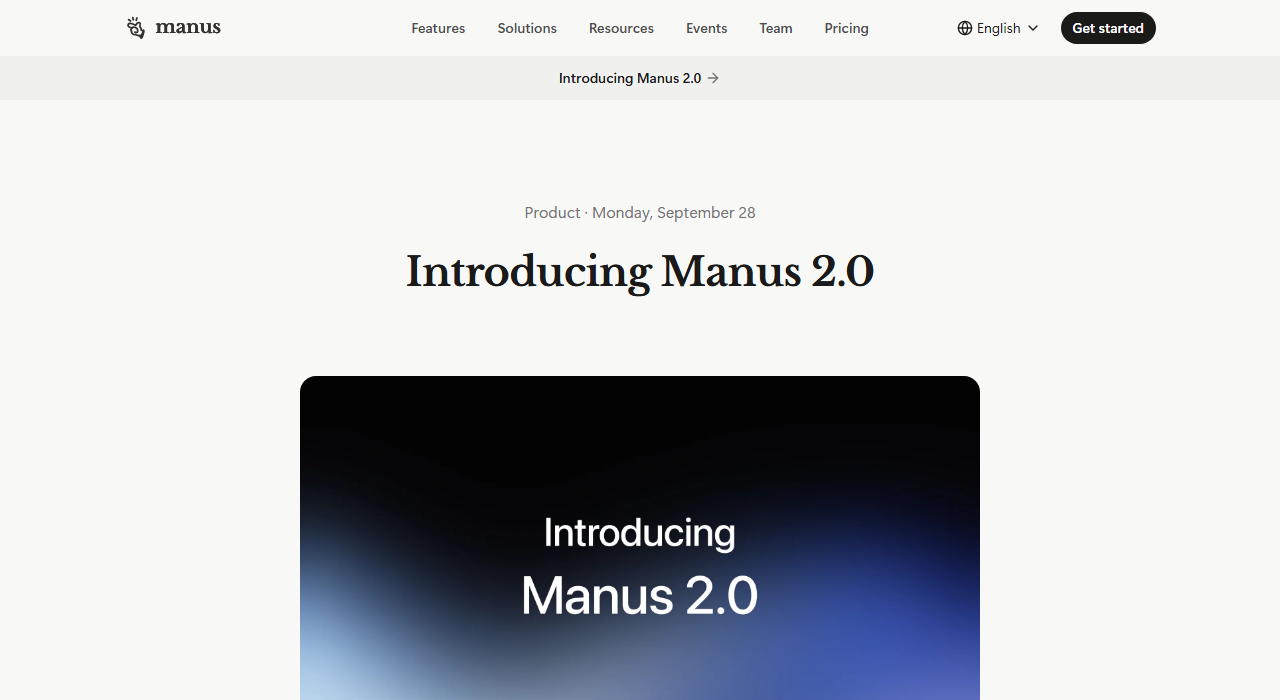 The Manus launch post for 2.0, captured 1 Oct 2026.
Treat the Cascade numbers as Manus's own. They come from one setup, with no published method and no outside replication. That is a claim to test, not a benchmark to buy on.
Manus also launched Cue, a separate app where each personal agent gets its own email address, phone number, wallet and computer. Cue is invite-only early access, so it is not part of this comparison and has no HokAI page to link.
OpenAI's side moved differently. ChatGPT Work already existed, and what changed at DevDay on 29 September was the packaging around it: the Pro plan now lists Dot, an always-on agent, and Pro reasoning on GPT-6 Astra. Our write-up of what OpenAI's dots actually do covers that agent in detail, and the three-way comparison with Grok Bot and Muse covers the always-on category.
What each one costs: credits against plan tiers
The two companies bill in different units, which is why a straight price comparison misleads.
Manus sells credits. Its pricing page lists three paid tiers, each with 300 refresh credits every day on top of a monthly pool. Every tier carries 20 concurrent tasks and 20 scheduled tasks. Annual billing saves 17%.
| Manus plan | Monthly price | Monthly credits | Positioning on the page |
|---|---|---|---|
| Pro Standard | $20 | 4,000 | Standard monthly usage |
| Pro Customizable | $40 | 8,000 | Usage you set yourself |
| Pro Extended | $200 | 40,000 | Extended usage for productivity |
The pricing page animates its digits, so a text read of it returns the credit pools but not the dollar amounts. The prices above are what HokAI recorded from the vendor on 29 September 2026. A Team plan is priced per seat with pooled credits, and Manus lists no public figure for it.
ChatGPT bills by subscription, and the agent comes with it. The pricing page shows local prices, and it showed Indonesian rupiah to us.
| ChatGPT plan | Price on 1 Oct (IDR/month) | ChatGPT Work access |
|---|---|---|
| Free | 0 | Limited, desktop app only |
| Go | 75,000 | Limited, desktop app only |
| Plus | 349,000 | Desktop, web and mobile |
| Pro | From 1,889,000 | Longer Work sessions, plus Dot |
Business is priced per seat and starts at two users. HokAI's last check of the vendor, on 16 July, recorded ChatGPT Plus at $20 a month.
That July check also recorded Business at $20 a seat billed annually. Monthly billing ran higher. Treat these as dated figures, because the live page we read showed only rupiah for individual plans.
What does a finished task cost? On Manus it depends on how many credits the task burns, and Manus does not publish a typical figure. On ChatGPT it depends on plan limits, and OpenAI describes Plus as "expanded" rather than giving a number. If a vendor will not say what a task costs, run a trial task and read your own usage meter.
A fair test is cheap. Pick one job you repeat each week, such as a competitor summary of 10 sources. Run it three times on each product, note the credits or limit consumed, and average the result. That gives you a number no vendor page will.
What each one can do, side by side
A feature table is only useful if each cell comes from a vendor page, so these do. Where a page was silent, the cell says so.
| Capability | Manus 2.0 | ChatGPT Work |
|---|---|---|
| Event-triggered tasks | Yes: email, calendar, Slack, Notion | Scheduled and watch-for-updates tasks |
| Plan review before work | Not stated on the page | Plan mode, approve before it starts |
| Video and game output | Video Editor and Game Dev | Not listed on the Work page |
| Connected apps | Connectors, Browser Operator | More than 1,400 plugins |
| Team features | Team plan, pooled credits | Team tasks and shared Spaces |
| Always-on box | Cloud Computer, bought separately | Dot, listed under Pro |
The table shows two products that overlap in the middle and diverge at the edges. Both run tasks in the background, both schedule recurring work, and both connect to outside services. The edges are where a buyer should look.
Manus leans toward making media and keeping a machine alive for a long project. ChatGPT Work leans toward reaching into the tools a company already uses and letting a team share the job. Neither page claims to do the other's specialty, though absence from a page is not proof of absence from the product.
One more difference is who the page is written for. The Work page speaks to teams with templates, shared tasks and approval points. The Manus launch post speaks to individual makers: the song you swap, the shot you drop in, the villager you give silver hair.
Where Manus wins: it builds the artifact and watches for triggers
Manus is built around handing over a goal and receiving a file. Its launch post describes a project in which the brief, the page, the video and the automation stay one connected thing. That is a different promise from a chat assistant that takes steps.
The strongest case is creative output that is more than a document. Video Editor hands you a timeline with the clips, text, motion graphics and audio as separate pieces, so you can swap a song or drop in your own footage and export. Before 2.0 you re-prompted and regenerated the whole video. Game Dev adds a playable-game workflow, backed by the new Cloud Computer for the server side.
The second case is event-driven work. Automations start a task when a connected service changes. ChatGPT Work also schedules and watches for updates, as the next section shows, but Manus is the one that sells the always-on box as a separate purchase.
Third, Manus is a pure agent product with its own pricing logic. Heavy users can buy 40,000 credits a month without changing anything about their chat subscription. If you already pay for ChatGPT or Claude for conversation, Manus sits beside them rather than replacing them.
Manus argues its case on a comparison page of its own. It says it can research 100 or more sources at once with Wide Research and handle 100 or more files in context, and it calls ChatGPT advisory rather than action-oriented. That page is marketing by a party to the comparison. Read it as the case Manus wants to make, not as a test.
For a wider view of tools in this category, see the AI agents directory, and our earlier piece on what Manus is actually for sets out which jobs it suits.
Where ChatGPT Work wins: your tools are already connected
OpenAI's Work page says the product uses your apps, files, tools, browser and approved business context to produce documents, decks, spreadsheets, sites and analyses. It lists more than 1,400 plugins. That breadth of connection is the real difference.
The practical effect is that a weekly brief can pull from your calendar, messages and docs without you uploading anything. The page's example prompts are mundane on purpose: survey analysis in Google Sheets, draft email replies left unsent for review, a project tracker from a planning doc. These are the jobs most teams actually repeat.
Two controls matter for a cautious buyer. Plan mode gathers context, asks questions and proposes a step-by-step plan that you approve before work begins. Team tasks let teammates edit the instructions of a shared recurring job, such as a weekly report. Together they make ChatGPT Work easier to govern than a single person's agent.
Cost is the other win. The agent is a feature of a plan, so a team already on Business adds no new contract. On the Plus tier it is available on web and mobile as well as desktop, and even Free and Go get limited desktop access. You can try it before you commit anything.
The model underneath matters too. Pro reasoning runs on GPT-6 Astra, and the standard tiers list GPT-6 Sol. For a side-by-side of current models by price and benchmark, the model leaderboard shows what each vendor publishes. Look at the absolute figures there and the sources behind them, not the rank.
For team use, our business operations agents guide lists the alternatives, and what teams actually use ChatGPT for shows the everyday jobs.
Data handling: what each privacy page says
Both vendors send your prompts to third-party AI providers. After that, the policies diverge in ways a procurement team would care about.
| Topic | Manus (policy dated 28 Sep 2026) | ChatGPT (pricing page, 1 Oct) |
|---|---|---|
| Headquarters | Singapore | Not stated on the page |
| Training use | May use de-identified data to improve models | Opt-out available on Free to Pro |
| Sandbox files | Kept up to 7 days free, 21 days paid | Not stated on the page |
| Deletion | Account data removed within 30 days | Not stated on the page |
Manus's privacy policy says the company is headquartered in Singapore and may transfer data to the United States and other countries. It says it may create aggregated, de-identified data from your content to develop its models, and that you can opt out by contacting the company. It also says task execution logs are kept for replay and debugging.
Some Manus details deserve attention before you connect work accounts. When you enable Browser Operator, page content from sites you are logged into is sent to Manus servers. On a Team plan, the owner can see all session data of members, and an administrator can see a subset. Saved third-party credentials are stored if you choose to use that feature.
On the OpenAI side, the pricing page says all data is encrypted in transit and at rest, and it lists administration controls such as SAML SSO, SCIM and data residency in ten regions, including Singapore. The grid showing which plan carries which control did not survive text extraction, so we cannot say whether Business or only Enterprise gets data residency. Ask OpenAI sales before you rely on it.
We have not seen a retention period for ChatGPT Work task data on the pages we read. If your work involves client or regulated data, that gap matters more than any feature list.
Switching cost: what you lose when you leave
Neither product locks your files away, but each has a lock-in that is easy to miss.
Manus keeps sandbox data for a limited time, so the deliverables must leave the sandbox before it resets. Automations and scheduled tasks live inside Manus, and the plan caps you at 20 of each, so a heavy workflow needs rebuilding if you move.
ChatGPT's lock-in is context. The value of Work comes from the plugins, memory, projects and Spaces you have set up. Moving away means reconnecting every source and rewriting team tasks by hand, which is slower than it sounds. Memory may also be limited on lower tiers, as the plan grid shows.
The cheapest way to hedge is a small test. Run the same three jobs on both: one research report, one recurring task and one deliverable your team really needs. Keep the exported files in your own storage and the outputs side by side, and you will see how portable each result is.
If you are comparing more than these two, the agentic AI roundup and the best AI agents list cover the wider field. Alternatives that build apps rather than run tasks include Lovable and Replit, while Genspark is another general-purpose agent worth a trial.
If neither fits: four smaller agents in the same category
Manus and ChatGPT Work are the two names buyers type, but the agent category is wider than either. HokAI's directory files four smaller products in the same agentic-AI category as Manus, and each solves a narrower problem.
- Skygen is an autonomous agent that executes computer tasks end to end, using screen vision to operate interfaces.
- HappyCapy is a browser-based agent computer where agents code, browse and run sandboxed tasks, free to start with paid tiers.
- Prometheus is Firecrawl's agent that turns plain-English requests into tested TypeScript scrapers.
- Hyper is a YC Spring 2026 context layer that gathers company tools into a shared memory for Claude, Cursor and Codex.
These descriptions come from each vendor's record in the directory, not from a hands-on test. They are not substitutes for Manus or ChatGPT Work in every case. Prometheus does one job, scraping, and does not draft a deck. Hyper feeds context to other tools rather than finishing a task itself.
The point of the list is scope. If your job is "build me a scraper" or "give my coding agent company context", a narrow tool may beat a general agent on cost and on how easy the result is to review. If your job is open-ended, the two big names are the better starting trial.
Who should pick which
The honest split is by job and by who pays.
| You are | Pick | Why |
|---|---|---|
| Solo creator making short video or a game | Manus | Editor timeline and Game Dev exist only there |
| Team already on ChatGPT Business | ChatGPT Work | It is part of the plan, with plugins |
| Researcher who wants one big report | Either | Test both on the same brief |
| Buyer with regulated client data | Neither yet | Retention terms are unclear for Work |
If the right answer depends on your stack, HokAI's Smart Match takes your constraints and returns a shortlist from the directory rather than a fixed ranking. The full agent directory lists every record, and the tools index covers the wider catalog.
For always-on agents specifically, compare Grok Bot, Muse and OpenAI's dots first. They solve a different problem from either product here: a persistent assistant rather than a project builder.
If you want workflow glue rather than an agent, Zapier and Make trigger actions in a fixed, auditable way. They give you less autonomy but far more predictability, which suits regulated work.
What would change this verdict, and the strongest objection to it
The best argument against this guide is that the split is too tidy. Plenty of teams will find Manus's credit meter cheaper than a seat for occasional heavy tasks, and plenty of individuals will find ChatGPT Work's plugins matter more than a video editor.
That is fair, and it is why the table says "either" for research. The split holds only for the clearest cases: creative building favours Manus, workplace-tool orchestration favours ChatGPT Work.
Three things would flip the call. An independent test that confirms or kills the Cascade cost claims would reprice Manus for heavy users. A published per-task credit cost, from either vendor, would let you budget properly. And a clear retention statement for ChatGPT Work would close the data gap for regulated buyers.
Watch also how OpenAI's company page and the Manus pricing page change over the next month. Both vendors are moving weekly, and a figure that holds today may not hold at your next renewal. Cue, once it leaves invite-only access, is the other thing to watch: a personal agent with its own wallet changes what "agent" means for a buyer.
Frequently asked questions
Is the ChatGPT agent the same thing as ChatGPT Work?
People still search for the ChatGPT agent, but OpenAI's own pricing and product pages now call the product ChatGPT Work. It sits inside ChatGPT plans rather than being sold separately. Free and Go get limited desktop access, and Plus and above reach it on desktop, web and mobile.
What changed in Manus 2.0?
Manus announced 2.0 on 28 September 2026 with a new agent harness called Cascade, a purchasable Cloud Computer, event-triggered Automations and a desktop app renamed Manus Studio. Studio adds a Video Editor and a Game Dev environment. Manus's cost and speed figures for Cascade come from one tested setup and have not been independently replicated.
How much does Manus cost compared with ChatGPT?
Manus sells monthly credit pools of 4,000, 8,000 or 40,000, with 300 refresh credits a day on each paid tier. ChatGPT sells subscriptions, and its pricing page showed Plus at IDR 349,000 a month on 1 October 2026. Neither vendor publishes a typical price per finished task, so run the same job on both and read your usage meter.
Where does Manus store my data?
Manus says it is headquartered in Singapore and may transfer personal data to the United States and other countries. Its policy, dated 28 September 2026, says sandbox files are kept for up to 7 days on free plans and 21 days on paid plans. It also says it may use de-identified data to improve its models, with an opt-out by contacting the company.
Should a business pick Manus or ChatGPT Work?
A team already on ChatGPT Business gets Work as part of the plan and can connect existing tools through plugins. Manus fits creative building such as video and games, where its editor and Game Dev environment have no direct equivalent. Buyers with regulated client data should wait for clear retention terms for Work task data.
Covered in this guide
- Manus: Autonomous AI agent that plans and executes multi-step work from one prompt: research, documents, apps and video. The September 2026 release adds Cascade, Automations and Studio. Free tier available.
- ChatGPT Work: OpenAI's ChatGPT Work agent plans and finishes multi-step projects across connected apps and files, launched July 9, 2026 for Business and Enterprise plans.
- ChatGPT: ChatGPT is OpenAI's AI assistant, with 1.2 billion weekly users by OpenAI's count, the GPT-6 model family and plans that run from a free tier to a premium Pro tier.
- Claude: Claude API with Sonnet 5 (agentic, near-Opus performance at half the cost) and Claude Science (auditable research workbench). Free to Pro.
- Genspark: Genspark is an AI super agent that runs 8+ LLMs and 80+ tools to build slides, research reports, and apps, with a free daily-credit tier and paid Plus/Pro plans.
- GPT-6 Astra: OpenAI's flagship model, launched September 2026 as the first ever rated at the Preparedness Framework's Critical cybersecurity level.
- GPT-6 Sol: OpenAI's mid-tier GPT-6 model (Sep 2026), 1.05M-token context, 68.8% on DeepSWE v1.1 coding, half GPT-5.6 Sol's price.
- Grok Bot: xAI's always-on AI agents that sign into your existing apps and finish multi-step jobs, bundled with eligible SuperGrok and Cursor plans.
- HappyCapy: HappyCapy is a browser-based agent-native computer where AI agents code, browse, and run sandboxed tasks, free to start with paid tiers for more skills and credits.
- Hyper: YC Spring 2026 AI context layer that silently aggregates 160+ company tools into a shared brain and injects knowledge into Claude, Cursor, and Codex via MCP on every turn.
- Lovable: Build something lovable. Create apps and websites by chatting with AI.
- Make: No-code visual automation platform to connect apps and build AI workflows at scale
- Muse: Meta's personal AI agent books travel, negotiates bills and fills out forms from your accounts; launched Sept 8, 2026 with free, $20 and $100 tiers.
- company page: OpenAI builds the GPT-5.6 model family (Sol, Terra, Luna), o3, ChatGPT (900M+ weekly users), and the OpenAI API. Closed a $122B round at an $852B valuation in March 2026, the largest private funding round in history.
- dots: OpenAI's always-on agent in ChatGPT runs on GPT-6 Astra with its own cloud computer, and asks approval before consequential actions.
- Prometheus: Prometheus is Firecrawl's AI agent that turns plain-English requests into tested, reviewable TypeScript scrapers built on the Firecrawl SDK.
- Replit: Cloud coding environment where you describe an app in plain English and AI builds and deploys it.
- Skygen: Autonomous AI agent that executes computer tasks end-to-end with screen vision and human-level interface precision.
- Zapier: The automation layer for agentic AI connecting 8,000+ apps
Sources
Still deciding?
This guide covers a handful of options. Smart Match checks every listing in the directory against how you actually work and what you can spend, then hands you the shortlist and the reason behind each pick.
Start Smart MatchRelated guides
- The AI 80s Photo Trend: How to Make Yours (and Turn It Into a Video) in 2026AnalysisWhat changed and who it affects
- AI Development Services in 2026: Which Layer You Actually NeedBuyer's guideHow to pick, across a category
- Arc Browser Hasn't Shipped a Feature in 449 Days. Cloudflare Just Showed Why.AnalysisWhat changed and who it affects
- Bardeen vs Browse AI: Same Comparison, Different Products NowComparisonHead-to-head, with a verdict
- Best Agentic AI in 2026: Pick the Job, Not the GeneralistBuyer's guideHow to pick, across a category
- Best AI Agents in 2026: Autonomy Level Matters More Than BenchmarksBuyer's guideHow to pick, across a category