Claude vs ChatGPT vs Gemini in 2026: Plans, Prices and the Pick for Each Job
Claude, ChatGPT and Gemini each sell a personal plan at about $20 a month (Claude Pro, ChatGPT Plus, Google AI Pro). They differ below and above it: Google AI Plus costs $4.99, ChatGPT Go costs $8, Claude has no plan under $17, and only ChatGPT sells a $500 tier.
The short version
Pick ChatGPT for everyday use: unlimited text chats on every plan, plus images and voice. Pick Claude for long writing and coding: the strongest free model and Claude Code from $17. Pick Gemini for Google households and students: AI Plus at $4.99, 5 TB on AI Pro and a free student year.
Not sure which one fits you? Describe your situation and Smart Match names three tools.Find my AI tools
In this guide13 sections
On 13 November 2026, Claude, ChatGPT and Gemini all sell a plan at about $20 a month, and that is the only rung where the three ladders meet.
So the choice turns on the edges: the free tier, the cheap rung, and the one job you need most, whether that is everyday chat, long documents, code, video or a student budget. Every price and plan line below was read from the vendors' own pages today.
Three questions settle it. Only three. What will you really pay? Which model answers on that plan? And what comes with the plan besides chat?
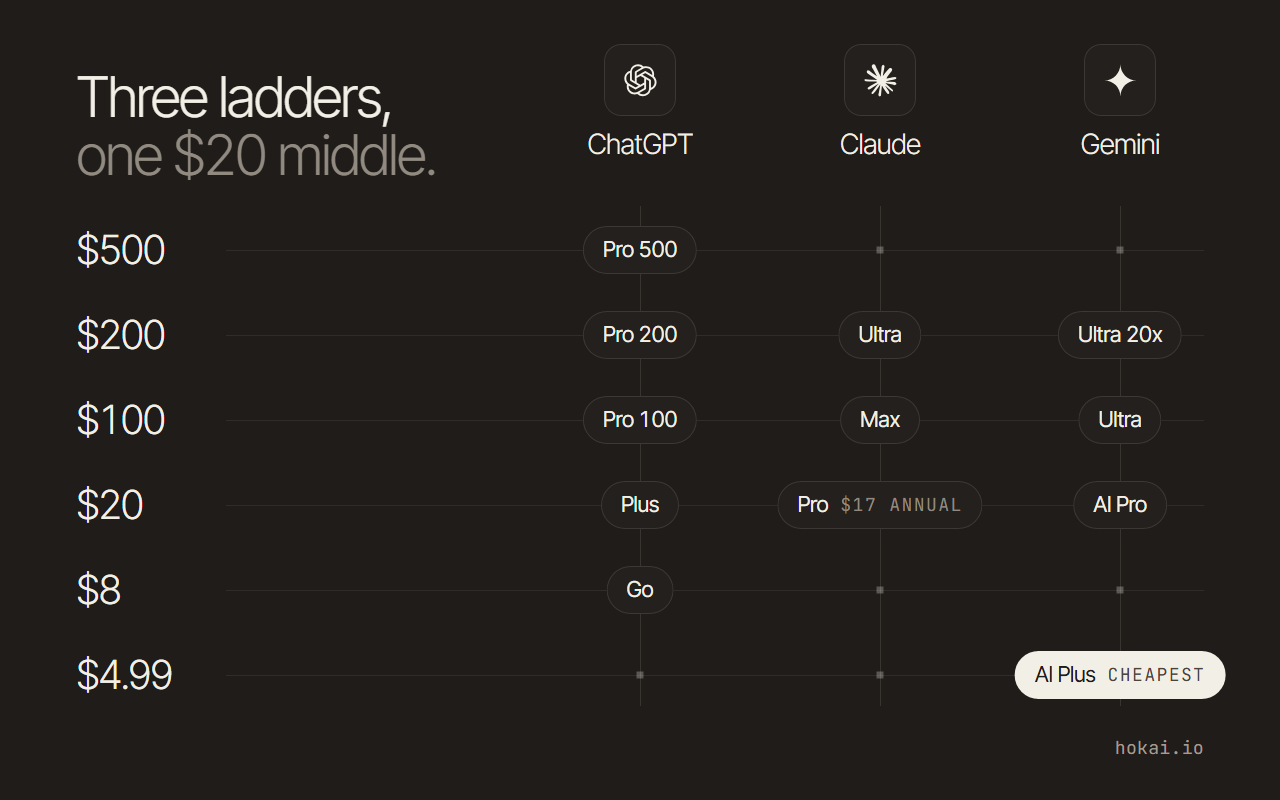 Hokai chart of personal-plan monthly prices, from the Anthropic, OpenAI and Google plan pages as checked on 13 November 2026.
- Cheapest paid plan of the three
- $4.99
- Google AI Plus
- ChatGPT Go a month
- $8
- May include ads
- Claude Pro on annual billing
- $17
- Monthly billing costs more
- Plans at about $20 a month
- 3
- One from each vendor
What each plan costs: the three ladders side by side
Every vendor runs a free tier, a middle plan near $20 and one or two heavy plans above it. The rungs below and above the middle are where they split.
| Monthly price | ChatGPT | Claude | Gemini |
|---|---|---|---|
| $0 | Free | Free | Free |
| $4.99 | None | None | AI Plus |
| $8 | Go | None | None |
| About $20 | Plus ($20) | Pro ($17 or $20) | AI Pro ($19.99) |
| About $100 | Pro 100 | Max ($100) | AI Ultra ($99.99) |
| About $200 | Pro 200 | Ultra ($200) | AI Ultra ($199.99) |
| $500 | Pro 500 | None | None |
OpenAI's help article on the $20 plan says it bills monthly. Its Codex pricing page lists the cheaper Go plan at $8.
The article on its top tiers names three sizes for their monthly price: 100, 200 and 500 dollars. Only the biggest includes Ultrafast, a speed mode. None of the three can be paid annually.
Anthropic's pricing page shows its middle plan at $17 a month with the annual discount, paid in one go at the start of the year. Billed month by month it costs $20.
The two heavy plans cost $100 and $200 there, and both bill monthly only.
Google's plans page puts its cheapest paid plan at $4.99 and the middle one at $19.99.
Its top plan comes in two sizes. The smaller gives five times the usage of the middle plan, and the larger gives twenty times.
Read from each vendor's own plan or pricing page.
So the cheapest way into a paid plan is Google's. By a lot. Anthropic has nothing between free and $17. On pricing alone the middle rung is a tie within a cent, and price only decides things at the edges.
Which model answers on each plan
Price is half the story. The other half is the model behind the chat box, because each vendor keeps its best model for the people who pay, and the gap between a free model and a paid one is now wider than the gap between the three paid ones. Look closely.
| Plan level | ChatGPT | Claude | Gemini |
|---|---|---|---|
| Free | GPT-6 Luna | Sonnet, Haiku | Flash-Lite |
| Cheap rung | GPT-6 Luna (Go) | None | Hydrogen (AI Plus) |
| About $20 | GPT-6.1 Sol, GPT-6 Astra | Adds Opus; Fable on credits | Argon and Hydrogen |
| Top plans | Expanded limits | Fable up to half the weekly limit | Carbon (AI Ultra) |
OpenAI's pricing page marks GPT-6.1 Sol and GPT-6 Astra as included on its $20 plan and expanded above it. Free and Go users get GPT-6 Luna, the fast small model.
Anthropic's table gives free users Sonnet and Haiku, and adds Opus once you pay. Its top family, Fable, costs extra usage credits on the $20 plan. On the two heavy plans it is included, up to half your weekly limit. The page prints no version numbers, so those names are its own.
Google moved this week. Its plans page now labels the $4.99 plan with Gemini 4 Hydrogen, the $19.99 plan with Gemini 4 Argon and the top plan with Gemini 4 Carbon, its strongest model.
How strong those models are on one shared test
How good are they? Artificial Analysis runs every major model through the same tasks and publishes one index score. Its leaderboard, read today, ranks the best model in each $20 plan like this, each at its strongest public setting.
Read from the Artificial Analysis models leaderboard.
Claude Opus 5.5 scores 59 at max, and Astra scores 57. Hydrogen scores 54 at xhigh, ahead of Argon's 50 at high. That pair is odd. The model on the $4.99 plan outscores the flagship named on the $19.99 one, though the dearer plan includes both.
One caution. A big one. A chat app does not always run a model at its max setting, none of the three vendors says which setting its app uses, and a busy app may route a short question to a lighter mode. Read these numbers as a ceiling.
Our model leaderboard shows the same families on price per million tokens.
The free plans are where the three differ most
Most people start free. Here the three diverge hard, and the trade is stark: one gives you unlimited chat on a small model, one gives you a strong model on a meter that runs out, and one gives you research, pictures and storage on the weakest model of the lot.
| Free plan | Model | Limits | Stand-out extras |
|---|---|---|---|
| ChatGPT | GPT-6 Luna | Unlimited text chats | Some images, voice, deep research |
| Claude | Sonnet, Haiku | Metered every 5 hours and week | Files, code runs, memory, Docs |
| Gemini | Flash-Lite | Compute-based, 5-hour refresh | Images, deep research, 15 GB storage |
On that leaderboard, Claude Sonnet 5.5 scores 55 at max and Luna scores 28. Gemini 3.5 Flash-Lite, the newest model of its line on the list, scores 12. Google's page names the free model only as "Flash-Lite".
Read from the Artificial Analysis models leaderboard.
So the free Claude is the smartest of the three by a wide margin. The catch is the meter. Its free plan is "limited" on both a 5-hour clock and a weekly one, while OpenAI promises unlimited text chats on every plan, subject to abuse guardrails.
The free Gemini has the best extras: image generation and editing, a full research tool, live voice and 15 GB of storage across mail, files and photos. The rival from Anthropic shows research as "No" until you pay. For a sourced report at no cost, one free plan does it properly.
For everyday use: ChatGPT is the easiest default
Everyday use means the small jobs. Lots of them. A recipe swap, a quick email, a photo of a parking sign in another language, a question asked out loud while you cook. For that, the plan that never makes you wait wins.
OpenAI's pricing page lists unlimited everyday text chats from the free tier to the top. Voice is on every plan, limited at first, and the $20 plan adds voice with video. Image creation is on every tier too. No other ladder combines all three without a 5-hour meter.
The $8 Go plan adds uploads, images and longer memory. It "may include ads", and the help article on Go says ads are being tested with eligible users in select regions. Our explainer on those ads shows what they look like.
The Google assistant is the better everyday pick on an Android phone, where it is built in, and for anyone who wants help inside their inbox. The $4.99 plan puts it in Gmail, and the $19.99 one adds Docs. A Labs experiment called CC goes further for busy families, sorting school and club emails into one shared calendar. For the phone-first angle, read our Android assistant comparison.
Claude is the weakest everyday default here. Not because it answers worse. Far from it. Because the free meter can stop you mid-afternoon, and it cannot make a picture, since the Motion feature is switched off for every individual subscriber.
For writing and content creation: words in one tool, pictures in another
Content creation splits in two. Text is one job; images and video are another. Nobody wins both.
For text, Claude has the case. Its paid plan includes Opus, top of the $20 chart above, and every plan lists a context window of "up to 1M, varies by model". OpenAI's middle plan lists a 256K reasoning window, roughly 320 pages of text, and its top plans 400K. Google says its middle plan holds 1M tokens, and it accepts files totalling 1,500 pages in one go.
So for a long report, a book chapter or a folder of interview transcripts, two of the three hold far more in one chat than the $20 ChatGPT plan. Anthropic also includes its Design, Slides and Docs tools on the free tier, which matters if you build decks from your drafts.
For visuals, look elsewhere. OpenAI lists image generation, including a slower mode that thinks first, on its middle plan. Google lists images on its free plan and video from $4.99 up, with 200 credits a month for its Flow studio on that plan and 1,000 on the next.
For coding: three agents at the $20 rung
All three middle plans now include a coding agent that edits files, not just a chat that pastes code. They differ in how plainly the plan says what you get.
| Vendor | Coding agent | From which plan |
|---|---|---|
| Claude | Claude Code | The $17 plan and up |
| ChatGPT | Codex | Limited free, fuller from $20 |
| Gemini | Antigravity | Entry rate limits at $19.99 |
Claude Code is a terminal agent, marked "Yes" from the first paid plan and "No" on free. OpenAI lists "Limited Codex access" free and "Expanded Codex usage" on its middle plan. Codex is its coding agent, and the pricing page for it says the top plans currently have no five-hour limit.
Google's middle plan says "entry rate limits" for its agent in Antigravity, with more on the top plan. The command-line route is Antigravity CLI.
At $20, our pick is Claude, on two grounds from the evidence above. Opus scores highest of the three middle-plan models. And the plan names the tool, with a 1x meter that the heavy plans multiply by five and by ten.
If you code all day, one rule flips it, and it is buried in a footnote on the pricing page for the coding agent rather than on the main plan page where most buyers would ever think to look for it. At $100, OpenAI drops the five-hour limit entirely, while Anthropic gives five times its middle meter. Our Codex vs Claude Code guide goes deeper.
For students: one vendor gives a year away
Students get the clearest single deal here. It comes from Google. Its release notes for 19 August 2026 offer eligible students a year of the middle plan at no cost if they live in America. In more than 140 other countries the free year covers the cheaper tier instead.
You can claim it until the last day of 2026. After the year it rolls onto the normal monthly price unless you cancel, so a free year becomes a $19.99 bill. Put a reminder in your calendar the day you sign up.
OpenAI's offer is a feature, not a discount. Study mode is listed on every plan, free included. Its pricing page also mentions a free plan for verified American school teachers, which runs to June 2027.
Anthropic sells an education plan to whole universities, covering students, faculty and staff. Its pricing page shows no price for a single student. A student paying their own way gets the cheapest deal from Google, and the most generous no-cost plan from OpenAI.
Where Gemini wins: storage, video and the cheapest paid plan
Most comparisons treat Gemini as the third option. For a lot of households it is the first, because the subscription is really a storage plan with an assistant inside.
| Google plan | Storage | Also included |
|---|---|---|
| Free | 15 GB | Flash-Lite, images, deep research |
| AI Plus | 400 GB | Hydrogen, video, help in Gmail |
| AI Pro | 5 TB | Argon, help in Docs, YouTube Premium Lite |
| AI Ultra | From 20 TB | Carbon, full YouTube Premium, Genie |
A family already paying for cloud storage gets the AI for little extra. The middle plan bundles 5 TB and a lite video subscription. Neither rival sells storage at all.
The $4.99 plan is the other quiet win. It is the cheapest paid plan here by $3, it now carries Hydrogen, and it adds video.
The weak spot is the free model. It is small. It scores 12 on the index, lowest of the three free models by a long way. And the limits are "compute-based", so there is no message count to plan around at all.
Adding Copilot: the fourth option for Microsoft 365 homes
People who search for a four-way comparison with Copilot usually already pay for Office. That changes the maths, because Microsoft Copilot comes inside the Office plans.
| Microsoft plan | Monthly price | Copilot level |
|---|---|---|
| Copilot (free) | $0 | Chat, usage limits |
| Microsoft 365 Personal | $9.99 | Higher usage than free |
| Microsoft 365 Premium | $19.99 | Extensive usage, limited agents |
Microsoft's plan comparison page puts the assistant inside the desktop apps on the $9.99 plan. The annual price is $99.99.
Its $19.99 plan gives "extensive" usage. The page also shows a cut-price first month today.
If your work lives in spreadsheets and documents, this is the one assistant that sits inside those files by default. Anthropic now lists its own add-ins for those apps and for email from the $17 plan, which narrows the gap. For the wider field, with Grok and Poe as well, see our five-way assistant chooser.
The verdict: which one to pick, by reader
The three are close at the top and far apart everywhere else. So the right pick depends on which edge you will actually use, which for most people is the free tier, the cheap rung or one specific job like code, video or long documents, rather than the flagship score.
| You are | Pick | Plan to start on |
|---|---|---|
| Everyday user, one app for everything | ChatGPT | Free, then Go or Plus |
| Writer, analyst, long documents | Claude | Free, then Pro |
| Developer on a $20 budget | Claude | Pro, for Claude Code |
| Google and Android household | Gemini | AI Plus or AI Pro |
| Student | Gemini | The free year of AI Pro (US) |
| Image and video maker | ChatGPT or Gemini | Plus for images, AI Pro for video |
- ChatGPT
- unlimited text chats on every plan, images and voice on every tier, Go at $8 may show ads
- Claude
- strongest free model on the index, Claude Code from $17, a 1M context ceiling, no image generator
- Gemini
- cheapest paid plan at $4.99, 5 TB on AI Pro, a free student year, Carbon on the top plan
If none of those rows sounds like you, Smart Match asks about your work and tools, then ranks the assistants against them. For two of the three at a time, our ChatGPT vs Claude guide goes deeper on the pair most readers start with.
The best argument against picking ChatGPT first
The strongest objection to the everyday verdict is quality. On the free plans, the model from Anthropic scores 55 on the index and OpenAI's scores 28. If you want the best answer rather than the most answers, the free Claude gives more per message.
That is true, and it is why the verdict splits by reader. But everyday use is mostly short questions, where a small model is quick and good enough, and a meter that locks you out for hours costs more than a few index points. That is why the writer and the developer rows above go the other way: their jobs are the hard ones.
The second objection is ads. Fair. Go may carry them, and the $20 plan costs what Anthropic charges month to month. If ads rule it out, skip Go, and the case rests on images and voice. Our plan-by-plan breakdown walks each rung.
What would change this in the next few months
Three things would move the verdict, and each one shows up on a vendor page first.
If Anthropic adds image generation to a personal plan, its assistant becomes a fair everyday default. The plan page already lists Motion in beta, marked "No" on every personal plan today.
If Google says which setting Hydrogen runs at in the app, the $4.99 plan could be the best value of the field. A score of 54 for that price would beat every other paid plan on points per dollar.
If OpenAI moves a stronger model onto its free tier, the free gap closes. Watch the models table on its pricing page. For the frontier race behind these apps, our Grok, Opus, Astra and Gemini comparison covers it. Until one of those happens, the call stands: start on ChatGPT's free plan for everyday use, pay for Claude Pro if you write long or code, and take Google's cheapest plan, or the free student year, if you live in Gmail.
Frequently asked questions
Which is better for everyday use, Claude or ChatGPT?
ChatGPT, for most people. Its pricing page promises unlimited everyday text chats on every plan, including Free, with voice and image creation on every tier. Claude's free plan runs a stronger model but meters you every 5 hours and every week, and it has no image generator.
How much do Claude, ChatGPT and Gemini cost?
All three have a free plan and a middle plan at about $20 a month: Claude Pro at $20 (or $17 on annual billing), ChatGPT Plus at $20 and Google AI Pro at $19.99. Below that, Google AI Plus costs $4.99 and ChatGPT Go costs $8. The heavy plans run from about $100 to $200, and ChatGPT Pro 500 costs $500.
Which is best for coding?
Claude Pro, at the $20 rung. Claude Code is included from Pro, and Opus 5.5 scores 59 on the Artificial Analysis Intelligence Index against 57 for GPT-6 Astra and 54 for Gemini 4 Hydrogen. For all-day coding, ChatGPT's Pro plans currently have no five-hour limit in Codex.
Which is best for students?
Gemini, on price. Google offers eligible students a free year of Google AI Pro in the US, or AI Plus in more than 140 countries, redeemable until 31 December 2026; it renews at the standard price unless cancelled. ChatGPT includes Study mode on every plan, Free included.
Where does Microsoft Copilot fit?
Copilot suits homes that already pay for Microsoft 365. Microsoft 365 Personal at $9.99 a month adds Copilot in Word, Excel, PowerPoint and Outlook, and Microsoft 365 Premium at $19.99 gives extensive Copilot usage. The free Copilot chat has usage limits.
Covered in this guide
- Claude: Claude is Anthropic's AI assistant, with a free tier, Pro, Max and Ultra personal plans, and Team and Enterprise seats. Opus access starts at Pro.
- ChatGPT: ChatGPT is OpenAI's AI assistant, with 1.2 billion weekly users by OpenAI's count, the GPT-6 model family and plans that run from a free tier to a premium Pro tier.
- Gemini: Google's multimodal AI assistant and model family, sold as a free app, tiered subscriptions and a pay-per-token API
- Antigravity CLI: Google's successor to Gemini CLI, running subagents and a 5-model picker (Gemini, Claude, GPT-OSS) from the terminal.
- Claude Code: Anthropic's agent for the terminal, IDEs, desktop, web and mobile that edits files, runs tests and opens pull requests. There is no free plan.
- Claude Opus 5.5: Anthropic's September 2026 flagship LLM with a 1 million token context window, built for long-running agentic coding and computer use.
- Claude Sonnet 5.5: Anthropic's fastest Sonnet-class model, launched in September 2026, with a 1M context and output more than 30% faster than Sonnet 5.
- Gemini 3.5 Flash-Lite: Gemini 3.5 Flash-Lite is Google DeepMind's July 2026 model built for high-volume AI subagents: 1M-token context, fastest in the Gemini 3.5 family.
- Gemini 4 Argon: Google DeepMind's Gemini 4 frontier model, generally available on the paid Gemini API: 1M-token context and output, text, image, video, audio and PDF input.
- Gemini 4 Carbon: Google DeepMind's Gemini 4 Carbon, open to paying Gemini API developers since 10 November: a reasoning model for agentic coding, research and cyber defense.
- Gemini 4 Hydrogen: Google DeepMind's November 2026 Gemini 4 model for coding agents, with four thinking levels from low to xhigh and a free tier in AI Studio.
- CC: Gemini-based Google Labs experiment that reads only the senders you share, then builds a shared calendar, task list and morning email for a household.
- GPT-6 Astra: OpenAI's flagship model, launched September 2026 as the first ever rated at the Preparedness Framework's Critical cybersecurity level.
- GPT-6 Luna: GPT-6 Luna (Sept 2026) is OpenAI's lowest-cost GPT-6 model, tuned for high-volume chat, extraction and classification with six adjustable reasoning-effort levels.
- GPT-6.1 Sol: GPT-6.1 Sol is OpenAI's September 2026 mid-tier reasoning model for coding, computer use and document work, built to sit just below GPT-6 Astra.
- Microsoft Copilot: Microsoft's AI assistant across Windows, Edge, Word, Excel, Outlook and Teams, from a free tier to per-seat work plans on OpenAI's latest GPT-5 models.
- Codex: Clones a GitHub repo into a sandbox, writes and tests code, then opens a pull request; included in every ChatGPT plan, with the newest GPT-6 models from Plus.
Sources
Still deciding?
This guide covers a handful of options. Smart Match checks every listing in the directory against how you actually work and what you can spend, then hands you the shortlist and the reason behind each pick.
Find your tools