AI price changes: October and early November 2026
Google raises Gemini 4 Carbon from $2 and $10 to $4 and $20 per million tokens on 1 December 2026. Claude Fable 5.2 undercuts Fable 5.1 by a fifth at $8 and $40. Durable, Adalo and Jetwriter each lifted their cheapest paid plan by at least half, and five vendors withdrew published pricing entirely.
The short version
Thirty-four published prices, plans and free tiers moved in six weeks: nine went up, six came down, and five price lists disappeared from vendor sites altogether. The headline number is Google doubling Carbon on 1 December. Cheap subscription tiers rose hardest; most token rates fell.
Not sure which one fits you? Describe your situation and Smart Match names three tools.Find my AI tools
In this guide12 sections
Between 1 October and 13 November 2026, vendors listed on Hokai changed 34 published prices, plans or free tiers, and the one that will cost developers most has not taken effect yet. Nine were rises and six were cuts. The rest were plan ladders, free tiers and whole price lists being rebuilt or taken off the web.
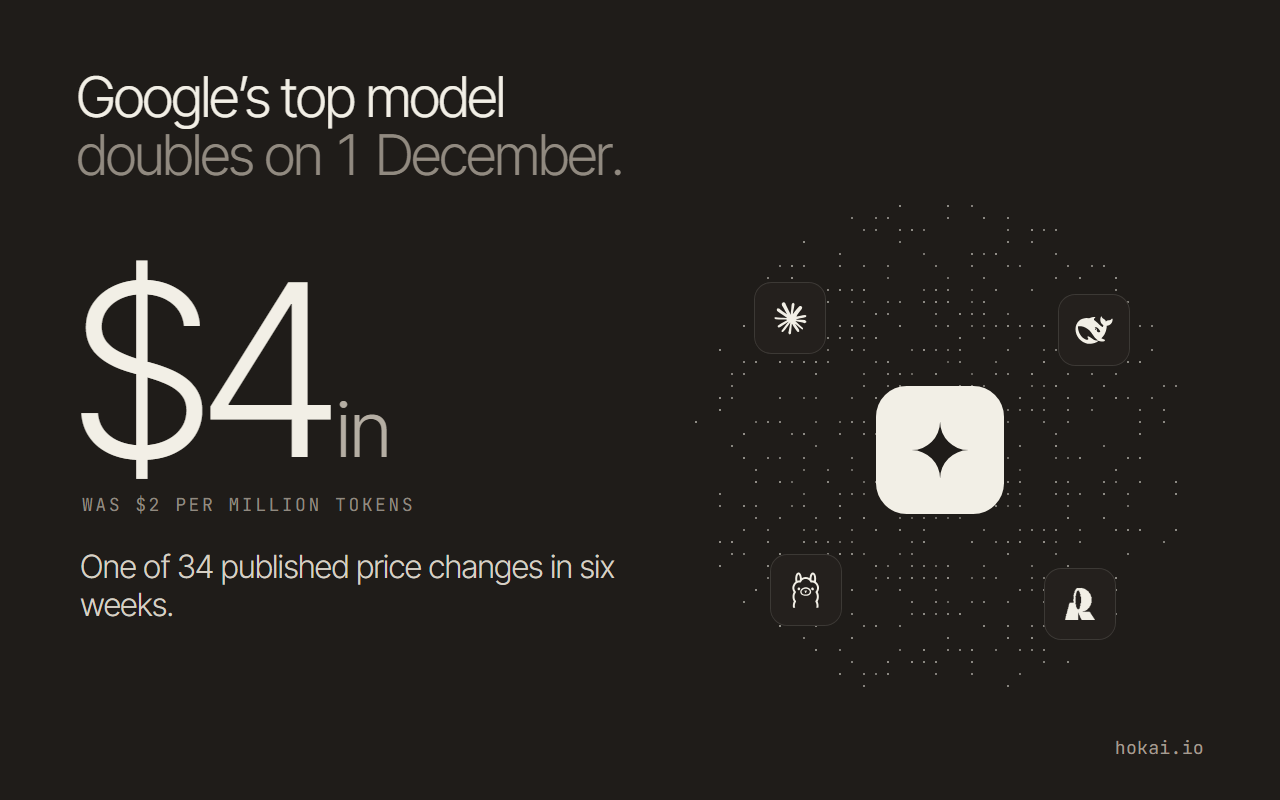
Google opened Gemini 4 Carbon to any paying developer on 10 November, at the same rate as the cheaper Argon model: $2 per million input tokens and $10 per million output.
That rate is introductory. The announcement carries a footnote saying the period expires on 30 November 2026, after which the figures are $4 and $20.
So the strongest model Google sells doubles in price on 1 December, and the page that says so is a launch post most readers skimmed two days ago.
Source: the Carbon availability post on blog.google, read 13 November 2026.
Every figure below was read on the vendor's own pricing page on 13 November 2026, and each line names that page. Where a vendor publishes its own date for a change, the date is the vendor's rather than ours.
One limit, stated plainly. This record of superseded prices starts in November 2026, so nothing here can be compared against a figure from before that month. October was a month of arrivals rather than price moves: of 35 availability changes recorded then, only four carried a figure at all. Every before-and-after price in this edition is from November.
- Gemini 4 Carbon input, per million tokens, from 1 December
- $2 to $4
- a doubling
- of 34 verified changes
- 9 rises, 6 cuts
- 1 October to 13 November 2026
- stopped publishing any price
- 5 vendors
- two of them left a 404
What changed, and when
There is no single direction in the month. Frontier token prices fell at the top of Anthropic's range and rose at the top of Google's. The cheap end of the small-business software market went up hard, in several cases by half or more, while some of the same vendors widened a free plan underneath it. And five companies simply stopped telling anyone what they charge.
The dates worth a diary entry:
- 22 Oct 2026 the browser stops working on 22 DecemberArc stops accepting new accounts
- 9 Nov 2026 a fifth under Fable 5.1Claude Fable 5.2 lists at $8 in, $40 out per million tokens
- 10 Nov 2026 at Argon's introductory rateGemini 4 Carbon opens to all paying developers
- 30 Nov 2026 $4 in and $20 out apply from 1 DecemberCarbon's introductory rate ends
- 5 Jan 2027 $5 in and $25 out, whatever it routes toSakana's base Fugu rate becomes fixed
Price rises
- Gemini 4 Carbon: $2 in and $10 out per million tokens, rising to $4 and $20 when the introductory period closes on 30 November. Source: blog.google, "Gemini 4 Carbon is now available", and its footnote.
- DeepSeek V4 Pro: $0.435 in and $0.87 out per million tokens, now $0.66 and $1.98 off peak and $1.32 and $3.96 during weekday peak hours. Off-peak output is up 128%. Source: api-docs.deepseek.com/quick_start/pricing.
- Fugu, the base model: billed at whatever rate the underlying model charges, becoming a flat $5 in and $25 out per million tokens below 272K of context, and $7 and $35 above it, on 5 January 2027. Source: console.sakana.ai/pricing.
- Sakana Namazu, the Japanese-language model on that same page: $0.95 in and $4 out per million tokens, going to $1.90 and $6 on 1 December 2026. The input price doubles.
- Adalo: Starter at $45 a month is retired, so the cheapest plan that publishes an app is Builder at $65 ($52 billed yearly), with Business at $200 ($160 yearly). Old plans are grandfathered. Source: adalo.com/pricing.
- Durable: Starter at $15 a month ($12 yearly) is replaced by Launch at $25 ($22 yearly). The top of the ladder moved the other way, with the $95 Mogul plan gone and Grow topping out at $49. Source: durable.com/pricing.
- Rytr: a ladder whose top plan was $29 is now Free, Lite $9, Personal $19 and Pro $49, with 20% off for yearly billing. Source: rytr.me/pricing.
- Jetwriter: the $12 Pro plan is gone and paid access starts at Elite $18 a month, with Ultra at $39 above it and a free plan capped at 15 AI responses a month. Source: jetwriter.ai/pricing.
- Codag: a $19 Hobby plan and a $199 Team plan are replaced by per-credit billing at $0.05 a credit, with Team at $499 a month for 12,500 credits. Source: codag.ai/pricing.
Price cuts
- Claude Fable 5.2: $8 in and $40 out per million tokens. Fable 5 and Fable 5.1 are still sold at $10 and $50, so the newest of the three is the cheapest by a fifth. Source: claude.com/pricing.
- Exa: Monitors fall from $15 to $2 per 1,000 requests, and a new Lite search tier costs $4 per 1,000 against Auto's $7. Zero data retention now needs a $12,000 annual credit commitment. Source: exa.ai/pricing.
- Recraft: the cheapest raster image drops from $0.04 to $0.007 on the V4.1 Flash model. Recraft V3 still costs $0.04 raster and $0.08 vector, and is labelled previous generation. Source: recraft.ai/docs, API model overview.
- Reducto: billing moved from credits to pages. Parse r-1 is $10 per 1,000 pages and r-1 mini is $1, against $15 for a standard legacy page and $30 for a complex one. Source: docs.reducto.ai/reference/credit-usage.
- Archal: a $199 per seat plan is gone and there is no subscription at all. New accounts get $20 of one-time credit, then pay $0.10 per active environment-minute. Paid continuation is not open to self-serve accounts yet. Source: docs.archal.ai/pricing-usage.
- Superhuman: suite Pro was recorded at $25 per member a month and now lists at $12 billed annually ($15 monthly), with Business at $33 annually ($40 monthly). Source: superhuman.com/plans.
Plans and free tiers that changed
- Mem0: Starter at $19 and Pro at $249 are withdrawn from new accounts. What remains is Free, which allows 50,000 memory adds and 10,000 retrievals a month on your own model key, and Custom by quote. Source: mem0.ai/pricing.
- Ollama: the free tier is renamed Pay as you go at $0, starter cloud credits are replaced by a published per-million-token table, and concurrency rises from one request to three. Pro $20, Max $100 and Team $500 are unchanged. Source: ollama.com/pricing.
- Parahelp: a sales call became a public number. It charges $1 per auto-resolved ticket, with no seat fee, no platform fee, and no minimum term. A ticket that reaches a human is not billed. Source: parahelp.com/pricing.
- Pylon: the Starter plan is removed. Seats are Professional $89 and Advanced $139 a month on annual terms, phone is $35 per seat, and the AI features moved from a per-seat add-on to a credit balance. Source: usepylon.com/pricing.
- Recraft again, on the subscription side: Advanced at $27 for 4,000 credits and Pro at $48 for 8,400 are both gone. The new Pro is $16 a month billed annually for 2,000 credits. The headline fell by two thirds while the price per credit rose about 40%.
- Kinovi: credit packs at $17.99 and $114 are replaced by a per-second rate for every model it routes to, from $0.0125 a second for Grok Imagine Video 1.5 Lite to $0.1197 for Seedance 2.5. Source: kinovi.ai/pricing.
- Surfer: six plans rebuilt around AI search tracking, billed yearly at $49, $82, $99, $182 and $299 from the entry tier up. The old $89 and $219 plans are gone. Source: surfer.ai/pricing.
- Hermes: every price held (Free $0, Plus $20, Super $100, Ultra $200) and what they buy changed. Usage is now sold as shared, 5x Plus and 10x Plus, each tier carrying a cloud-hosting allowance of 4GB or 8GB of memory. Source: portal.nousresearch.com/cloud.
- TubeAI: a free monthly plan now exists where the public pricing had none, including the research agents, ideas, titles, thumbnails and scripts. Source: tubeai.app.
The prices that left the internet
Five vendors here stopped publishing a price. It is the quietest change on the list and the hardest to notice later, because nothing is left on the page to compare against.
- Jigso had a free Basic tier and a Pro plan around $19 per user a month. The pricing page is a 404 now and the site asks for a demo.
- LanceDB no longer lists its $0.02 per GB cloud tier anywhere. The site offers an embedded build (free, Apache 2.0) and Enterprise through sales, and the $779 a month benchmark survives only inside a blog post from May 2026.
- Akkio removed a free view-only plan, Basic at $49 per user, Pro at $99 and a Build-On tier from $999, replacing all four with one custom-priced platform aimed at media agencies. There is no free tier.
- GovDash moved from per-module subscriptions to seat plans called Starter, Growth and Enterprise. Seat prices and credit allowances sit behind "talk to sales".
- Conveo added a free sign-up to a site that still publishes no price for anything else.
Models retired or replaced
- Fable 5 and Fable 5.1 were superseded by Fable 5.2 on 9 November 2026. Both older versions stay on sale at the higher $10 and $50 rate, which is the unusual part: the replacement is cheaper and the predecessors were not repriced.
- Recraft V3 is marked previous generation, and V4.1 is the API default.
- Gemini 4 Carbon stopped being gated. It launched to cyber defenders through a vetted programme, then opened a fortnight later to every paying developer, to enterprises on the business plan, and to the top consumer subscription in the assistant app, the coding agent and search.
Products that shut down
- Arc is being retired by its maker. New accounts closed on 22 October 2026. The AI features and account sign-in end on 23 November, and the macOS and Windows builds stop working on 22 December, when accounts are deactivated and their data is deleted within 30 days. Source: the farewell notice on arc.net.
- Gistify no longer sells the meeting-summary product it was listed for. Its pricing page returns a 404 and the domain carries a different product.
What arrived in October, with no price moves behind it
October's record is availability, not pricing. Seven families of model reached new surfaces, and for most of them the first published rate is still the only one:
- Gemini 4 Argon landed on the API, the assistant app, search and the coding agent on 13 October.
- Kimi K3.1 Pro reached five surfaces at once on 23 October, from its chat app to its coding tool, with open weights following a fortnight later.
- GPT-6.1 Terra arrived on 26 October across the API, Codex for work, and both big clouds.
- LFM3 shipped as weights, an API and a playground on 27 October.
- Particle-1 appeared on its own API and on OpenRouter on 28 October.
- GPT-6 Rosalind reached the API and Codex for Work on 30 October.
- Microsoft Decision-1 entered the Foundry catalogue on 9 October at $0.042 per million input tokens, with output listed as not applicable.
Who this hits hardest
The people who pay for this month are solo operators and small teams sitting on the cheapest paid tier of a tool they already use. Look at where the rises landed:
| Product | Cheapest paid plan before | After | Change |
|---|---|---|---|
| Durable | $15 a month | $25 | up 67% |
| Adalo | $45 a month | $65 | up 44% |
| Jetwriter | $12 a month | $18 | up 50% |
| Codag | $19 a month | usage at $0.05 a credit | plan withdrawn |
None of those is a large number by itself. All of them are the plan a one-person business actually buys, and each moved up by at least 44% while the tier above it barely changed or came down. Two of the three added or widened a free plan in the same pass, which softens the blow for someone evaluating and does nothing for someone already paying.
Developers buying tokens had a better month, with one exception. Anthropic's newest Fable is a fifth cheaper than the version it replaces. Recraft's cheapest image fell by 82%. Reducto's new parse tier costs a fifteenth of a complex legacy page. Against all that, anyone who builds on Carbon between now and the new year is budgeting against a figure that doubles on 1 December.
What to do before 1 December
- Price any Carbon workload at $4 and $20, and test whether Argon does the job.
- If Fable 5 or 5.1 is in production, read the 5.2 rate card. The older versions were never discounted.
- Export your Arc data. Sign-in stops on 23 November, a month before the browser does.
- Keep a copy of any quote from a vendor that has withdrawn its pricing.
- Stay on a grandfathered plan. It is worth more this year than the new tier's features.
What would change this picture
Two things would make this read differently. The first is coverage: a few thousand products are followed here and these 34 changes come only from those, so a month that looks quiet at the cheap end of the market may simply be a month when the vendors that moved are not on the list.
The second is timing. A price read on one day is a fact about that day, and three of the changes above are dated into the future, which means a vendor can still reverse them. An introductory window has been shortened before. A rise published weeks ahead can quietly fail to arrive.
There is also a reading of the month that is less dramatic than a column of rises suggests. Several of the biggest increases arrive with a new or wider free tier underneath them, and a few vendors, Archal and Parahelp among them, swapped a subscription for usage billing that will cost a light user far less than the plan it replaced. A company lifting its entry price while opening a free plan is reaching for a different customer, not only charging more.
How this list is made
Hokai's refresh routines read vendor pricing pages on a schedule and keep the figure that was there before alongside the one that replaced it, each with its page and the date of reading. That superseded figure is the part nobody else keeps. A vendor replaces a price without preserving the old one, so within weeks the only proof of what something used to cost is a note somebody made at the time.
Each line here was then opened again at its source on 13 November 2026 before publication, and anything the live page no longer supported was left out rather than estimated. Six items were dropped that way.
This is the first of these reports. The next one covers 14 November onwards.
Frequently asked questions
Which AI price rise in late 2026 matters most?
Gemini 4 Carbon. Google opened it to all paying developers on 10 November 2026 at an introductory $2 per million input tokens and $10 per million output, and its announcement says $4 and $20 apply once that period ends on 30 November. Anyone budgeting a Carbon workload past 1 December should price it at the higher rate.
Did AI model prices go up or down in October and November 2026?
Both, at different ends of the market. Token prices mostly fell, with Claude Fable 5.2 listing a fifth under Fable 5.1 and Recraft cutting its cheapest image from $0.04 to $0.007. Subscription software went the other way, and the cheapest paid plans rose fastest.
Why does this report have no October price changes?
Because the record of superseded prices begins in November 2026. October is covered here as availability: which models and surfaces arrived, and at what opening rate. A before-and-after price for October would mean comparing against a figure nobody kept.
How are these price changes verified?
Each figure was read again on the vendor’s own pricing page on 13 November 2026 before publication, and the page is named on the line. Six items that the live page no longer supported were left out instead of being published with an estimate.
Which AI products shut down in this period?
Arc and Gistify. Arc closed new accounts on 22 October 2026, ends AI features and sign-in on 23 November, and stops working on 22 December. Gistify withdrew the meeting-summary product it was listed for and its pricing page now returns a 404.
Covered in this guide
- Adalo: AI app builder that turns a description into native iOS, Android and web apps with a built-in database
- Akkio: Akkio is a no-code AI analytics platform that trains predictive models up to 100x faster than AutoML, with natural language data queries. Plans start at $49/user/month.
- Arc Browser: Arc was a free Chromium browser with a vertical sidebar and Spaces. The Browser Company closed new accounts in October 2026 and shuts Arc down in December 2026.
- Archal: Stateful API sandboxes for testing AI agents and integrations: 22 environments such as GitHub, Slack and Stripe, billed per environment-minute. YC S26.
- Claude Fable 5: Superseded by Fable 5.1 and Fable 5.2 but still sold on the Claude API: Anthropic's first generally available Mythos-class model, released June 2026, with a 1M-token context.
- Claude Fable 5.1: Superseded by Claude Fable 5.2 in November 2026 but still sold on the Claude API: Anthropic's second Mythos-class model, released Sept 1, 2026, for long-horizon coding and research.
- Claude Fable 5.2: Anthropic's November 2026 Fable model: the Mythos 5.2 weights behind cyber and biology safeguards, built for multi-hour agentic coding and research.
- Codag: Cuts AI coding-agent costs by trimming oversized tool results, from test runs to grep output, down to the lines that matter, with the rest kept on your machine.
- Conveo: AI moderator that runs and analyzes video interviews with consumers; Google and Unilever are named customers, and it raised a $50M Series A in 2026.
- DeepSeek-V4-Pro-0813: DeepSeek-V4-Pro-0813 is DeepSeek's flagship 1.6T-parameter mixture-of-experts model, generally available since August 2026 with MIT-licensed open weights.
- Durable: AI website builder for small service businesses, with SEO, a CRM, online bookings and AI agents in one plan
- Exa: Search API that ranks the web by meaning for AI agents and retrieval pipelines, with Lite, Auto and Deep search modes, an asynchronous research Agent and an official MCP server. A free Starter plan with monthly credits needs no payment method.
- Fugu: Sakana Fugu routes each request across a pool of models behind one OpenAI-compatible API, in four models. Fugu Max costs $2/$6 per 1M tokens and Fugu Ultra $5/$30.
- Gemini 4 Argon: Google DeepMind's Gemini 4 frontier model, generally available on the paid Gemini API: 1M-token context and output, text, image, video, audio and PDF input.
- Gemini 4 Carbon: Google DeepMind's Gemini 4 Carbon, open to paying Gemini API developers since 10 November: a reasoning model for agentic coding, research and cyber defense.
- Gistify: Formerly an AI tool that turned recorded meetings and lectures into a searchable summary. As of 2026-11-10 the vendor has pivoted to a different product.
- GovDash: AI platform for government contractors covering sourcing, capture, pricing, proposals and contracts, with a FedRAMP Moderate Equivalent environment.
- GPT-6 Rosalind: OpenAI's life sciences reasoning model on GPT-6 Astra weights, released in October 2026 for organizations approved through its trusted-access program.
- GPT-6.1 Terra: GPT-6.1 Terra is OpenAI's October 2026 model for computer use, image reading and writing, built for high-volume agent work.
- Hermes Agent: Hermes Agent is Nous Research's MIT-licensed, self-hosted AI agent, past 260,000 GitHub stars. Model-agnostic, with optional Portal plans and cloud hosting.
- JetWriter AI: AI reply assistant for Gmail, WhatsApp Web, LinkedIn and Outlook that drafts replies from the thread and your style; the free plan has 15 responses a month.
- Jigso: Proactive AI operating system for enterprise teams that monitors connected business apps, surfaces risks and action items, and exposes the data through an MCP server and a REST API. Sold by demo; no public pricing.
- Kimi K3.1 Pro: Moonshot AI's October 2026 reasoning model: a 1M-token window, always-on thinking, text and image input, and open weights on Hugging Face.
- Kinovi: Kinovi is a pay-as-you-go API and browser studio that runs dozens of video, image and audio models from ByteDance, Alibaba, xAI and others on one credit balance.
- LanceDB: Open-source embedded retrieval library with a distributed Enterprise lakehouse on the same Lance format; its GitHub repository shows 11.9k stars.
- LFM3: Six open-weight models from Liquid AI, each near 2B parameters, spanning text, vision, audio, omni and decision work, launched in October 2026.
- Mem0: Memory layer for AI agents: an Apache-2.0 SDK, a managed Platform and an MCP server, with a free plan and 68.8k GitHub stars.
- Microsoft-Decision-1: Microsoft-Decision-1 is a Qwen3.5-9B based decision model in Foundry public preview (October 2026) that returns probabilities for routing and labelling.
- Ollama: MIT-licensed runtime that runs open-weight LLMs on macOS, Windows and Linux with a local API, plus an optional paid cloud for larger models.
- Parahelp: Support agent that resolves tickets over email, chat and Slack, set up by your own coding agents; Kit's AI lead is quoted beside a 70.3% auto-resolution rate.
- Particle-1: Particle AI's first model: DeepSeek V4.1 Flash post-trained for coding and data engineering, with a 1M-token context window.
- Pylon: B2B help desk with AI agents across Slack, Teams, email and chat, used by 1,800+ B2B companies including Airtable, Linear and Together AI.
- Recraft: Browser design canvas for native SVG and raster images from Recraft's own models, with iOS and Android apps, an MCP server and third-party models.
- Recraft V3: Recraft's former flagship image model, a previous generation since V4, still the API line for inpainting and exact text placement at 1K output.
- Reducto: Agentic document platform that parses, extracts and splits PDFs, scans and spreadsheets for AI teams; its About page cites more than 5 billion pages processed.
- Rytr: Relationship assistant that drafts follow-ups in your voice from Gmail, Slack, calendar and meeting notes, plus the original Rytr writer. Free plan; paid from $9/mo.
- Superhuman Suite: Superhuman's bundle of Mail, Docs, Grammarly and the Go assistant on one login, with a free plan and Mail sold alone or inside Business.
- Surfer SEO: AI search visibility platform: track brand mentions in ChatGPT, Gemini and Google AI, then write and optimize content to get cited
- TubeAI: TubeAI is a YouTube strategy app built around a chat assistant, Hugo, that finds outlier videos in a niche, drafts titles, thumbnails and scripts, and reads your channel analytics, with a no-card free plan and three paid ones.
Sources
Still deciding?
This guide covers a handful of options. Smart Match checks every listing in the directory against how you actually work and what you can spend, then hands you the shortlist and the reason behind each pick.
Find your tools