
Recraft V3 remains available in 2026 as the more stylized, lower-cost option next to Recraft's newer V4 and V4.1 models, which have taken over as the default for photorealistic and compositional work. It once beat Flux's 1143 Elo score to top the Artificial Analysis Text-to-Image Leaderboard, and still suits teams who specifically want its distinct illustrative look.
Recraft V3 is a text-to-image and vector model that scored a 1172 Elo rating and a 72% win rate to top the Artificial Analysis Text-to-Image Leaderboard in October 2024. Unlike most rivals at the time, it also generates native SVG vector output instead of only raster images.
Provider: Recraft · Family: Recraft
Input modalities: text, image · Output: image
About Recraft V3
Recraft V3 is the third-generation image model from the London AI design startup Recraft, released on October 30, 2024 under the development codename Red Panda before the company confirmed authorship. It is a text-to-image and text-to-vector model, reported at roughly 20 billion parameters, that generates raster images (JPEG/PNG) and native vector graphics (SVG) from a text prompt or a reference image, sitting in Recraft's lineup between the 2024 V2 release and the 2026 V4 and V4.1 generations.
V3 took first place on the Artificial Analysis Text-to-Image Leaderboard on release, scoring a 1172 Elo rating with a 72% win rate in head-to-head human comparisons, ahead of Flux1.1 Pro at 1143 Elo and Midjourney v6.1 at 1093 Elo. Independent coverage at the time confirmed it also beat DALL-E 3, Stable Diffusion and Ideogram on the same leaderboard, which is why the model spent weeks circulating anonymously as the mystery entry Red Panda before Recraft claimed it.
As an image model rather than a language model, V3 has no token context window in the LLM sense; input is a text prompt plus, optionally, one or more reference images for style matching. Recraft's docs describe an Artistic level parameter that trades conventional composition for more unusual angles and framing at higher settings, and the model supports a curated style library plus an effectively unlimited library of AI-generated custom styles.
V3 accepts text and reference-image input and produces image output only: no audio, video, or code. It was the first Recraft model able to render mid-size text accurately inside a generated image and, at launch, the only model on the market able to place that text at a specific position in the frame rather than somewhere approximate. Two output modes exist: Recraft V3 (raster JPEG/PNG) and Recraft V3 Vector, which emits native SVG paths rather than a traced raster file, with far fewer anchor points than a typical auto-traced vector, cutting real cleanup time for a designer.
Via the Recraft API, a raster generation is priced per image and takes about 7 seconds to return; the vector variant costs roughly double the price and about twice the latency, close to 16 seconds. Third-party hosts including fal.ai, Replicate and OpenRouter mirror the same per-image pricing as of 2026 rather than setting their own rates. Inside the Recraft Studio subscription, V3 draws from the same monthly credit pool as the other model generations rather than being billed separately.
V3 is reachable through Recraft's own API, through the Recraft Studio web and mobile apps, and through third-party inference hosts fal.ai, Replicate and OpenRouter, each with their own API key and billing. It is closed-weight: there is no downloadable checkpoint, no self-hosting path, and no quantized or fine-tuned variant, so every request runs on Recraft's or a licensed host's infrastructure.
Recraft has not published a system card or named red-team partners specific to V3. At the company level, Recraft keeps customer-generated and uploaded assets out of any external training pipeline, and personal data handling follows GDPR, including honoring deletion requests; the company's SOC 2 Type II audit and AIUC-1 certification were completed after V3's release and apply to the platform as a whole rather than to V3 specifically.
V3 remains a reasonable pick for teams that specifically want its more stylized, illustrative look and its lower per-image cost and faster generation time than the newer V4 family. Teams that need V3's benchmark-topping photorealism updated for 2026, or better compositional control, should move to Recraft V4 or V4.1 instead; teams that need the single most photorealistic raster image regardless of vendor should still benchmark against Midjourney and Flux directly, since both remain close competitors on the same leaderboard V3 once led.
Recraft does not disclose V3's own training data sources or a specific training cutoff date, and no HIPAA or dedicated enterprise data-residency commitments are published for V3 specifically -- those remain platform-level policies covered above, not per-model disclosures.
V3 was followed by Recraft V4 on February 17, 2026, which Recraft documents as a ground-up rebuild improving photorealistic rendering, text-in-image accuracy and compositional control, and by Recraft V4.1 on May 14, 2026, a refinement pass with stronger prompt understanding. Recraft's own model docs now position V4 and V4.1 as the default choice for most generation tasks, with V3 kept live mainly for its distinct stylization and lower cost.
V3 was followed by Recraft V4.1, which Recraft's own docs now position as the default choice for most generation tasks. Teams running the same kind of crowd-judged Elo comparison V3 once topped should also weigh Flux 2 and Flux 3 from Black Forest Labs, or the app-first alternatives Midjourney, Ideogram, Leonardo.Ai, Adobe Firefly and the generator built into Canva. The tool listing for Recraft packages V3 alongside V4 and V4.1 in one subscription for teams that would rather not commit to a specific generation up front.
HokAI's guides to the best AI image generators, best AI for graphic design, best AI for logo design and best AI for photo editing and restoration each cover where V3 and its rivals fit for different jobs, and the full image generation model directory lists every option HokAI tracks.
Screenshots
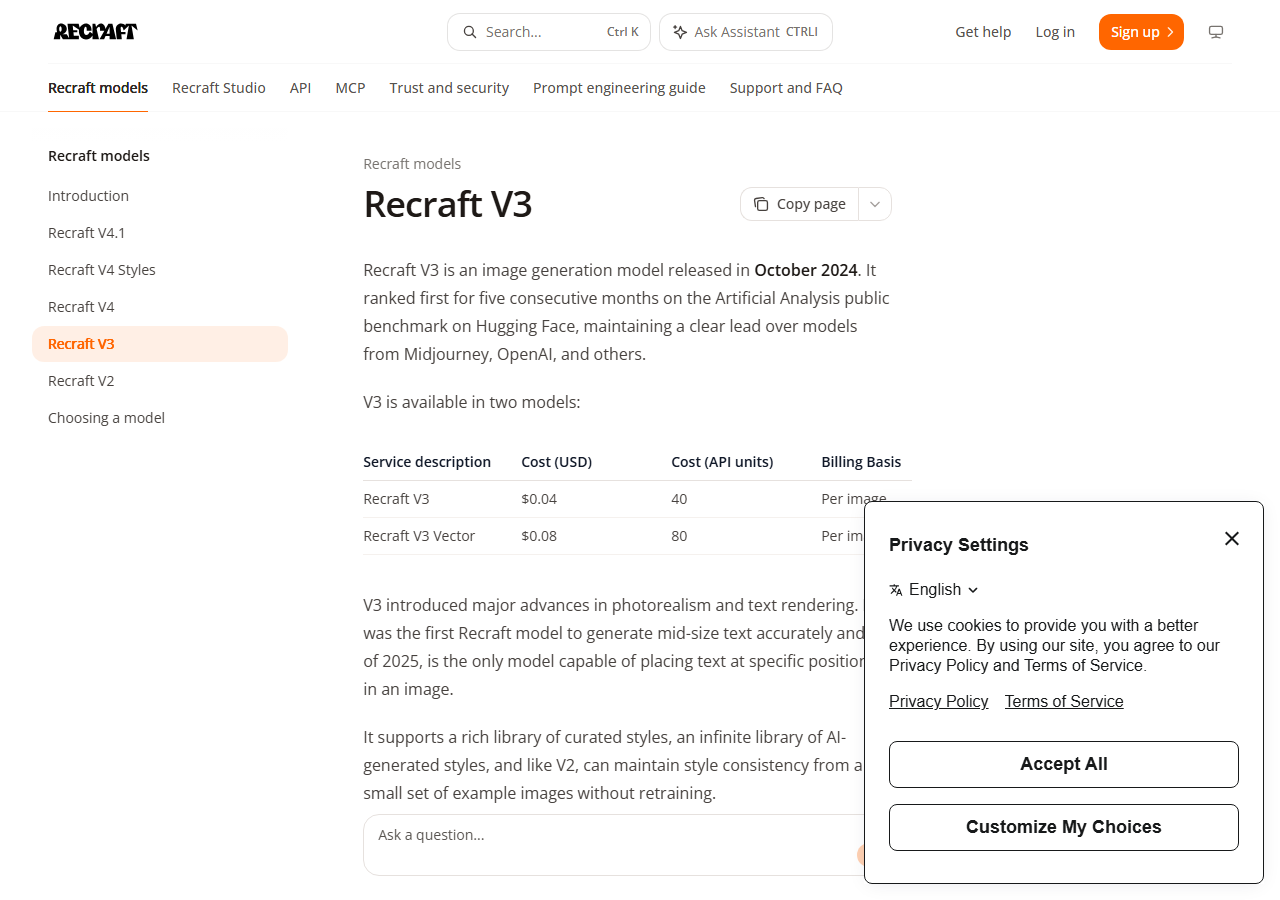
Pricing
Recraft V3 costs $0.04 per raster image (40 API credits, about 7s) and $0.08 per vector image (80 credits, about 16s) via the Recraft API; the same $0.04/$0.08 rates are mirrored by fal.ai, Replicate and OpenRouter. Inside Recraft Studio, V3 draws from the same monthly credit plans as other Recraft models rather than being billed separately.
| Tier | Rate |
|---|---|
| Raster API | $0.04 per image (40 credits), ~7s generation |
| Vector API | $0.08 per image (80 credits), ~16s generation |
Key Features
- Native vector output: Recraft V3 Vector emits real SVG paths with substantially fewer anchor points than a traced raster file, so exports are clean enough to hand off to a designer directly.
- Positioned text rendering: V3 was the first Recraft model able to place readable text at a specific spot in a generated image rather than somewhere approximate in the frame.
- Artistic level control: An Artistic level parameter trades conventional, direct compositions at low settings for unusual angles and perspectives at high settings, in the same request.
- Style library and custom styles: Pick from a built-in style catalog or generate a new AI style on demand, then lock a prompt onto that specific visual language without retraining anything.
- Multi-host API access: Available through Recraft's own API as well as fal.ai, Replicate and OpenRouter, each running the same model on its own infrastructure and billing.
Pros
- Topped the Artificial Analysis Text-to-Image Leaderboard on release, beating the leading Flux and Midjourney models in head-to-head comparisons.
- Native SVG vector output means exported logos and icons are already editable paths, not a raster file that needs manual tracing.
- Priced per image rather than per subscription seat, so occasional or API-only users are not forced onto a monthly plan.
Cons
- Superseded by Recraft's newer V4 generation for photorealism and compositional accuracy, so new projects generally default to it instead.
- Recraft has never published a dedicated safety writeup or named outside evaluators for this specific generation, unlike frontier language models from larger labs.
- Nothing about the weights is downloadable or self-hostable, so uptime for every request depends entirely on Recraft's servers or a third-party host's.
Benchmarks
- AA Image Arena Elo: 1172 cited: Artificial Analysis · 30 Oct 2024
- AA Image Arena Win Rate (%): 72 cited: Artificial Analysis · 30 Oct 2024
A benchmark is an exam, not the job. Scores transfer unevenly between tasks, so weigh the one closest to your workload and read every figure with its source.
Frequently Asked Questions
What does Recraft V3 cost to generate an image?
Recraft V3 costs $0.04 per raster image and $0.08 per vector image through the Recraft API, credit-metered at 40 and 80 API units respectively, with the vector version taking roughly twice as long to generate. Third-party hosts fal.ai, Replicate and OpenRouter charge the same per-image rate rather than marking it up.
How does Recraft V3 compare on benchmarks to Flux and Midjourney?
Recraft V3 outscored both Flux and Midjourney in the crowd-judged pairwise comparisons that decided the leaderboard's initial rankings, taking the top spot outright. Recraft's newer V4 generation has since taken over as the higher-photorealism choice, so V3 today wins mainly on stylization and lower cost, not raw benchmark rank.
Can Recraft V3 be self-hosted, or is it API-only?
Recraft V3 is fully proprietary: there is no downloadable checkpoint, open license, or self-hosting option. It runs only through Recraft's own API and Studio app, or through licensed third-party hosts fal.ai, Replicate and OpenRouter, each requiring their own API key and billing.
Is my data used to train future Recraft models?
No: images and files a customer generates or uploads stay inside that account and are not fed into training runs for other models, and account holders in Europe can invoke standard GDPR deletion rights on request. No V3-specific retention window or zero-retention enterprise option has been published separately from Recraft's general platform policy.
Who is Recraft V3 best for, and who should avoid it?
V3 is the right pick when the brief wants Recraft's original stylized, illustrative look, lower per-image cost, or faster raster generation than the V4 family. Teams chasing 2026-level photorealism, tighter compositional control, or the newest text-rendering quality should choose Recraft V4 or a rival like Midjourney v6.1 instead.
HokAI guides covering Recraft V3
- How HokAI Verifies a Listing Before It Goes Live: We pulled all 656 HokAI listing records from the public API on 18 August 2026 and counted the receipts: 39,161 fields and dated check stamps you can audit.