Best Personal AI Agent in 2026: Pick by How You Live
A personal AI agent is software that signs into your accounts and keeps working on chores after you close the app, then asks before it sends, pays or signs. In October 2026 the main options are bundled into existing plans, start free, bill per task, or are open source you host yourself.
The short version
Pick a personal AI agent by where you live and where you already talk, not by brand. US founders on Claude should try Duet, Instagram sellers Muse, ChatGPT teams dots, X users Grok Bot, texters Poke, Prime households Alexa+, researchers Perplexity Computer, and tinkerers OpenClaw or Hermes.
Want this decided for your own case? Find your tools with Smart Match, starting from this guide's question.
This autumn Meta, OpenAI and Anthropic each shipped an agent that keeps working after you close the app, and two of the three are fenced to North America. That fence matters more than any benchmark. Start there.
A personal AI agent is no longer one product type. Some live in your texts, some in a smart speaker, some on a cloud computer the vendor runs, and some on a server you rent yourself. Pick the "best" one by brand and you can end up with an agent in the wrong place, in the wrong country, on a plan you do not pay for.
So this guide picks by reader. Every price below comes from the vendor's site, checked on 24 October 2026.
If you want the four big-lab agents set side by side, our four-way always-on agent comparison does that job. The monthly bill in detail lives in what personal AI agents really cost. This page answers the question before both: which kind of agent fits your life at all.
How to choose a personal AI agent: four questions to ask first
Most bad picks fail on one of four questions, and the order matters, because the first one alone removes half the field for anyone who lives outside the United States or Canada. Answer them in order.
- Can you get it where you live? Check this first. Claude Duet is a US waitlist, Muse is the US and Canada, and dots reach "eligible markets" that OpenAI's page does not list. A great agent you cannot sign up for is a zero.
- Where will you talk to it? An agent you text gets used. One that needs its own app gets forgotten. Match the channel to where you already spend your day: a chat app, a kitchen speaker or a terminal.
- Which subscription do you already pay for? Four of the agents here ride inside an existing plan. If you already pay one of those vendors, the cheapest trial is the one in your wallet.
- What may it do without asking? Write down the actions that must always come back to you: sending, paying, signing, deleting. Then reject any agent that cannot hold that line.
That last question is the one people skip, and it is the one that costs money. Our guide to personal AI agent approval gates walks through each vendor's rules in depth.
The shortlist: one pick for each kind of person
Here is the short answer. Find your row. Each row is a reader, the agent we would start them on, the cheapest way in, and the one thing to check before you commit.
| Who you are | Start with | Cheapest way in | Check first |
|---|---|---|---|
| Small business owner in the US | Claude Duet | Claude Pro, $20 | Waitlist, US only |
| Seller on Instagram or Facebook | Muse | Free tier | US and Canada only |
| Team that lives in ChatGPT | OpenAI dots | ChatGPT Pro | Price not readable |
| X power user or Cursor developer | Grok Bot | Premium, $30 | Pool shared with Cursor |
| Wants to just text an assistant | Poke | Free, no card | Background work needs Pro |
| Runs a household on Amazon | Alexa+ | Free with Prime | A home helper, not a work agent |
| Wants finished reports and decks | Perplexity Computer | Pro, $17 yearly | Not on free accounts |
| Wants to own the whole stack | OpenClaw or Hermes | $0 software | You run the server |
The sections below take one reader at a time, with the reason for each pick, the plan it needs, and the alternative we would try second if the first choice is closed to you. Skip to yours.
If you run a small business: Claude Duet or Muse
Two agents are built for the owner who does everything. They split on where your customers are.
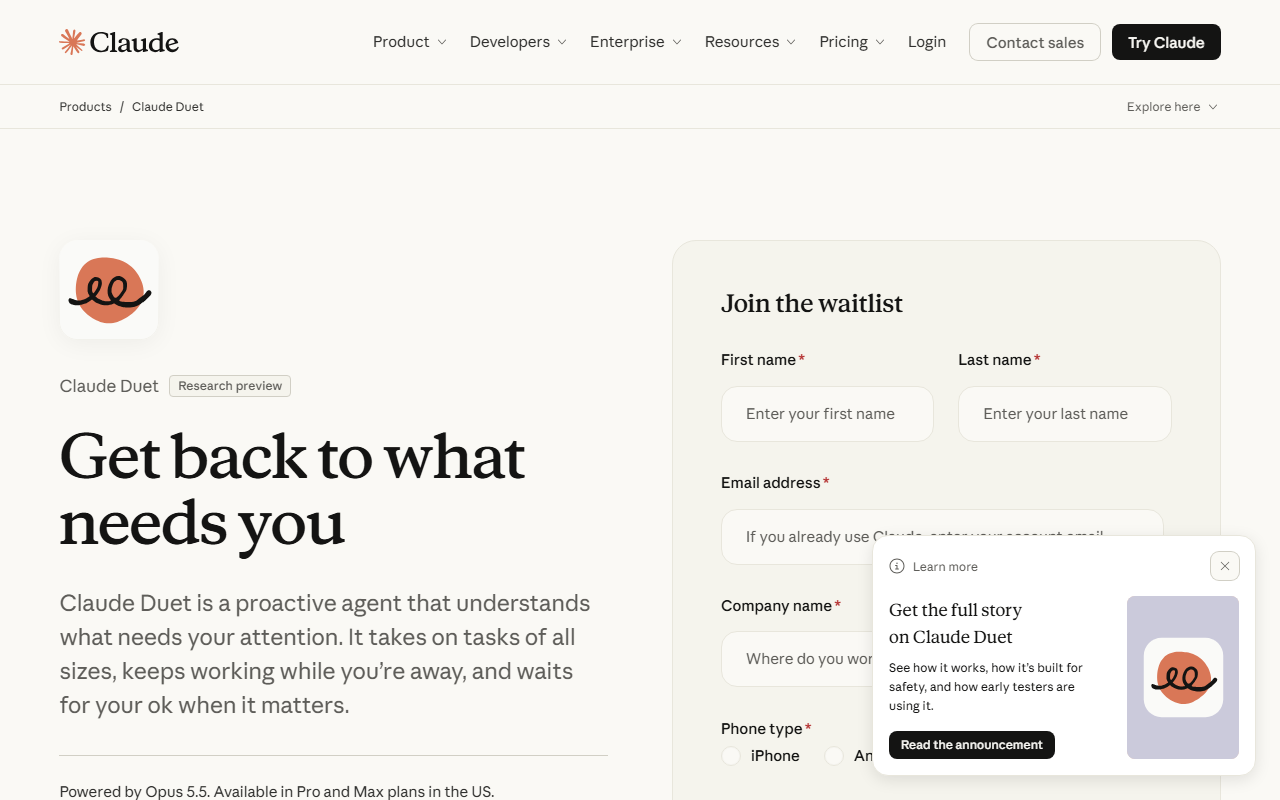 Anthropic's Claude Duet page, captured 24 October 2026. The waitlist form and the US-only plan line at the bottom are the two facts to check before anything else.
Claude Duet is the back-office pick. Anthropic's product page describes an agent that sends a morning brief, flags what needs you in your inbox and calendar, finds unpaid invoices and drafts the reminders, and prepares payroll. It runs on Claude Opus 5.5 and keeps its own cloud computer.
The catch is access. Anthropic lists it as a research preview on a waitlist, open to US subscribers on its Pro and Max plans, Team and Enterprise plans are not included yet, and the page gives no date for when either of those limits might lift.
Duet also inherits your Claude account: memory, skills and connectors carry over. Daily users start with context. That head start is worth a week of setup elsewhere.
Muse is the pick when the business lives on Meta's apps. According to Meta's small-business launch post, a few clicks link your Instagram analytics, your Facebook Pages and your ad accounts, and outside tools such as Shopify and QuickBooks join them. In the same post, an Iowa grocer named Tom Mulholland says he puts in about 65 hours a week. That is the reader Meta is chasing. Busy, and short on staff.
Muse starts free with a usage limit that refreshes, per Meta's subscription help page. Power costs $20 a month for 500M Muse tokens a week, and Maximum costs $100 for 3B. Meta says Muse is available in the US and Canada, and that subscriptions are still in limited testing.
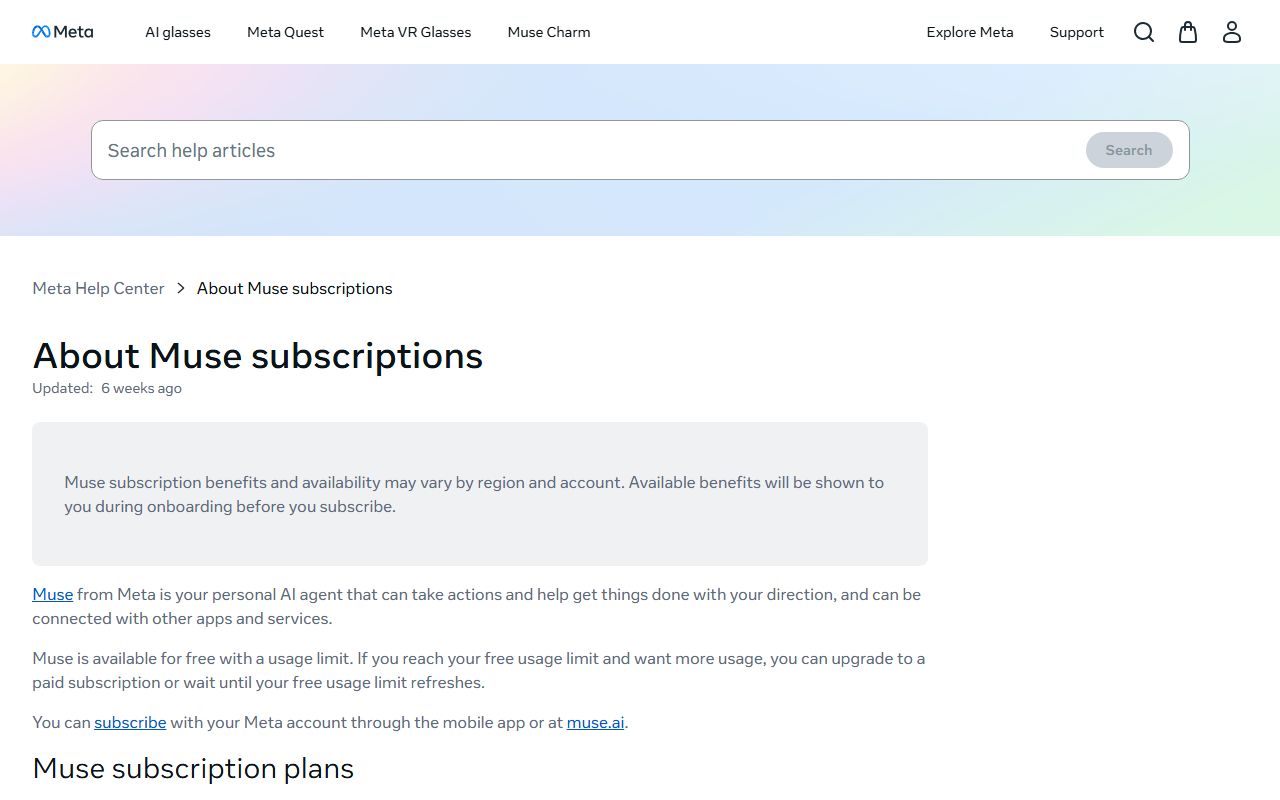 Meta's Muse subscriptions help page, captured 24 October 2026. It confirms the free tier and its refreshing limit, but prints no size for that limit.
Claude Duet or Muse: the side-by-side
The two split cleanly on four questions.
| Question | Claude Duet | Muse |
|---|---|---|
| Entry cost | Claude Pro, $20 a month | $0 free tier |
| Where offered | US, by waitlist | US and Canada |
| Best at | Invoices, payroll, inbox | Instagram, Facebook, ads |
| Talk to it | Text or voice in Claude's app | Muse app or WhatsApp |
Our pick: a US founder already paying for Claude should join the Duet waitlist today. A Canadian shop, or anyone whose sales start on Instagram, should open Muse first, because it costs nothing to find out.
If your team works in ChatGPT or on X: dots or Grok Bot
These two are built for people who already spend the working day inside one company's product, where the agent's real advantage is that it starts with everything that product already knows about you.
OpenAI dots start from your ChatGPT memory and use Codex plus your connected tools, per OpenAI's dots page. You message a dot in ChatGPT on web, mobile and desktop, and it can also sit in Slack and Microsoft Teams. Access covers Pro, Business Premium and Enterprise in eligible markets. OpenAI says texting a dot is coming next.
The page lists work examples, such as a finance lead whose dot tracks revenue and refreshes the investor deck, or a developer whose dot reads customer feedback, scopes the small fixes, builds them and tests them while the developer gets on with the next big feature. It runs on GPT-6 Astra. We could not read a ChatGPT Pro price on OpenAI's pricing page, which sent us to a login screen, so the shortlist leaves that cell honest rather than filled.
Grok Bot is the pick for heavy X users and for anyone who codes in Cursor. xAI's pricing page lists Bot from the $30 Premium plan up. Every tier draws on one usage pool shared with Cursor. The two cheapest plans leave Bot out entirely.
xAI's Bot page has the most unusual idea in this field: you do a workflow once while a Bot watches, and it saves that as a routine it runs on its own next time. You can also put several Bots in one thread and let them hand work to each other. Message them from desktop or iOS. That is it.
Our pick: dots for a team whose decisions already happen in Slack or Teams. Grok Bot for a solo operator who wants several agents in parallel and does not mind sharing a pool with coding work.
If you just want an assistant you can text
Some people do not want another app. They want a contact in their phone that answers, remembers what they said last Tuesday, and sends a nudge when a bill is due without being asked to.
Poke is that contact. Its homepage says it works through the messaging apps you already use, by text or voice note. The pricing page lists a Free plan with no credit card, Pro at $19 a month and Ultra at $199. Read the Pro line carefully. Background automations sit there, not on Free. On Free, Poke answers when you text it. On Pro, it texts you first.
One more line on Poke's homepage matters for anyone building a habit around it. A banner reads "Poke is joining Cognition", so the plan you sign up for today may be repriced by new owners.
Cue, from the team behind Manus, goes further. Its site describes an agent with its own phone number, email address, wallet and computer. It takes calls you forward, emails from its own address and pays with its own card. Cue offers Windows and macOS downloads, a mobile app and an Apple Messages route. We found no price on the page.
Our pick: start on Poke Free for a week. If you catch yourself wishing it would message you first, that is the signal to pay for Pro.
If the agent is for the whole household: Alexa+
Every agent above is built around one person. Alexa+ is built around a home. Big difference.
Amazon's announcement says Alexa+ is free for Prime members, and $19.99 a month for anyone without Prime. Non-Prime customers in the US can also try a free text chat at Alexa.com and in the Alexa app, with limits. Prime access covers the whole household across Alexa-enabled devices, Alexa.com and the app.
The examples Amazon gives are domestic, from pairing with Ring cameras to flag unusual patterns to emailing a school schedule to Alexa+ so every date lands on the family calendar without anyone typing it in. That is a different job from chasing invoices. Alexa+ will not run your back office, and nobody here would recommend it for that.
Our pick: if you already pay for Prime, switch Alexa+ on before you pay for anything else on this list. It is the only option that costs a Prime household nothing and that the whole family can talk to.
If you want finished work, not reminders
A different group of buyers does not want an assistant at all. They want a deliverable. A report, a dashboard, a deck.
Perplexity Computer is the clearest fit. Perplexity's credits help page sets the rate at 100 credits to $1, puts a quick fact at 15 to 70 credits and a multi-step research report at 350 to 950. So a typical report costs under $10. Computer is not available on free accounts.
| Plan | Price, billed yearly | What Computer gets |
|---|---|---|
| Pro | $17 a month | Weekly allowance, Light effort |
| Max | $167 a month | 10,000 credits a month |
Auto-refill is off by default. Keep it that way. With it on, Perplexity charges your card when credits run out and the task simply keeps going, which is convenient on a deadline and expensive on a job that has wandered off course.
Three alternatives fit the same reader. ChatGPT Work turns a goal into a document or deck inside ChatGPT. Manus takes a whole goal and keeps going after you close the tab. QwenWork, from Alibaba, has a free plan with 200 daily login credits for a limited time, and a Plus plan at $20 a month with 2,000 credits.
Our pick: Perplexity Computer for research-heavy work, because it is the only vendor here that prints what a typical job costs before you run it.
If you would rather own the whole thing
The last reader wants the agent on hardware they control, running the model they choose, with no vendor able to change the rules, raise the price or switch the product off on a quiet Friday. Several open-source projects serve them.
OpenClaw is the best-known. Its site says it runs on Mac, Windows or Linux, keeps its state on your machine, and talks to you on WhatsApp, Signal, iMessage or any of 29 chat channels. A non-profit foundation keeps the project MIT licensed and sells no paid tier. It now has iOS and Android apps with remote approvals paired to your own gateway.
Hermes Agent from Nous Research is the one that learns. Its site says it builds persistent memory and generates its own skills from how it solved past problems. It reaches you on 5 chat apps or by email, ships a desktop app for macOS and Windows, and is MIT licensed too. Unlike OpenClaw, Hermes offers an optional hosted deployment through Nous Portal if you want the agent without the server.
Lighter options exist for tinkerers. NanoClaw keeps its source small enough to read. nanobot is a Python take that runs from a browser or terminal. Agent Zero works inside its own Linux machine via Docker.
None of these cost anything to license. All of them cost a model bill. And your evenings. Our OpenClaw playbook covers the setup decisions, and the cost guide prices the always-on heartbeat.
Where you can actually use each agent
This is the table the "best of" lists skip. Availability decides more picks than features do, so here it is in one place, as each vendor's own page stated it on 24 October 2026.
| Agent | Where it is offered | How you reach it |
|---|---|---|
| Claude Duet | US, Pro and Max, waitlist | Claude app, text or voice |
| Muse | US and Canada, age 18+ to subscribe | Muse app, WhatsApp |
| OpenAI dots | Eligible markets, unlisted | ChatGPT, Slack, Teams |
| Grok Bot | No country limit stated | Desktop, iOS |
| Poke | No country limit stated | Messages, WhatsApp, Telegram |
| Alexa+ | US subscription and Prime | Alexa devices, Alexa.com, app |
| Perplexity Computer | Paid Pro and Max plans | Web and apps |
| OpenClaw, Hermes | Wherever you host them | 29 or more chat channels |
Two readers should study this table hardest. Anyone outside North America loses Duet and Muse outright. That leaves four realistic options: Grok Bot, Poke, Perplexity Computer and a self-hosted agent. And anyone in China has a separate set of agents, from QwenWork to Tencent's WorkBuddy and Z.ai's AutoClaw, built for the chat apps used there.
One listing has gone quiet since our 26 August check. Google's page for Gemini Spark now redirects to the general Gemini plans page, which mentions "Tasks in Gemini" on the Ultra plan, from $99.99 a month, in select countries instead. We have left Spark off the shortlist until Google says what replaced it.
What a personal agent really costs you
The sticker price is rarely the cost. What matters is the extra money you spend because of the agent.
- Bundled agents (Duet, Grok Bot, dots) cost nothing extra if you already pay for the plan. They spend the same allowance as your chat and coding, so a heavy agent can push you up a tier.
- Free-to-start agents (Muse, Poke) let you test at $0. The paid step is $19 or $20 a month once you want more work, or background work, from them.
- Metered agents (Perplexity Computer) bill the job. That is the most predictable model for occasional big tasks.
- Self-hosted agents (OpenClaw, Hermes) cost $0 to license and a model bill to run. An idle agent that checks in on a schedule can still run up a real invoice, as the cost guide works out.
For the per-tier tables and our heartbeat arithmetic, read the full personal agent cost breakdown. If you want a recommendation built from your own stack rather than a persona, Smart Match asks what you want handed off and narrows the field from there.
What happens to your data and your logins
Every agent here signs into your real accounts. So ask two things. Where does it do that, and what may it do alone?
The hosted agents each run on a computer the vendor manages. Muse's homepage describes a persistent, isolated Linux machine with a full browser, saved logins kept in a store Muse cannot see, and a one-time card number generated at checkout. Meta's small-business post adds that Muse needs your sign-off before anything goes out or any money moves.
Anthropic says Duet runs approvals, logins and safety checks in your own cloud computer. OpenAI says dots let you set Custom Rules to allow, require approval for or block specific actions, and that steps like changing your password stay with you.
Self-hosting moves all of that onto you. All of it. OpenClaw keeps state on your machine, which is real privacy, but you patch the server and guard the API keys. Pick the trade you would rather live with. A vendor's rules. Or your own maintenance.
Who should skip a personal agent for now
Skip the category if nothing in your week repeats. A brief you never open is not help. Only a trial tells you whether you will read one. Run a free trial on Muse, Poke or Alexa+ before you pay for anything.
Skip it too if what you need is one narrow job done well. A dedicated tool is cheaper and more predictable: a calendar scheduler such as Reclaim.ai or Motion, or a workflow builder like Lindy. And if your whole working day runs in Microsoft 365, start with the assistant already in it, Microsoft Copilot, before adding a second vendor.
The case against picking by persona
The strongest objection to this guide is that personas are a shortcut. A founder might be better served by dots than Duet, and the persona table cannot see that. We found no independent test of how often these agents finish a job without help, so we cannot rank them on results.
That objection is fair. It is why every pick above starts with the cheapest trial. The persona only tells you which two agents to try first, and it takes a week of real work, with the same chores handed to both, to tell you which one is worth keeping. Give both the same two chores, keep approvals on, and count the jobs that finished without a rescue.
The other objection is that availability will change. It will. Fast. But the field moves fastest at the edges: who gets access, which plan includes it. The four questions at the top of this guide will still sort it when it does.
What we could not verify
- The cost of the plan that carries dots. On 24 October 2026 OpenAI's plan page opened only to a login screen for us, so the shortlist leaves that cell blank.
- Muse's free allowance. Meta confirms a usage limit that refreshes but does not publish its size.
- Where dots are offered. OpenAI says "eligible markets" without a list on the dots page.
- What replaced Gemini Spark. Google's Spark page now redirects, and no Google page we read names a successor.
- Cue's price. The site we read lists downloads and features but no plan or price.
What would change these picks
A short list of events would reshuffle the table. Each is plausible within months. Duet leaving the waitlist, or reaching countries outside the US, would make it the default pick for any Claude subscriber. Muse expanding beyond the US and Canada would make the only free big-lab agent available to most of the world. And a published, independent completion test would let us rank on results rather than fit.
The one to watch first is texting. OpenAI says texting a dot is coming next, and when it lands, Poke's best reason to exist becomes a feature of ChatGPT.
Frequently asked questions
What is the best personal AI agent in 2026?
There is no single winner, because availability and channel decide more than features. Claude Duet suits US small business owners already on Claude, Muse suits sellers on Instagram and Facebook in the US and Canada, and Poke suits anyone who wants an assistant they simply text.
Is there a free personal AI agent?
Yes. Muse has a free tier with a usage limit that refreshes, Poke has a Free plan with no card, and Alexa+ is free for Prime members in the US. OpenClaw and Hermes Agent are free open-source software, though you pay for the model and the machine.
Which personal AI agents work outside the US?
Claude Duet is US only and Muse covers the US and Canada, per their vendors. Grok Bot and Poke stated no country limit on the pages we read, and a self-hosted agent such as OpenClaw runs wherever you host it.
Can a personal AI agent spend my money?
Some can, but the major ones ask first. Muse checks before sending email or making a purchase and uses a one-time card number, and dots let you set Custom Rules that allow, require approval for or block actions. Keep approval on for anything that pays, sends, signs or deletes.
Should I self-host a personal AI agent?
Self-host only if you want control more than convenience. OpenClaw and Hermes Agent are MIT licensed and keep your data on your own machine, but you run the server, pay the model provider and handle security yourself.
Covered in this guide
- Agent Zero: Agent Zero is a free, MIT-licensed agent framework that runs in Docker with a Linux desktop, browser and projects. 19.5k GitHub stars.
- Alexa+: Amazon's LLM-based Alexa that books tables, orders food and runs your home, live in the US since February 2026 and launched in 12 countries.
- AutoClaw: Z.ai's desktop agent for Windows, macOS and Linux runs 50+ built-in skills on GLM models, with a free tier of daily credits.
- ChatGPT: ChatGPT is OpenAI's AI assistant, with 1.2 billion weekly users by OpenAI's count, the GPT-6 model family and plans that run from a free tier to a premium Pro tier.
- ChatGPT Work: OpenAI's ChatGPT Work agent plans and finishes multi-step projects across connected apps and files. It launched on 9 July 2026 and now reaches every ChatGPT plan, with limits.
- Claude: Claude is Anthropic's AI assistant, with a free tier, paid personal plans, and Team and Enterprise seats. Opus access starts at the first paid plan.
- Claude Duet: Anthropic's research-preview agent on Claude Opus 5.5 watches your connected apps, messages you first, and waits for your OK before it sends, pays or signs.
- Claude Opus 5.5: Anthropic's September 2026 flagship LLM with a 1 million token context window, built for long-running agentic coding and computer use.
- Cue: Invite-only Manus app that gives each personal agent four things of its own: a phone line, an inbox, a wallet and a computer.
- Cursor: Cursor is an AI code editor built on VS Code, widely adopted across large enterprise engineering teams, with Agent Mode, Tab completion, and Cloud Agents.
- Gemini Spark: Google's persistent AI agent, launched May 2026, that runs 24/7 on cloud VMs to manage Gmail, Calendar, and Docs inside Google's top-tier AI Ultra plan.
- GPT-6 Astra: OpenAI's flagship model, launched September 2026 as the first ever rated at the Preparedness Framework's Critical cybersecurity level.
- Grok Bot: xAI's always-on AI agents that sign into your existing apps and finish multi-step jobs, included in xAI's joint Grok and Cursor bundle from the Premium tier up.
- Hermes Agent: Hermes Agent is Nous Research's MIT-licensed self-improving AI agent, past 250,000 GitHub stars by October 2026. Self-hosted, model-agnostic, with optional paid Nous Portal plans.
- Lindy: AI teammate that handles email, meetings and workflows across 1,000+ apps; no free plan, just a 7-day trial then per-seat billing.
- Manus: Autonomous AI agent that plans and executes multi-step work from one prompt: research, documents, apps and video. The September 2026 release adds Cascade, Automations and Studio. Free tier available.
- Microsoft Copilot: Your everyday AI companion powered by GPT-5.6 (preferred model July 2026), GPT-4o, and GPT-5 for productivity, creativity, and intelligent assistance
- Motion: Motion is an AI-powered scheduling and productivity platform used by 1M+ professionals that automates calendar management, task prioritization, and project planning with AI Employees.
- Muse: Meta's AI agent runs tasks in its own cloud computer; since 29 Sept 2026 it connects Shopify, QuickBooks, Meta ads and more for small businesses in the US and Canada.
- nanobot: nanobot is a free, MIT-licensed personal AI agent you host yourself, with a browser WebUI, a terminal client and chat apps. 49k GitHub stars.
- NanoClaw: NanoClaw is a free, MIT-licensed personal AI agent for your own Mac or Linux machine, running one Docker container per session behind your chat apps.
- Nous Research: Nous Research, founded 2023, builds the open-source Hermes Agent and is launching Hermes for Businesses for enterprise teams.
- OpenAI dots: OpenAI's always-on agent in ChatGPT runs on GPT-6 Astra with its own cloud computer, and asks approval before consequential actions.
- OpenClaw: OpenClaw is a free, MIT-licensed agent gateway: one self-hosted process connects your chat apps to the AI model you choose, with the OpenClaw Foundation as steward.
- Perplexity Computer: Perplexity's autonomous worker runs research, documents and email tasks in a cloud sandbox, with a Mac and Windows app that adds your local files.
- Poke: Text-first personal agent in Apple Messages, WhatsApp and Telegram that handles email and reminders, now part of Cognition (since 23 July 2026).
- QwenWork: Alibaba's work agent opened an international beta on 26 August 2026 and merges 3 agent platforms into one web and desktop app.
- Reclaim.ai: AI calendar app that automatically schedules tasks, meetings, and focus time to reclaim your workweek.
- WorkBuddy: Tencent's desktop work agent runs on Mac and Windows, takes one-sentence tasks and offers a free plan with monthly credits.
Sources
Still deciding?
This guide covers a handful of options. Smart Match checks every listing in the directory against how you actually work and what you can spend, then hands you the shortlist and the reason behind each pick.
Find your toolsRelated guides
- The AI 80s Photo Trend: How to Make Yours (and Turn It Into a Video) in 2026AnalysisWhat changed and who it affects
- AI Development Services in 2026: Which Layer You Actually NeedBuyer's guideHow to pick, across a category
- The AI Tools That Do One Microsoft Copilot Job, CheaperBuyer's guideHow to pick, across a category
- Attio vs HubSpot in 2026: Which CRM for a Startup?ComparisonHead-to-head, with a verdict
- Best Agentic AI in 2026: Pick the Job, Not the GeneralistBuyer's guideHow to pick, across a category
- Best AI Agent Builders in 2026: Automate, Build or Self-HostBuyer's guideHow to pick, across a category