Personal AI Agent Cost in 2026: What You Really Pay Each Month
A personal AI agent in 2026 costs $0 to about $200 a month. Muse has a free tier, Poke Pro is $19, Claude Duet comes inside Claude Pro at $20, Grok Bot starts at $30, and self-hosted OpenClaw needs a server from $6 plus model API spend.
The short version
Most personal AI agents cost more than their sticker price suggests. Claude Duet and Grok Bot spend the same allowance as your chats, Muse and Poke start free but Poke's background work begins at $19, Perplexity bills per task, and self-hosting OpenClaw swaps a subscription for a model bill that idle check-ins alone can push past $50.
Want this decided for your own case? Find your tools with Smart Match, starting from this guide's question.
On 21 October 2026 Anthropic opened Claude Duet to a waitlist, and its FAQ answers the money question in one line: the agent's background checks count toward the same usage limits as your chats. No new invoice. A new drain.
That is the pattern across the seven personal agents worth pricing this autumn. Two are bundled into plans you may already pay for, two start free and charge once the work runs in the background, one bills per job, and two are free software that runs up a model bill instead. If you already pay for one AI subscription and want an agent that works while you sleep, the sticker price tells you almost nothing about the month you will actually have.
Every price below was read on the vendor's own page on 22 October 2026. Where a vendor hides a number, we say so instead of filling it in. For what these agents may do without asking you, read our companion piece on personal AI agent approval gates; this guide is only about the bill.
How to count the real monthly cost before you pick
Four numbers decide what an agent costs you. Find all four before you compare anyone's headline price.
- The entry plan that runs background work. Several free tiers let you chat with the agent but stop short of letting it act on a schedule. That cut-off is the real entry price.
- The pool it draws from. A bundled agent usually shares a usage allowance with chat, coding and image tools. Its cost is whatever that sharing pushes you into buying.
- The overage path. When the pool runs dry, some vendors block you until the weekly reset, some sell top-ups, and one charges your card automatically if you let it.
- The marginal cost. If you already pay for the plan, the agent's cost is the upgrade it forces, not the plan price.
The fourth number is the one most comparisons skip. A $20 plan you already own is a $0 agent until the day it is not.
What each personal AI agent costs per month
This is the cheapest way into each agent with background work switched on, plus the next step up where it matters. The full per-tier tables for the four big-lab agents sit in our four-way always-on agent comparison.
| Agent | Plan that runs it | Monthly price | What background work draws on |
|---|---|---|---|
| Claude Duet | Claude Pro | $20, or $17 billed yearly | Same limits as chat and coding |
| Claude Duet | Claude Max | From $100 | 5x or 20x the Pro limits |
| Grok Bot | Premium | $30 | Weekly pool shared with Grok and Cursor |
| Grok Bot | Super | $100 | 15x the Plus pool |
| Muse | Free | $0 | A weekly limit Meta does not publish |
| Muse | Power | $20 | 500M Muse tokens a week |
| OpenAI dots | ChatGPT Pro | Not readable on OpenAI's site | Pro, Business Premium or Enterprise |
| Poke | Pro | $19 | Background automations start here |
| Perplexity Computer | Pro | $17 billed yearly | Weekly included usage, then credits |
| Perplexity Computer | Max | $167 billed yearly | 10,000 credits a month |
| OpenClaw | Self-hosted | $0 software | Your server plus model API |
| Hermes Agent | Self-hosted | $0 software | Your provider, or Nous Portal |
Two rows deserve a warning. The dots price is missing because OpenAI's pricing page sent both of our browsers to a login screen; our explainer on what OpenAI dots do covers what the agent includes. The Perplexity rows show yearly billing because that is the only rate its plan page prints.
Bundled agents spend the allowance you already pay for
Claude Duet has no price of its own. It is a research preview for US subscribers on Claude Pro and Max, and the product page is unusually direct about usage: during the preview, Duet draws on the same limits as everything else in your Claude account, its background checks count, and big jobs such as a financial model or a deck take more model turns.
So the real question for a Claude subscriber is how much headroom you have left. If you already hit your Pro limit by Thursday while coding in Claude Code, an agent that checks your inbox all day will hit it sooner. The upgrade it pushes you toward is Max, which Anthropic's pricing page lists from $100 a month for 5x the Pro usage.
Duet runs on Claude Opus 5.5, which Anthropic's API price list charges at twice the per-token rate of Sonnet 5.5. That matters for drawdown: Duet does not let you pick a lighter model for its routine checks.
Grok Bot works the same way with a wider pool. xAI leaves Bot out of its Free and Plus plans and switches it on at Premium. Every tier shares one weekly pool across Grok chat, image and voice, Bot itself and Cursor's coding agents. The allowance refreshes weekly. When you run out, you buy top-ups or wait.
xAI's own advice is telling. Its pricing page recommends Premium for new users and Super "for daily agent users", which puts the practical price of a busy Bot at $100 rather than $30. A developer who also codes in Cursor feels that first, because a heavy Bot week and a heavy coding week now come out of the same bucket.
The Grok API is a separate story. xAI says paid plans include API access, billed at model rates and kept out of the shared pool, so scripts you build yourself will not eat the Bot's allowance.
Muse and Poke: free to start, and where free stops
Muse is the one big-lab agent you can run at $0. Meta's help center says Muse "is available for free with a usage limit" that refreshes, and Meta's own launch post says the free version covers most people's needs. What Meta does not say is how big that free limit is. We could not find the number on any Meta page.
The paid plans are published, in Muse tokens per week:
- Power: $20 a month for 500M tokens a week.
- Maximum: $100 a month for 3B tokens a week.
Maximum is five times the price for six times the tokens, so the heavy plan is the cheaper rate per token. Both renew monthly and need you to be 18, and Meta says subscriptions are still in limited testing and not offered everywhere yet.
Poke is the cleanest example of where "free" stops. Its pricing page offers a Free plan forever, with no card, and lets you connect email, calendar and other apps. Background work is not on it. "Real-time automations running in the background" first appear on Pro, at $19 a month, along with frontier models and higher rate limits.
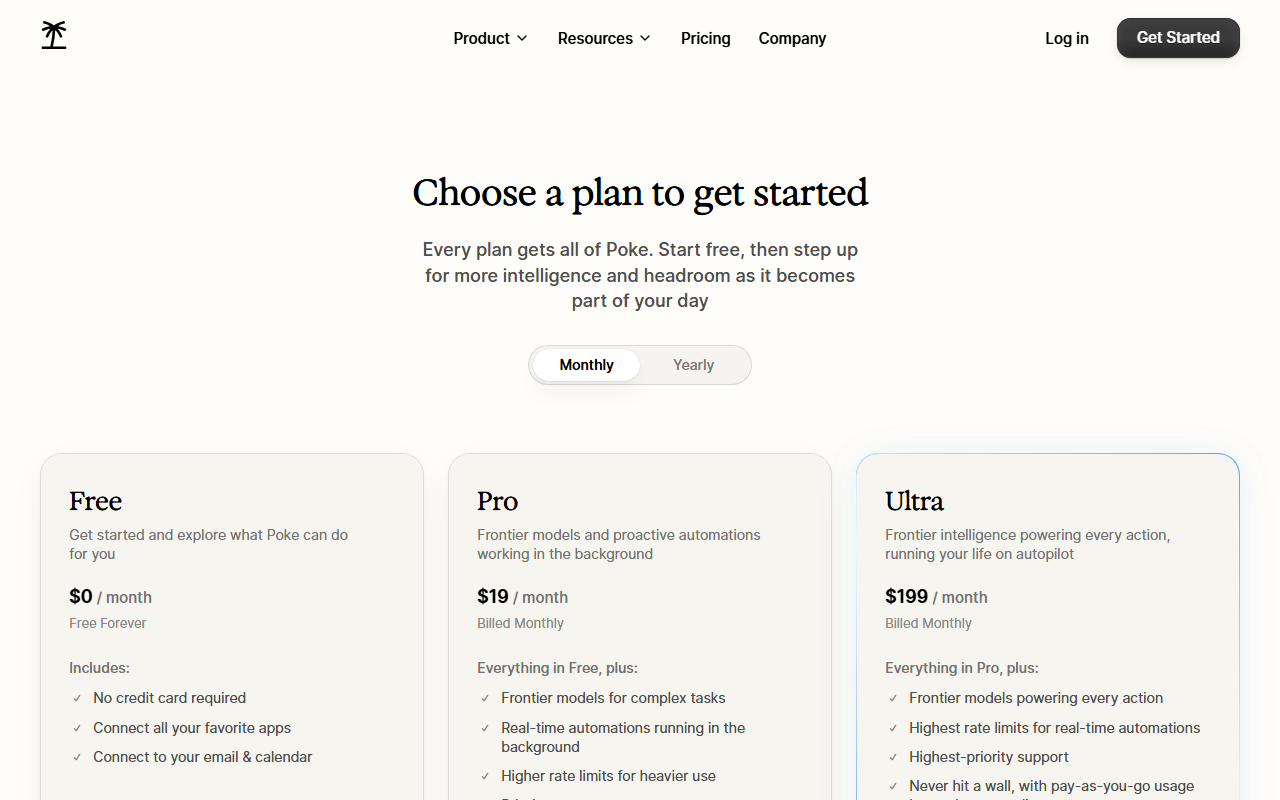 Poke's plan cards, captured 22 October 2026. The background-automation line sits under Pro, not Free.
So the honest entry price for a proactive Poke is $19. The Ultra plan, at $199, adds the highest rate limits and pay-as-you-go usage past its credits. Poke's homepage also carries a banner saying it is joining Cognition, which is worth noting before you build habits around a plan that new owners may reprice.
Perplexity Computer prices the work, not the month
Perplexity Computer is the only agent here that tells you what a single job costs. Its help center fixes the exchange rate at 100 credits to $1 and publishes typical ranges by task type:
| Task | Typical credits | Rough dollars |
|---|---|---|
| Quick fact or definition | 15 to 70 | Under $1 |
| Multi-step research report | 350 to 950 | $3.50 to $9.50 |
| Data dashboard | 2,400 to 9,800 | $24 to $98 |
| Whole app or multi-day build | 15,000 or more | $150 or more |
Perplexity labels those as examples, not guarantees. Even so, they are more than any other vendor in this guide publishes.
The plans wrap that meter differently. Max includes 10,000 credits a month, which is $100 of work at the published rate, inside a plan listed at $167 a month on yearly billing. Pro has no monthly credits; instead it includes a weekly amount of Computer usage, limited to the Light effort setting until you buy credits.
The overage rule is the one to read twice. When included usage runs out, Computer switches to credits. If you have none and auto-refill is on, Perplexity charges your card and the task keeps going. With auto-refill off, the session stops. Ordinary Perplexity searches never spend credits; only Computer tasks do. Comet, Perplexity's browser, is a separate product; this guide prices only Computer.
What self-hosting OpenClaw or Hermes really costs
OpenClaw costs nothing to license. Its site says the foundation behind it keeps the whole product MIT licensed, with "no enterprise edition and no paid version". Hermes Agent, from Nous Research, is also MIT licensed and says plainly that model providers and hosted services have their own pricing.
The bill has two parts: a machine that stays on, and the model the agent calls.
The machine. OpenClaw's own DigitalOcean guide puts a persistent install on the 1 GB Basic Droplet, and DigitalOcean's pricing page lists that size at $6 a month. The guide warns that 1 GB is enough only for API models, not a local one. Its hosting page lists more providers:
- Hetzner, which OpenClaw's docs describe as more cores and RAM per dollar.
- Hostinger, with one-click setup.
- Daytona, a cloud sandbox with preview URLs.
- Oracle Cloud's Always Free ARM tier, up to 4 cores and 24 GB of RAM, which the docs call finicky to sign up for.
A spare Mac or Raspberry Pi at home also works. Then the hardware is already paid for, and the cost is power and your time.
The model. This is where the money goes. Hermes users can bring their own provider or buy credits through Nous Portal, whose paid plans pay out slightly more in credits than they cost:
- Plus: $20 a month, with $22 of credits and a $10 rollover cap.
- Super: $100 a month, with $110 of credits.
- Ultra: $200 a month, with $220 of credits.
Portal's Free plan runs free models only. Hermes also offers a hosted, always-on deployment through the same portal, if you would rather not run a server at all.
One crossover is easy to miss. Anthropic's pricing page now lists $100 to $200 a month in API credits on Claude Max. Those credits are for the Claude Platform, which is the same API an OpenClaw or Hermes install calls when you point it at Claude Sonnet 5.5.
The heartbeat bill: our arithmetic for an always-on install
What makes an agent "always on" is a scheduled check. OpenClaw's docs say its heartbeat job runs every 30 minutes by default. That is 48 checks a day, or 1,440 in a 30-day month, before you hand it a single real task.
Each check sends the agent's own system prompt plus its workspace files. The token-use docs cap that injected bootstrap text at 60,000 characters, and estimate about four characters per token for English, so a full workspace sends roughly 15,000 tokens per check. Anthropic's pricing page lists Sonnet 5.5 at $2 per million input tokens.
We priced four cases. The 500 output tokens per check are our assumption, not a vendor figure.
| Workspace sent per check | Model | Cost per check | Heartbeats per month |
|---|---|---|---|
| Lean, 4,000 tokens | Sonnet 5.5 | $0.013 | $18.72 |
| Lean, 4,000 tokens | Opus 5.5 | $0.026 | $37.44 |
| Full, 15,000 tokens | Sonnet 5.5 | $0.035 | $50.40 |
| Full, 15,000 tokens | Opus 5.5 | $0.07 | $100.80 |
Read the bottom row again. A self-hosted agent on the heavy model, with a fat workspace, can spend as much on idle check-ins as a Max subscription costs, and it has not booked a flight yet.
Prompt caching can shrink the input side. Anthropic lists cache reads for Sonnet 5.5 at $0.10 per million tokens, a twentieth of the normal input price. Whether a check 30 minutes after the last one still finds a warm cache depends on the cache lifetime you pay for, so treat caching as upside, not the plan. OpenClaw's /usage cost command reports what your sessions actually spent; run it after the first week:
/usage costThe cheapest lever is not the model. It is the interval. A heartbeat every two hours instead of every 30 minutes cuts the idle bill to a quarter.
What self-hosting saves, and the data you take on
Self-hosting buys you control over where your data lives. OpenClaw's pitch is that your context and skills sit on your own computer, not in a vendor's account. That is real. It also means the security work is yours.
The hosted agents each run on a cloud computer the vendor manages. Muse gives every user a persistent, isolated Linux machine and keeps saved logins in a credential store it says Muse cannot see. Duet runs approvals and logins in your own cloud computer. dots get their own cloud computers too, governed by Custom Rules you set.
On a $6 droplet, none of that comes with the box. You patch the server, store the API keys, decide which inbox the agent can read, and back up its memory. Our OpenClaw playbook walks through the setup decisions, and plan for upkeep even in months when nothing breaks.
Three budgets, and the pick for each
| Your situation | Pick | Monthly cost | The one caveat |
|---|---|---|---|
| Pay nothing | Muse Free | $0 | Free limit unpublished |
| Already on Claude Pro | Claude Duet | $0 extra | US waitlist; shares your limits |
| New, under $20 | Poke Pro | $19 | Owner is changing hands |
| Occasional big jobs | Perplexity Computer | Per task, from under $1 | Auto-refill charges your card |
| Daily heavy delegation | Grok Super or Claude Max | $100 | Pool also feeds chat and coding |
| You like running servers | OpenClaw on a droplet | $6 plus API | Heartbeat can top $50 |
If none of these fits cleanly, our Smart Match asks what you actually want delegated and narrows the field from there.
Who should skip paying for a personal agent at all
Skip the whole category if your week does not have a recurring chore an agent could own. Morning briefs and inbox triage sound useful, but a Muse Free trial will tell you within a week whether you read them. That trial costs nothing.
Skip the upgrade if you are already near your limits for work you value more. Duet and Grok Bot both draw on the pool you code and chat from. If that pool is tight, the agent competes with you, not for you.
And skip self-hosting if you want an agent rather than a project. The software is free; the evenings are not. A buyer who wants something that runs itself is better served by ChatGPT Work or Manus, which keep the server their problem.
The case against self-hosting to save money
The strongest objection to this guide's numbers is that self-hosting looks expensive only because we priced it on Anthropic's models. Point OpenClaw at a free or cheap model, run it on Oracle's free tier, and the bill falls close to zero. OpenClaw's own docs point to Oracle's free tier for that reason.
They are right about the arithmetic and wrong about the comparison. A cheap model is not the same agent. The bundled agents run on each lab's flagship: Duet on Opus 5.5, dots on GPT-6 Astra by OpenAI's account. Downgrading the model to save $40 a month gives you a different, weaker assistant doing the same chores, and the failures cost time you did not price in.
There is a second, fairer point. Self-hosting is the only option here whose price you control line by line. The interval, the model, the workspace size and the server are all yours to cut. Every hosted agent can change its limits overnight, and one of them is changing owners. For a reader who values that control, the $6 droplet is the right answer even when it costs more.
What we could not verify
- ChatGPT Pro's price. OpenAI's pricing page redirected Obscura and Chrome to a login screen on 22 October 2026, so the plan that includes dots has no price here.
- Muse's free limit. Meta's help center confirms a free usage limit but not its size.
- Perplexity's monthly-billing prices. The plan page shows only yearly billing.
- Real heartbeat token counts. Our heartbeat table uses OpenClaw's documented cap and interval plus an assumed 500 output tokens. Your workspace will differ;
/usage costis the ground truth.
Comparisons elsewhere quote figures for several of these. We left them out rather than repeat numbers no vendor page confirms.
What would change these numbers
Watch three things. First, whether Anthropic splits Duet's usage from chat once the research preview ends; the FAQ ties the shared limit to "during the research preview", which leaves room for a separate meter. Second, whether Poke's Pro price survives the move to Cognition. Third, whether xAI's top-ups or Perplexity's credits become the default way to pay, which would turn every always-on agent into a metered one.
For the broader field beyond personal agents, our guide to the best AI agents in 2026 ranks them by autonomy rather than price. Re-check this page's table before you subscribe: we will, the day Duet leaves preview.
Frequently asked questions
How much does a personal AI agent cost per month?
Between $0 and about $200 a month for one person, read from vendor pages on 22 October 2026. Muse starts free, Poke's background automations start at $19, Claude Duet rides inside Claude Pro at $20, and Grok Bot starts at $30. Heavy users usually end up on a $100 tier.
Is Claude Duet free if I already pay for Claude?
It adds no charge for a US Pro or Max subscriber accepted from the waitlist. Anthropic says the agent spends your plan allowance alongside chat and coding, so the cost shows up as limits reached sooner. A heavy user may need to move up to Max.
Which personal AI agent has a real free tier?
Muse runs free with a weekly usage limit that Meta does not publish. Poke also has a free plan, but its background automations start on Pro. OpenClaw and Hermes Agent are free software, though you still pay for a server and a model.
How much does it cost to self-host OpenClaw?
The software is MIT licensed and free. OpenClaw's docs put a persistent install on a 1 GB DigitalOcean Droplet, listed at $6 a month, and the model API is the larger cost. At the default 30-minute heartbeat, our arithmetic puts idle check-ins at roughly $19 to $101 a month on Claude Sonnet 5.5 or Opus 5.5.
What does one Perplexity Computer task cost?
Perplexity's help center sets 100 credits to $1. A multi-step research report typically uses 350 to 950 credits, or $3.50 to $9.50, and a data dashboard 2,400 to 9,800. Perplexity calls these examples, not guarantees.
Covered in this guide
- Anthropic: Anthropic is a Public Benefit Corporation started by 7 ex-OpenAI researchers. It builds the Claude model family and counts Amazon and Google among its largest backers.
- ChatGPT Work: OpenAI's ChatGPT Work agent plans and finishes multi-step projects across connected apps and files. It launched on 9 July 2026 and now reaches every ChatGPT plan, with limits.
- Claude: Claude is Anthropic's AI assistant, with a free tier, paid personal plans, and Team and Enterprise seats. Opus access starts at the first paid plan.
- Claude Duet: Anthropic's research-preview agent on Claude Opus 5.5 watches your connected apps, messages you first, and waits for your OK before it sends, pays or signs.
- Claude Opus 5.5: Anthropic's September 2026 flagship LLM with a 1 million token context window, built for long-running agentic coding and computer use.
- Claude Sonnet 5.5: Anthropic's fastest Sonnet-class model, launched in September 2026, with a 1M context and output more than 30% faster than Sonnet 5.
- Comet: Perplexity's Chromium-based AI browser with a built-in assistant, free on Mac, Windows, iOS and Android, with 7 headline features.
- Cursor: Cursor is an AI code editor built on VS Code, widely adopted across large enterprise engineering teams, with Agent Mode, Tab completion, and Cloud Agents.
- Daytona: Per-second billed sandboxes for AI agents, in US and EU regions, with GPU and Windows options and $200 of starter credit; the core repo went private in 2026.
- Grok Bot: xAI's always-on AI agents that sign into your existing apps and finish multi-step jobs, included in xAI's joint Grok and Cursor bundle from the Premium tier up.
- Hermes Agent: Hermes Agent is Nous Research's MIT-licensed self-improving AI agent, past 250,000 GitHub stars by October 2026. Self-hosted, model-agnostic, with optional paid Nous Portal plans.
- Hetzner: Hetzner provides cloud VPS, dedicated servers, and object storage across 5 locations with generous included bandwidth and ISO 27001 certification.
- Hostinger: Hostinger sells shared, cloud and KVM VPS hosting from data centers on four continents, plus hourly GPU servers, with a 30-day money-back guarantee.
- Manus: Autonomous AI agent that plans and executes multi-step work from one prompt: research, documents, apps and video. The September 2026 release adds Cascade, Automations and Studio. Free tier available.
- Muse: Meta's AI agent runs tasks in its own cloud computer; since 29 Sept 2026 it connects Shopify, QuickBooks, Meta ads and more for small businesses in the US and Canada.
- Nous Research: Nous Research, founded 2023, builds the open-source Hermes Agent and is launching Hermes for Businesses for enterprise teams.
- OpenAI dots: OpenAI's always-on agent in ChatGPT runs on GPT-6 Astra with its own cloud computer, and asks approval before consequential actions.
- OpenClaw: OpenClaw is a free, MIT-licensed agent gateway: one self-hosted process connects your chat apps to the AI model you choose, with the OpenClaw Foundation as steward.
- Perplexity Computer: Perplexity's autonomous worker runs research, documents and email tasks in a cloud sandbox, with a Mac and Windows app that adds your local files.
- Poke: Text-first personal agent in Apple Messages, WhatsApp and Telegram that handles email and reminders, now part of Cognition (since 23 July 2026).
- xAI: Elon Musk's AI company (roughly 4,000 to 4,900 employees) builds the Grok models and merged into SpaceX, taking the combined business public on Nasdaq as the largest IPO on record.
Sources
Still deciding?
This guide covers a handful of options. Smart Match checks every listing in the directory against how you actually work and what you can spend, then hands you the shortlist and the reason behind each pick.
Find your toolsRelated guides
- AI Development Services in 2026: Which Layer You Actually NeedBuyer's guideHow to pick, across a category
- Attio vs HubSpot in 2026: Which CRM for a Startup?ComparisonHead-to-head, with a verdict
- Best Agentic AI in 2026: Pick the Job, Not the GeneralistBuyer's guideHow to pick, across a category
- Best AI Agents in 2026: Autonomy Level Matters More Than BenchmarksBuyer's guideHow to pick, across a category
- Best AI App Builder in 2026: Pick by What You're BuildingBuyer's guideHow to pick, across a category
- Best AI Assistant Apps for Android in 2026, Now That Google Assistant Is DeadBuyer's guideHow to pick, across a category