Bardeen vs Browse AI: Same Comparison, Different Products Now
Bardeen is a browser-based lead-generation tool: it scrapes, searches, and enriches contact data for sales prospecting, priced from $10 to $50 a month. Browse AI is a no-code web scraper and monitor for any website, priced from free to $500 a month. They no longer compete for the same job despite shared origins as automation extensions.
The short version
Bardeen and Browse AI look like rival browser-automation tools but now solve different problems. Bardeen rebuilt around sales lead enrichment, charging triple credits for contact data; Browse AI still scrapes and monitors any website on a schedule. Pick Bardeen for lead lists, Browse AI for general scraping, using verified 2026 pricing from both vendors.
Bardeen's own homepage does not mention browser automation once above the fold. It promises to "find and reach leads no one else can," and it charges three credits for an enrichment row against one credit for a plain scrape, according to Bardeen's own pricing page as of 18 August 2026.
That is a strange thing for a "browser automation tool" to be selling. Most comparisons still treat Bardeen as just another flavor of the same product as Browse AI: a point-and-click robot that scrapes or automates a browser without code. They were, in 2023.
Bardeen has since rebuilt its entire marketing site around finding and qualifying sales leads, while Browse AI kept doing exactly what it always did: train a robot on any page, scrape it, and watch it for changes. For a founder or a small ops team choosing between them today, the question is not which one is better. It is which job you are actually hiring for.
Bardeen stopped being a browser-automation tool
Visit bardeen.ai today and the first screen is about prospecting, not automation. The product page leads with "Web Scraper," "Web Search," "Enrichment," and "AI Tools," each aimed at building and qualifying a lead list rather than gluing arbitrary web apps together. Customer numbers on the same page back that pivot: Deel reports a 75% efficiency gain building lead lists, and Casafari reports 60 hours saved per week on prospecting, both figures published on Bardeen's own site.
The pricing model confirms it. Bardeen's Basic plan costs $10 a month for 100 credits, and its Premium plan is $50 a month for 1,000 credits, or $480 billed annually for 12,000 credits, a 20% discount.
Inside that credit table, a scraper action or a web search costs 1 credit per row, but an enrichment row (the step that turns a name into a validated phone number or email) costs 3 credits. Utilities and import/export are free. Nowhere in that table is a generic "monitor any page for changes" action, because that is no longer the product Bardeen is building.
Bardeen's own Chrome Web Store listing backs up how far the shift has gone. Its screenshots do not show a generic workflow builder; they show a scraper pulling LinkedIn profiles into a spreadsheet under the same "find and reach leads" tagline as the homepage. The listing also carries a verifiable install count: 200,000 users and a 4.4-star rating across 451 reviews, dated 18 August 2026 on the Chrome Web Store. Unlike the marketing copy, that figure is real and checkable.
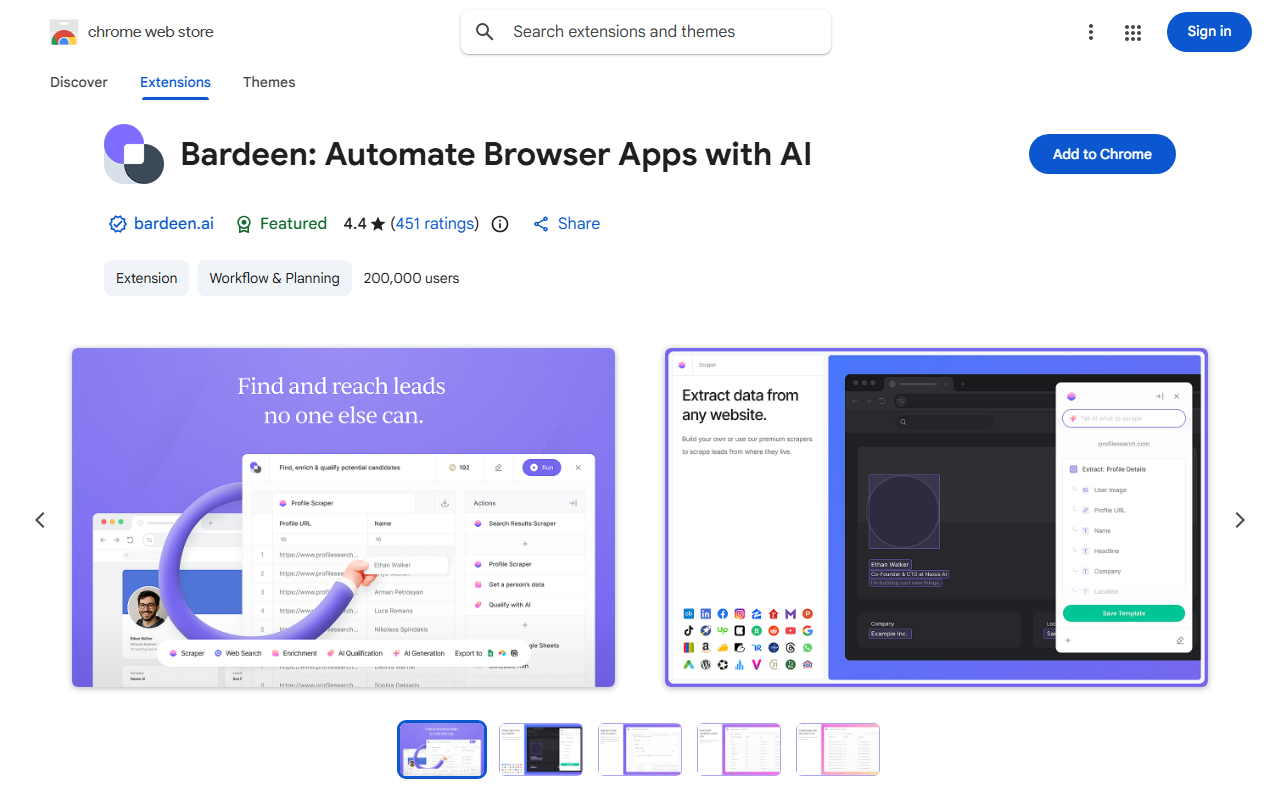 Captured from the Chrome Web Store, 18 Aug 2026. The install count and rating are independently verifiable, and the screenshots show a lead-sourcing workflow rather than general browser automation.
Browse AI still does what both used to promise
Browse AI has not pivoted. Its features page still leads with four things: scraping, monitoring, turning a site into an API, and 7,000-plus integrations for the extracted data. It ships more than 250 prebuilt robots for common sites and claims automatic re-adaptation when a target site's layout changes, so a robot trained in June does not silently break in July.
Monitoring is the feature Bardeen has no real equivalent to. A Browse AI robot can recheck a page on a schedule from every minute to once a month, and it reports what specifically changed with a visual diff, not just a "something moved" alert, according to Browse AI's own product pages. That is built into every robot on every plan, including the free one.
Its own Chrome Web Store listing tells a smaller, less flattering story than its homepage does. The install count reads 100,000 users, with a 3.9-star rating from 44 reviews as of 18 August 2026, well behind Bardeen's 200,000 and 4.4 stars on the same day.
Meanwhile the browse.ai homepage still displays a headline claim in the shape "the leading data scraper that provides reliable data for over {{userCount}} users worldwide," with the template variable rendering unfilled rather than a real figure. None of the top-ranking comparisons of these two products mention that; the Chrome Web Store numbers are the only independently checkable install figures either company publishes.
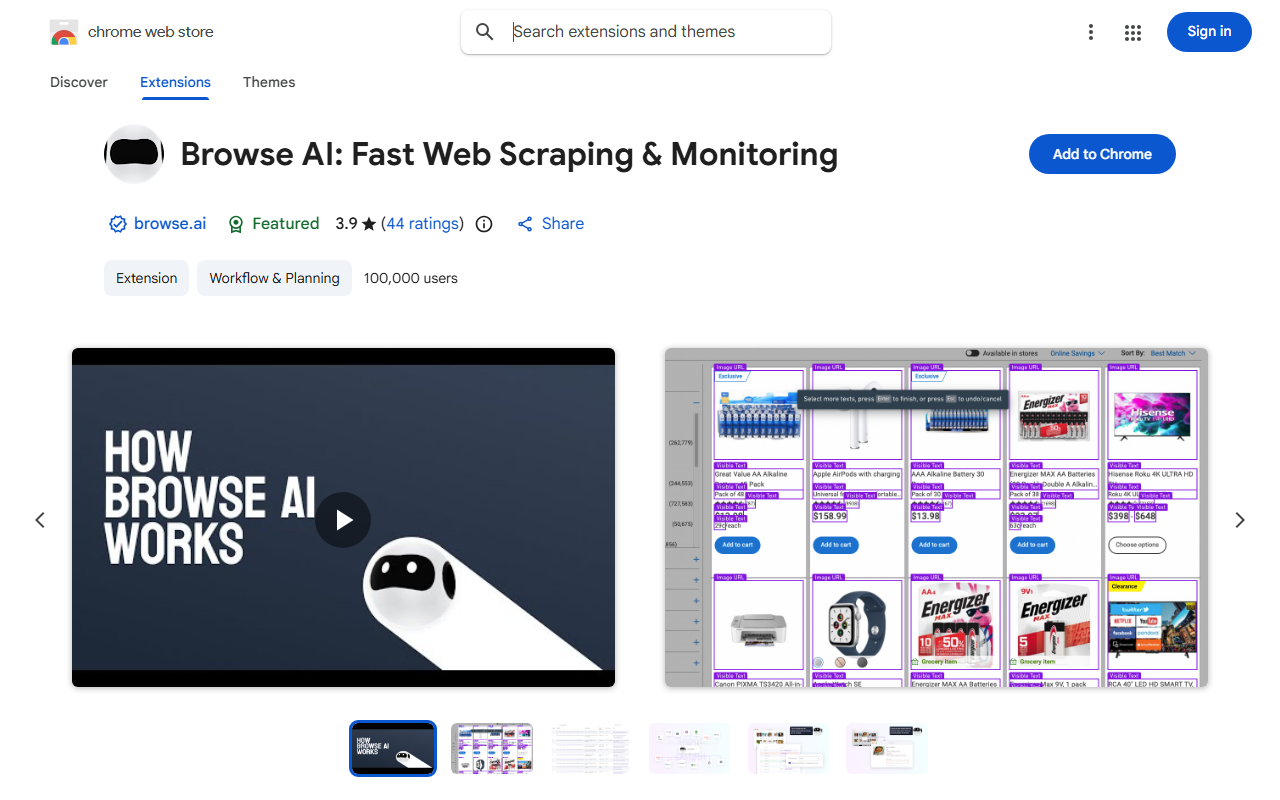 Also pulled from the Chrome Web Store on 18 Aug 2026. The install base trails Bardeen's, even while Browse AI's own homepage shows an unrendered {{userCount}} placeholder instead of a real figure.
The verdict, stated early
If the job is building a list of qualified leads with real contact data inside a browser workflow, buy Bardeen. Its enrichment credits and AI qualification tools are purpose-built for that, and nothing in Browse AI's credit table does the same job.
If the job is scraping or monitoring a website that has nothing to do with sales prospecting (a competitor's pricing page, a marketplace listing, a directory of local permits), buy Browse AI. Its free tier alone covers 2 websites and 50 credits a month with unlimited robots, which is enough to monitor a handful of pages without paying anything.
What each actually costs
Verify the numbers yourself, because at least one widely cited comparison gets them wrong. Aloa's Bardeen-versus-Browse-AI piece lists Bardeen's plans at $99 to $1,500 a month. Bardeen's own pricing page, fetched today, shows $10 a month for Basic and $50 a month for Premium, with only the uncapped Enterprise tier requiring a custom quote.
That is a five-to-tenfold gap between what a competing article claims and what the vendor actually charges. It is the kind of error that survives in search results long after a vendor changes its pricing page.
Browse AI's ladder, read from its own site with the annual toggle on: Free at $0 for 50 credits a month across 2 websites and 3 users, Personal at $19 a month billed annually for 12,000 credits a year across 5 websites, Professional at $69 a month billed annually for 60,000 credits a year across 10 websites (its "most popular" tier), and Premium starting at $500 a month billed annually for 600,000-plus credits with a dedicated account manager.
Paid monthly instead of annually, Personal jumps to $48 and Professional to $87, a 20% annual discount either way.
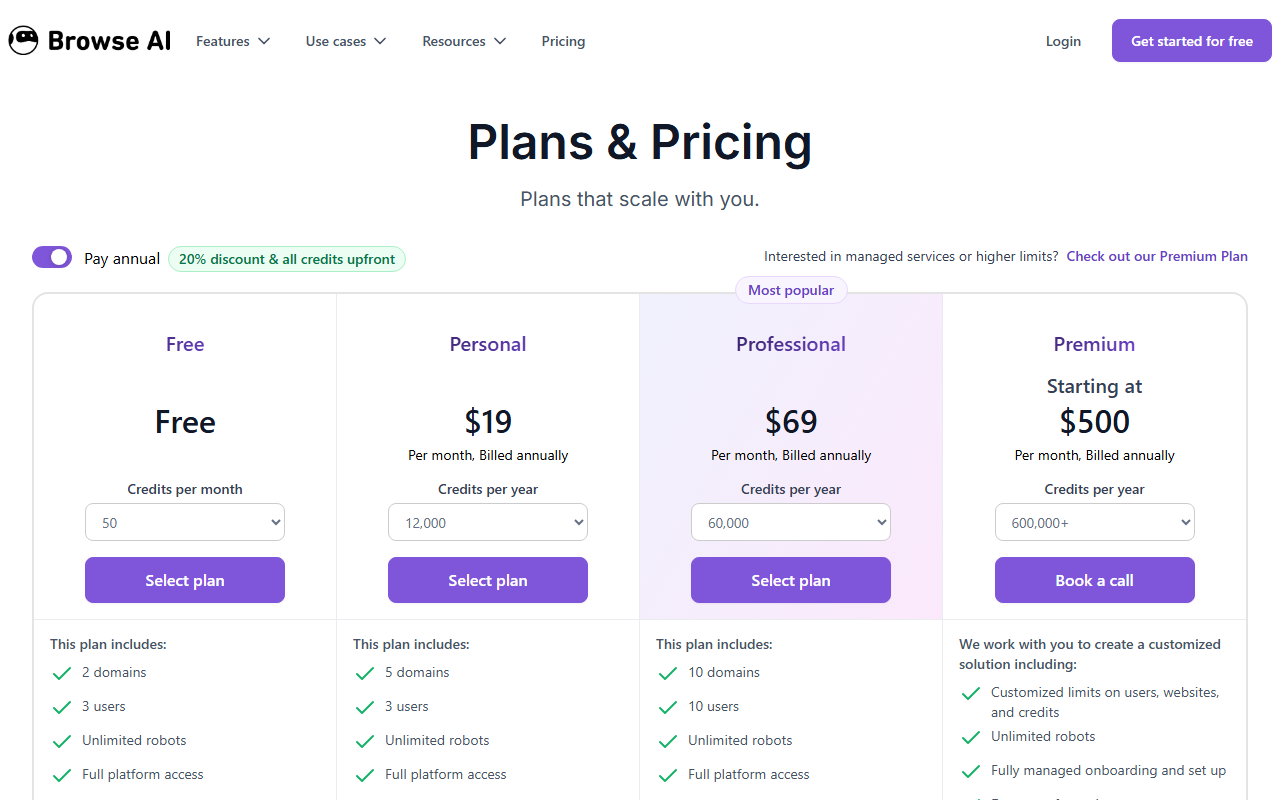 Browse AI's pricing page, captured 18 Aug 2026 with annual billing selected. Switching to monthly billing raises the same two middle tiers to $48 and $87.
Neither company publishes a price cut, a new tier, or a merger since this article was researched, so treat both ladders as current as of 18 August 2026 and re-check before budgeting past that date.
Where Bardeen wins
Name the use case: a two-person sales team at an early-stage startup that needs 200 warm leads a month with verified emails, pulled from LinkedIn and company sites, without hiring an SDR. Bardeen's AI Tools scraper and enrichment credits are built for exactly that loop, run from inside the browser where the prospecting already happens. Clay competes for that same budget with a heavier, pricier enrichment waterfall built for larger sales teams; Bardeen is the cheaper entry point for a team that has not outgrown a single browser extension yet.
Where Browse AI wins
Name the other use case: an e-commerce operator tracking 30 competitor product pages for price changes, or a real-estate analyst pulling new listings from five sites every morning. Neither task involves a person's name, phone number, or email, so Bardeen's enrichment credits buy nothing here. Browse AI's point-and-click robots and scheduled monitoring, running from every minute to monthly, are the direct fit, and its free tier is enough to start before any card is charged.
The turn
The obvious rebuttal: both products still technically do browser automation, and a determined team could force either one into the other's job. Take Browse AI's scraped output and wire it into an enrichment API using a general workflow tool, no Bardeen required. Point Bardeen's generic scraper actions at a competitor's pricing page instead of a lead list, and it does roughly what Zapier or a plain scraper would. Neither move takes more than an afternoon.
That rebuttal misses what the products themselves are priced for. A company designs its credit table around the job it wants customers doing, and Bardeen's is the only one of the two with a separate, three-times-cost credit type for enrichment. Browse AI's credit table has no equivalent line. The marketing copy could be spin; the cost structure is a harder thing to fake, and it points the same direction the marketing does.
Switching cost
Moving between them is not free, even setting price aside. Bardeen workflows live as browser-extension playbooks tied to Chrome. Browse AI robots live as server-side, scheduled jobs with their own history and API, callable outside the browser entirely.
There is no migration path that ports one into the other, so a team that built 40 Bardeen playbooks around lead sourcing is not a quick switch away from Browse AI's monitoring model, and the reverse is just as true. Budget a rebuild, not an import, if the job genuinely changes.
Seat limits tilt the comparison further. Browse AI's Personal and Professional plans include 3 and 10 users respectively at the flat monthly rate quoted above, no per-seat add-on required. Bardeen's own pricing page lists "Teams" as a feature checkbox on both Basic and Premium, but does not state how many seats that includes or whether growing past a default headcount costs extra. A five-person team gets a clear seat count on Browse AI's Professional plan and has to ask Bardeen's sales team to find out its own.
Reach for the underlying reason the products diverged, and switching gets easier to justify or avoid. TinyFish, which launched from stealth in 2025 with $47 million in Series A funding, sells enterprise web-agent infrastructure at a scale neither Bardeen nor Browse AI is built for, a reminder that "browser automation" now spans a founder's Chrome extension on one end and funded infrastructure on the other. Both products in this piece sit closer to the founder's end than either wants to admit in its pricing.
Watch what each vendor spends its next product cycle on. If Browse AI adds a native phone or email verification credit type, or Bardeen ships a scraper template gallery to match Browse AI's 250-plus prebuilt robots, the split-job verdict here stops holding. The choice collapses back into a straight price comparison, and this article gets rewritten.
Frequently asked questions
Is Bardeen the same kind of tool as Browse AI?
Not anymore. Bardeen's product pages and pricing now center on sales lead generation and contact enrichment, while Browse AI remains a general-purpose no-code scraper and monitor for any website. Both launched as browser-automation extensions around 2023, but their roadmaps have since split.
How much does Bardeen cost in 2026?
Basic runs $10 a month for 100 credits. Stepping up to Premium costs $50 a month for 1,000 credits, or $480 once a year for 12,000, a 20 percent saving over paying monthly. Anything larger needs a custom Enterprise quote from Bardeen's sales team.
How much does Browse AI cost in 2026?
The free tier gives 50 credits monthly across 2 sites at no cost. Annual plans then step up through Personal at $19, Professional at $69 (its most-popular tier), and Premium starting at $500, each billed yearly with a matching credit allowance.
Which tool is better for finding sales leads?
Bardeen, because its credit system charges specifically for contact enrichment, three credits per row against one for a plain scrape, and its AI Tools feature is built to qualify leads. Browse AI's published credit table has no equivalent action, so it can pull a list but not validate a phone number or email.
Which tool is better for monitoring websites for changes?
Browse AI, since scheduled monitoring ships on every plan including the free one, rechecking a page anywhere from every minute to once a month and reporting the specific change with a visual diff. Bardeen has no comparable scheduled-monitoring feature in its current product lineup.
Covered in this guide
- Bardeen: Find and reach leads no one else can with agentic web scraping, AI qualification, and contact enrichment.
- Browse AI: Browse AI is a no-code web scraping and monitoring platform used by 500,000+ users, turning any website into structured data with point-and-click robot training and a free plan available.
- Clay: AI go-to-market platform with waterfall data enrichment and Claygent AI research agents, with plans from free to enterprise.
- TinyFish: TinyFish is enterprise infrastructure for AI web agents that automate business workflows across hundreds of sites, reporting a 98.7% success rate.
- Zapier: The automation layer for agentic AI connecting 8,000+ apps
Sources
Still deciding?
This guide covers a handful of options. Smart Match checks every listing in the directory against how you actually work and what you can spend, then hands you the shortlist and the reason behind each pick.
Start Smart MatchRelated guides
- 41 of 100 HokAI Guides Carry a Screenshot. All 106 Still Load.Inside HokAIHow the directory works, verified in the open
- Apollo vs Clay: Which One Should You Buy First?ComparisonHead-to-head, with a verdict
- Best AI Orchestration Tools in 2026: How to Actually ChooseBuyer's guideHow to pick, across a category
- Best AI SDR Tools in 2026: The Data Layer, Not the Autonomous AgentBuyer's guideHow to pick, across a category
- How to Automate Repetitive Work With AI (Without Writing Code)Buyer's guideHow to pick, across a category
- How to Build an AI-Powered App Without Being a DeveloperBuyer's guideHow to pick, across a category