MultiOn Alternatives in 2026
MultiOn alternatives for browser automation include Browser Use, which charges pay-as-you-go credits, Skyvern, which sells plans from $29 a month, and Browserbase, which rents hosted browsers by the hour. All prices were read from vendor pages on 5 November 2026.
The short version
MultiOn's address now leads to AGI, Inc., a phone agent company, and its browser API shows no price or release date. Browser Use suits pay-per-task developers, Skyvern suits fixed-fee portal chores from $29 a month, and Browserbase suits teams renting browsers for their own agents.
Want this decided for your own case? Find your tools with Smart Match, starting from this guide's question.
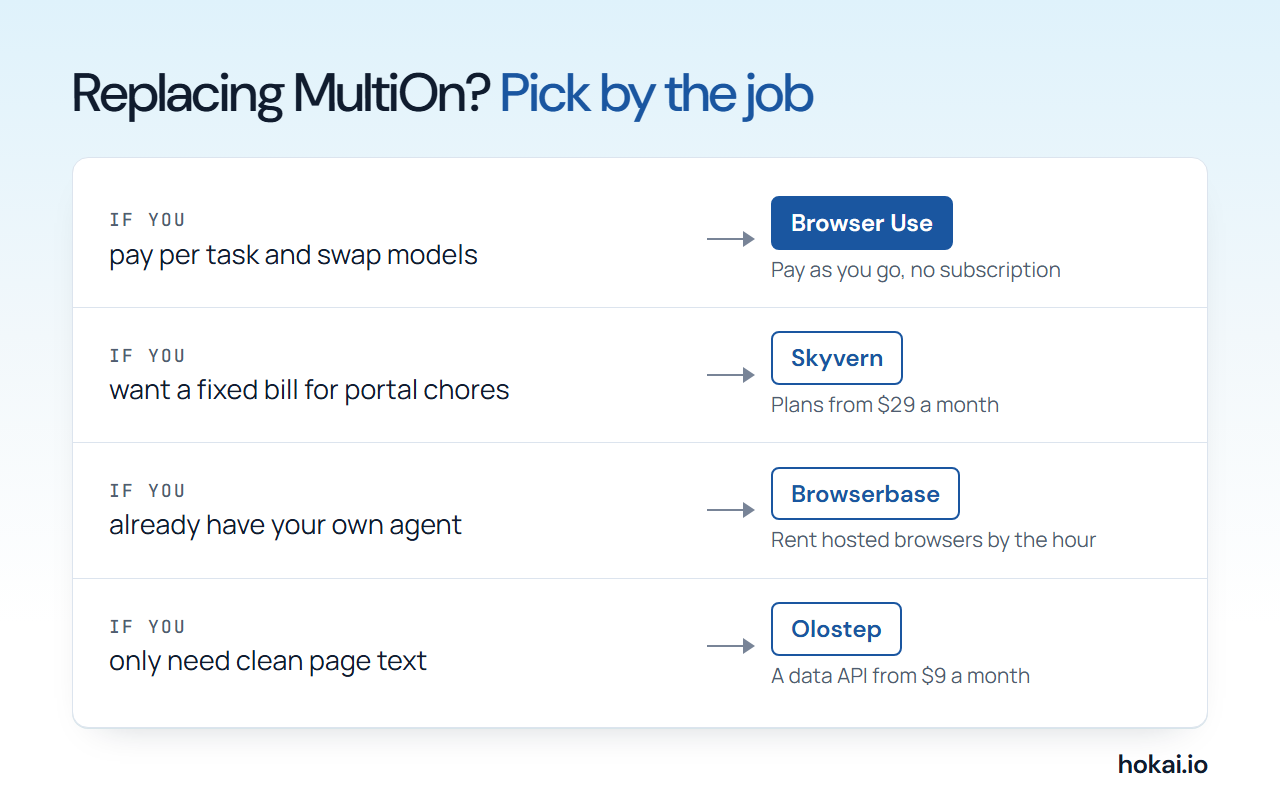 Hokai chart of which MultiOn alternative fits which job, from the vendors' pricing pages as read on 5 Nov 2026.
Type multion.ai into a browser today and you land on a different company. The address redirects to theagi.company, titled "AGI, Inc. | Private action AI for phones and devices", and the headline reads "Do anything, hands-free". The browser agent that many developers wired into LangChain has become a phone product, at least on the front door.
That matters for one reader in particular, and the rest of this page is written for that person: a developer or operations lead who still has a MultiOn call in a script, or who found the name in an older tutorial and wants the same job done.
The job is clear: give an AI a plain-language instruction, let it drive a real website that has no API of its own, and get the result back through a clean API of your own, without writing and maintaining a brittle script for every page that changes its layout.
Three questions settle it. Does the work happen inside a browser you control, or on someone else's? Do you pay per task, per month or per browser hour? And who holds the logins?
This page works through all three, using the vendors' own pages, read on 5 November 2026, and it also names the places where a page said nothing at all and a reader would otherwise have to guess. For the wider field of agents, see the best AI agents of 2026, and for agents built for office work, the business operations roundup.
Is MultiOn still a product you can buy?
Short answer: the name is alive, the browser product is not clearly on sale. Here is what the sources show.
- multion.ai redirects to theagi.company. The title names AGI, Inc. The copy says it builds "fast, private action AI for your phone or computer".
- The same page states "AGI-0: 100% on AndroidWorld (116/116 tasks)". That is the vendor's own claim about a phone benchmark, not an independent result.
- The documentation site, docs.multion.ai, is still online. Its welcome page calls itself "the documentation for MultiOn Agent V1 Beta" and adds that "AgentQ support will be out in Agent 2.0 upcoming Release!"
- The docs list support@multion.ai and a Discord server for questions.
- No pricing page was found. Nothing read on 5 November showed a current plan, a price or a dated release for the browser agent.
The honest status? Documented, not obviously sold. Hokai's MultiOn record tracks the same gap. Same story. If your production code still calls the V1 Beta API, treat that as a risk to retire, not a foundation to extend.
The company's August 2026 blog post, written by Div Garg and dated 6 August 2026, shows where the effort went. It describes an MCP server that lets an agent tap and type on a whole phone, and says it works with any MCP client, including Claude Code, Codex and Cursor. That is a real product direction. It is also not a replacement for a script that fills in a web form on a laptop, which is the job most readers of this page still need done on Monday morning.
How to choose a replacement for a browser agent
Job first. Logo last. Most MultiOn users did one of three things. Each has a different best fit.
- Run a task from a sentence. You want an agent plus a model. Look at Browser Use or Skyvern.
- Keep your own agent and rent the browser. You need hosted sessions, proxies and CAPTCHA handling. Look at Browserbase, Notte or Kernel.
- Skip the browser. The data may sit behind a search or fetch API. Firecrawl, Tavily and Olostep cover that. So does a workflow tool such as Zapier, n8n or Make when the app has an official connector.
Four checks apply to any of them:
- Does it log in as you, and where are the credentials stored?
- What does a failed run cost?
- Can a human approve a risky step, such as a payment or a send?
- Is there a plan with a security attestation your buyer will ask for?
Unsure which branch fits? Hokai's Smart Match takes a plain description of the job and returns a shortlist. The category page for AI agent builders lists the wider set.
The shortlist at a glance
The table compares the three real alternatives on the facts that decide the choice. Every cell comes from the vendor's pricing page, read on 5 November 2026.
| Option | How you pay | Entry price | Best for |
|---|---|---|---|
| Browser Use | Pay as you go credits | $1 free credit | Developers testing models |
| Skyvern | Monthly plan with credits | $29 a month | Portal and form work |
| Browserbase | Plan plus browser hours | Free tier, 1 browser hour | Teams with their own agent |
| Notte | Plan plus usage credits | $20 a month | Sessions that need logins |
| Kernel | Not read | None read | Speed-sensitive agents |
| Olostep | Monthly credits | $9 a month | Data pulls, no browser driving |
| AGI, Inc. | Not published | None found | Phone automation, by invitation |
The paragraph under each row below explains the numbers. Pricing in this market moves often, so the dates matter more than the totals.
- Skyvern Hobby plan a month
- $29
- 30,000 credits
- Browserbase Developer extra browser hour
- $0.12
- After 100 included hours
- AGI-0 tasks passed on AndroidWorld
- 116/116
- AGI, Inc.'s own claim
Browser Use: the pay-as-you-go option for developers
Browser Use is the closest in spirit to MultiOn's API. Its pricing page opens with "Pay as you go. No subscription. Credits never expire." New accounts get $1 of free credit. The page also lists SOC 2 Type II and HIPAA, which matters if a customer's security team gets involved.
The page's most useful content is a benchmark chart. It plots model quality against price per task on "very hard browser tasks", using the company's BU_Bench_v2 set, which it describes as 60 tasks per setting. One entry reads "GPT-6 Luna · high · 53.9 quality · at least $0.15 per task". Two caveats come from the page itself. Quality scores measure findings, not task success. And recorded agent costs exclude judge, browser hosting, runner and unrecorded calls, so they are not Cloud prices.
What does that mean for a buyer? Cost per task depends on the model. Short answer: a lot. A cheap model may finish many tasks at a fraction of a dollar, while the strongest ones cost more. The vendor's chart is a starting guide for your own test, not a promise. Run twenty of your real tasks and divide the credits spent by the tasks finished.
Pick this if you write code, want to change models freely and prefer to pay only for what runs. Skip it if you want a fixed monthly bill, since the page shows no subscription at all.
Skyvern: fixed monthly plans for portal work
Skyvern sells the opposite model: a monthly plan with a pool of credits. Its pricing page, read on 5 November 2026, shows:
| Plan | Price | Credits | Concurrent runs |
|---|---|---|---|
| Hobby | $29 a month | 30,000 a month | 10 |
| Pro | $149 a month | 150,000 a month | 25 |
| Enterprise | Custom | Custom | 100 |
Every self-serve plan starts with a 14-day free trial of 30,000 credits at Hobby limits, and the page says you pay nothing if you cancel before day 14. By simple division, both paid plans work out near $1 for every 1,000 credits, so Pro buys scale and features rather than a cheaper rate.
The feature gap is where the choice sits, because the credit pool is nearly the same price per credit on both plans and the extras are what you actually buy. Hobby has a basic CAPTCHA solver, webhooks and stored credentials. Pro adds an advanced CAPTCHA solver, team workspaces, 2FA and TOTP support, a residential proxy, and a 1Password integration. An SMS number costs $10 a month each. Enterprise lists HIPAA, a SOC-2 report and human-in-the-loop controls.
The vendor says it is SOC 2 Type II certified and HIPAA compliant, and claims 500+ enterprise teams. Treat the last figure as marketing until you see references.
Pick it for repeatable portal chores, such as downloading invoices from a supplier site that has no API. The fee is predictable. Skip it if your volume is tiny or erratic. Unused credits are just a fixed cost.
Browserbase: rent the browser, bring your own agent
Browserbase is not a MultiOn clone. It sells the browser, and you supply the logic. That suits teams that already have an agent loop and are tired of running their own Chrome fleet.
The pricing page lists four tiers. The free tier includes 3 concurrent browsers, 1 browser hour, 3 agent runs, 1,000 search calls, 1,000 fetch calls and 15-minute sessions. Developer includes 25 concurrent browsers and 100 browser hours, then $0.12 for each extra hour. Startup includes 100 concurrent browsers and 500 hours, then $0.10 for each extra hour. The enterprise tier starts at 250 concurrent browsers.
Extra usage costs more on Developer than on Startup. The table shows the overage rates on the pricing page.
| Usage | Developer | Startup |
|---|---|---|
| Extra browser hour | $0.12 | $0.10 |
| Extra search calls | $5 per 1,000 | $5 per 1,000 |
| Extra fetch calls | $1 per 1,000 | $0.5 per 1,000 |
| Proxies | $12 per GB | $10 per GB |
The page lists auto CAPTCHA solving on paid plans, and HIPAA with a BAA, a DPA and SSO on the enterprise tier. Monthly plan prices did not appear in the text read from the page, so this guide does not quote them. Check the live page.
Pick it if you have developers and want hosted sessions that scale. Skip it if you wanted an agent that works from a sentence, since the planning is still your code.
Notte: cheap browser time with a utility-style bill
Three smaller names fill gaps the big three leave. Each was read on 5 November 2026.
Notte prices like a utility. Its page lists browser sessions at $0.01 an hour and browser functions at $0.05 an hour. Residential proxies are billed per GB. LLM tokens carry no Notte markup when you use its managed keys.
The plans differ mainly in credits and limits:
| Plan | Price | Concurrent browsers | Longest session |
|---|---|---|---|
| Free | $0, with $10 credits once | 5 | 15 minutes |
| Developer | $20 a month | 25 | 120 minutes |
| Startup | $100 a month | 100 | 300 minutes |
Enterprise adds SSO, SLAs and HIPAA. Fine. Notte's page says core features are available across plans, which makes the free tier a fair test of what a paid plan would do, since the paid tiers mainly add credits, concurrency and longer sessions. Rare.
Kernel and Olostep: speed claims and plain data pulls
Kernel describes itself as "browser infrastructure for web agents and automations". Its homepage claims cloud browsers that spin up in under 30 milliseconds, managed auth, stealth proxies and CAPTCHA solving, and wallet integrations for agent checkout. It also shows SOC 2 and HIPAA badges and says 11,000+ teams build on it. Obscura could not load the page, so it was read in Chrome. No price appeared on the homepage, and the pricing URLs tried either failed or returned nothing.
The homepage includes a speed chart, measured by computesdk, and it is the company's own pick of benchmark. It shows Kernel at 6.43 actions per second, Browserbase at 4.00 and Browser Use at 3.61. Treat it as a claim, and check it on your own sites before you build around a speed difference that may not survive a real login flow, a slow vendor portal or a CAPTCHA.
Read from the Kernel homepage; it compares itself with two competitors.
Speed matters for long test suites, where thousands of small actions add up to minutes of waiting and a pipeline that finishes after the team has gone home. For a nightly invoice download? Hardly.
Olostep is a different animal. It is a web data API for AI, not a driveable browser. Plans are monthly bundles of credits. A free plan covers 500 requests, and credit packs last 6 months.
| Plan | Price | Credits | Per 1,000 requests |
|---|---|---|---|
| Starter | $9 a month | 5K | $1.80 |
| Standard | $99 a month | 200K | $0.50 |
| Scale | $399 a month | 1M | $0.40 |
If your MultiOn job was really "fetch this page and give me clean text", this costs less than any browser.
What does each option cost in practice?
Compare on one unit: a month of light use, say 200 tasks that each open a few pages.
- Browser Use: credits per task, so the bill follows your model. Start with the $1 credit.
- Skyvern: $29 a month buys 30,000 credits. The page does not say how many credits one task burns. Use the 14-day trial to find out.
- Browserbase: the free 1 browser hour is a short test. Developer includes 100 hours, plenty for 200 short tasks. The model that drives the browser is extra.
- Notte: sessions cost $0.01 an hour, so the browser is cheap. Model tokens are the larger line.
- Olostep: $9 a month covers 5K credits.
- AGI, Inc.: no price published.
Model choice moves the bill more than the agent does. Hokai's record for Claude Fable 5 is one place to check a frontier model's price. Pattern: Browser Use, Browserbase and Notte charge by usage, Skyvern charges by bundle. Under light, unpredictable use, usage pricing wins. Under steady daily runs, a bundle wins.
Where did MultiOn go? AGI, Inc. and the phone
If you only read the homepage, AGI, Inc. looks like a different business. The company site describes AGI-0 as its action model, and the front page links to a Google Play listing for its Android agent. The August post pitches an MCP for "every app on your phone", noting that apps like banking and ride apps lack APIs.
That is an interesting bet. Mobile apps resist automation because they expose no web page to drive. If your work lives on a phone, this is the one vendor here that aims at it. If your work lives on websites, the pivot is a reason to look elsewhere. Rich Miner, a co-founder of Android, joined as an advisor on 4 August 2026, according to the company blog. That suggests the phone focus is deliberate, not a pause.
Data handling: who holds your logins?
Browser agents ask for the keys to accounts, so ask three questions.
- Where do credentials live? Skyvern lists stored credentials on every plan. Pro adds 1Password. Enterprise adds Bitwarden and Azure Key Vault. Kernel advertises managed auth. The Browser Use and Browserbase pages did not describe a vault. Ask before you hand over a password.
- What attestation covers it? Browser Use and Skyvern state SOC 2 Type II. Browserbase lists HIPAA with a BAA on enterprise. A pricing-page badge is not an audit report. Request the report.
- Who approves a risky action? Skyvern lists human-in-the-loop on Enterprise. For anything that moves money or sends messages, add your own approval step. Hokai's piece on approval gates for personal agents applies the same logic.
For consumer use, an assistant that lives in your own browser is a different risk profile. Perplexity Comet is one example, and Genspark and Lindy bundle agent work into a hosted workspace. Their pages were not read for this guide, so this page makes no pricing or capability claims about them. Hokai's browser roundup covers that group.
Who should skip these and pick something else?
- You need a general chat agent. These tools run browser jobs. For a broader assistant, read ChatGPT agent against Manus and what Manus is for.
- The task is an API call in disguise. If the site has an official API or connector, use that. Agents break when pages change.
- You have no engineers. Browser Use and Browserbase assume code. A hosted workspace or a workflow tool is closer to what you need.
- You need a vendor with a long track record. This category is young, and prices move.
For cost on the model side, see OpenAI's Agents API and computer-use pricing, and for model price and benchmark comparisons use Hokai's model leaderboard. The models behind most of these agents come from OpenAI, Anthropic and Google.
The case for staying with MultiOn
The strongest objection to switching is cost of change. A working script is worth something. MultiOn's docs are still online, and nothing read for this guide says the V1 Beta API has been switched off.
The answer is about risk. Not today's behaviour.
The homepage no longer markets the browser agent. The docs say Agent 2.0 is "upcoming" with no date. No pricing page was found.
A script on an unpriced, undated product can fail with no notice. Nobody to call, and no published plan for the day the endpoint goes quiet, so the first you hear of it may be a customer asking why a report is empty. A failure in production costs more than a planned move. Minor script? Leave it and watch it. If a customer depends on it, move now.
What would change this verdict
Three things would reopen the question:
- MultiOn or AGI, Inc. publishes a dated Agent 2.0 release with a price. Then it is a candidate again.
- A tested run shows one of these tools failing your sites. Vendor benchmarks do not cover your portals.
- Browserbase or Skyvern changes plans. Both pages show current numbers only, and this guide cites them as read on 5 November 2026.
Gaps in this guide: no MultiOn price, no Perplexity Comet or OpenAI agent page read, and no independent test of task success. Those stay open until a source can be read.
Frequently asked questions
Is MultiOn still available?
The multion.ai address redirects to AGI, Inc., a phone and device agent company. The MultiOn V1 Beta docs remain online, but no pricing or dated release for the browser agent was found on 5 November 2026.
What is the closest alternative to MultiOn's API?
Browser Use is the closest in spirit: it sells pay-as-you-go credits with no subscription, per its pricing page. Skyvern offers monthly plans from $29, and Browserbase rents hosted browsers if you already have your own agent code.
How much does Skyvern cost?
Skyvern lists Hobby at $29 a month for 30,000 credits and Pro at $149 a month for 150,000 credits. Enterprise is custom. Self-serve plans start with a 14-day free trial, per the vendor's pricing page.
Is Browserbase an agent or infrastructure?
Browserbase is infrastructure. It provides hosted browser sessions, proxies and CAPTCHA solving, while your own code or model plans the actions. Its free tier includes 3 concurrent browsers and 1 browser hour.
Should I keep running a script on the MultiOn V1 Beta API?
Only for minor jobs. The docs call Agent 2.0 upcoming without a date and no price was found, so a customer-facing script should move to a vendor with published plans.
Covered in this guide
- MultiOn: MultiOn was a browser agent with a Chrome extension and Agent API. The vendor, AGI, Inc., has since moved to AGI-0 for phones, and the V1 Beta docs remain online.
- Anthropic: Anthropic is a Public Benefit Corporation started by 7 ex-OpenAI researchers. It builds the Claude model family and counts Amazon and Google among its largest backers.
- Browser Use: Open-source browser agent with a hosted cloud: describe a web task in one sentence, get JSON back. The repo has 117,000+ GitHub stars.
- Browserbase: Hosted headless browsers for AI agents, with a free plan of 3 concurrent sessions, session replays and the open source Stagehand SDK.
- Claude Fable 5: The first generally available Mythos-class Claude model, with 1M context and 95.0% SWE-bench Verified. Released June 2026 by Anthropic.
- Perplexity Comet: Perplexity's Chromium-based AI browser with a built-in assistant, free on Mac, Windows, iOS and Android, with 7 headline features.
- Firecrawl: Web data API for AI agents: search, scrape, crawl and interact, returning LLM-ready Markdown. Open source core with a free plan and an MCP server.
- Genspark: Genspark is an AI super agent that runs 8+ LLMs and 80+ tools to build slides, research reports, and apps, with a free daily-credit tier and paid Plus/Pro plans.
- Kernel: Hosted MCP server giving AI agents 18 tools to control cloud Chromium browsers with sub-150ms cold starts, stealth proxies, and CAPTCHA solving.
- Lindy: AI teammate that handles email, meetings and workflows across 1,000+ apps; no free plan, just a 7-day trial then per-seat billing.
- Make: No-code visual automation platform to connect apps and build AI workflows at scale
- Notte: Notte Labs' browser infrastructure for agents: sessions, page actions, scraping, autonomous browser agents and Functions, exposed as 15 API endpoints, a CLI and MCP.
- Olostep: Web data API for agents: seven endpoints (scrape, batch, crawl, map, search, answer, retrieve) returning Markdown, HTML, text, JSON, PDF or screenshots.
- OpenAI: OpenAI builds ChatGPT, the GPT-6 family (Astra, Sol, Luna), Codex and the OpenAI API. It reports 1.2B weekly ChatGPT users and an $852B valuation after its March 2026 round.
- Skyvern: Open-source AI browser agent with 23.2k GitHub stars that logs in, fills forms, downloads files and extracts data from sites with no API.
- Tavily: Five-endpoint web access API for AI agents: search, extract, map, crawl and research, with a free plan and a keyless trial mode.
Sources
Still deciding?
This guide covers a handful of options. Smart Match checks every listing in the directory against how you actually work and what you can spend, then hands you the shortlist and the reason behind each pick.
Find your toolsRelated guides
- Abacum Alternatives in 2026: FP&A Tools for Mid-Market Finance TeamsBuyer's guideHow to pick, across a category
- Arc Browser Hasn't Shipped a Feature in 449 Days. Cloudflare Just Showed Why.AnalysisWhat changed and who it affects
- Attio vs HubSpot in 2026: Which CRM for a Startup?ComparisonHead-to-head, with a verdict
- Best Agentic AI in 2026: Manus, Genspark and the Platforms That Finish Whole TasksBuyer's guideHow to pick, across a category
- Best AI Agent Builders in 2026: Automate, Build or Self-HostBuyer's guideHow to pick, across a category
- Best Autonomous AI Agents in 2026: How Much Control to Hand OverBuyer's guideHow to pick, across a category