Abacum Alternatives in 2026: FP&A Tools for Mid-Market Finance Teams
Abacum alternatives for mid-market finance teams include Aleph, Pigment, Datarails, Cube, LiveFlow and Campfire. As of 5 November 2026 none of the seven platforms shows a list price. The real differences are the spreadsheet link, the connector list, the modelling language and whether a free trial exists.
The short version
Teams leave Abacum over opaque pricing, a technical formula language or slow setup. Aleph suits Excel-first teams, Pigment suits cross-department planning, Datarails and Cube keep the CFO in a spreadsheet, and LiveFlow or Campfire fix the ledger. None publishes a list price, so ask each for the same quote inputs.
Want this decided for your own case? Find your tools with Smart Match, starting from this guide's question.
Abacum's homepage lists 700+ integrations and an AI agent called Abra as of 5 November 2026, yet it still shows no price anywhere on the page.
That gap, more than any missing feature, is why people search for alternatives. A finance lead who cannot see a number cannot budget a pilot. Nor can they tell a board what a switch would cost.
Abacum is a planning platform for mid-market finance teams, and it is sold by quote only. Rivals now offer free trials, spreadsheet add-ins and agents of their own. Three questions settle the choice: how your analysts model, which systems feed the plan, and who carries the implementation.
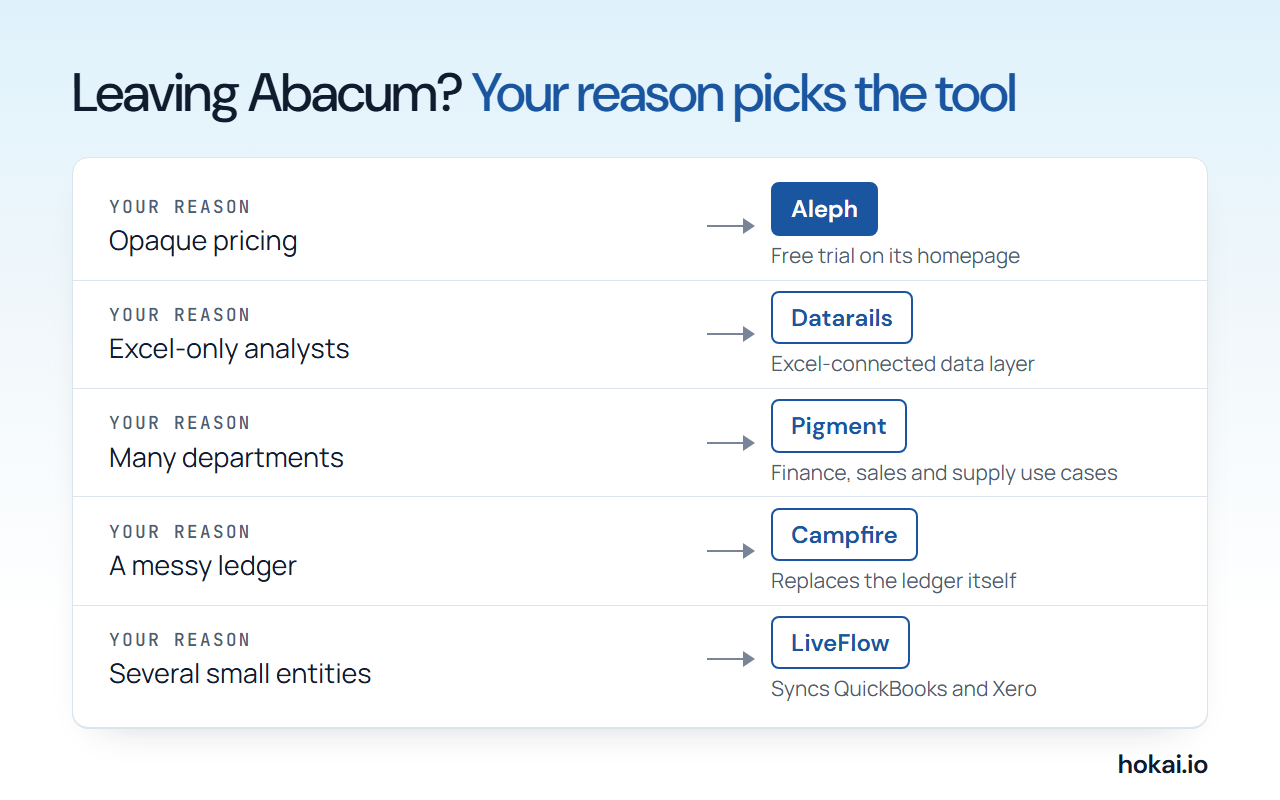 Hokai chart of which alternative fits which reason, from the vendor pages read on 5 November 2026.
How to choose: which reason for leaving Abacum is actually yours?
Buyers leave a planning platform for five reasons, and each points to a different replacement. Sort yours first, then read the vendors.
- Price and seat model: quotes arrive only after a demo, so you cannot compare before you talk to sales.
- Connectors: your ERP, HRIS or billing system may not be on the list.
- Modelling depth: the formula language may be too technical for your analysts, or too thin for your drivers.
- AI features: you want an agent you can question, not a report you read.
- Time to implement: you need a plan for next quarter, not next year.
On the first point the record is plain. According to Hokai's Abacum record, the vendor publishes no pricing. Third-party buyer guides estimate annual contracts from about $15,000 for a small pilot to $75,000 or more for a full mid-market rollout. Abacum has not confirmed either figure, so treat them as estimates.
On modelling, reviewers on G2 and Capterra describe Abacum's SQL-like formula language as capable but a steep climb for finance staff without a technical background. If your analysts live in Excel, that is the reason to keep reading. If they already write SQL, it may be a feature.
Once you know your reason, the table below gives a first pick for each. It is a starting point for a demo request, not a verdict.
| Your reason | Start with | Because | Check before you sign |
|---|---|---|---|
| Opaque price | Aleph | Free trial available | Quote after the trial ends |
| Excel-only analysts | Datarails | Excel-connected layer | Implementation fees in writing |
| Many departments | Pigment | Finance, sales and supply use cases | Fit for a small team |
| Messy ledger | Campfire | Replaces the ledger | Migration effort |
| Several small entities | LiveFlow | Syncs QuickBooks and Xero | NetSuite is still in beta |
Find your row, then run the same demo script past the first pick and one other. Our AI financial assistants directory lists the catalog entries side by side, and the Aleph record is the one to open first if price is your reason.
The shortlist: seven platforms and what each one is built around
Seven platforms cover the realistic options for a mid-market team, and the table below sorts them by the thing that matters most in a first call. Each row comes from the vendor's own page, read on 5 November 2026, or from the linked Hokai record.
| Platform | Built around | Spreadsheet link | Price visible |
|---|---|---|---|
| Abacum | Own modelling engine, Abra agent | Excel connector page | Quote after demo |
| Aleph | Excel and Google Sheets add-ins | Yes, two-way add-ins | Demo or free trial |
| Pigment | Agent-led enterprise modelling | Not stated on homepage | Free trial, no price page |
| Datarails | Excel as the working surface | Yes, Excel-connected | Custom quote |
| Cube | Spreadsheet front end, AI agents | Excel and Google Sheets | Demo, no price shown |
| LiveFlow | QuickBooks, Xero, NetSuite feeds | Sheets and Excel | Quote after demo |
| Campfire | AI-native ledger and close | No, it replaces the ledger | Quote by module |
Four of the seven keep the spreadsheet as the working surface. Abacum and Pigment ask your team to move into a purpose-built modelling environment. Campfire sits apart: it replaces the ledger rather than the plan.
Pigment, Datarails and Cube are not yet in Hokai's catalog, so they appear here without a profile link. The rest have pages you can open from the AI financial assistants category.
- Abacum integrations
- 700+
- Claimed on its homepage
- Datarails data sources
- 600+
- Claimed on its homepage
- Currencies in Campfire's ledger
- 180+
- Hokai record, August 2026
- Pigment Series E
- $250M
- Announced in a banner on its homepage
What does each one cost, and does anyone publish a number?
Not that we could find. None of the seven shows a list price on the pages we read, so the useful comparison is what each vendor says drives the quote.
- Abacum: custom quote after a demo, with no self-serve free tier.
- Aleph: its pricing URL returned a not-found page when Hokai last checked on 23 October 2026. It offers a demo and a free trial.
Two of the others hide their numbers more loudly than they admit.
- Pigment: the /pricing URL returned "Page Not Found" on 5 November 2026. The homepage offers a free trial and a demo booking.
- Datarails: its pricing page says you get a custom quote with "no consultant fees, ever".
- LiveFlow: priced by how many QuickBooks, Xero or NetSuite entities you connect and which modules you need.
- Campfire: core accounting and revenue automation are sold as separate modules.
Take the three you shortlist into a call with the same questions. How many entities and users does the quote assume? Is implementation included or billed separately? What happens at renewal if you add a second subsidiary?
LiveFlow is the only one with outside figures. Two buyer guides, which LiveFlow has not confirmed, estimate single-entity plans in the low hundreds of dollars a month and multi-entity plans from several hundred to over a thousand. Treat that as a rumour with a range, not a price.
Aleph is the pick if Excel stays your working surface
Aleph describes itself as AI-native FP&A that connects your data, strategy and spreadsheets. Its homepage offers both a demo and a free trial, which makes it the easiest of the seven to try without a sales call.
The product keeps the sheet as the model. Two-way add-ins for Excel and Google Sheets pull data from the ledger, so a forecast built in a sheet updates when the books do. According to the vendor, its AI Scan tool spots and explains variances in seconds, and the Aleph Agent answers plain-language questions about the numbers.
Hokai's record lists connectors for NetSuite, QuickBooks, Xero and SAP, warehouses such as Snowflake and BigQuery, and HRIS systems such as Workday and BambooHR. The company was founded in 2020 by two Y Combinator alumni, and announced a $29M Series B in September 2025 led by Khosla Ventures. Total funding is about $46M.
What you give up is a purpose-built workspace. When the model lives in a spreadsheet, the formulas live in files someone can copy, break or email. For a team of five analysts that is fine. For fifty contributors it is where governance gets hard.
Pick Aleph when your analysts already build the forecast in Excel and you want AI help without retraining them. Skip it if you need approvals and workflow routing across many department heads.
Pigment is the pick if planning spans finance, sales and supply chain
Pigment calls its homepage pitch "agentic AI for enterprise business planning". The use cases it lists reach well past finance: budget planning, three-statement models, long-range planning, sales capacity planning and incentive compensation.
Its AI layer has two named agents. The Analyst Agent explains performance and drivers, and the Modeler Agent builds models from instructions. Pigment also ships an MCP server, which lets outside assistants query the planning data. A banner on the page announces a $250M Series E. The vendor also cites a Dresner Advisory Services ranking of number one for agentic AI in enterprise performance management, which is a claim we cannot check against the report itself.
The honest limit is fit. The page speaks to enterprise planners, so a 40-person finance team may buy more platform than it needs. That is our reading, not a vendor statement. A free trial is offered, so you can test the Modeler Agent on your own driver tree before anyone signs.
Pick Pigment when sales, supply chain and finance must plan from one model. Look elsewhere when the plan is a finance-only exercise run from Excel.
Datarails and Cube: for teams whose CFO will not leave Excel
Datarails positions its FinanceOS product as a governed, Excel-connected layer over live data from 600+ sources. Its homepage promises version control, audit trails and permission settings, and displays a G2 rating of 4.9. The product line covers FP&A, month-end close, cash, spend and a support desk.
That breadth is useful if you want one vendor for planning and close. The price is the same as everywhere else: a custom quote. The pricing page does at least promise no consultant fees, a line worth holding the sales rep to in writing.
Cube pitches the same instinct from a different angle. Its homepage lists four AI agents, aimed at data managers, analysts, planners and business partners, and an MCP surface for outside assistants. The "surfaces" menu names Excel and Google Sheets first. We found no price and no free trial on the page, only a demo request.
Neither is in Hokai's catalog yet. Both fit a team that prefers a spreadsheet front end with a governed data layer behind it. They overlap heavily with Aleph, so choose between them on connector coverage and the quote, not on feature lists.
LiveFlow and Campfire: when the real problem is the books
Some teams leave a planning tool because the plan is only as good as the ledger feeding it. Two catalog entries start from that end.
LiveFlow syncs QuickBooks Online and Xero, and NetSuite in beta, into live Sheets and Excel reports. Its FP&A product covers budgeting, forecasting, department reporting and multi-entity consolidation. In February 2026 it launched Flow, an AI-native ERP with accounting agents that handle intercompany eliminations and reconciliations. A human reviews every change before it posts. The company has raised $23.23M.
Campfire is the bolder move. It is an AI-native ERP for startups and mid-market tech companies that have outgrown QuickBooks but not reached NetSuite. The ledger consolidates across 180+ currencies. Campfire says its accounting model passes 95% task accuracy on categorisation, against roughly 80% for general-purpose AI. That is a vendor figure we could not reproduce.
Two narrower tools sit next to these. Truewind automates month-end workpapers for QuickBooks Online and Sage Intacct, and Kick targets automated bookkeeping for smaller teams. Neither plans or forecasts, so they only help if the close is your bottleneck.
Pick LiveFlow when you have several QuickBooks or Xero files and want one reporting layer. Pick Campfire when you are ready to move the ledger itself.
Which connectors matter before you commit to a platform?
A connector count is a sales number until you check your own stack. Abacum claims 700+ integrations and Datarails claims 600+ sources, both on their homepages. Neither number tells you whether your ERP, payroll provider and billing tool sit inside it.
Build a one-page list before the first call:
- Your general ledger or ERP, with the exact version
- Your HRIS, because headcount is the biggest line in most plans
- Your billing system, if revenue forecasting is in scope
- Your CRM, if sales pipeline feeds the forecast
- Any warehouse that already holds cleaned data
Then ask each vendor to show a live sync for the first two items, not a logo slide. A logo means a connector exists. A live sync means it works on your chart of accounts.
The catalog entries differ in a useful way. Hokai's Aleph record lists NetSuite, QuickBooks, Xero and SAP, and LiveFlow starts from QuickBooks Online and Xero, with NetSuite still in beta. Campfire syncs Stripe data for revenue recognition. If your ledger is a niche system outside those lists, Abacum's longer list may be the real reason to stay.
One more check saves a week of rework: ask whether the connector writes back or only reads. Two-way sync means a budget approved in the platform can post to the ledger. One-way means someone retypes it.
What do the AI agents actually do for a finance team?
Every vendor on this list now sells an agent, and the word covers very different jobs. Reading the pages side by side shows three kinds.
The first kind answers questions. Abacum's Abra, Aleph's agent and Campfire's Ember assistant all take a plain-language question about the numbers. Abacum says Abra only sees what each user is allowed to see, which matters more than its name when a CFO and an intern share a workspace.
The second kind builds. Pigment's Modeler Agent and Cube's planner agent draft models and forecasts from instructions. This is where hours of setup work could shrink to minutes, according to a customer quote on Pigment's own homepage. A customer quote is marketing, though. Test it with a model you already built by hand.
The third kind does the close. LiveFlow Flow agents handle intercompany eliminations, and Campfire Ember Agents reconcile bank transactions and draft flux commentary. Both vendors say a human reviews every entry before it posts, and that rule is the one to hold them to.
Abacum also says custom Abra agents are coming soon, which tells you the product is still building toward what Pigment already shows. Ask each vendor which agent features are live today and which are announced. The Abacum record will show what Hokai has verified.
Who should skip this list and keep Abacum?
The case against switching is stronger than most alternatives pages admit. Abacum holds SOC 2 Type II and ISO 27001 badges on its homepage, claims 700+ integrations, and routes approvals through a workflow layer instead of email. Its homepage cites customers such as Acorns and Dish Networks, and promises 10x faster reporting, 10x faster forecasting and 8 fewer days to close. Those are the vendor's numbers, not ours.
Switching also costs real time. Every model, driver tree and board pack has to be rebuilt, and the new platform's formula logic will not match the old one. A team already live on Abacum with working connectors rarely recovers that cost in the first year.
The picture changes for teams still choosing. If you have not signed, the rival free trials at Aleph and Pigment give you evidence that a demo never will.
Can a chat assistant replace a planning platform?
For a team of two or three, sometimes. Microsoft Copilot inside Excel, Claude from Anthropic, and ChatGPT from OpenAI can all explain a sheet, draft commentary on a variance and clean an export. A spreadsheet-native AI tool such as Rows goes a step further.
The limit is governance. None of these holds a multi-entity plan with permissions, version history and a close calendar, and a chat history is not an audit trail. Hokai's guide to AI tools for Excel data analysis covers where the chat route works, and the wider guide to AI financial assistants maps the categories.
We have not priced these options here because their plans change often. Check each vendor's page, and use the Microsoft company page to see which of its tools you already pay for.
How should you test data handling before you sign?
Give each trial read-only credentials and a single entity. Then ask for the security report before you connect a production ledger.
The vendors differ in what they show. Abacum displays SOC 2 Type II and ISO 27001 badges. Pigment links a security page from its menu. Datarails promises version control, audit trails and permission settings. Aleph says its AI is fully observable, and Campfire says nothing posts without a human review, per its Hokai record.
- Shortlist Week 1Pick three platforms from the reasons above and request the same demo script.
- Connect Week 2Link one entity with read-only credentials and check what syncs.
- Rebuild Week 3Recreate one real budget and one board report in each trial.
- Decide Week 4Compare the quotes on entities, users and implementation.
If two or three candidates still look equal after that, Hokai's Smart Match can rank them against your stack. The wider AI tools directory lists every record we hold.
What would change this list?
Three things would move the ranking before the end of 2026.
First, Abacum's homepage says custom Abra agents are coming soon. If they ship with a published price, the main reason to leave weakens. Second, Pigment and Cube both expose MCP servers, so assistants like Claude can query live planning data, and that will matter more as finance teams standardise on one assistant. Third, any vendor that puts a list price on its site resets the comparison for everyone else.
Hokai re-reads these pages as the vendors change them, and the full guides index shows what has been refreshed. The first vendor to print a number will be the one buyers trust.
Frequently asked questions
What is the best Abacum alternative for an Excel-first team?
Aleph and Datarails both keep Excel as the working surface. Aleph also offers a free trial, which makes it the easier of the two to test without a sales call. Datarails sells on a custom quote.
Does Abacum publish its pricing?
No. Abacum quotes after a demo and has no self-serve free tier. Third-party buyer guides estimate annual contracts from about $15,000 to $75,000 or more, but Abacum has not confirmed those figures.
Which Abacum alternatives offer a free trial?
Aleph and Pigment both advertise a free trial on their homepages as of 5 November 2026. Datarails, Cube, LiveFlow and Campfire route buyers to a demo or a quote instead.
Is Campfire an FP&A tool?
No. Campfire is an AI-native ERP that replaces the ledger. Teams choose it when the books, not the plan, are the bottleneck. LiveFlow sits between the two, with FP&A reporting and a newer ERP.
When should a team stay on Abacum?
Stay when the connectors work, the quote is acceptable and the models are built. Switching means rebuilding every model and board pack, which rarely pays back inside the first year.
Covered in this guide
- Abacum: AI-native FP&A platform rated 4.7/5 on G2, used by mid-market finance teams to automate reporting, forecasting, and scenario planning.
- Aleph: AI-native FP&A platform that syncs ERP, CRM and HRIS data into live Excel and Sheets models, backed by Khosla Ventures and Y Combinator.
- Anthropic: Anthropic is a Public Benefit Corporation started by 7 ex-OpenAI researchers. It builds the Claude model family and counts Amazon and Google among its largest backers.
- Campfire: AI-native ERP for startups, consolidating multi-entity books across 180+ currencies with the Ember AI Assistant, used by Replit and PostHog.
- ChatGPT: ChatGPT is OpenAI's AI assistant, with 1.2 billion weekly users by OpenAI's count, the GPT-6 model family and plans that run from a free tier to a premium Pro tier.
- Claude: Claude is Anthropic's AI assistant, with a free tier, Pro, Max and Ultra personal plans, and Team and Enterprise seats. Opus access starts at Pro.
- Kick: Kick is an AI bookkeeping platform that automates categorization and reporting for 5,000+ business owners and their accountants.
- LiveFlow: AI-native accounting platform used by 6,000+ businesses to sync QuickBooks and Xero into live Sheets and Excel reports, plus a new agentic ERP called Flow.
- Microsoft: Microsoft, founded 1975, is a public company (NASDAQ: MSFT) and the Redmond maker of Windows, Azure, GitHub and the Copilot assistants, with $331.8B of fiscal 2026 revenue.
- Microsoft Copilot: Microsoft's AI assistant across Windows, Edge, Word, Excel, Outlook and Teams, from a free tier to per-seat work plans on OpenAI's latest GPT-5 models.
- OpenAI: OpenAI builds ChatGPT, the GPT-6 family (Astra, Sol, Luna), Codex and the OpenAI API. It reports 1.2B weekly ChatGPT users and an $852B valuation after its March 2026 round.
- Rows: AI spreadsheet scoring 89% first-try accuracy vs Excel's 53%, with GPT formula functions and 50+ live integrations. Acquired by Superhuman; sunset May 31, 2026.
- Truewind: AI accounting agent that turns bank statements into journal entries for QuickBooks Online and Sage Intacct; the vendor cites 500+ accountants.
Sources
Still deciding?
This guide covers a handful of options. Smart Match checks every listing in the directory against how you actually work and what you can spend, then hands you the shortlist and the reason behind each pick.
Find your toolsRelated guides
- The AI 80s Photo Trend: How to Make Yours (and Turn It Into a Video) in 2026AnalysisWhat changed and who it affects
- The AI Tools That Do One Microsoft Copilot Job, CheaperBuyer's guideHow to pick, across a category
- Attio vs HubSpot in 2026: Which CRM for a Startup?ComparisonHead-to-head, with a verdict
- Best Agentic AI in 2026: Manus, Genspark and the Platforms That Finish Whole TasksBuyer's guideHow to pick, across a category
- Best AI Agent Builders in 2026: Automate, Build or Self-HostBuyer's guideHow to pick, across a category
- Best Autonomous AI Agents in 2026: How Much Control to Hand OverBuyer's guideHow to pick, across a category