Revnu vs Meta Muse for Small Business: A $99 Growth Hire or Meta's Free Agent?
Muse for Small Business is a free set of skills and 15 connectors inside Meta's Muse agent, with paid plans at $20 and $100 a month for more weekly tokens. Revnu is a $99-a-month AI growth agent that runs outbound email, Google, LinkedIn, Reddit, X and Microsoft ads, and SEO pages, but not Meta ads yet.
The short version
Pick Muse for Small Business if your customers find you on Instagram or Facebook: it is free to start, reads your Meta ads, Shopify and QuickBooks data, and drafts for approval. Pick Revnu at $99 a month if you sell software to businesses and need outbound, search ads and SEO pages run for you.
Want this decided for your own case? Find your tools with Smart Match, starting from this guide's question.
Meta's Muse for Small Business costs nothing to start and reads a shop's Instagram, Facebook Page and Meta ad accounts, while Revnu charges $99 a month and cannot yet run a single Instagram ad.
That one fact settles most of this comparison. On 29 September 2026 Meta added business skills and 15 named connectors to Muse, its personal agent, so a shop owner in the US or Canada can now hand it a sales goal for free.
Revnu, a Y Combinator startup that raised $3M on 1 October, sells the opposite bet: an agent that works the channels Meta does not own. If you run a small business and keep seeing both names, the question is not which agent is smarter. It is where your customers already are.
The verdict: Instagram shops pick Muse, software founders pick Revnu
Pick Muse if your customers find you on Instagram or Facebook, you sell through Shopify or a local counter, and you want an agent that reads your sales, books and ad results before it drafts anything. It is free to try, it lives inside Meta's own apps, and nothing it drafts goes out until you tap approve.
Pick Revnu if you sell software to other businesses, nobody on the team owns growth, and your buyers live in Google search, LinkedIn, Reddit or a cold inbox. At $99 a month it does work Muse is not built for: finding target companies, writing to them, running search ads and publishing pages meant to be cited by AI assistants.
Neither is the right pick for everyone between those two. A consumer brand that wants Google Shopping ads, a team outside North America, or a company that needs a published track record before connecting its ad accounts should read the alternatives section first. Our roundup of AI marketing agents ranks five options on the same permission test. The Smart Match tool will shortlist from your own stack and budget if you would rather answer a few questions than read 3,000 words.
| If your business is... | Pick | Why |
|---|---|---|
| A shop selling on Instagram or Facebook | Muse | Reads Meta ads and page data for free |
| A B2B software startup with no marketer | Revnu | Runs outbound, search ads and SEO pages |
| Outside the US and Canada | Revnu, or neither | Muse is not available there |
| Spending mainly on Google Shopping | Neither | Revnu does not run Shopping campaigns |
What each one costs: Muse for Small Business vs Revnu's $99 plan
The search people type most is "muse for small business cost", and the answer is shorter than the question. There is no separate business price. Meta describes Muse for Small Business as a set of skills and connectors inside Muse, and its launch post says most people will never need to pay for it.
Heavier use is metered in tokens. Meta's own subscriptions help page lists two paid plans:
| Plan | Price (USD) | Weekly allowance | Notes |
|---|---|---|---|
| Muse free | $0 | Usage limit that refreshes | Meta publishes no number |
| Muse Power | $20 a month | 500M Muse tokens | Renews monthly |
| Muse Maximum | $100 a month | 3B Muse tokens | Renews monthly |
| Revnu Pro | $99 a month | No token meter | First day usually free |
| Revnu Managed | Quoted on a call | No daily limit | Adds a growth engineer |
Two hidden costs change the real bill. With Revnu, ad spend is never in the fee: campaigns run in your own ad accounts and each platform bills your card directly, according to Revnu's pricing page. With Muse, the free allowance is unpublished, so a busy month can push you onto Power without warning. Meta's help page says a person who hits the limit can either upgrade or wait for it to refresh.
Plans on both sides are per account, and both renew every 30 days or so rather than yearly. Muse subscriptions belong to one Meta account; there is no team plan on the help page. Revnu Pro is one agent for one company, billed monthly with no contract, and cancelling takes one click.
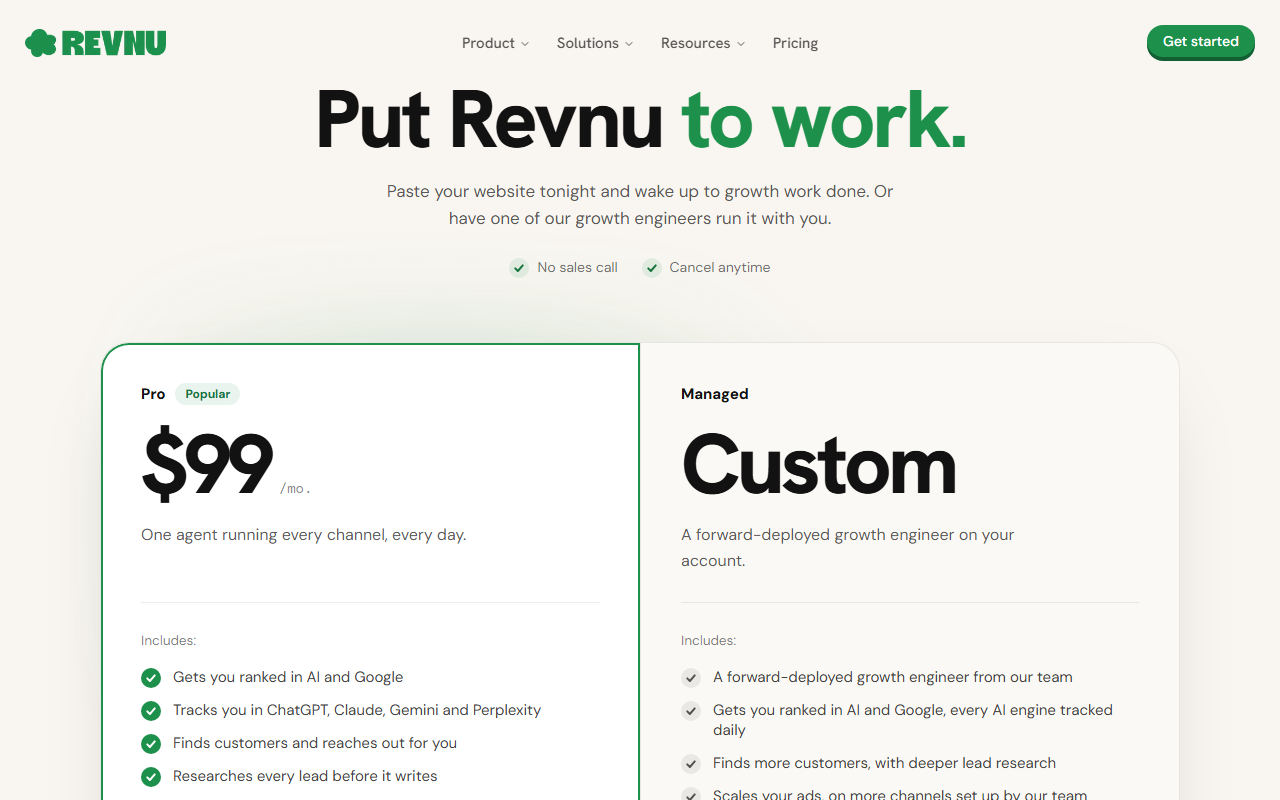 Revnu's two plans as its site showed them on 19 Oct 2026. Neither card includes ad spend, which each network bills to you.
Put simply, a shop already advertising on Instagram will most likely sit on the free tier or the first paid one. A software founder pays the Revnu fee every month, plus whatever Google and Reddit bill for the clicks.
Which channels each agent can actually touch
Price is the easy part. Channel coverage is where the two products stop overlapping, and it is the part most write-ups skip.
| Channel | Muse for Small Business | Revnu |
|---|---|---|
| Instagram and Facebook ads | Yes, via Meta ad accounts | Listed as coming next |
| Google Search ads | No | Yes, self-serve |
| Google Shopping | No | Not supported |
| LinkedIn, X, Microsoft ads | No | Yes, set up by Revnu's team |
| Reddit ads | No | Yes, self-serve |
| TikTok ads | No | Not supported |
| Cold email and LinkedIn outreach | Drafts only | Yes, threads replies to a booked call |
| SEO and AI search pages | No | Yes, tracked in 4 AI assistants |
| Shopify, QuickBooks, Klaviyo data | Yes | No |
Revnu's paid ads page is explicit: Google Ads and Reddit Ads connect from the dashboard, LinkedIn, X and Microsoft Ads are connected by Revnu's team, Meta ads are "coming next" and TikTok is not supported. That matters because Revnu's homepage demo shows an Instagram ad being scaled up, and its pricing FAQ mentions ads running "in your own Google or Meta account". We follow the more specific paid-ads page. If Instagram is your main ad channel, confirm it in writing before you pay.
Muse sits on the other side of the line. According to Meta, linking a shop's Instagram insights, its Facebook Page and its ad account is a few clicks of work, and 15 named business tools sit alongside them. Design work flows in from Canva and Figma. Planning docs come from Notion. Meeting notes arrive from Granola. Even app prototypes built in Lovable can be read. What it cannot do is buy a Google keyword or send a cold sequence to a list of companies it found.
Where Muse wins: the shop that already sells on Instagram
Muse's advantage is context it gets for free. Once the Meta business accounts are linked, Meta says Muse already knows what you sell, how your brand sounds and what customers keep asking. No third-party agent gets that view inside Meta's apps in one step.
Meta's launch post quotes Tom Mulholland, who runs a grocery in Malvern, Iowa, saying he works about 65 hours a week and that Muse is "taking over a few" of his roles. That is a vendor-chosen testimonial, not an audit, but it describes the buyer well: someone short on hours, not ideas.
The suggested jobs fit that buyer too. Meta's own example prompts include:
- Read this year's sales, campaigns and social posts, then build a growth plan for next year.
- Work out which ads and posts worked, and draft next week's campaign around what is trending.
- Check this month's numbers and flag expenses that look off.
- Sort the inbox and calendar, then take what it can off your plate.
A florist with a Shopify store, a Klaviyo email list and an Instagram ad budget gets all of that in one agent, at no cost to start. Muse also works through WhatsApp and a Mac app, and it is powered by Muse Spark, the model Meta built in-house, so no second AI subscription is involved.
Its limits are real. It is open only to people aged 18 and over in the US and Canada, with no date for other markets. It is weeks old as a business product. And it reads business data without being a system of record: there is no built-in CRM, books or storefront. For the consumer side of Muse, and how it compares with xAI's and OpenAI's assistants, see our Grok Bot vs Muse vs Dots comparison; this guide covers the business tier only.
Where Revnu wins: the B2B founder with no growth hire
Revnu is built for a different customer. Its funding post says most of its customers today are in San Francisco and the founders, George Jefferson and Art Freebrey, built it because "finding customers was the hard part" in every company they started. The product reflects that: it hunts for buyers rather than reading the ones you have.
Three jobs carry the weight:
- Outbound. Revnu scores target companies on buying signals, such as a new funding round or an open growth role, writes to the right person and threads replies until a meeting is booked.
- Paid search and social. It plans small tests per channel, launches them paused for approval, then moves budget toward what books calls.
- SEO and AI search pages. It publishes pages aimed at Google and tracks where your company appears in 4 assistants. ChatGPT is one; Claude, Gemini and Perplexity are the others.
None of that is in Muse's job description. A founder selling a scheduling app to swim schools does not find buyers on Instagram; they find them by email and search. Revnu's customers page reports that Soljio, a one-founder swim school software company, got its first interested buyer 18 hours after sign-up. That figure is Revnu's own, and we found no independent customer reviews to check it against on 19 October 2026.
Revnu is also honest about what it does not make. The paid ads FAQ says it writes keywords, audiences, ad copy and images, but no video, no tracking pixels, no new retargeting audiences, and no Google Shopping or app campaigns. That list is the reason a consumer product brand should hesitate: Shopping is the Google format built around a product catalog, and Revnu leaves it out.
What each agent does without asking you first
Both vendors promise you stay in control. They mean slightly different things, and the difference decides how much attention each needs from you.
Muse routes every outside action through a separate system Meta calls Sentinel. According to Meta's security write-up, the agent proposes and Sentinel decides, and when it asks you, the approval is bound to that connector and use. You choose the grant:
- one time only
- for this session
- for this task
- for a set time window
- permanently
Meta's business page goes further: posts, messages and purchases all wait for a tap from you, and each one can be reversed. Where a service allows it, read access and write access are split, so you can let Muse read your calendar long before it books meetings.
Revnu writes its rules down per channel. Campaigns start life switched off; going live, a bigger monthly budget and a higher daily spend all need your yes. Inside limits you approved, though, it acts alone: it moves budget between live campaigns, launches replacement tests inside an approved test budget, and switches off a campaign once a week of clean tracking has passed with nothing qualified to show for twice its target cost. Deleting a campaign is always your call.
One caveat on spend caps. Revnu's FAQ says everything pauses once reported spend reaches the cap you set. Ad networks lag in reporting, and two of them can overdeliver on a single day, so the bill can end up slightly above it. Budget a small margin.
How Muse and Revnu handle your business data
This is the section to read before connecting a payment account.
Muse keeps your connected logins in a credential store the agent itself cannot read, generates a one-time card number when it buys something, and Meta says your conversations are not shared with its ad systems.
The catch is training. Meta's security page says conversation and tool-call "trajectories" are used to train new model checkpoints by default, after personal details are stripped, and that you can opt out with a switch in Muse settings. Do that before you paste in customer lists. A confidential mode that would stop Meta itself seeing data in your agent's machine is promised for later this year and was not live on 19 October 2026.
Revnu's pricing FAQ is shorter. On the self-serve Pro plan, lessons from how agents perform are pooled across accounts to improve the product, while promising that no other customer sees your material, your contact lists or your numbers. Managed customers get isolation: nothing leaves their own account. Ad spend never touches Revnu: it runs in accounts you own.
| Question | Muse | Revnu |
|---|---|---|
| Used to improve the AI? | Yes by default, opt-out switch | Pooled lessons on Pro, isolated on Managed |
| Who holds ad accounts? | You, linked to Meta | You, billed by each platform |
| Card details seen by agent? | No, one-time card numbers | Not applicable, no purchasing |
Since its 8 September 2026 launch, Muse has carried a public bug bounty paying up to $300,000 for valid reports, including prompt injection attacks on Muse. Revnu has published nothing comparable, which is normal for a seed-stage company and still worth knowing.
The case against splitting it by business type
The strongest objection is that the line between a shop and a software company is blurrier than this guide makes it. Plenty of B2B companies advertise on Instagram, and plenty of shops would love cold outreach to wholesale buyers. Why not run both?
You can, and for some businesses that is the honest answer. Muse costs nothing to start, so a software founder can keep it for reading Meta ad results and inbox triage while Revnu works search and outbound. The overlap is small enough that the two rarely fight over the same task.
The reason we still split the verdict is attention. Each agent asks for approvals, and approval fatigue is how small teams end up clicking "always allow". Two agents means two queues. For a five-person team the better plan is to start with the one that covers the channel where your customers already convert, then add the second only when its channel shows real demand.
The second objection is proof. Revnu is new and unproven at scale, and Muse's business skills are weeks old. That is true of both, and it is why the approval model matters more than any demo: it caps what a bad week can cost you.
Switching cost: what you lose if you leave either one
Leaving Muse is cheap. Your shop data stays in Shopify, QuickBooks and Klaviyo; Muse only read it. What you lose is the memory it built of your brand voice and the routines you set up, which live in its own cloud machine. Cancel a paid plan and you drop back to the free tier rather than losing access.
Leaving Revnu takes more planning, because it does more on your behalf:
- Ad campaigns stay in your own Google, Reddit or LinkedIn accounts, so they survive, but nobody will be moving the budget.
- Outbound sequences stop. If you are on Managed, ask who owns the sending domains and mailboxes Revnu set up before you cancel.
- SEO pages it published stay on your site. Its AI search tracking does not.
- Pipeline records were never in Revnu, which lists no CRM, so nothing needs exporting there.
The cancellation itself is one click with no minimum term, according to Revnu's pricing page, and the trial before your first $99 charge usually lasts 1 day. The real switching cost is the month of learning about which angles worked, so write that down while it is running.
Alternatives if neither agent fits
Most readers who rule both out want one channel done well rather than an agent doing everything.
For cold email alone, lemlist is a sending tool you run yourself, so every email goes out on your schedule rather than an agent's. Instantly is the second sending tool worth pricing against it. If you want the list built from enrichment data first, our Apollo vs Clay comparison covers the two databases most teams start from. Pick Clay for custom research workflows. Pick Apollo for a searchable contact base.
For search visibility without ads or outreach, Semrush covers Google rankings. Peec AI tracks how often AI assistants mention your brand. Our AI search visibility guide compares the trackers on that one job.
For an autonomous sales rep aimed at bigger sales teams, 11x sells AI SDRs that work alongside human reps. For Meta's own help with ads and messaging inside Instagram and WhatsApp, Meta AI is the assistant built into those apps rather than an agent. And if what you want is a personal agent outside Meta's ecosystem, Grok Bot is the closest consumer rival. The full set of marketing tools sits in our marketing tools directory.
What would change this verdict
Our verdict rests on 3 facts that could each flip within the next 6 months.
- Revnu ships Meta ads. Its paid ads page lists Meta as coming next. If Instagram and Facebook campaigns go live with the same rules, the shop half of this verdict weakens.
- Meta adds outbound or Google. A Google Ads connector or a sending mailbox in Muse would put a $0 to $20 agent against a $99 one for the software founder. Meta's launch post promises more connectors in the months ahead.
- Independent results appear. Today both vendors' proof is self-reported. Ten or twenty outside reviews showing booked meetings or better campaigns would matter more than any feature list.
Watch Revnu's paid ads FAQ and the connector list in Muse's settings. When either one changes, the cheapest test is the same: give the agent one channel, a capped budget and every approval switched on for a month, then judge it on booked calls or orders, not on what it says it did. The bigger shift will come from Meta itself: the day a free Muse can buy a Google keyword, a $99 growth agent needs a better answer than coverage.
Frequently asked questions
How much does Muse for Small Business cost?
There is no separate business price. Muse for Small Business sits inside Muse, which Meta says is free for most needs with a usage limit. Meta's help page lists Power at $20 a month with 500M tokens a week and Maximum at $100 a month with 3B tokens a week.
Can Revnu run Instagram or Facebook ads?
Not yet, according to Revnu's paid ads page, which lists Meta ads as coming next and TikTok as unsupported. Today it runs Google and Reddit ads self-serve, and LinkedIn, X and Microsoft ads set up by its team. Confirm Meta support in writing before relying on it.
Is Revnu worth $99 a month for a small business?
It is for a software startup with nobody running growth, because it covers outbound, search ads and SEO pages in one plan. It is a poor fit for a shop whose ads run on Instagram or Google Shopping, neither of which it supports. Ad spend is billed separately by each platform.
Does Muse post or spend money without asking?
No. Meta says posts, messages and purchases wait for your approval and can be reversed. A separate system called Sentinel rules on every outside action, and you choose whether an approval covers one action, a task, a time window or every future request.
Can a small business use Muse and Revnu together?
Yes, and the overlap is small: Muse reads Meta ads, Shopify and books, while Revnu works Google, LinkedIn, Reddit and cold email. The cost is attention, since each agent has its own approval queue. Start with the one covering the channel where customers already buy.
Covered in this guide
- Revnu: Y Combinator-backed AI growth agent that runs outbound, ads on Google, LinkedIn, Reddit, X and Microsoft, and SEO pages for software startups, with drafts held for approval.
- Muse: Meta's AI agent runs tasks in its own cloud computer; since 29 Sept 2026 it connects Shopify, QuickBooks, Meta ads and more for small businesses in the US and Canada.
- 11x: Alice runs outbound across 3 channels and Julian qualifies inbound leads by phone and chat, with both logging activity back to your CRM.
- Apollo: Apollo.io is a sales intelligence platform with a searchable B2B contact database, used by 500,000+ companies for prospecting and outreach.
- Canva: Helps everyone design anything and publish it anywhere
- ChatGPT: ChatGPT is OpenAI's AI assistant, with 1.2 billion weekly users by OpenAI's count, the GPT-6 model family and plans that run from a free tier to a premium Pro tier.
- Claude: Claude is Anthropic's AI assistant, with a free tier, paid personal plans, and Team and Enterprise seats. Opus access starts at the first paid plan.
- Clay: AI go-to-market platform with waterfall data enrichment and Claygent AI research agents, with plans from free to enterprise.
- Granola: Bot-free AI notepad that merges your typed notes with a device-audio transcript, with apps for Mac, Windows, iPhone and Android and a free plan.
- Grok Bot: xAI's always-on AI agents that sign into your existing apps and finish multi-step jobs, bundled with eligible SuperGrok and Cursor plans.
- Instantly: Cold email platform with built-in warmup, a B2B lead database and credit-metered AI agents, priced by sending volume rather than per mailbox.
- lemlist: Multichannel outreach platform covering email, LinkedIn, calls and SMS, with a built-in lead database, lemwarm warmup and a lemAgent campaign builder.
- Lovable: Build something lovable. Create apps and websites by chatting with AI.
- Meta: Meta AI ships open-weight Llama (1B+ downloads) and the closed Muse models, led by Muse Wonder with a 1M-token context window.
- Meta AI: Meta's free AI assistant, available inside Facebook, Instagram, WhatsApp, and Messenger.
- Muse Spark: Muse Spark 1.3, released September 2, 2026 by Meta AI Research, is an agentic model for long coding, long documents and tool-heavy work, with max reasoning on the Standard API tier.
- Notion: Your AI everything app: All your tools and work in one unified workspace.
- Peec AI: Daily AI search tracker scoring brand visibility, position and sentiment across ChatGPT, Gemini and Copilot; Peec lists 3,500+ brands and agencies.
- Semrush: Adobe-owned SEO suite: keyword, backlink and rank data plus AI visibility tracking across 4 AI engines; a Free plan is available.
Sources
Still deciding?
This guide covers a handful of options. Smart Match checks every listing in the directory against how you actually work and what you can spend, then hands you the shortlist and the reason behind each pick.
Find your toolsRelated guides
- 41 of 100 HokAI Guides Carry a Screenshot. All 106 Still Load.Inside HokAIHow the directory works, verified in the open
- The AI 80s Photo Trend: How to Make Yours (and Turn It Into a Video) in 2026AnalysisWhat changed and who it affects
- Apollo.io Alternatives in 2026: Pick by the Job You Hired Apollo ForBuyer's guideHow to pick, across a category
- Apollo vs Clay: Which One Should You Buy First?ComparisonHead-to-head, with a verdict
- Bardeen vs Browse AI: Same Comparison, Different Products NowComparisonHead-to-head, with a verdict
- Best Agentic AI in 2026: Pick the Job, Not the GeneralistBuyer's guideHow to pick, across a category