Adobe Firefly vs Topaz Photo AI: Which Should You Use in 2026?
Adobe Firefly is a generative AI platform that creates new images, video and audio from text prompts. Topaz Photo AI is a photo enhancement tool that denoises, sharpens, upscales and restores existing photographs but cannot generate new images. Adobe agreed to acquire Topaz Labs on June 25, 2026, expected to close in late 2026.
The short version
Firefly generates images, video and audio from prompts. Topaz Photo AI only fixes photos that already exist: noise, blur, low resolution, damaged faces. Adobe agreed to buy Topaz in June 2026, but the deal hasn't closed, so buy for what you need done this quarter, not for an unannounced future bundle.
Adobe agreed on June 25, 2026 to buy Topaz Labs, the company whose software most professional Firefly users already run alongside it.
The Federal Trade Commission granted early termination of its antitrust review on July 28, clearing the deal to close months ahead of the standard 30-day waiting period. Terms were not disclosed, though reporting puts the price between $700 million and $1 billion.
For anyone weighing whether to buy Firefly or Topaz Photo AI right now, that timeline matters more than a features table: Adobe has said it will fold Topaz's enhancement models into Firefly, Firefly Services, and Creative Cloud after the deal closes. Until it does, the two tools still solve different problems, and the honest answer to "which one" depends on whether the image you're working with exists yet.
The verdict: pick by the job, not the brand
Buy Firefly if the image does not exist yet: a product shot generated from a text prompt, a background extended to fit a new aspect ratio, an ad variant dubbed into a language nobody on your team speaks. Buy Topaz Photo AI if the image already exists and something about it is wrong: noise from a high-ISO shoot, a soft focus pull, a face blurred by motion, a scan that needs restoring past its original resolution.
Most working photographers need Topaz far more often than they need Firefly. Most marketing and brand teams need the reverse. A team that genuinely needs both jobs done well has a third option worth reading before buying two Adobe-adjacent subscriptions, covered near the end of this piece.
What actually changed in June
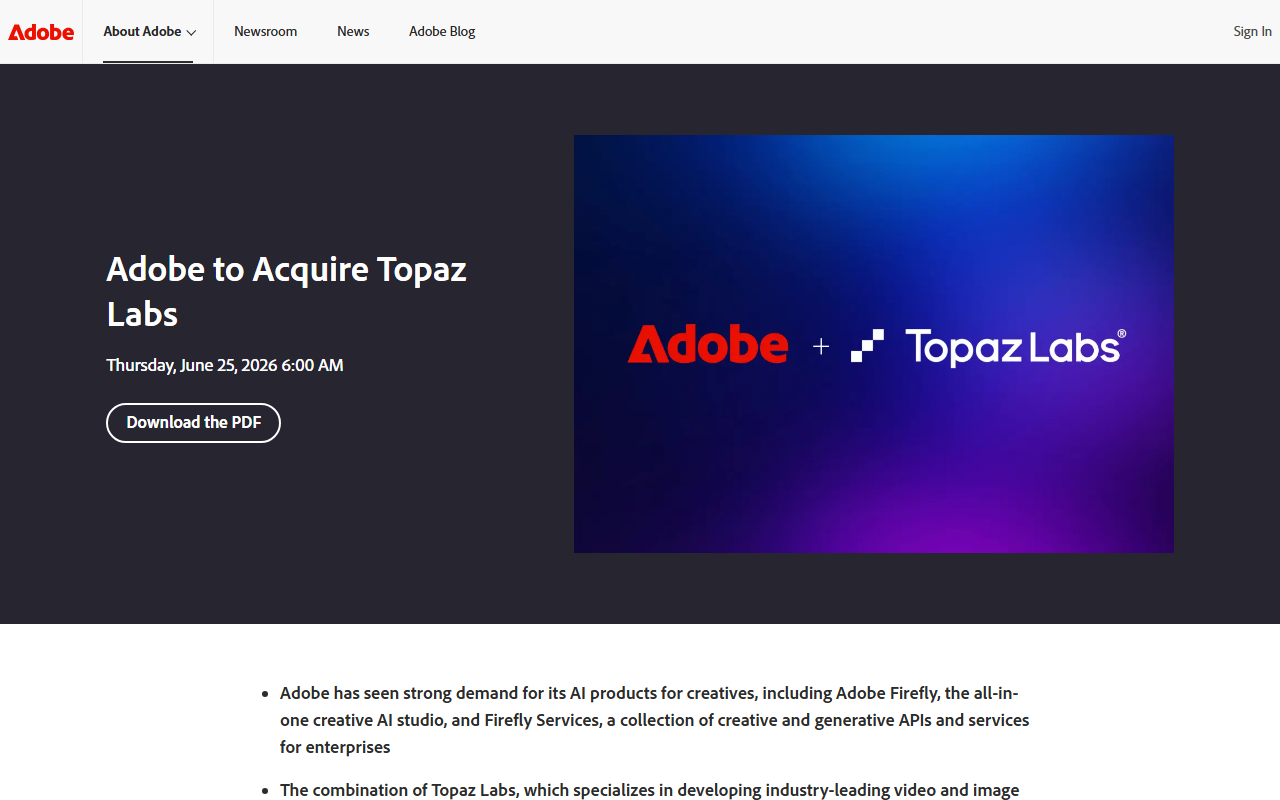 Adobe's official announcement, published 25 June 2026. The deal has not closed as of this writing.
Adobe's own framing, from the June 25 announcement, ties the deal to rising demand for mixing captured and generated media, promising "every creator" the ability to produce work "at higher quality and resolution." Topaz's chief executive, who stays on to lead the team after close, said the companies share a belief that "technology should serve human creativity rather than replace it."
The stated plan is to integrate the enhancement models into Firefly itself, into Firefly Services for enterprise API customers, and into Photoshop and other Creative Cloud apps. None of that has shipped. The deal has not closed. Topaz says its standalone apps keep selling through its own site after close, with no announced end date.
What Firefly actually costs
Firefly's free tier gives 25 generative credits a month with a watermark on the output. Standard runs $9.99 a month for 2,000 credits; Pro is $19.99 for 4,000; Premium is $199.99 for 50,000, according to Adobe's current published tiers as tracked by a pricing monitor on June 9, 2026. Generative Fill and basic text-to-image are unlimited and credit-free on every paid tier, so credits mostly get spent on video generation, dubbing, and outside models such as Google's Imagen, all accessible inside the same workspace.
Adobe is also running a limited-time cut on its two biggest plans: Pro Plus at $34.97 a month instead of $49.99, a 30% first-year discount reported ending August 26, 2026. Credits do not roll over month to month, and fast-generation mode burns credits at double the normal rate. Annual billing on any paid tier saves roughly 14% against paying monthly, which matters more at the Premium end, where the gap runs into hundreds of dollars a year.
What Topaz costs now that the lifetime license is gone
Topaz discontinued perpetual licenses on October 3, 2025, moving its whole lineup, including the app long known as Photo AI, to subscription only. The product itself was renamed Topaz Photo around the same time, though most searches and reviews still call it Topaz Photo AI.
Current pricing, per Topaz's own site: Personal runs $39 a month or $199 a year, about $17 a month when paid annually. Pro runs $63 a month on an annual commitment or $599 a year, about $50 a month. The gap between tiers is commercial rights, not features: Personal covers organizations under $1 million in annual revenue, and Pro is required above that threshold. Both tiers include the same enhancement models, plus unlimited local rendering.
Generating and restoring are not the same job
Firefly's flagship generation model builds a picture from a text prompt, with sliders for camera angle, lighting, and style intensity. There is nothing to feed it but words. Topaz's models do the opposite: they need a real photograph, and they never invent new subject matter, only recover detail the camera captured but couldn't render cleanly. Adobe's own numbers claim Generative Fill saves 60 to 80% of manual retouching time on a typical background extension, a task Topaz cannot do at all.
Resolution tells the same story from a different angle. Firefly's output is capped by whatever the generation model renders at, typically well under the pixel count a modern camera captures. Topaz works the other direction, upscaling an existing photo well past its original resolution while trying to invent as little new detail as possible. Feeding a Firefly image into Topaz for a sharper export is common; feeding a Topaz output into Firefly for further generation is not, because there is nothing left to prompt against.
If neither product fits your budget or your workflow, two real alternatives sit on either side of the split. FLUX generates images with a documented focus on keeping the same character or product consistent across dozens of variations, useful if you're producing a catalog rather than a single hero shot. Microsoft Designer covers basic text-to-image generation for free, without a credit system, for teams that don't need Firefly's ecosystem depth.
Where Firefly wins
A five-person agency shipping 40 localized ad variants a week for a retail client is the clearest case. Firefly's dubbing and lip-sync feature translates spoken dialogue into 20-plus languages while matching mouth movement to the new audio, cutting a job that used to take days of manual re-recording down to an afternoon of prompt adjustment. Topaz has no equivalent; it does not generate or translate anything.
Where Topaz wins
A wedding or event photographer delivering 800 images shot across mixed indoor lighting is the clearest case for the other side. Topaz's denoise and recover-faces models run as a batch across an entire shoot, correcting motion blur and high-ISO grain without touching composition. Firefly could regenerate a face from scratch, but that changes the person in the photo, not an acceptable trade for a client who paid for their actual wedding.
The obvious objection, and why it's premature
The obvious question is why anyone should pay Topaz $199 a year when its models are reportedly coming to Firefly anyway. Three reasons the wait is a bad bet right now.
First, the deal has not closed; the public language is "expected to close in the second half of 2026," not a firm date, and the FTC's early clearance shortens the antitrust review, not the closing process itself. Second, there is no word yet on whether the enhancement models will run inside Firefly's existing credit system, as a paid add-on, or free.
A team that needs restoration work done this quarter cannot plan around an unannounced pricing model. Third, the standalone apps are explicitly staying on sale after close, so there is no cliff edge forcing a decision either way. A photographer who needs clean, upscaled images for a client delivery next month gains nothing by waiting on a roadmap nobody has published yet.
The one subscription that tries to do both
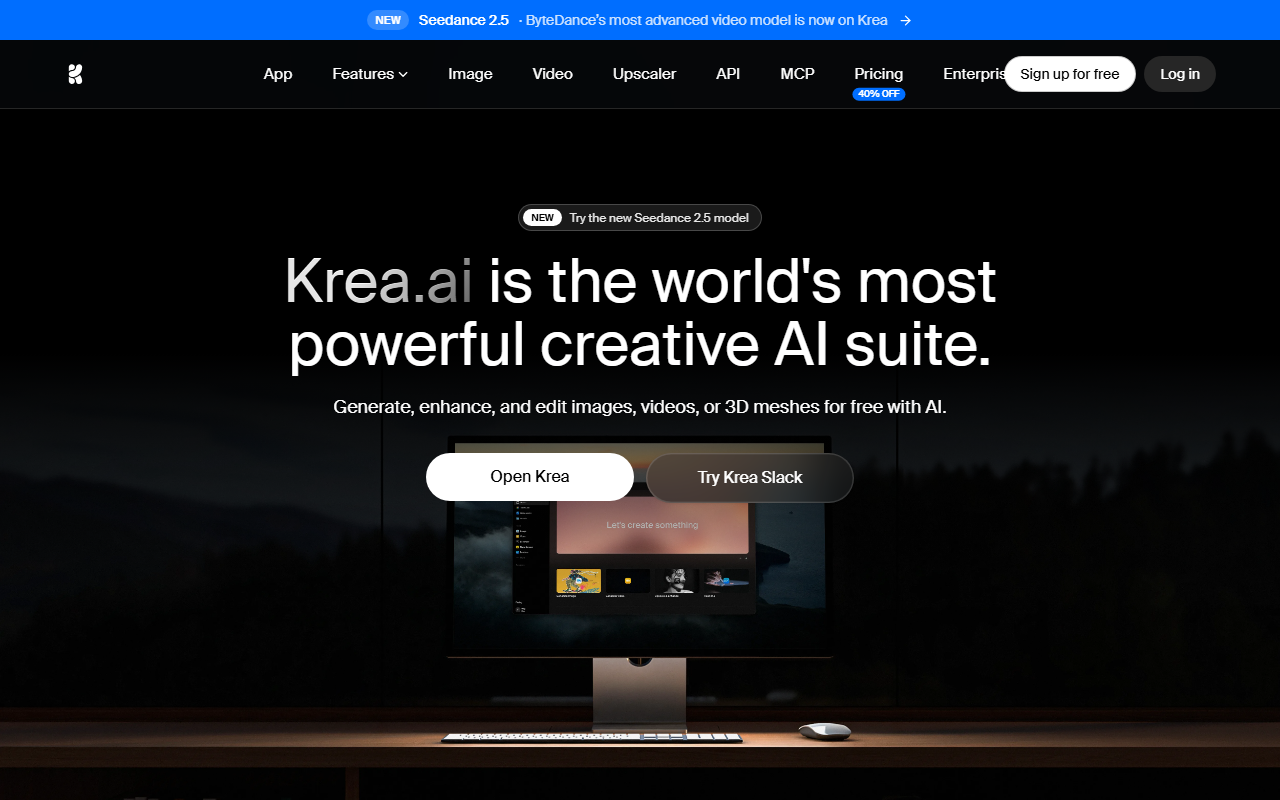 Krea's own positioning, captured 26 August 2026. It pitches both jobs at once, not just one.
Krea markets itself, in its own words, as a suite to "generate, enhance, and edit images, videos, or 3D meshes for free with AI," which is a direct pitch at the gap this piece just described. It will not match Topaz's restoration quality on a genuinely difficult noise or blur case, and its generation models are a step behind Firefly's best, but for a solo creator who wants one bill instead of two, it is the closest single product to both jobs at once.
If you're still not sure which category your own workflow actually falls into, HokAI's Smart Match can walk through the kind of files you're starting from and point at the narrower pick instead of asking you to guess from a features table.
What to watch
The number that will actually answer this comparison hasn't been published yet: whether the enhancement models arrive inside Firefly as a free upgrade to existing credits, or as a new paid tier on top of them. That decision, whenever it comes, is the real price of this acquisition for photographers who never signed up to be Adobe customers in the first place.
Frequently asked questions
What is the difference between Adobe Firefly and Topaz Photo AI?
Firefly generates new images, video, and audio from text prompts using Adobe's own models plus more than 30 partner models, including Google's Imagen 3. Topaz Photo AI only enhances photographs that already exist: removing noise, sharpening detail, upscaling resolution, and recovering blurred faces. Neither product can do the other's job.
Does Adobe's acquisition of Topaz Labs change which one I should buy in 2026?
Not yet. The deal was announced June 25, 2026 and is expected to close in the second half of the year, and Adobe has not said when or how Topaz's models will appear inside Firefly. Buy based on the work in front of you now, not an unannounced future bundle.
How much does Topaz Photo AI cost now that it dropped one-time purchases?
Topaz discontinued perpetual licenses on October 3, 2025. Its Personal plan now runs $39 a month or $199 a year, and the Pro plan required for organizations over $1 million in annual revenue runs $63 a month or $599 a year.
Is there a cheaper alternative that handles both generation and photo enhancement?
Krea combines generation and enhancement in one subscription and is the closest single product to both Firefly's and Topaz's jobs, though it does not match Topaz's restoration quality on genuinely difficult noise or blur cases. Microsoft Designer offers free generation only, with no photo enhancement features.
Will Topaz Photo AI still be sold as a standalone app after Adobe's acquisition closes?
Adobe and Topaz have both said standalone Topaz products will keep selling through Topaz's own site after the deal closes, with no announced end date. That could change once integration work with Firefly and Creative Cloud actually begins.
Covered in this guide
- Firefly: Adobe Firefly generates commercially safe AI images and video inside Photoshop and Illustrator, trained exclusively on licensed content for full commercial-use IP indemnification.
- Topaz Photo AI: Topaz Photo AI sharpens, denoises, and upscales images up to 16x. Trusted by 1.5M+ photographers at Apple and NASA. Annual plans from $199, no free tier.
- FLUX: FLUX by Black Forest Labs is an AI image generation and editing model family built to keep characters and products visually consistent across dozens of generated variations.
- Krea: An AI suite for creatives that generates, enhances, and edits images, videos, and 3D assets in one browser-based platform.
- Microsoft Designer: AI-powered graphic design tool for creating professional visuals from text descriptions
Sources
Still deciding?
This guide covers a handful of options. Smart Match checks every listing in the directory against how you actually work and what you can spend, then hands you the shortlist and the reason behind each pick.
Start Smart MatchRelated guides
- 41 of 100 HokAI Guides Carry a Screenshot. All 106 Still Load.Inside HokAIHow the directory works, verified in the open
- Adobe Firefly or Gencraft: A 2026 Pricing and Feature ComparisonComparisonHead-to-head, with a verdict
- Best AI Tools for Graphic Designers in 2026Buyer's guideHow to pick, across a category
- Best AI for Creating Logos in 2026: Tested Picks & VerdictBuyer's guideHow to pick, across a category
- Best AI Image Generators in 2026: Pricing, Licensing, and the Real Cost Per ImageBuyer's guideHow to pick, across a category
- Best AI Tools for Photo Editing and Restoration in 2026Buyer's guideHow to pick, across a category