Best AI for Doctors in 2026: Evidence Search, Scribes and What Is Safe to Use
AI for doctors falls into evidence tools that answer clinical questions with citations and ambient scribes that draft visit notes. In November 2026 two evidence tools are free to verified US clinicians, while scribes mostly sell through health-system contracts, and any use with patient data needs a signed business associate agreement.
The short version
Pick by job, then by contract. OpenEvidence and ChatGPT for Clinicians are free for verified US clinicians. Abridge, Claude's HIPAA plan and ChatGPT for Healthcare need an organization. A UC Davis pilot found 5.3% of scribe notes held a serious-risk error, so review every draft.
Want this decided for your own case? Find your tools with Smart Match, starting from this guide's question.
In November 2026, two of the most capable AI tools a US doctor can use cost $0, while the scribe many hospitals have bought cannot be bought by an individual at all.
OpenAI's ChatGPT for Clinicians and OpenEvidence are free once a licence is verified. Abridge, a scribe sold through health-system contracts, publishes no price. Claude can sign a HIPAA agreement only for an Enterprise organization, never on a personal plan. Which tool is "best" therefore depends less on features than on who you are, which country you practise in and whether patient data will touch the tool.
This guide splits the field by job: finding evidence at the point of care, drafting the visit note, and the legal gate in front of both. It is written for clinicians choosing software, not for patients seeking advice. Hokai gives no medical advice, and nothing here replaces a clinician's judgment.
Every price, eligibility rule and agreement below was read on a vendor's own page on 6 November 2026. Hokai ran none of these products on real patients, so accuracy comes from published studies, with their limits stated. Where a page could not be read, the guide says so.
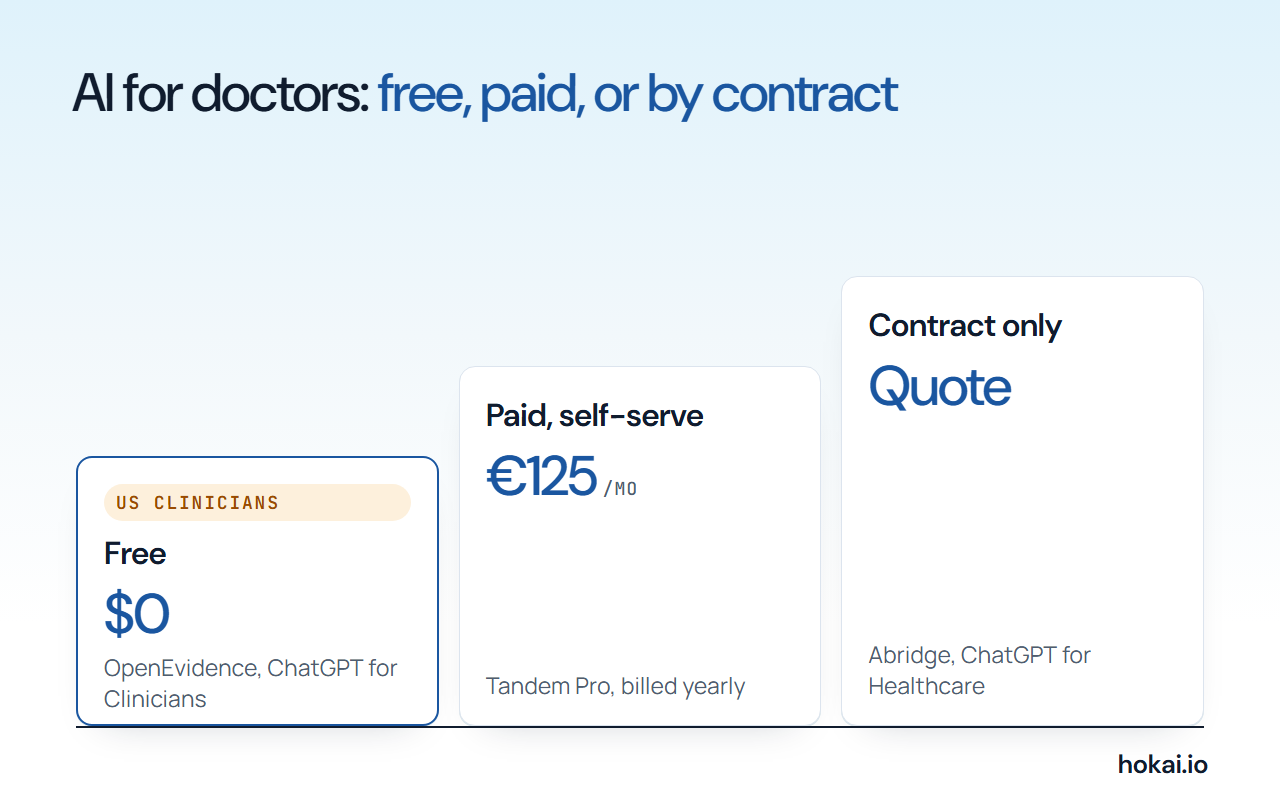 Hokai's chart of how each tool is bought, from vendor pages read on 6 Nov 2026.
- ChatGPT for Clinicians for verified US clinicians
- $0
- Free at launch, per OpenAI
- Tandem Pro per user a month
- €125
- Billed yearly
- Scribe notes with a serious-risk error
- 5.3%
- UC Davis pilot, 356 notes reviewed
How to choose AI as a doctor: the job comes first
Start with the task, because the tools that win each one barely overlap. An evidence answer needs citations you can open. A visit note needs to listen to a room and write into your record. A letter to a payer needs neither, only good drafting.
Then run four tests, in this order.
- Country. Several of the best tools are US-only. OpenEvidence and ChatGPT for Clinicians both verify a US licence.
- Contract. Will patient details ever go in? If so, you need a signed business associate agreement (BAA) before you start, not after.
- Proof. Does the vendor show how often it is wrong, and did anyone independent check?
- Review. Can you open the source behind every claim in under a minute?
The table maps the three jobs to the tools covered below.
| Job | Tools in this guide | Who can sign up |
|---|---|---|
| Evidence answers | OpenEvidence, ChatGPT for Clinicians, Heidi, Claude | US clinicians for the first two |
| Visit notes | Abridge, Heidi, Tandem Health | Enterprise for Abridge |
| Drafting letters | ChatGPT for Clinicians, Claude | Verified clinicians, or Enterprise |
Clinical evidence answers: OpenEvidence and ChatGPT for Clinicians
OpenEvidence answers clinical questions from licensed medical content. Press coverage of its January 2026 funding round says it is free to verified doctors, paid for by advertising, and has content partnerships with the American Medical Association, the New England Journal of Medicine and JAMA. The company says more than 40% of US physicians use it daily and that it passed $100 million in annual revenue. Those are the company's figures, not an audit.
Its trust center lists SOC 2 Type 2 and HIPAA. Hokai could not open openevidence.com from Singapore: the site returned a location block on 6 November, so features, models and sign-up rules here rest on press coverage and the trust center, not the product pages.
ChatGPT for Clinicians is the free alternative from OpenAI. OpenAI's help center says it is free at launch for verified US physicians, nurse practitioners, physician assistants and pharmacists. You need a ChatGPT account, a valid National Provider Identifier and a licence that a third-party provider can verify. It offers cited clinical search, deep research across medical literature, drafting of referral and prior authorization letters, and credit toward continuing medical education on eligible questions.
OpenAI's own launch post from 22 April 2026 says physicians rated 99.6% of 6,924 test conversations safe and accurate. Read that as a vendor test: OpenAI ran it, with its own advisors, on its own benchmark. The same post says the product is designed to support clinicians, not replace their judgment.
Two more entrants belong on the shortlist. Heidi, an ambient scribe, now sells an Evidence feature with citations; its pricing page lists unlimited cited answers under Evidence, though Hokai could not read dollar prices for the paid plans. And Claude from Anthropic offers a HIPAA-ready version only inside an Enterprise organization, which rules it out for a solo clinician.
Researchers who want papers rather than answers can look at Consensus or Perplexity, both covered in our guide to AI for research. Neither is a clinical product, and Hokai did not verify either vendor's healthcare terms.
Which is best for evidence? What the independent studies say
Vendors grade themselves. Independent tests are rarer, and they disagree.
A December 2025 preprint compared OpenEvidence and UpToDate Expert AI with GPT-5, Gemini 3 Pro and Claude Sonnet 4.5 on a 1,000-item mini-benchmark built from MedQA and HealthBench. The generalist models scored higher, GPT-5 highest, and the two clinical tools showed gaps in completeness, communication and safety reasoning. The authors' title says generalist models outperform clinical tools on medical benchmarks. It is a preprint, not a peer-reviewed paper, and it tests the versions available in late 2025.
The practical reading: a medical wrapper does not guarantee a better answer than a frontier model, and a frontier model does not come with licensed journal access. Use the tool that cites sources you can open, then open them.
How to check an AI answer in sixty seconds
A citation is a claim that a source says something, not proof that it does. The check is short. Open the cited study.
Confirm the population matches your patient: age, comorbidities and setting. Confirm the answer's number appears in the paper, and note whether the paper is a trial, a guideline or an observational study. If the tool cites a guideline, check its date. OpenAI's own help pages tell clinicians to review cited sources before relying on deep research outputs in care, and the same habit applies to every tool in this guide.
Ambient scribes: a short section
If you are weighing a pocket recorder rather than a software scribe, our guide to AI voice recorders sets out the recording-consent rules by state and where each maker stores the audio.
An ambient scribe listens to a visit and drafts the note. Abridge is the best known in US hospitals. Its pricing is not published, and access runs through an employer's contract. Abridge's clinician page claims 78% of clinicians report improved work satisfaction, a vendor figure. It publishes a standard business associate agreement and lists SOC 2 Type 2 and HIPAA on its trust center.
For a solo clinician, two options do offer self-serve starts. Heidi has a free plan with one seat and a 14-day trial of paid tiers. Tandem Health, from Stockholm, lists a free plan with unlimited note generation and a Pro plan at €125 per user per month billed yearly. Tandem is built for European markets; its Hokai record lists GDPR, ISO 13485 and EU MDR Class IIa certification, and no HIPAA claim, so it suits a clinician in Europe more than a US practice.
Two records in the same ambient scribe category are not for doctors. voize targets nursing and long-term care, and VetRec is built for veterinary practices.
Drafting letters, patient instructions and prior authorizations
Paperwork is where a general assistant earns its keep, because the task needs good drafting, not a medical database. OpenAI's help center lists referral letters, prior authorization letters and plain-language patient instructions as ChatGPT for Clinicians uses, each "for clinician review". The organization product adds discharge instructions and the ability to connect to SharePoint, Teams and Outlook, so a draft can follow a hospital's approved care pathways.
Two limits apply. The Epic connection is available to organizational workspaces, where an administrator sets it up and access stays read-only, and it is not offered on the individual clinician plan. And a draft is not a message: nothing here should go to a patient before a clinician has read it.
Claude can draft this kind of letter too, but with patient details the BAA rules above decide whether it is allowed. A practical habit that works under any contract: draft the letter with placeholders, then fill the identifiers in your own record system.
What it costs: free tiers, paid tiers and contracts
Most individual US clinicians pay $0 today, and the reason is worth knowing. OpenEvidence runs on advertising. OpenAI says ChatGPT for Clinicians is free "at launch", which is not a promise about next year.
- OpenEvidence
- Free for verified US clinicians, ad-supported
- ChatGPT for Clinicians
- Free for verified US clinicians
- Tandem Health
- Free plan, Pro €125 per user per month
- Abridge
- Enterprise contract only
- Claude
- HIPAA only on Enterprise plans
ChatGPT for Healthcare, the organization version, is priced on ChatGPT Enterprise with a shared credit pool and a sales call. Abridge is also quoted per contract.
HIPAA and BAA: what each vendor says
HIPAA does not certify software. What a clinic needs is a signed business associate agreement and a tool that sits inside it.
| Tool | BAA | Condition |
|---|---|---|
| ChatGPT for Clinicians | Yes, individual | Sign in Settings, Agreements |
| ChatGPT for Healthcare | Yes | Organization contract |
| Claude | Yes, click to accept | Enterprise plans only |
| Abridge | Standard BAA published | Via customer contract |
Read the small print. OpenAI says protected health information should not go into ChatGPT for Clinicians unless a BAA is in place and you can sign one, and says memory features are not covered by the BAA on the Healthcare plan. Anthropic says a BAA covers only features it lists as covered, and that Team, Pro and Max plans cannot enable HIPAA. A BAA protects the data; it does not make the output correct.
Data handling: training, retention and where queries go
OpenAI says content shared with ChatGPT for Clinicians and with ChatGPT for Healthcare is not used to train its models. The Healthcare plan adds data retention controls, data residency options, audit logs and customer-managed encryption keys, none of which an individual account has.
OpenEvidence's trust center, as read on 6 November, lists SOC 2 Type 2 and HIPAA but does not state a training or retention policy on that page. That is a gap, not a finding: ask the vendor for its documents before entering anything sensitive. Hokai did not read Anthropic's training terms for Claude in this pass, only its HIPAA enablement rules.
For a clinic that wants the least exposure, the cheapest control is the one in your own hands: leave identifiers out of queries. Most evidence questions, such as "first-line therapy for condition X in adults with kidney disease", need none.
Private AI options matter here for clinicians who would rather keep patient material off cloud tools altogether. Our guide to private AI covers local models, and the general ChatGPT alternatives page lists other assistants, with no healthcare claims made.
FDA status: when AI software counts as a medical device
FDA's final guidance on clinical decision support software, dated January 2026, explains which decision-support functions fall outside the legal definition of a device under the 21st Century Cures Act. In broad terms, software that only informs a clinician, who can review the basis for the recommendation, is treated differently from software that is intended to diagnose or direct treatment for a patient.
OpenAI's and Anthropic's pages describe their tools as support for clinicians, not a replacement for judgment, and Hokai found no clearance claim in the vendor pages it read. A missing clearance is not a flaw, but it also means non-device software is not reviewed by FDA for accuracy. Tools aimed at patients or caregivers fall under FDA's existing digital health policies, which is one more reason this guide stops at clinicians.
- Confirm the BAA Before first useSign it, or confirm your employer has, and read what it covers.
- Strip identifiers Every queryLeave out names and record numbers unless the BAA covers the feature.
- Open the source Every answerClick through to the cited study for any answer that changes care.
- Edit the note Every visitRead the whole scribe draft before signing.
Hallucination risk: what scribe studies measured
The best public evidence is on scribes. In a 2026 paper in JMIR Medical Informatics, UC Davis Health had 31 physicians use an ambient scribe on 7,545 notes over two months in 2024 and rate 356 of them. Accidental omissions appeared in 18% of the rated notes, hallucinations in 11.5% and accidental inclusions in 9.3%. Bias was rare, at 1.1%. Of the 356 notes, 19, or 5.3%, held an error rated serious or imminent risk if left uncorrected.
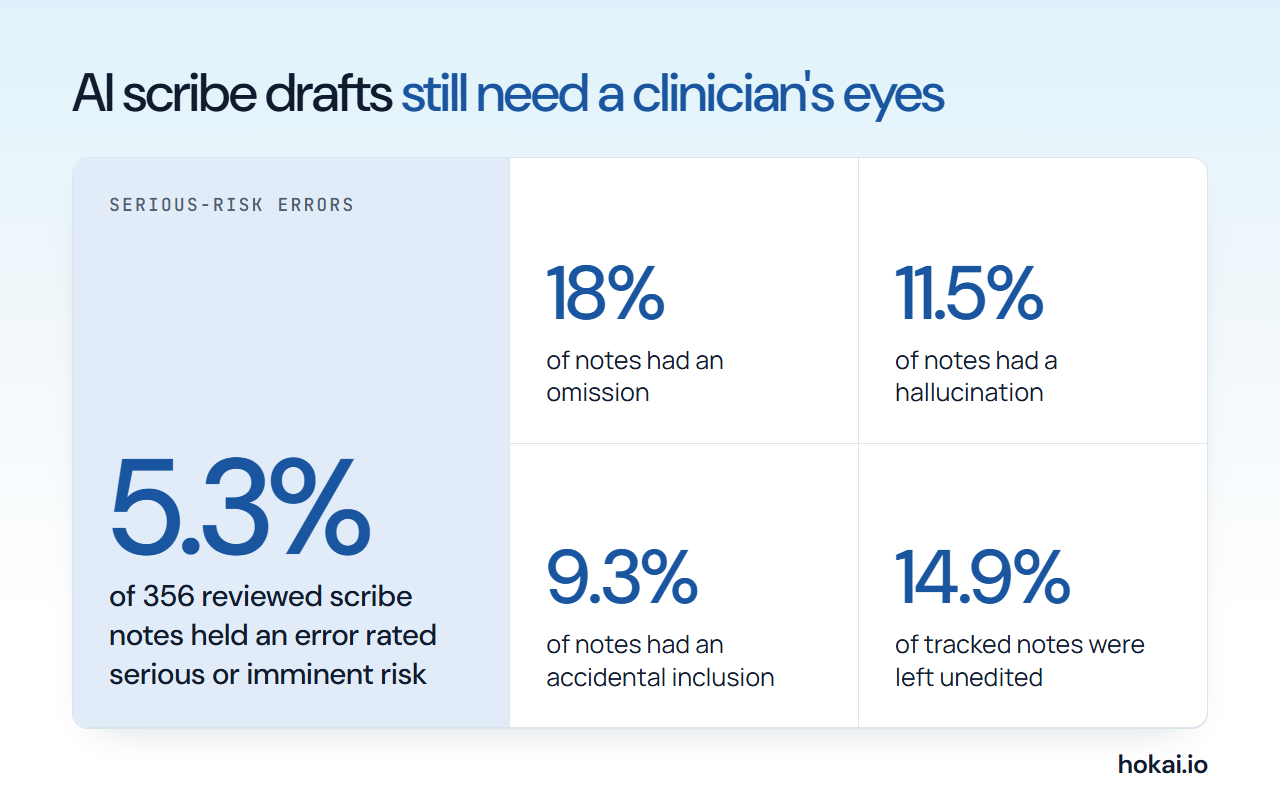 Hokai's chart of the UC Davis scribe pilot, JMIR Medical Informatics, published 17 Apr 2026.
Figures from the JMIR Medical Informatics pilot, published 17 April 2026.
Examples the authors list at the top severity levels include a note that wrongly added a directive to start aspirin for ankle pain and one that stated a patient had diabetes. Physicians left 14.9% of notes entirely unedited, and the share of words changed ranged from 1.9% to 69.3% by physician. The authors conclude that careful review remains imperative and that organizations should pilot a tool first.
The study has limits: volunteers, self-rated severity, and the vendor was not named. It shows what drafts look like, not what any one product does today.
Which to pick: by role
The honest answer changes with the clinician.
- Solo US clinician, no patient details in queries. Start with OpenEvidence and ChatGPT for Clinicians side by side for a week. Both are free, both cite sources, and which one your questions suit is quickly visible.
- Solo US clinician who wants to paste patient detail. ChatGPT for Clinicians with its signed individual BAA is the only self-serve route Hokai verified that offers one.
- Clinician outside the US. OpenEvidence and ChatGPT for Clinicians verify US licences. Tandem Health and Heidi sell outside the US and offer free plans for notes.
- Hospital or group practice. Ask for ChatGPT for Healthcare or an Abridge contract, and have counsel read the BAA before a pilot.
- Resident or student. The free tiers cover study, but verification asks for an NPI and a licence a third party can check, so confirm your own status first.
For the rest of the field of assistants, our ChatGPT alternatives page lists other general tools, none with a medical claim made by Hokai.
The strongest case against all of this
The best argument against adopting these tools is speed. A physician with seven minutes a patient may skim an AI draft instead of reading it, and the UC Davis data hints at it: some clinicians changed almost nothing. If review slips, a fluent error is worse than a blank field, because it looks finished.
The answer is not to avoid the tools but to price the review in. A scribe that saves ten minutes and costs two of careful reading still wins. One that is never read does not. Choose tools that make the check cheap: citations that open, notes with source quotes, and a clinic policy that says who reads what.
Who should skip these tools, and what would change this guide
Skip all of this if you cannot sign a BAA and the task needs patient detail. Skip OpenEvidence and ChatGPT for Clinicians if you practise outside the US, since both verify US licences. Skip any tool whose vendor will not state where data goes.
This ranking would change if an independent, peer-reviewed head-to-head showed a clear winner, if OpenAI ended the free tier, or if FDA moved evidence tools into device regulation. Billing and coding assistants were not tested here: Hokai found no vendor page it could read with a verifiable claim. For help matching a stack to your clinic's constraints, Smart Match asks a few questions and narrows the field.
For model-level comparisons outside medicine, see the model leaderboard and our guide to AI email assistants for inbox work. Browse every medical AI tool Hokai tracks. Microsoft's Copilot and Google's Gemini, from Microsoft and Google, were not reviewed for clinical use, and NotebookLM suits a clinician summarizing a PDF they already trust.
Gaps in this guide
- OpenEvidence's own site blocked access from Singapore on 6 November, so its models and sign-up rules are unconfirmed.
- Heidi's paid prices did not appear on its US pricing page when read.
- Doximity's AI tool sat behind a sign-in wall and is not covered.
- UpToDate Expert AI was named in one study but not reviewed.
The next test will be a peer-reviewed comparison of evidence tools that nobody who sells one has paid for.
Frequently asked questions
What is the best AI for doctors in 2026?
It depends on the job. For evidence answers, OpenEvidence and ChatGPT for Clinicians are both free to verified US clinicians and cite sources. For visit notes, Abridge sells through health systems, while Heidi and Tandem Health offer self-serve plans. No tool here has a large independent accuracy result.
Is ChatGPT HIPAA compliant for doctors?
OpenAI offers a business associate agreement for ChatGPT for Clinicians, which verified US clinicians can sign under Settings and Agreements. It says PHI should not be shared unless that agreement is in place. A BAA covers only listed features, and it does not guarantee correct answers.
Can doctors use Claude with patient data?
Only on an Enterprise plan. Anthropic's help center says Team, Pro and Max plans cannot enable HIPAA, and the Primary Owner of an Enterprise organization accepts the agreement. Some features, including Claude Code and Cowork, need extra configuration to be covered.
Do AI scribes make mistakes?
Yes. In a UC Davis Health pilot of 356 reviewed notes, 18% had omissions, 11.5% had hallucinations and 5.3% held an error rated serious or imminent risk if uncorrected. The authors concluded that careful clinician review remains imperative before a note is signed.
Is OpenEvidence free?
Press coverage of its January 2026 funding says it is free to verified doctors and paid for by advertising. Hokai could not open openevidence.com from Singapore on 6 November because of a location block, so check its sign-up page for current terms.
Covered in this guide
- OpenEvidence: Free, ad-supported AI medical search for verified US clinicians, with cited answers from licensed journals and a 3-model family launched in September 2026.
- Abridge: Enterprise ambient AI clinical scribe used at 300+ health systems. Converts doctor visits to Epic EHR notes in real time, saving 70+ hours/month per clinician.
- Anthropic: Anthropic is a Public Benefit Corporation started by 7 ex-OpenAI researchers. It builds the Claude model family and counts Amazon and Google among its largest backers.
- ChatGPT for Clinicians: ChatGPT is OpenAI's AI assistant, with 1.2 billion weekly users by OpenAI's count, the GPT-6 model family and plans that run from a free tier to a premium Pro tier.
- Claude: Claude is Anthropic's AI assistant, with a free tier, Pro, Max and Ultra personal plans, and Team and Enterprise seats. Opus access starts at Pro.
- Gemini: Google's multimodal AI assistant and model family, sold as a free app, tiered subscriptions and a pay-per-token API
- Google: Google (Alphabet, NASDAQ: GOOGL) runs Search, Cloud and the Gemini models, including Gemini 4 Argon (October 2026).
- Microsoft: Microsoft, founded 1975, is a public company (NASDAQ: MSFT) and the Redmond maker of Windows, Azure, GitHub and the Copilot assistants, with $331.8B of fiscal 2026 revenue.
- Copilot: Microsoft's AI assistant across Windows, Edge, Word, Excel, Outlook and Teams, from a free tier to per-seat work plans on OpenAI's latest GPT-5 models.
- OpenAI: OpenAI builds ChatGPT, the GPT-6 family (Astra, Sol, Luna), Codex and the OpenAI API. It reports 1.2B weekly ChatGPT users and an $852B valuation after its March 2026 round.
- Tandem Health: AI medical scribe from Stockholm that turns consultations into notes and referrals; trusted by 10,000+ European care organisations, with a free plan.
- VetRec: Veterinary AI scribe that turns consults and phone calls into SOAP notes, with PiMS transfer and a free trial for clinics.
- voize: Voice documentation for skilled nursing and long-term care: caregivers speak into a phone and voize files structured EHR entries. Over 200,000 nurses use it.
Sources
Still deciding?
This guide covers a handful of options. Smart Match checks every listing in the directory against how you actually work and what you can spend, then hands you the shortlist and the reason behind each pick.
Find your toolsRelated guides
- Abacum Alternatives in 2026: FP&A Tools for Mid-Market Finance TeamsBuyer's guideHow to pick, across a category
- The AI 80s Photo Trend: How to Make Yours (and Turn It Into a Video) in 2026AnalysisWhat changed and who it affects
- The AI Tools That Do One Microsoft Copilot Job, CheaperBuyer's guideHow to pick, across a category
- Attio vs HubSpot in 2026: Which CRM for a Startup?ComparisonHead-to-head, with a verdict
- Best Agentic AI in 2026: Manus, Genspark and the Platforms That Finish Whole TasksBuyer's guideHow to pick, across a category
- Best AI Agent Builders in 2026: Automate, Build or Self-HostBuyer's guideHow to pick, across a category