
Last updated: 2026-09-04
OpenEvidence answers clinical questions for over 650,000 US physicians with citations from primary sources rather than general web content. It draws exclusively from licensed peer-reviewed journals such as NEJM and JAMA, covering care decisions in under 10 seconds per query, unlike general-purpose AI assistants.
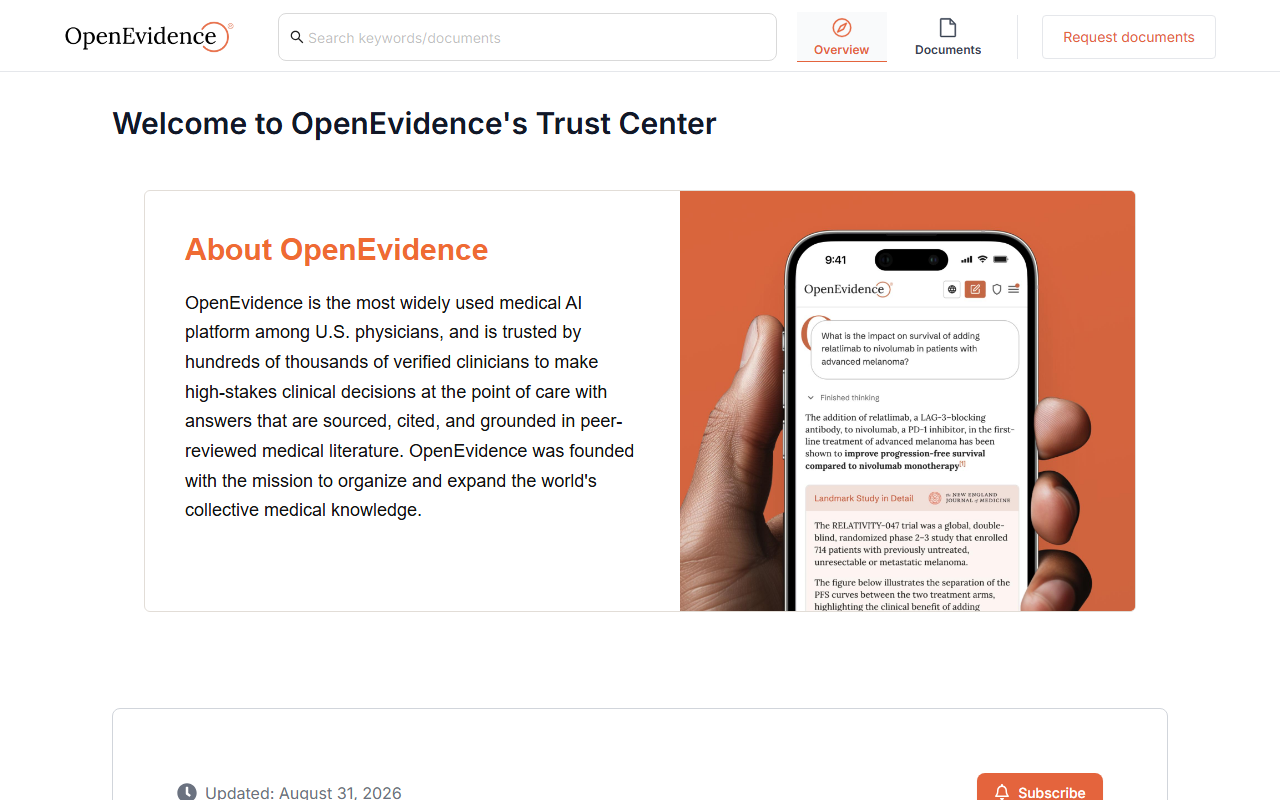
About OpenEvidence
OpenEvidence is a free AI medical evidence-search tool for physicians, founded in 2022 by Daniel Nadler and Zachary Ziegler. It is now used by roughly 650,000 physicians across 10,000+ hospitals, the fastest adoption of any medical technology in US history. The company has raised $700 million in total funding, including a $250 million Series D co-led by Thrive Capital and DST Global on January 21, 2026, at a $12 billion valuation.
Every query runs through a real-time evidence retrieval engine that cross-references licensed journal databases rather than general internet content, so physicians can click through to the primary source behind every answer. DeepConsult handles complex, multi-study cases: physicians request deeper analysis and receive a full report back within hours. Coding Intelligence, added in March 2026, suggests diagnosis and billing codes with supporting rationale to help physicians capture reimbursement they might otherwise miss. Dotflows, released April 7, 2026, lets clinicians save reusable natural-language prompts that shape how OpenEvidence answers for their specialty. Voice Mode, added May 21, 2026, lets clinicians ask questions aloud and hear cited answers read back hands-free, and the platform runs embedded inside Epic via FHIR at health systems including Sutter Health and Mount Sinai.
Screenshots
Pricing
Free for all verified US healthcare professionals, with no query limits or subscription tiers. OpenEvidence earns revenue through pharmaceutical advertising shown during answer-loading screens, with CPMs reported between $70 and $150. No paid plan exists as of September 2026.
Access requires a valid NPI number, and the platform withdrew from the UK and EU on April 28, 2026 over EU AI Act uncertainty, so non-US clinicians have no route in.
Feature Comparison by Tier
| Feature | Free (Verified Clinician) |
|---|---|
| Price | $0 |
| Access requirement | US NPI verification |
| Query limit | Unlimited |
| Evidence base | 300+ licensed journals (NEJM, JAMA, NCCN) |
| DeepConsult multi-study synthesis | Included |
| Coding Intelligence (ICD-10/CPT) | Included |
| Dotflows custom prompts | Included |
| Voice Mode | Included |
| Epic EHR integration (FHIR) | Included |
| Mobile apps | iOS, Android |
| UK/EU access | Blocked since Apr 2026 |
Key Features
- Peer-Reviewed Evidence Search: Returns citation-backed answers from 300+ licensed medical journals, including NEJM and JAMA, in 5 to 10 seconds per query, covering 1,000+ diseases and 160 medical specialties.
- DeepConsult AI Agent: Synthesizes evidence across multiple studies into a PhD-level research report on complex clinical questions, delivered to a physician's inbox within hours for cases that need more than a quick lookup.
- Coding Intelligence: Launched March 2026, it auto-generates ICD-10 diagnoses, E/M level recommendations with MDM rationale, and CPT code suggestions at the end of every clinical note to reduce billing errors and missed reimbursement.
- Dotflows Workflow Customization: Clinicians define reusable natural-language prompts, called Dotflows, that adjust how OpenEvidence answers for their specialty or preferred workflow; a community library lets physicians share and clone Dotflows from colleagues.
- Epic EHR Embedding: Runs directly inside Epic through FHIR so physicians can search evidence without ever leaving the patient chart, live now at Sutter Health, Mount Sinai, and other Epic-based systems.
- NPI-Verified Free Access: Verified US clinicians get full access after a one-time NPI check, with no per-query caps, giving physicians at smaller practices the same evidence access as those at major academic hospitals.
- Voice Mode: Launched May 21, 2026 as the first native speech-to-speech medical AI interface, it lets clinicians ask a question aloud and hear a cited answer read back hands-free on web or mobile, built for moments like rounds or scrubbed into a procedure.
Pros
- Reaches 65% of US physicians, the fastest and widest adoption of any clinical AI tool to date, spanning 10,000+ hospitals.
- Requires no subscription: physicians register once with an NPI number, compared to UpToDate's $639 per year for equivalent reference access.
- iOS and Android apps carry unusually high satisfaction for a medical tool: 4.9/5 and 4.7/5 respectively, each from thousands of verified reviews.
- Physicians report spending 40% less time on clinical documentation when using the platform, per OpenEvidence's own analysis of usage data.
Cons
- Withdrew entirely from the UK and Europe on April 28, 2026, citing regulatory uncertainty; a clinician outside the US now hits a hard access block with no stated return date.
- Skips drug dosing calculators and differential diagnosis tools that competitors such as Vera Health include, so it is not a full point-of-care suite on its own.
- Funded by pharmaceutical advertising shown during every answer's loading screen, which some physicians see as a conflict-of-interest risk in clinical decisions.
Data Handling
- Training-data policy
- HIPAA-compliant; secures Protected Health Information (PHI) per BAA; data retention and disposal policy available; does not publicly disclose whether physician queries are used for model training.
- Compliance
- HIPAA · SOC 2 Type II
Frequently Asked Questions
How much do you pay for OpenEvidence?
There is no cost: OpenEvidence is completely free for any US healthcare professional who verifies a National Provider Identifier (NPI) number. The company covers its costs through pharmaceutical ads that appear while an answer loads, at reported rates of $70 to $150 per thousand impressions. No premium tier or paid plan has launched.
What do you get on OpenEvidence's free tier?
Free access on OpenEvidence covers DeepConsult, Coding Intelligence, and unlimited clinical queries, sourced from a large library of peer-reviewed journals with no hidden charges. The only requirement is a valid NPI number verifying US healthcare licensure; clinicians outside the US are not currently eligible.
What are OpenEvidence's closest competitors?
UpToDate remains the most established alternative, curated by thousands of physician authors, but costs $639 per year versus OpenEvidence's free access. Doximity's DoxGPT combines clinical answers with drug monographs and peer review inside the largest US physician network. Vera Health is a newer free option that adds drug-dosing calculators and differential-diagnosis tools OpenEvidence does not offer.
Is OpenEvidence better than ChatGPT for Clinicians?
ChatGPT for Clinicians answers medical questions using OpenAI's general-purpose models trained on broad web data, without licensed journal partnerships or NPI verification. OpenEvidence instead cites primary sources exclusively from its licensed journal partners and requires NPI verification before granting access, keeping every answer auditable for clinical use. For point-of-care evidence lookup, OpenEvidence is the stronger choice; for general medical writing or patient-communication drafts, ChatGPT for Clinicians has broader scope.
What does it take to start using OpenEvidence?
Go to openevidence.com, click Sign Up, and register with your name, email, and a valid NPI number. After verification, ask any clinical question in plain language and expect a citation-backed answer within seconds. Download the app on iOS or Android for point-of-care access on rounds, and enable DeepConsult from the search bar when a question needs deeper research.
Top Alternatives
- ChatGPT: ChatGPT stretches across everything from drafting emails to writing code, well beyond clinical work; OpenEvidence stays narrowly focused on point-of-care evidence lookup with a citation trail built for clinical documentation.
- Perplexity: Perplexity searches the open web across any topic; OpenEvidence searches exclusively within licensed, peer-reviewed medical journals behind an NPI-verified login.
- Claude: Claude flexes across medical writing, patient-communication drafts, and reasoning tasks outside a clinical search format; OpenEvidence stays fixed on fast, auditable citations from licensed clinical journals at the point of care.
HokAI guides covering OpenEvidence
- ChatGPT Use Cases in 2026: What It's Actually For Now: ChatGPT gained a work agent, health records and an 80% API price cut in eleven weeks. Here is what it is actually best for now, where a specialist wins.
- The Best AI for Research in 2026 Depends on the Job: Consensus, Gemini Notebook, Harvey and OpenEvidence each solve a different research problem in 2026. Here is how to match the right AI to your specific job.