Best AI Voice Recorders in 2026: What They Cost and What the Law Allows
An AI voice recorder is a pocket or wearable device that records speech and uses cloud AI to transcribe and summarise it. In November 2026 prices run from $74.99 for Bee Frontier to $229 for HiDock P1, and most add a paid plan. Federal US law needs one party's consent; about 11 states need all.
The short version
Judge an AI voice recorder by its two-year cost and by the law where you record. HiDock P1 is $229 with free transcription. Bee Frontier is $74.99 plus $99.99 a year. Plaud Note Pro is $189, free for 300 minutes a month. About 11 US states need everyone's consent.
Want this decided for your own case? Find your tools with Smart Match, starting from this guide's question.
A small recorder that costs $75 can cost more than $270 once you add the subscription. The price on the box tells you almost nothing about the price you will pay, and the law about whom you may record tells you even less. That is the problem with AI voice recorders in November 2026.
Four things decide a purchase. Where do you record: a room, a phone call or a lecture hall? Who pays for the transcripts after the first year? Whose permission do you need before you press the button? And where does the audio go once it leaves the device? This guide reads each maker's own pages for all four and says plainly where a page stays silent.
- Plaud Note Pro, device only
- $189
- Free plan covers five hours a month
- Bee Frontier wearable
- $74.99
- Pro plan is $11.99 a month
- HiDock P1
- $229
- Transcription listed as free
- US states that mainly require everyone's consent
- 11
- Reporters Committee count
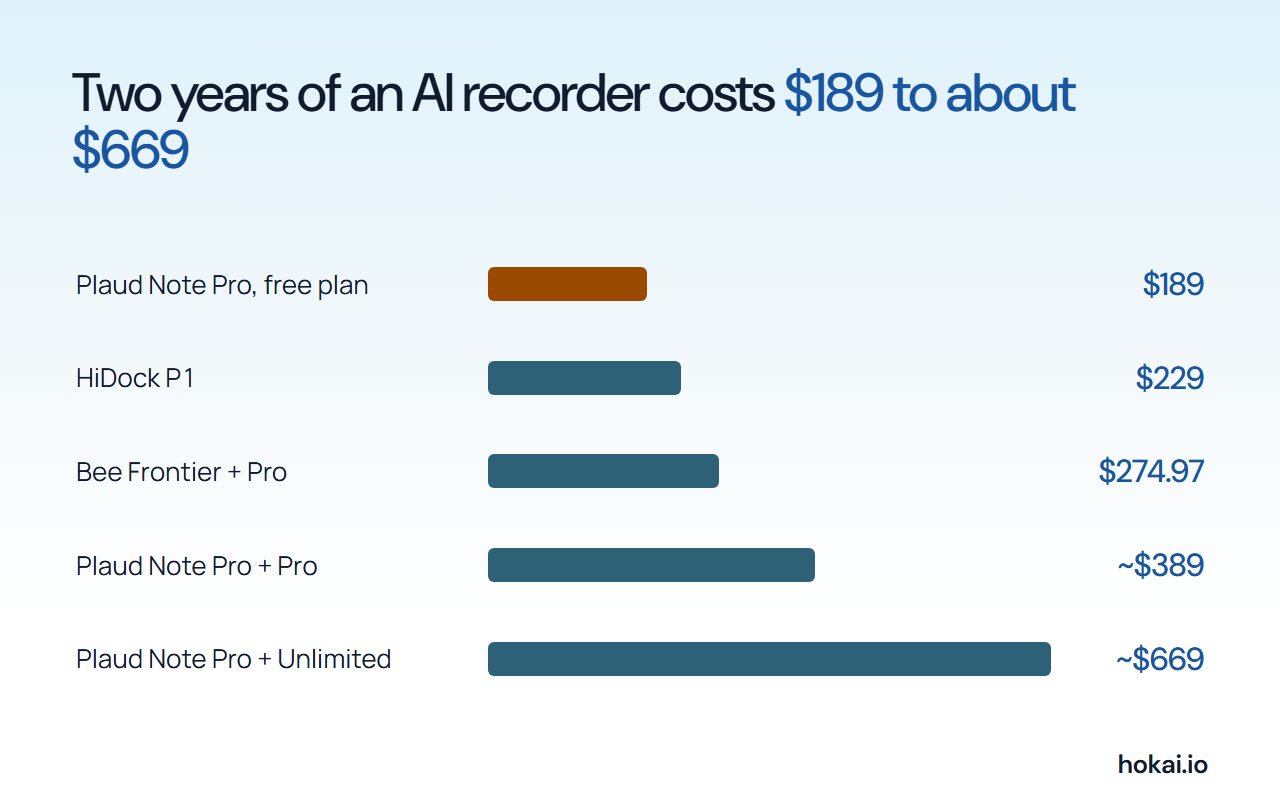 Hokai chart of two-year cost per setup, from each maker's pricing page as read on 6 November 2026. Plaud's yearly plan prices are rounded from its monthly rates.
Which fits: a card, a pin, an earphone dock or your phone
Start with the situation, not the brand.
If you sit across a table from people, a card-shaped recorder that clips to the back of a phone or sits on the desk is enough. Plaud sells two of those, the Note and the Note Pro. If you want something that stays on your lapel all day, Plaud's NotePin S and the Bee Frontier are the wearable options. The next section prices all of them.
Calls are the odd case. A phone is hard to record from outside, which is why HiDock built the P1: it sits between you and your Bluetooth earphones and captures both sides. Its page lists transcription as free.
Then there is the device you already own. An iPhone running iOS 18 or later can record a call itself, and both people hear a notice. It costs nothing, and it does not work in the European Union.
- Meetings and lectures, one room
- Plaud Note or Note Pro
- All-day capture on your clothes
- Bee Frontier or Plaud NotePin S
- Calls on earphones
- HiDock P1
- Occasional call, no purchase
- the iPhone's built-in recording where it is offered
One market signal explains why this category exists at all. In its seventh Top 100 consumer list, a16z notes that the big AI labs have not ventured far into hardware, and that Plaud, which sells both a physical device and a subscription, debuted at #16 on the consumer spend list. People are paying for this.
What each setup costs over two years
The box price is the smaller number for most buyers. Three of the four makers charge for the AI part separately, and the plan decides how much you actually use.
| Setup | Device | Plan | Two years |
|---|---|---|---|
| Plaud Note Pro, Starter | $189 | Free, 300 min a month | $189 |
| Plaud Note Pro, Pro | $189 | About $100 a year | About $389 |
| Plaud Note Pro, Unlimited | $189 | $240 a year | About $669 |
| Bee Frontier, Pro | $74.99 | $99.99 a year | $274.97 |
| HiDock P1 | $229 | Listed as free | $229 |
Read it by hours, not dollars. The Plaud free Starter plan gives 300 transcription minutes a month, which is five hours. The Pro plan gives 1,200, which is 20 hours a month, or 240 hours across a year for about $100. That works out near 42 cents per hour of transcription. The Unlimited plan, at $20 a month billed annually, is for people who record most of the working day. Its page marks it "24hrs/day" with an asterisk, so read the fine print before you count on that.
Computed from each maker's own device and plan prices.
Bee works out at $274.97 over two years: the device plus two years of its annual Pro plan. Its Pro plan is free for the first 30 days, and Bee says buyers of the earlier Pioneer device before 15 October 2026 keep their feature set for free.
HiDock needs its own caveat. Trade press reported a lower launch price, but its product page shows $229 today, with bundle prices that run both lower and higher. Prices on all three sites move, so check the page before you buy.
Plaud: the benchmark, and the plan is the real purchase
Plaud is the reference point for the category, and the a16z spend ranking is the best public evidence that it sells. Here is its lineup in early November 2026.
| Device | Price | Form |
|---|---|---|
| Note | $159 | Card |
| NotePin | $159 | Wearable capsule |
| NotePin S | $179 | Wearable, pill-shaped |
| Note Pro | $189 | Card with display strip |
| Plaud One | No price shown | Earbuds and case, waitlist |
Every device comes with the same free Starter plan. Past that, you pick a paid tier.
| Plan | Minutes a month | Price, billed annually |
|---|---|---|
| Starter | 300 | Free |
| Pro | 1,200 | $8.33 a month |
| Unlimited | Unlimited | $20 a month |
| Team | Unlimited | $20 per user a month |
The Team plan is shown against a struck-through $25. Add-on minute packs of 600, 3,000 and 6,000 are sold separately. All plans list 112 or more transcription languages and more than 10,000 summary templates.
What do you get beyond a transcript? Plaud lists calendar and Slack and Notion connectors as a preview feature, and says answers from its "Ask Plaud" assistant are traceable back to the original audio. That traceability matters. A summary you cannot check against the recording is a rumour.
The honest weakness is the subscription. A buyer who records a few meetings a month will never leave the free tier, and the Note Pro is then a one-off purchase. A buyer who records daily will hit the 300-minute cap within a week, and the device becomes a bigger first-year decision, as the cost table above shows.
HiDock P1: the one built for calls
HiDock took a different route. The P1 is a small block that pairs with your Bluetooth earphones and, over a USB-C cable to a computer or a recent phone, records the call without a bot joining the meeting. It has three modes: Call Mode for private calls, Room Mode for meetings, and Whisper Mode for quick ideas. The page lists 1,000 hours of storage and a 600mAh battery, at 72 grams.
The pitch is the free transcription: unlimited, in 75 or more languages, described as lifetime free. I could not read the answer to the page's own question, "Is transcription really free forever?", so treat the word "lifetime" as the vendor's claim and not a guarantee. What the page does say is that it is compatible with models from OpenAI and Anthropic.
The trade is that the P1 is not a clip-on you forget about. It is a tool for a person who takes calls on earphones at a desk and wants the other side of the call captured without installing anything on the other person's machine.
Bee: the cheapest wearable, and a different promise
Bee sells through Amazon, and it is the lowest-priced hardware here at $74.99 for the Frontier wearable. It aims at a different job from the others. Plaud and HiDock record meetings. Bee runs all day on your wrist or clothing, builds a timeline of conversations, suggests to-dos and drafts emails and events.
That ambition is what the Pro plan pays for. Bee says selected features need Pro, which is free for 30 days and then $11.99 a month or $99.99 a year, and that Bee Basic stays available afterwards. The page lists seven days of battery. A second product, Eclipse, is marked "coming soon" and is meant to process both sides of every phone call; no price is shown.
An always-on recorder changes the consent question, because you are no longer deciding to record a meeting. You are deciding to record everyone near you. That is the reason Bee's privacy claim is the most specific of any maker in this guide, and the next sections check it.
Limitless: not on the list, and here is why
You will see Limitless on older roundups. It does not belong on one in November 2026. Its own site says it has been acquired by Meta, that it stopped selling the Pendant on 5 December 2025, and that existing customers keep service throughout 2026 with the Unlimited plan free.
Two more facts matter if you own one. From 5 December 2025 the service was withdrawn in Brazil, China, the European Union, Israel, South Korea, Turkey and the United Kingdom. And the Rewind app, which our directory also lists, had its screen and audio capture disabled on 19 December 2025. The company offers an export tool and a delete option for your data.
If you bought one, export your transcripts now. If you have not, there is nothing to buy.
Your phone is the free alternative, with limits
Before you buy a $159 card, test the thing in your pocket. Apple's support pages say an iPhone can record a call starting in iOS 18, and that both people hear an audio notice that the call is being recorded. Recordings land in a Call Recordings folder in Notes, with a transcript in selected languages and an Apple Intelligence summary on supported devices. Apple tells you to check that the other person is willing to be recorded.
The real limits are geographic. Apple lists the European Union, Turkey, the United Arab Emirates, Saudi Arabia, South Africa, Egypt, Nigeria, Russia and several other places where call recording is not available. In those places a phone alone will not do it.
Software covers the rest. If your recordings are mostly video calls, a notetaker that runs on your computer needs no hardware at all. Otter, Fathom, Granola and Krisp are the ones our directory lists, and our ranking of AI meeting assistants compares them. Browse the meeting assistant category for the rest.
For general notes rather than meetings, the AI note-taking guide is the better start, and the note-taking category lists the tools. Wispr Flow covers dictation, which has its own voice dictation category. If you want to talk to an assistant and not record other people, our voice assistants ranking is the right page.
A hardware recorder wins in three cases:
- In-person conversations, where a phone microphone is a poor fit.
- Places with no laptop, such as a site visit or a lecture hall.
- Moments when a bot joining a call would change the conversation.
Is it legal to record? One-party versus all-party
This is the section that hardware reviews skip, and it is the one that can cost you money. I am not a lawyer, and this is a summary of primary sources, not legal advice.
Federal US law sets a floor. Under 18 U.S.C. section 2511(2)(d), it is lawful for a person not acting under color of law to intercept a communication where they are a party to it, or where one party has given prior consent, unless the purpose is a crime or a tort. That is one-party consent.
States can go further. The Reporters Committee for Freedom of the Press counts about 11 states that mainly require everyone's consent: California, Delaware, Florida, Illinois, Maryland, Massachusetts, Michigan (at least for recordings by someone outside the conversation), Montana, New Hampshire, Pennsylvania and Washington. Four more require it for either in-person talk or phone calls. Missouri and Oregon require it for in-person talk. Connecticut and Nevada require it for phone calls. Hawaii and Maine require it in particularly private places. Vermont has no recording statute.
| Rule | Where | What it means for you |
|---|---|---|
| One-party | Federal law and most states | You may record a conversation you are in |
| All-party | About 11 states | Everyone must agree before you record |
| Split rules | MO, OR, CT, NV, HI, ME | Depends on call, room or place |
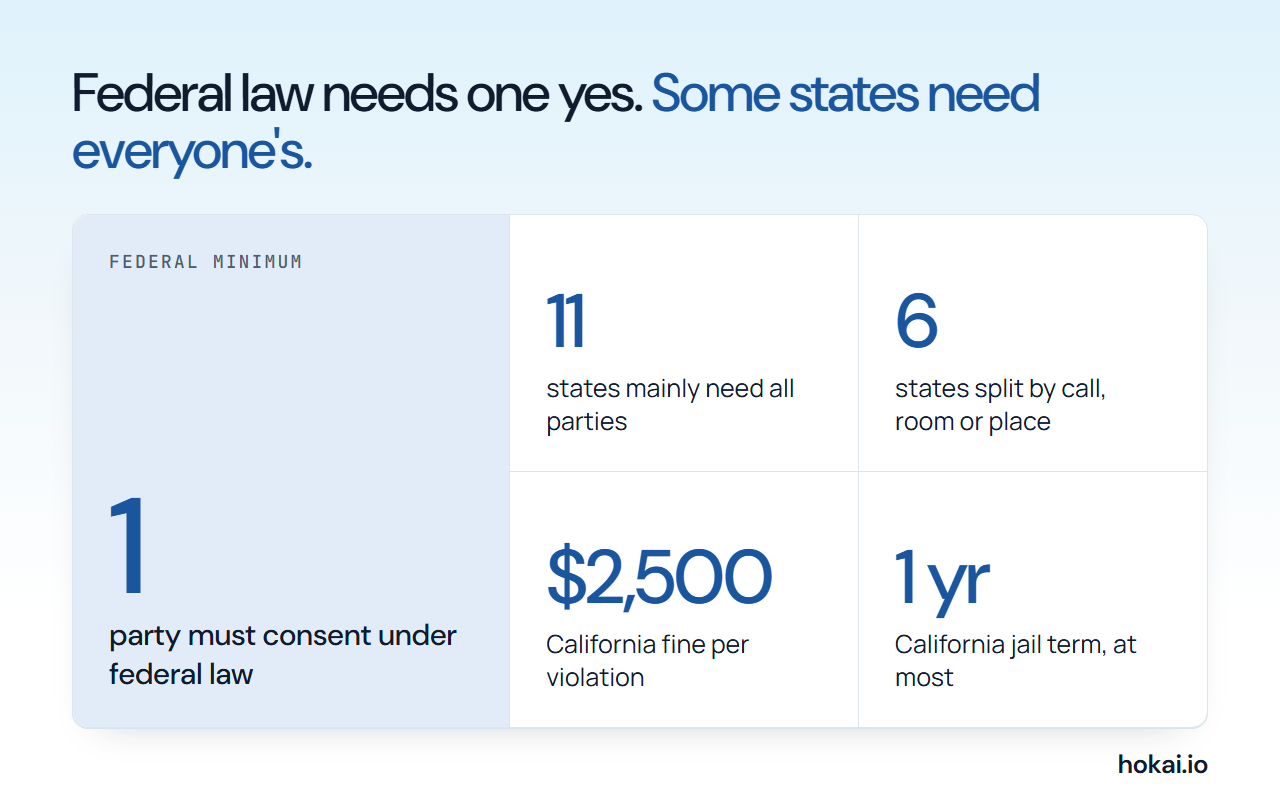 Hokai card of the consent rules above, from 18 U.S.C. 2511 and the press freedom group's recording guide, as read on 6 November 2026.
California is the example to remember. Penal Code section 632 punishes anyone who, intentionally and without the consent of all parties to a confidential communication, records it. The penalty is a fine of up to $2,500 per violation, or up to a year in jail, or both. A "confidential communication" is one where a party reasonably wants it confined to the parties, and the statute excludes public gatherings and settings where being overheard or recorded is expected.
Calls across state lines, and who carries the duty
What happens when the two ends of a call are in different states? The Reporters Committee notes that courts differ on whether the law of the recorder's location or the other person's applies, so a person who feels wronged may choose the more favourable state. The practical rule is simple: assume the stricter state applies.
Two facts help you in practice. Telling people works: the Reporters Committee says that where parties are warned of a recording and continue, consent is generally presumed, though recording a spoken yes is the best practice. And the makers put the duty on you. Plaud's privacy policy says that obtaining consent and complying with the recording-consent laws where you record is your responsibility.
I did not verify national recording rules outside the United States, so this guide does not summarise them. Apple's own pages show how much they vary: the EU is on its list of places where call recording is not offered at all. Check the law for each country where you record. If your work involves patients or clients, there are extra duties on top of consent, and our guides for doctors and legal work start from what each profession owes.
Data handling: where your audio goes and who can read it
Consent covers the person you record. The second question is what the maker does with the file. The answers differ more than the marketing suggests.
| Maker | Default storage | AI processing | Training |
|---|---|---|---|
| Plaud | On device, cloud sync opt-in | Third-party language model providers | Not without your consent |
| HiDock | Not stated on pages read | OpenAI and Anthropic named | Says none |
| Bee | Not stated beyond encryption | Audio processed then deleted | Not stated |
| Apple call recording | Notes on your iPhone | Apple Intelligence summary | Not stated |
The AI transparency policy at Plaud, updated 20 May 2026, says data is stored locally on your device by default and uploaded only if you turn on Private Cloud Sync, which is off. It operates servers in the United States, Germany, Japan and Singapore and stores your data in the one for your region. Data in transit uses TLS 1.2 or above and data at rest uses AES-256.
Its privacy policy adds that content is shared with third-party language model providers only to do the task you asked for, under contracts that bar them from training on it. Plaud's product page lists SOC 2, HIPAA, GDPR and EN 18031 and also advertises unlimited cloud storage, which sits oddly beside "local by default". Read that as two modes, and check which one your app is in.
HiDock's security page says no customer data is used to train the AI, names OpenAI and Anthropic as partners, and says any metadata shared with them, such as your name and email, is anonymised. It cites GDPR compliance. It does not say, on the page I read, where files are stored.
Bee's page makes the strongest single claim: conversations stay yours by default, encryption is controlled by you, not even Amazon can access the data unless you share it, and audio is processed instantly and then deleted. That is a vendor statement, and the Rewind shutdown above is a reminder that a promise holds only while the company behind it does. I found no certification or audit on the page, and the text does not say whether summaries stay on a server.
If privacy is your first filter, our guide to private AI sets out what to ask of any tool before you give it an hour of your life.
Who should skip a dedicated recorder
The strongest argument against all of this is that a recorder is a second device you will forget to charge, and that your phone does the job. It is a fair argument. A phone is always with you, costs nothing extra, and in the US it tells the other person it is recording.
My answer is narrow. A phone is a poor in-person recorder. Its microphone is built for calls, you cannot leave it recording and use it for something else, and the call feature is missing in the EU and a dozen other places. A card on the table solves those problems for the price of a dinner.
Then there is the chilling effect. People talk differently when a dedicated gadget sits between them and you. Some of your best conversations will not survive it. If that is your work, stay with a phone, ask permission every time and say what you will do with the file.
How to choose
- Pick the situation. Room, call or all day.
- Estimate your hours. Under five a month, the free plans are enough. Over 20, price the Unlimited plan.
- Check the law where you record. If it is an all-party state or country, plan to ask every time.
- Read the data page. Find where files sit by default and whether the maker bars training on your audio.
- Export before you commit. Limitless shows what happens when a maker is acquired.
Keep your own copy of anything you cannot re-record. File-recovery software such as Wondershare Recoverit, which scans USB drives and SD cards for deleted files, is a last resort, and I did not test it on any device here.
If the answer depends on what else you run, Smart Match takes a plain-language brief and narrows the field. For the wider office stack around a recorder, see our guide to AI assistants for office work. The rest comes down to whether you will actually carry the thing.
What would change this ranking
Three things. If Bee prices Eclipse and it records both sides of calls reliably, it takes the call slot from HiDock for people who live on a phone. If Plaud One ships at a price near the cards, an earbud form factor makes the pin less necessary. And if HiDock's free transcription gains a usage cap, its two-year advantage over Plaud's free tier disappears.
I did not test any of these devices. Battery life, microphone quality and transcript accuracy are not covered here, and I would not trust a number for them from a page that sells the product. Each price was read from the maker's own site on 6 November 2026 and may have moved since.
Frequently asked questions
What is the best AI voice recorder in 2026?
For meetings in a room, Plaud Note Pro at $189 has the most mature plans, with 300 free minutes a month. For calls on Bluetooth earphones, HiDock P1 at $229 lists free transcription. Bee Frontier at $74.99 is the cheapest, but selected features need its $11.99 monthly Pro plan.
Do AI voice recorders need a subscription?
Most do for heavy use. Plaud gives 300 free minutes a month, then charges about $8.33 a month for 1,200 minutes or $20 for unlimited, billed annually. Bee Pro is free for 30 days, then $11.99 a month. HiDock lists transcription as free, which is the vendor's claim.
Is it legal to record a conversation with an AI recorder?
Federal US law needs the consent of one party, which can be you. About 11 states, including California, Florida and Pennsylvania, mainly need every party to agree. California fines up to $2,500 per violation. Rules outside the US differ, so check each country, and ask aloud on the recording.
Where does an AI voice recorder store my audio?
It depends on the maker. Plaud says data stays on your device unless you turn on Private Cloud Sync, with servers in the US, Germany, Japan and Singapore. Bee says audio is processed and then deleted. HiDock's security page names OpenAI and Anthropic as partners and does not state a storage location.
Can I use my phone instead of an AI voice recorder?
Often, yes. An iPhone on iOS 18 or later can record calls, both people hear a notice, and recordings go to Notes. Apple lists the European Union and several other places where it is unavailable. For in-person talk, a dedicated recorder has better placement than a phone.
Covered in this guide
- Plaud: AI voice recorders (Note, Note Pro, NotePin) that sync to an app for transcripts, summaries and action items, with a free Starter plan.
- Amazon: Amazon, founded in 1994, runs AWS, the cloud and retail company behind Bedrock, in-house Nova models and custom AI silicon.
- Anthropic: Anthropic is a Public Benefit Corporation started by 7 ex-OpenAI researchers. It builds the Claude model family and counts Amazon and Google among its largest backers.
- Granola: Bot-free AI notepad that merges your typed notes with a device-audio transcript, with apps for Mac, Windows, iPhone and Android and a free plan.
- Krisp: Removes background noise from calls in real time, with optional meeting recording, transcription, and summaries.
- Meta: Meta AI ships open-weight Llama (1B+ downloads) and the closed Muse models, led by Muse Wonder with a 1M-token context window.
- OpenAI: OpenAI builds ChatGPT, the GPT-6 family (Astra, Sol, Luna), Codex and the OpenAI API. It reports 1.2B weekly ChatGPT users and an $852B valuation after its March 2026 round.
- Rewind AI: Discontinued December 2025. Rewind captured, searched and recalled everything you saw, said or heard on a Mac, until Meta acquired Limitless and switched it off.
- Wispr Flow: AI voice dictation app that dictates at up to 220 words per minute and reformats it for whichever app you're typing into, on Mac, Windows, iOS, and Android.
- Wondershare Recoverit: Recoverit is desktop data recovery software from Wondershare for Windows and Mac, with a capped free edition and paid monthly, annual, quarterly or one-time plans covering two devices.
Sources
Still deciding?
This guide covers a handful of options. Smart Match checks every listing in the directory against how you actually work and what you can spend, then hands you the shortlist and the reason behind each pick.
Find your toolsRelated guides
- Abacum Alternatives in 2026: FP&A Tools for Mid-Market Finance TeamsBuyer's guideHow to pick, across a category
- Attio vs HubSpot in 2026: Which CRM for a Startup?ComparisonHead-to-head, with a verdict
- Best Agentic AI in 2026: Manus, Genspark and the Platforms That Finish Whole TasksBuyer's guideHow to pick, across a category
- Best Autonomous AI Agents in 2026: How Much Control to Hand OverBuyer's guideHow to pick, across a category
- The Best Android AI Assistant in 2026, Free and Paid, Now That Google Assistant Is GoneBuyer's guideHow to pick, across a category
- Best AI Assistant for Office Work in 2026Buyer's guideHow to pick, across a category