Best AI Legal Tools in 2026: For Firms, In-House Teams and Everyone Else
The best AI legal tools in 2026 depend on the buyer. Large firms shortlist Harvey, Legora, CoCounsel Legal and Lexis Protégé. Contract teams look at Draftwise and Spellbook. Individuals have no AI lawyer, only general assistants for preparation, with citations checked and confidential facts kept out.
The short version
Every serious legal AI tool is sold by demo or trial request, and none prints a price. Pick by buyer: firms, in-house teams, individuals. Courts have logged 2,266 hallucination decisions, so verify every citation, protect privilege, and never treat a chatbot as your lawyer.
Want this decided for your own case? Find your tools with Smart Match, starting from this guide's question.
In November 2026, none of the legal research and drafting vendors read for this guide prints a price on its product page. A large firm can ask Harvey for a quote, a small team can start a seven-day trial of Spellbook, and a person with a landlord dispute cannot buy any legal AI that a regulator will let call itself a lawyer.
That split decides which of the best AI legal tools applies to you, and it matters more than any feature list. This guide sorts the field by buyer: law firms, in-house teams and contract work, and individuals or small businesses. It also covers the three questions that decide whether a tool is safe to use at all: what happens when it invents a case, where your client's data goes, and what the bar says you owe.
Hokai gives no legal advice, and nothing here is a substitute for a lawyer. This is a software buyer's guide. Hokai read each vendor claim below on the vendor's website on 6 November 2026, and ran none of these products on a real matter. Where a number comes from a court, a regulator or a study, the source is named.
- Court decisions logged for AI-hallucinated content
- 2,266
- Charlotin database, 6 Nov 2026
- Hallucination rate in leading legal research tools
- 17% to 33%
- Stanford study, May 2024
- Penalty in Mata v. Avianca
- $5,000
- S.D.N.Y., 22 Jun 2023
- Monetary relief ordered against DoNotPay
- $193,000
- FTC, Feb 2025
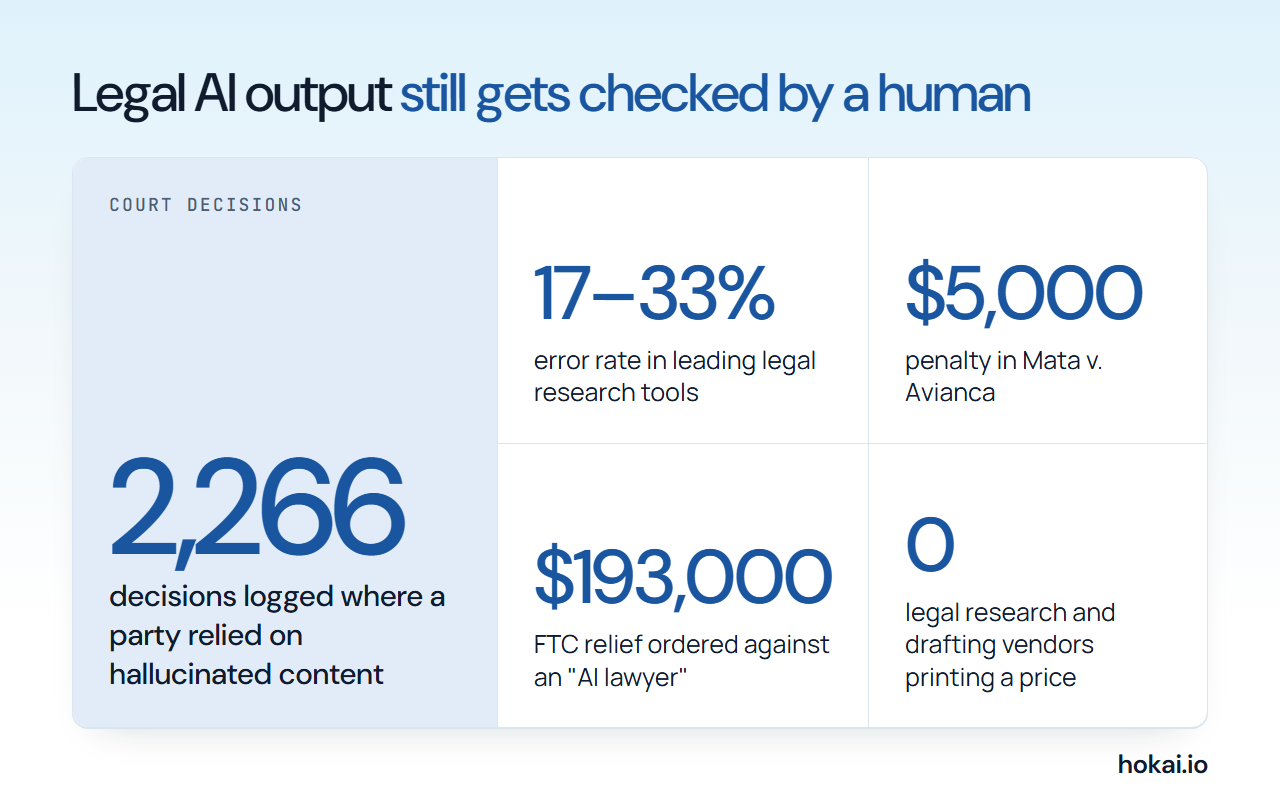 Hokai chart of four sourced figures, each read on 6 November 2026.
How to choose: the buyer matters more than the product
Three questions sort almost every legal AI purchase before a demo is booked.
- Who answers for the work? A firm answers to clients and its bar. An in-house team answers to a general counsel. An individual answers to no one, so consumer tools carry the most risk.
- Where does the work live? Firm tools link to a document system. Contract tools sit in Word. A chatbot sits in a browser tab.
- Who checks the output? Every product below says a lawyer must. The test is how fast the tool lets them reach the source.
If your answer to the first question is "me, alone, with no lawyer", skip to the section on individuals before reading anything else. If you are a firm or a legal department, the next two sections are the shortlist, and the two after them are the risk work that should come before any purchase.
The shortlist at a glance
| Tool | Built for | Price on its page | Free access |
|---|---|---|---|
| Harvey | Large firms, in-house teams | None | Demo request |
| Legora | Large firms, in-house teams | None | Demo request |
| CoCounsel Legal | Firms on Westlaw | None | Trial request |
| Lexis Protégé | Firms on Lexis | None | Trial request |
| Draftwise | Deal lawyers with a precedent archive | None | Demo request |
| Spellbook | Contract drafting in Word | None | 7-day trial |
All six are sales-led. Treat every figure you see in a blog post, including the buyer-reported ranges in the Harvey vs Legora comparison, as hearsay until a vendor quotes you in writing. That guide covers what is publicly reported about Harvey's and Legora's cost and onboarding.
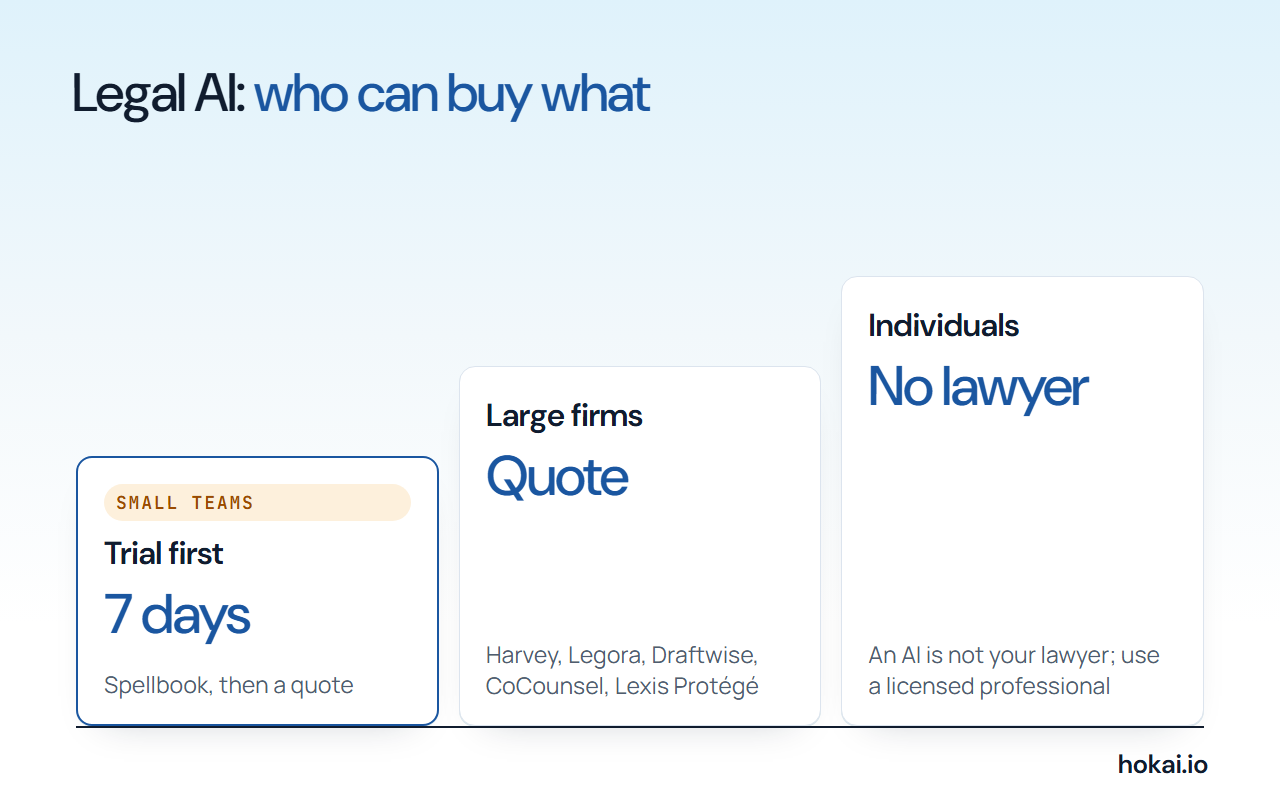 Hokai chart of how the products in this guide are sold, from vendor pages read on 6 November 2026.
Best AI legal tools for law firms
Four products compete for the research-and-drafting seat in a firm. The split between them is mostly about where your firm already keeps its sources.
Harvey is the name most firms mention first. It sells through a demo request and offers no self-serve signup, per the vendor's site read on 6 November 2026. Our profile of what Harvey is actually for covers the jobs it fits and the ones it does not.
Legora is the closest rival. Its site lists SOC 2 Type II, ISO 27001, GDPR and HIPAA, and says customer data is not used for model training. Those are vendor claims, so ask for the reports, not the badge. The sibling comparison covers how the two differ on onboarding, which is where most of the real cost sits.
CoCounsel Legal, from Thomson Reuters, is the pick when Westlaw is already the firm's research habit. Its page says it reasons from Westlaw content and Practical Law guidance, links its citations, and connects to iManage, NetDocuments, SharePoint and Microsoft Word. It also lists an MCP connection for Claude. The headline figures on the page, including a 33% average reduction in time spent, come from a Forrester study commissioned by Thomson Reuters itself.
Lexis Protégé is the equivalent on the LexisNexis side. Its page offers a trial request and lists user-controlled personalisation and no cross-user data training.
Client intake is a separate job from research. NextPhone is an AI receptionist for law firms and service businesses that answers calls and books appointments. Unlike every product above, it publishes prices: our record, read from its pricing page on 27 October 2026, lists plans from $199 a month with no per-minute charge. It never touches case law, so it carries none of the citation risk. Our AI receptionist guide compares the category.
One structural point for firms: the two incumbents sell a research database with AI on top, and the two start-ups sell an AI layer that must be connected to a research source. Neither design is automatically safer. They fail differently, which the hallucination section below explains.
Best AI for in-house teams and contract work
In-house legal departments mostly buy for contracts, and that market splits into precedent-led and playbook-led tools.
Draftwise drafts from the deals a firm or company has already signed rather than from a generic clause library. Its site routes buyers to a demo and publishes no price, and it announced a legal ontology product, Ontonomi, on its homepage. Our record notes that independent accuracy testing of it is thin.
Spellbook works inside Microsoft Word and is the only product here that advertises a seven-day free trial on its pricing page. It prices per team member on a licence and quotes after a demo. Its page says it uses Zero Data Retention agreements that prevent use of data for training. Ask whether that covers every sub-processor, not only the main model provider.
For real estate brokerages specifically, RealPact automates contract preparation, with quote-only pricing according to our record last reviewed on 19 August 2026. It is a transaction tool for brokers rather than a general legal assistant, so it belongs in a different budget line.
A cheaper route for small teams is to use a general assistant such as Claude or ChatGPT on a business plan for first-pass summaries, and keep legal-specific licences for the people who sign. That route only works with a contractual answer on data handling, which the next sections explain. Compare the options in our ChatGPT alternatives guide before picking.
What do AI legal tools cost?
Nobody publishes a rate card, so the useful numbers are the ones you can pin down.
- Sales-led pricing. Five of the six route to a demo or trial request. Spellbook prices by team members on a licence.
- Implementation is the hidden line. Reported onboarding hours and seat minimums sit in our Harvey and Legora comparison, as reported, not quoted.
- Verification time is the real cost. The American Bar Association says a lawyer can bill for reviewing a draft but, in most circumstances, not for learning the tool.
Hallucinated citations: what courts have actually done
The risk that sets legal AI apart from every other category is a fake case that looks real. Courts have been punishing it since 2023.
The founding example is Mata v. Avianca in the Southern District of New York. The docket shows a May 2023 order to show cause over non-existent cases cited in an affirmation. On 22 June 2023 the court imposed sanctions.
It ordered the lawyers to write to the plaintiff and to each judge falsely named as an author, and imposed a $5,000 penalty jointly on the lawyers and their firm. The same day it granted the airline's motion to dismiss. The docket entries do not name the AI tool, so this guide does not either.
The problem has not shrunk. Damien Charlotin's AI Hallucination Cases Database counted 2,266 decisions on 6 November 2026. It covers cases where a court found or implied that a party relied on hallucinated content, and includes self-represented litigants as well as lawyers. It tracks decisions, not every fake citation filed.
A recent entry shows that legal-specific tools are not exempt. In Farhat v. Cutera, decided in the Northern District of California on 28 October 2026, a lawyer was admonished under Rule 11 and warned that further fabricated authorities could bring sanctions. The database lists the AI tool as Legora and records no monetary penalty. Hokai could not read the decision itself, so this rests on the database entry, and the entry does not say how the fabricated material arose. It is one entry, not a finding about the product.
How reliable are the legal research tools themselves?
The best independent test of the tools themselves is older. A preregistered Stanford study of May 2024 found that Lexis+ AI and Thomson Reuters' Westlaw AI-Assisted Research and Ask Practical Law AI each hallucinated between 17% and 33% of the time. That was lower than general-purpose GPT-4, but the study notes the vendors had described their systems as eliminating or avoiding hallucinations, and called those claims overstated.
- Pull every authority AlwaysOpen each cited case in the official database, not in the AI tool.
- Read the quote AlwaysConfirm the quoted passage appears on the cited page.
- Check the holding AlwaysMake sure the case says what the draft claims it says.
- Log who checked Per filingRecord the name and date of the person who verified.
That checklist is Hokai's, not a court's. It applies the same logic the Mata sanctions order applied: the signature on the filing is a human's.
Data handling, privilege and retention
Recording a client call with a hardware recorder raises the same questions in a different place. Our guide to AI voice recorders covers one-party and all-party consent law and what three makers say about storage and model training.
Confidentiality is the second reason to separate legal-grade tools from consumer chatbots.
In February 2026, Judge Jed Rakoff of the Southern District of New York ruled in United States v. Heppner that a defendant's conversations with the public version of Claude were neither privileged nor work product. According to Orrick's analysis of the ruling, the defendant had used Claude on his own initiative, without direction from his lawyers, and about 31 documents recording the conversations were seized. The judge reasoned that an AI tool holds no law licence, and that Anthropic's privacy policy gives users no reasonable expectation of confidentiality.
The scope is contested. It was one trial court, a criminal defendant acting alone, and a consumer product. It did not hold that a firm's use of an enterprise tool waives anything. Still, the practical lesson reaches anyone: do not paste privileged advice into a consumer chatbot. Terms differ by plan and by maker, so read the data terms of Anthropic and OpenAI for the exact tier you would use, and see our private AI guide for the options.
What vendors say about their own data handling, all read on 6 November 2026:
- Thomson Reuters: CoCounsel Legal says data stays private and is never used to train underlying models, and lists SOC 2 and ISO 42001.
- Legora: Lists SOC 2 Type II and ISO 27001, and states zero AI training on customer data.
- Lexis Protégé: Lists no cross-user data training, with customers choosing whether personalisation is on.
- Spellbook: Says Zero Data Retention agreements prevent training use.
None of these is an audit. Ask for the SOC 2 report, the sub-processor list, the retention period for prompts and outputs, and the deletion process at contract end. Our AI governance and security tools guide covers the control layer a firm can add on top. For the highest-sensitivity matters, running models locally removes the vendor from the data path altogether, at a quality and maintenance cost.
What the bar says you owe your clients
The American Bar Association's first formal opinion on generative AI, Formal Opinion 512, was released on 29 July 2024. It says the model rules on competence, confidentiality, communication and fees apply.
- Competence (Rule 1.1): a lawyer must understand the benefits and risks of the technology used.
- Confidentiality (Rule 1.6): client information stays protected unless the client gives informed consent.
- Communication (Rule 1.4): a lawyer must reasonably consult the client about the means used.
- Fees (Rule 1.5): fees must be reasonable, and learning the tool is generally not billable.
State and local bars can add their own rules. Check your jurisdiction's current guidance rather than relying on a 2024 national opinion, because the opinion itself says bar committees will likely keep updating their guidance as the tools develop.
Best AI legal help for individuals and small businesses
Here the honest answer is short: there is no AI that is your lawyer, and the regulators have said so.
The Federal Trade Commission finalised an order against DoNotPay, which had marketed itself as "the world's first robot lawyer". The Commission voted 5-0 on 16 January 2025 and announced the order on 11 February 2025. It requires $193,000 in monetary relief, notice to consumers who subscribed between 2021 and 2023, and bars DoNotPay from advertising that its service performs like a real lawyer without sufficient evidence.
What a general assistant is good for, if you are not a lawyer, is narrower. Use ChatGPT, Claude, Gemini or Microsoft Copilot to understand a letter in plain English, list the questions to ask a solicitor or attorney, or organise your own documents. Do not use one to decide what to file, what to sign or what to say to the other side.
Two cautions follow from the cases above. Anything you type may not be confidential, and anything it states as law may not exist. If the stakes are real, pay for an hour of a licensed professional and treat the assistant as preparation. Our guide to the best AI chatbots compares the general assistants, and our research tools guide covers how to check what they cite. Clinicians face a parallel problem, covered in AI for doctors.
Who should skip legal AI for now
Some buyers should not buy yet.
- A solo practitioner with no document system. Firm-grade products assume integrations you lack. A business-plan assistant plus a human check costs less.
- Any team that cannot name its verifier. With no owner for the check, a research problem becomes a sanctions problem.
- Anyone pasting client secrets into a free chatbot. The Heppner ruling is the reason.
- Consumers hoping to skip a lawyer in court. The database counts many self-represented litigants who filed fabricated authorities.
If you are unsure which category fits, Smart Match can narrow the shortlist from your team size, stack and budget, and the AI legal assistant directory shows the full set of legal records.
What would change this verdict
The strongest objection is that the evidence is stale. The Stanford numbers describe 2024 products. CoCounsel and Protégé have been rebuilt around agentic workflows since, and Harvey and Legora have grown fast. If error rates have fallen sharply, insisting on line-by-line verification looks like caution for its own sake, and the ABA's competence rule cuts both ways: a lawyer is expected to understand the benefits of the technology too.
That is a fair challenge, and this guide has no newer independent number to answer it. Hokai found no published, preregistered re-test of the 2026 products.
What exists instead is vendor material, such as the Forrester study commissioned by Thomson Reuters, and a growing list of court decisions. One from October 2026 names a legal-specific tool. Verification takes minutes. A fabricated citation costs a penalty, a letter to a judge and a reputation. Even a tenfold gain in accuracy leaves the signature on the filing a human's.
What would change the verdict is an independent re-run of the 2024 study on current products, or a vendor that accepts liability contractually for the accuracy of its citations. Neither exists in what was read for this guide.
The next figure worth watching is not a vendor's accuracy claim. It is the count in the Charlotin database, and whether the tool column fills with legal-specific products rather than free chatbots. Until a fresh independent test says otherwise, price one verification hour into every seat.
Frequently asked questions
What are the best AI legal tools in 2026?
It depends on the buyer. Large firms usually compare Harvey, Legora, CoCounsel Legal and Lexis Protégé. Contract-heavy teams look at Draftwise and Spellbook. All are sales-led, so the right pick is the one that passes a trial on your own matters.
Do AI legal tools publish their prices?
None of the vendors read for this guide printed a price on its product page on 6 November 2026. Spellbook offers a seven-day trial and prices per team member after a demo. The rest route to a demo or a trial request. Treat reported figures as unconfirmed until quoted.
Can AI legal tools make up case law?
Yes. A Stanford study of May 2024 found three leading legal research tools hallucinated between 17% and 33% of the time. Courts have sanctioned lawyers over fabricated citations since Mata v. Avianca in 2023, so every authority must be opened and read before filing.
Is it safe to put client information into an AI tool?
Only with contractual protection. In United States v. Heppner (2026), a New York federal judge held a defendant's consumer chatbot conversations were not privileged. Ask any vendor for its security report, retention period and training terms, and keep client secrets out of consumer chatbots.
Can a person use AI instead of a lawyer?
No AI is a lawyer. The FTC ordered DoNotPay to pay $193,000 over its 'robot lawyer' claims. A general assistant can help you understand a letter or prepare questions, but anything it states as law needs checking by a licensed professional.
Covered in this guide
- Anthropic: Anthropic is a Public Benefit Corporation started by 7 ex-OpenAI researchers. It builds the Claude model family and counts Amazon and Google among its largest backers.
- ChatGPT: ChatGPT is OpenAI's AI assistant, with 1.2 billion weekly users by OpenAI's count, the GPT-6 model family and plans that run from a free tier to a premium Pro tier.
- Claude: Claude is Anthropic's AI assistant, with a free tier, Pro, Max and Ultra personal plans, and Team and Enterprise seats. Opus access starts at Pro.
- Draftwise: Contract drafting, redlining and precedent search for law firms and in-house teams, built from your own deal history. Backed by Y Combinator.
- Gemini: Google's multimodal AI assistant and model family, sold as a free app, tiered subscriptions and a pay-per-token API
- Harvey: Legal AI platform serving 60 of AmLaw 100 firms. Document review 80x faster with citations, contracts, due diligence, and workflow agents. Enterprise-only.
- Legora: AI workspace for lawyers built on Claude, used for bulk Tabular Review, contract drafting, and agentic legal workflows at the enterprise tier.
- Microsoft Copilot: Microsoft's AI assistant across Windows, Edge, Word, Excel, Outlook and Teams, from a free tier to per-seat work plans on OpenAI's latest GPT-5 models.
- NextPhone: AI receptionist for law firms and service businesses: answers every call 24/7, books into your calendar, on flat monthly plans with unlimited calls.
- OpenAI: OpenAI builds ChatGPT, the GPT-6 family (Astra, Sol, Luna), Codex and the OpenAI API. It reports 1.2B weekly ChatGPT users and an $852B valuation after its March 2026 round.
- RealPact: AI contract platform for real estate brokerages, backed by YC S26. Voice agents pull deed, tax, and MLS records to auto-fill contracts in minutes.
- Thomson Reuters: Toronto-based $41.1B public company (est. 2008) delivering agentic AI solutions and trusted intelligence for 50K+ professionals globally.
Sources
Still deciding?
This guide covers a handful of options. Smart Match checks every listing in the directory against how you actually work and what you can spend, then hands you the shortlist and the reason behind each pick.
Find your toolsRelated guides
- Abacum Alternatives in 2026: FP&A Tools for Mid-Market Finance TeamsBuyer's guideHow to pick, across a category
- The AI 80s Photo Trend: How to Make Yours (and Turn It Into a Video) in 2026AnalysisWhat changed and who it affects
- The AI Tools That Do One Microsoft Copilot Job, CheaperBuyer's guideHow to pick, across a category
- Attio vs HubSpot in 2026: Which CRM for a Startup?ComparisonHead-to-head, with a verdict
- Best Agentic AI in 2026: Manus, Genspark and the Platforms That Finish Whole TasksBuyer's guideHow to pick, across a category
- Best AI Agent Builders in 2026: Automate, Build or Self-HostBuyer's guideHow to pick, across a category