What Harvey Is Actually For
Harvey is a legal AI platform valued at $11 billion in March 2026, built for AmLaw 100 firms and enterprise in-house legal departments. Its four products, Assistant, Vault, Knowledge and Workflow Agents, handle research, contract review, due diligence and compliance at a scale and price point closed to solo and small-firm practices.
The short version
Harvey is an enterprise-only AI platform for large law firms and in-house legal teams, covering research, drafting, contract review and due diligence through four core products. It has no public pricing, no self-serve signup, and typically requires six-figure annual contracts, putting it out of reach for solo attorneys and small firms.
Want this decided for your own case? Find your tools with Smart Match, starting from this guide's question.
Harvey closed a $200 million round at an $11 billion valuation on March 25, 2026, co-led by GIC and Sequoia Capital. It now says it serves more than 200,000 lawyers across 2,400-plus organizations in 70 countries, according to Harvey's own site.
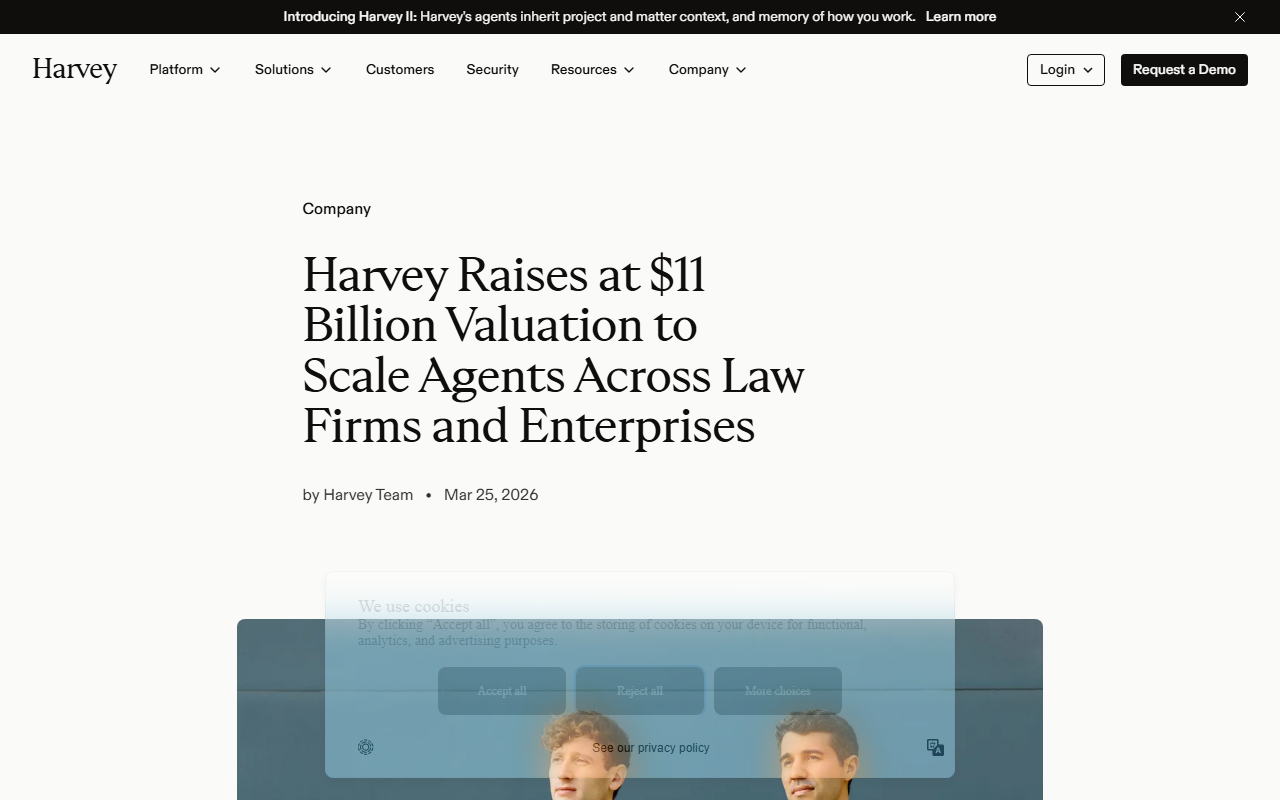 Harvey's funding announcement, captured 30 Aug 2026. The round was co-led by returning investors GIC and Sequoia.
That scale makes Harvey the most visible name in legal AI, and it shows up in searches from firms of every size. The reality behind the marketing page is narrower than the traffic it draws. Harvey sells exclusively through enterprise sales cycles, publishes no pricing, and offers no self-serve signup, built for teams already running six-figure legal information budgets. A solo attorney or a five-lawyer firm searching "Harvey AI" today is looking at a product they cannot buy.
What Harvey Actually Ships
Four named products carry the platform. Assistant, the part closest to Harvey II, drafts documents and answers legal research questions with citations, and now carries memory of a user's prior preferences and project context. Vault bulk-analyzes documents for due diligence and M&A discovery, up to 10,000 files at once inside a single project. Knowledge answers regulatory and tax questions across jurisdictions with citations traced to the underlying statute or filing.
Workflow Agents run multi-step legal tasks end to end, from contract negotiation loops to compliance review, without a lawyer driving each step. Command Center layers analytics and benchmarking across all four products, and a Harvey Mobile app, launched in September 2025, lets lawyers dictate and scan documents from a phone, syncing query history back to the desktop session.
The infrastructure underneath is not Harvey's own model. It runs on OpenAI's models through Microsoft's Azure OpenAI Service, a partnership Microsoft has detailed in its own customer case study, and Harvey's site now describes adding models from other providers to that stack as usage has grown (Microsoft).
Who Actually Uses It
More than 75 AmLaw 100 firms and over 1,000 law firms and enterprises use Harvey's platform today, per its own published customer count. Adoption inside those accounts runs at 92% monthly, and typical users report saving more than 25 hours a month.
That is the profile Harvey is built for: general counsel managing litigation and M&A at scale, AmLaw partners running high-volume contract work, and corporate legal operations teams automating document review across thousands of files a month. None of those descriptions fit a two-partner practice handling a docket of a few dozen active matters, and Harvey does not pretend otherwise in its own marketing.
Who Harvey Locks Out
That same design locks out everyone below it. Harvey does not list a price, but independent legal-tech pricing trackers put enterprise deployments in the $50,000 to $200,000-plus annual range, and separate industry estimates report per-seat costs near $1,000 to $1,200 a month once add-ons are included, figures Harvey itself has not confirmed. There is no monthly plan and no trial.
Reaching a signed contract runs six months or longer by most accounts, a process that assumes a procurement and security-review function most small firms do not staff, on top of the compliance stack Harvey requires: SOC 2 Type II, ISO 27001, and ISO 42001 for AI management. None of that is a reason a five-person firm typically has to build out on its own.
Legora, the challenger HokAI compared against Harvey earlier this month, lists per-seat pricing starting around $250, still enterprise-facing but a fraction of Harvey's floor.
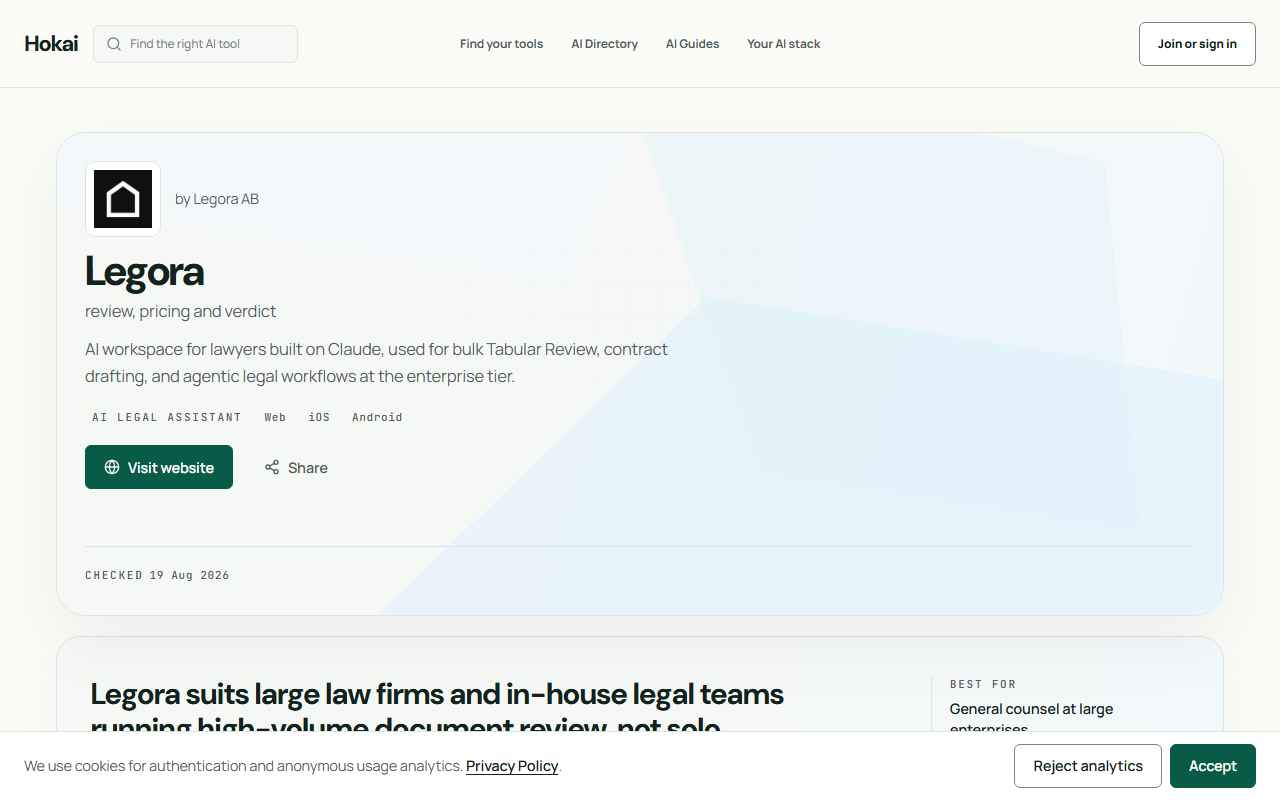 Legora's HokAI listing, checked 19 Aug 2026. Even the cheaper challenger is scoped for large teams, not solo practices.
Further down the market, RealPact, a Y Combinator-backed platform, skips general legal AI entirely and builds only for real estate brokerages, using voice agents to pull deed, tax and MLS records straight into contracts.
Neither tries to be Harvey at a smaller size. Both show that the fix for a solo or small practice is a narrower tool built for one job, not a scaled-down enterprise platform. HokAI tracks the rest of that category on the legal AI directory page.
The Case This Doesn't Matter
The strongest argument against all of this: AmLaw firms already spend well into six figures a year on Westlaw and Lexis subscriptions, so a $50,000 to $200,000 Harvey contract is not really a barrier for the buyer it targets. That is true, and it is exactly the point.
Harvey's price floor was never set to be affordable. It was set to match a specific buyer who already budgets that way, and Harvey just raised twice in five months on the strength of that model. Moving down-market would mean building a second go-to-market motion from scratch, not lowering a number, and nothing about the March round's stated use of funds points that direction.
What to Watch
Harvey's March 2026 raise was earmarked to expand the agents customers already run and grow embedded legal engineering teams inside existing accounts, not to build a lower tier, per the GIC newsroom announcement. Watch whether that changes before Harvey's next round: no public statement from the company points toward a self-serve or SMB tier.
Its agent-building peers that do serve smaller teams remain a separate product category entirely. If your practice does not fit either extreme, matching software against your actual caseload beats guessing from a marketing page. HokAI's Smart Match does that comparison for free.
Sequoia has now led three of Harvey's funding rounds, a level of conviction no other legal AI startup can claim, according to CNBC's reporting on the round. The open question isn't whether Harvey can serve more of the AmLaw 100. It already does. It's whether the sub-$50,000-a-year end of the legal market gets its own version of this story, or waits.
Frequently asked questions
What is Harvey AI used for?
Harvey handles legal research, contract analysis, due diligence document review, and regulatory compliance checks for law firms and corporate legal teams. Four products cover this: Assistant for drafting and cited research, Vault for bulk document analysis, Knowledge for cross-domain regulatory questions, and Workflow Agents for multi-step tasks like contract review run end to end.
How much does Harvey AI cost?
Harvey does not publish pricing. Third-party pricing trackers report enterprise deployments in the $50,000 to $200,000-plus annual range, with per-seat costs cited near $1,000 to $1,200 a month once add-ons are included, figures Harvey has not confirmed itself. There is no free tier or self-serve signup.
Can a solo attorney or small law firm use Harvey?
Not directly. Harvey sells only through enterprise sales cycles that industry sources describe as running six months or longer, and its products are built around document volumes a small practice does not generate. Firms below that scale typically look at lower-priced legal AI tools, such as Legora, instead.
Who owns Harvey and who funds it?
Harvey is an independent company. Its March 2026 round, $200 million co-led by GIC and Sequoia Capital, valued it at $11 billion, up from an $8 billion valuation the previous December. Sequoia has now led three of Harvey's funding rounds.
What AI models power Harvey?
Harvey runs on OpenAI's models through Microsoft's Azure OpenAI Service, a partnership Microsoft has documented in its own customer case study. Harvey's own site says it has since added models from other providers as usage has scaled.
Covered in this guide
- Harvey's own site: Legal AI platform serving 60 of AmLaw 100 firms. Document review 80x faster with citations, contracts, due diligence, and workflow agents. Enterprise-only.
- Legora: AI workspace for lawyers built on Claude, used for bulk Tabular Review, contract drafting, and agentic legal workflows at the enterprise tier.
- RealPact: AI contract platform for real estate brokerages, backed by YC S26. Voice agents pull deed, tax, and MLS records to auto-fill contracts in minutes.
Sources
Still deciding?
This guide covers a handful of options. Smart Match checks every listing in the directory against how you actually work and what you can spend, then hands you the shortlist and the reason behind each pick.
Find your toolsRelated guides
- The Best AI for Research in 2026 Depends on the JobBuyer's guideHow to pick, across a category
- Fireworks AI vs Together AI (2026): Managed Platform or Neocloud?ComparisonHead-to-head, with a verdict
- Harvey vs Legora: The 35-Hour Onboarding vs the 6-Month BuildComparisonHead-to-head, with a verdict
- The Top AI Tools in 2026: How to Actually Choose OneBuyer's guideHow to pick, across a category