Fireworks AI vs Together AI: Which Should You Use in 2026?
Fireworks AI and Together AI are both API platforms for running open-weight LLMs. As of August 2026 they price DeepSeek V4 Pro identically at $1.74 input and $3.48 output per million tokens. Fireworks specializes in high-volume model serving; Together adds GPU-cluster rental for training plus image, video and audio endpoints.
The short version
Fireworks and Together AI charge identical rates on their most-compared shared model, DeepSeek V4 Pro, so price will not decide this one. Pick Fireworks to serve one fine-tuned model at scale with fewer moving parts. Pick Together if the job includes training on rented GPUs, or you want chat, image, video and audio on one bill.
Together AI closed an $800 million funding round on July 1, 2026. Fireworks AI answered two weeks later with $1.505 billion, at more than double Together's new valuation.
Both platforms rent access to the same open weight models over an API. On the one model where a direct price comparison is possible, DeepSeek V4 Pro, they charge the identical rate: $1.74 per million input tokens, $3.48 per million output, confirmed against OpenRouter's live per-provider pricing table.
For a startup team deciding where to route inference for the next year, that means price stopped being the thing that separates Fireworks from Together. What actually differs is what each company just told its investors it would build.
The verdict, stated plainly
Pick Fireworks if the job is serving one or two fine-tuned models at high volume with the fewest moving parts. Pick Together if the job includes training or fine-tuning at real scale on rented GPUs, not just serving, or you want chat, image, video, audio and rerank endpoints on a single invoice.
That split is not a hedge. A four-person team shipping one specialized support-chat model to production, the kind of workload Fireworks' own case studies describe, has no reason to pay for Together's GPU cluster business. A team training its own model from a base checkpoint, or running mixed-modality pipelines across chat, image and audio, is paying for exactly the infrastructure Together's July raise says it is expanding.
The price that stopped being the differentiator
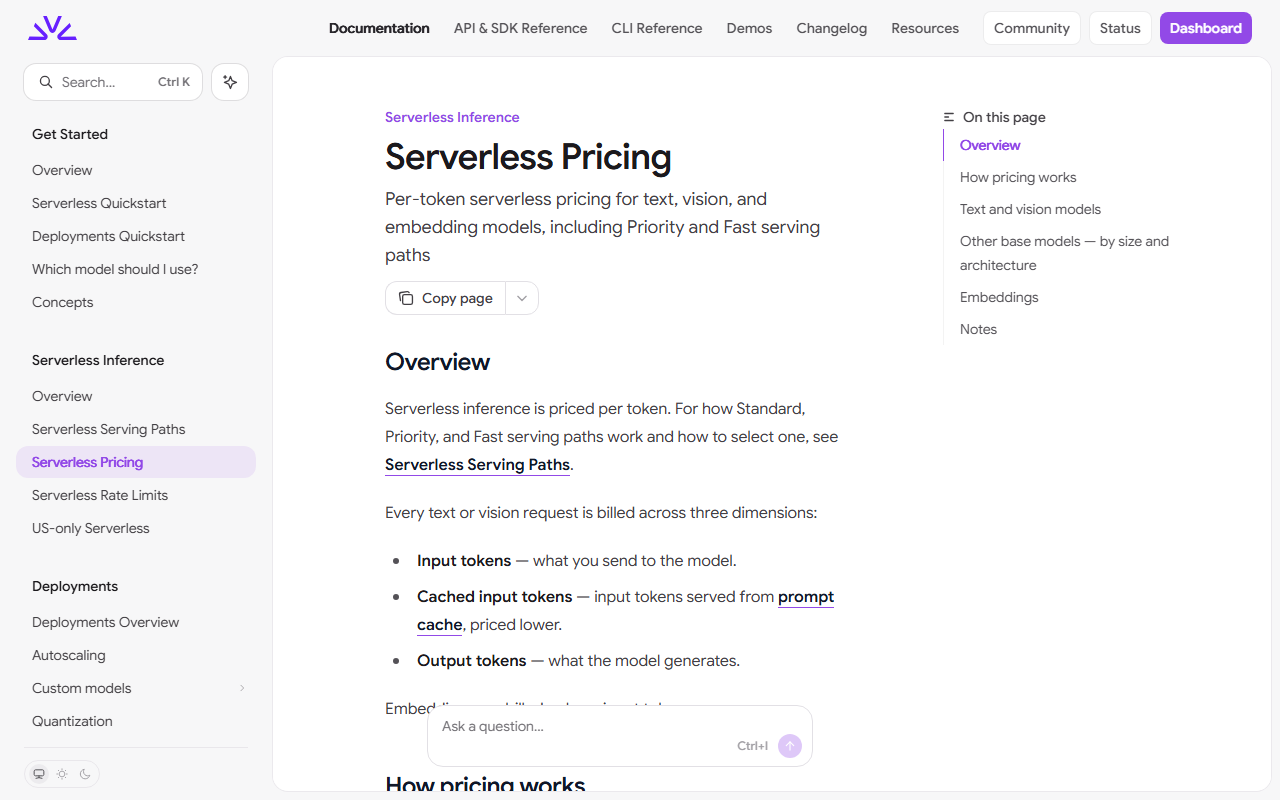 Fireworks' serverless pricing overview, captured 23 Aug 2026. The Standard/Priority/Fast split referenced below lives on this page.
Fireworks' serverless pricing docs list DeepSeek V4 Pro at $1.74 per million input tokens and $3.48 per million output on the Standard tier, with a Priority tier at $2.61 and $5.22. Together's own pricing page lists the same model at the same $1.74 and $3.48. OpenRouter's cross-provider table shows Baseten and Parasail matching that exact figure too. This is not a coincidence between two vendors: it is the market rate for hosting this specific model, and neither company is trying to win on it.
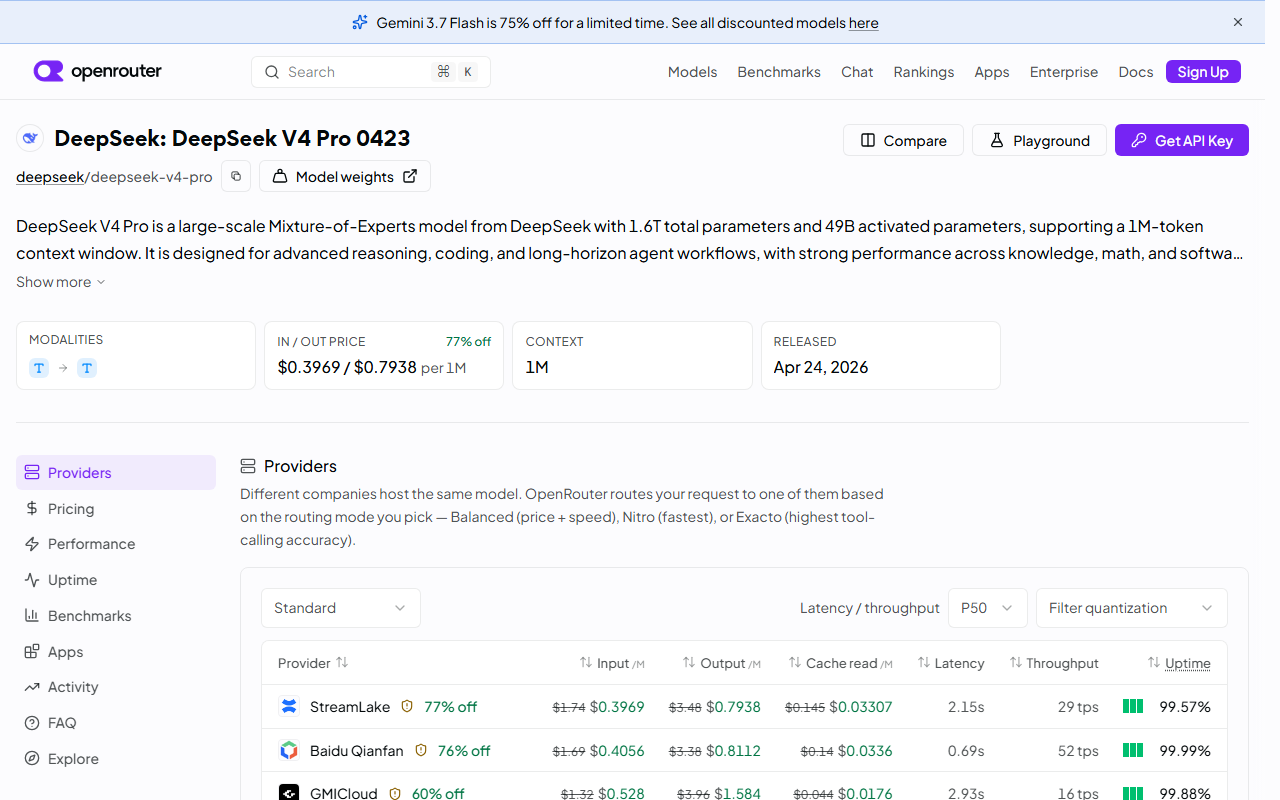 OpenRouter's live cross-provider table for DeepSeek V4 Pro, captured 23 Aug 2026. This is the page used to confirm Fireworks and Together's matching $1.74/$3.48 rate against a third, independent source.
Move down the catalog and the gap reopens. DeepSeek V4 Flash runs $0.22 input and $0.66 output on Fireworks, against $0.14 and $0.28 on Together, a real spread on a model built for high-volume, low-latency traffic. GLM-5.2 and MiniMax M3 both price identically across the two platforms again, at $1.40/$4.40 and $0.30/$1.20 respectively, which suggests the convergence is not limited to one popular model.
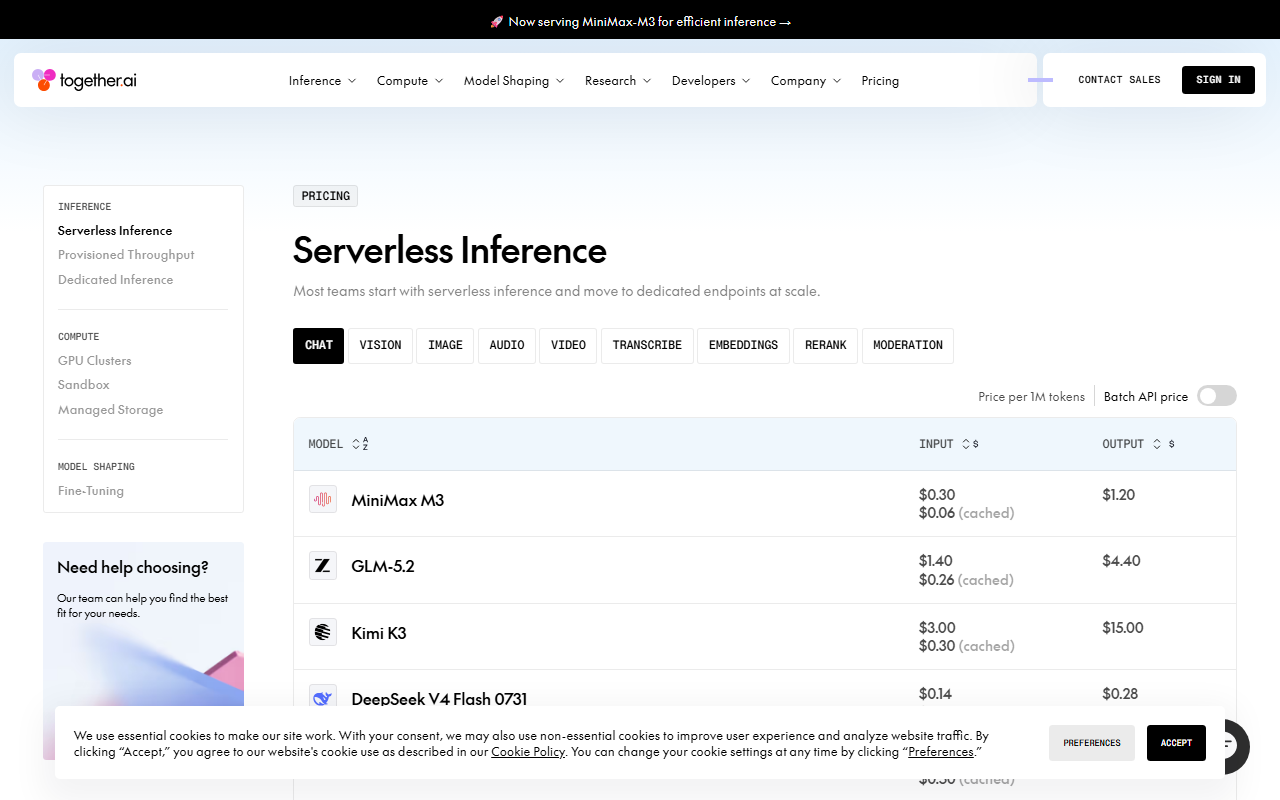 Together AI's serverless pricing page, captured 23 Aug 2026. The MiniMax M3, GLM-5.2 and DeepSeek V4 Flash rows shown here are the ones cited above.
Fine-tuning, and the self-host escape route
Fine-tuning tells a similar story. Fireworks charges $0.50 per million tokens for LoRA supervised fine-tuning up to 16 billion parameters, rising to $3.00 for models between 16.1 and 80 billion. Together charges $0.48 for its comparable up-to-16B tier and $1.50 for its 17B-69B band, with a $4 minimum charge per job. Neither number will decide a real budget on its own, but Together is consistently a few cents cheaper on the small-model fine-tuning jobs most startup teams actually run.
The cheaper route past both of them is Hugging Face's own Inference Endpoints, self-hosting the same open weights on rented GPU capacity without either company's markup. That is real money saved for a team with the engineering time to run its own serving stack. It is also the exact tax both Fireworks and Together exist to remove for everyone else.
What actually still differs
Together publishes a 99% uptime SLA on its Provisioned Throughput tier. Fireworks does not publish an uptime number on its own site. Third-party monitoring firm TokenMix measured 99.8% availability for Fireworks in the first quarter of 2026, the highest of the specialized inference providers it tracks, but that figure is TokenMix's, not Fireworks' own claim.
Model catalog breadth points the other way. Together's models page advertises "200+ models for text, image, video, code, and audio" behind one API. Fireworks does not publish a running total on its equivalent page, though its live catalog visibly includes DeepSeek, GLM, Kimi, Qwen, Gemma, MiniMax and FLUX image models.
Raw compute pricing is where the gap is largest. Together runs actual GPU clusters for rent: on-demand H100 at $3.99 an hour, H200 at $5.99, B200 at $8.19, dropping further with reserved commitments past 181 days. Fireworks' on-demand deployments start around $7 an hour for H100 or H200 and rise to $8 from September 1, 2026, roughly double Together's rate for the same chip.
Much of that hardware, on both platforms, runs on servers built by Supermicro, which neither company operates itself. Neither platform matches the raw inference speed of purpose-built silicon either: Groq's LPU chips outrun both on tokens-per-second for the models Groq supports, though Groq's much smaller model catalog rules it out for teams that need broad model choice.
Neither vendor discloses net revenue or profit margin, only annualized run rate. Fireworks says it has passed $1 billion in ARR and processes more than 40 trillion tokens a day, according to its Series D announcement. Together reported annual bookings above $1.15 billion in its most recent quarter, according to coverage of its own funding round. Bookings and ARR measure different things, so which company is actually larger cannot be answered from the numbers either has published.
Where Fireworks wins
Cursor is a named customer of both platforms, which makes it a useful comparison point rather than a tiebreaker on its own. Fireworks' homepage cites Notion cutting response latency from about two seconds to 350 milliseconds after switching, and Quora reporting a 3x speedup, both single-model, high-throughput workloads that map to what Fireworks was built to serve.
Gumloop's case study describes migrating a production agent from Opus 4.8 to GLM-5.2 on Fireworks with no user-visible change, evidence the platform's model-swapping is closer to a config change than a migration project. If your team's whole job is keeping one or two specialized models fast and reliable in production, and training is not part of the workload, Fireworks is built for exactly that job, and the case studies back it up with real latency numbers, not adjectives.
Where Together wins
Together's own case studies lean toward teams doing more than serving a static model. Decagon reports a 6x cost reduction per conversation turn against GPT-5 mini after moving to Together, and Vercept cites an 11x inference speedup, both figures Together names directly rather than implies. The GPU cluster pricing above matters here specifically: a team fine-tuning or training a model from a checkpoint, not just calling an API, pays Together's on-demand H100 rate of $3.99 an hour, roughly half of Fireworks' on-demand rate for the same chip.
Teams that also need image or video generation, transcription, or a code interpreter alongside chat inference get all of it on Together's one bill, at published per-unit rates: FLUX.1 schnell images run $0.0027 each, Whisper transcription runs $0.0015 a minute. A team that would otherwise be juggling Google AI Studio for one modality and a separate vendor for another can consolidate onto Together's invoice instead.
Modal covers similar serverless-GPU ground for teams that want more direct control over the compute layer than either vendor's managed endpoints offer, and is worth a look if neither abstraction fits.
The turn: capacity is not fixed
The obvious objection to a training-versus-serving split is that Together's own funding announcement says the raise funds infrastructure expansion of roughly 50 times its current footprint over five years. If Fireworks' present edge on serving reliability and scale rests partly on today's relative capacity, a buildout that size could close the gap, or invert it, well before this split's shelf life runs out.
That is a real risk to this verdict, and it is worth watching. It does not change the split today because the two companies are not building the same thing even as their capacity grows. Together is explicitly a full-stack cloud, GPU clusters included, expanding all of it together. Fireworks is expanding an inference-only business that has stayed narrow on purpose, betting specialization beats breadth on the one thing its customers actually pay for.
More GPUs at Together does not turn Fireworks into a GPU rental company. It does not turn Together into a specialized-inference-only shop either.
Switching cost: what actually moves
Both platforms expose an OpenAI-compatible chat completions endpoint, so a team already calling GPT-style APIs can point the same client code at either one by changing a base URL and an API key. What does not move automatically: fine-tuned model weights are not portable between the two without re-running the tuning job on the new platform.
Code built against Fireworks' FireFunction tool-calling behavior has no drop-in equivalent on Together's side, and the reverse is true of Together's rerank endpoint. For a team on a single serverless chat model with no custom fine-tune, switching is closer to an afternoon than a migration project. For a team with a fine-tuned model or platform-specific features in the critical path, budget a real sprint, not a config change.
The number worth checking again in six months is not either platform's price list. It is how much of Together's promised 50x capacity expansion has actually shipped, because that is the point at which cheap, direct GPU access starts to matter more than which company's managed layer sits on top of it.
Frequently asked questions
Is Fireworks AI cheaper than Together AI?
Not consistently. On DeepSeek V4 Pro, the model with the clearest overlap between the two, both platforms charge exactly $1.74 per million input tokens and $3.48 per million output, confirmed against OpenRouter's cross-provider pricing table. On other shared models the gap moves in both directions: Together is cheaper on DeepSeek V4 Flash ($0.14/$0.28 versus $0.22/$0.66), while fine-tuning pricing is close enough on both sides that it rarely decides a budget on its own.
Which one should a small startup team pick?
It depends on whether training is part of the job. A team serving one or two fine-tuned models at high volume with no training workload fits Fireworks' case studies, including Notion, Quora and Gumloop. A team that needs to train or fine-tune at scale on rented GPUs, or wants chat, image, video and audio on one invoice, gets more from Together's broader platform.
Do Fireworks and Together AI support the same models?
Mostly, since both host popular open-weight releases like DeepSeek, GLM, Kimi and Qwen. Together's own models page advertises 200+ models across text, image, video, code and audio. Fireworks does not publish an equivalent running total, though its visible catalog covers a similar range of model families plus FLUX image models.
How does GPU pricing compare for training versus serving?
Together's on-demand GPU clusters are meaningfully cheaper for raw compute: H100 at $3.99 an hour against Fireworks' roughly $7, rising to $8 from September 1, 2026. That gap matters most to teams that need to train or fine-tune at scale, not just call a serving API, since per-token serving costs are set by the identical rates described above.
Which platform has better uptime?
Together publishes a 99% uptime SLA for its Provisioned Throughput tier. Fireworks does not publish its own SLA number; third-party monitor TokenMix measured 99.8% availability for Fireworks in Q1 2026, the highest among the specialized inference providers it tracks, but that figure comes from TokenMix, not from Fireworks itself.
Covered in this guide
- Fireworks: Enterprise inference platform for open models: serverless tokens from $0.10 per 1M, managed fine-tuning per training token, and dedicated NVIDIA GPUs from $8.00/hr. $1 free credits, self-serve, no cold starts.
- Together: The AI Native Cloud: a full-stack platform for training, fine-tuning, and deploying open-source AI models
- Cursor: Cursor is an AI code editor built on VS Code, widely adopted across large enterprise engineering teams, with Agent Mode, Tab completion, and Cloud Agents.
- Google AI Studio: Free web-based IDE for building, testing, and deploying generative AI applications with Google's Gemini models
- Groq's: Fast open-model inference, now built on NVIDIA-licensed LPU hardware
- Hugging Face's: The AI community building the future. Platform for discovering, sharing and collaborating on machine learning models, datasets and applications.
- Modal: AI infrastructure that developers love: serverless compute for ML inference, training, and batch processing
- OpenRouter's: Single API endpoint for 300+ AI models from OpenAI, Anthropic, Google, and other providers, with one bill and no vendor lock-in.
- Supermicro: Supermicro designs AI server hardware from edge systems (65W TDP) to 8-GPU data center nodes, with $12.68B quarterly revenue and NASDAQ: SMCI listing.
Sources
Still deciding?
This guide covers a handful of options. Smart Match checks every listing in the directory against how you actually work and what you can spend, then hands you the shortlist and the reason behind each pick.
Start Smart MatchRelated guides
- AI Development Services in 2026: Which Layer You Actually NeedBuyer's guideHow to pick, across a category
- The AI Tool Ecosystem in 2026: Buy the Meter, Not the CategoryBuyer's guideHow to pick, across a category
- AIML API vs OpenRouter: Which AI Gateway Should You Use in 2026?ComparisonHead-to-head, with a verdict
- Best AI Chatbots in 2026: Pick by the Job, Not the LeaderboardUpdatedRechecked against current sources
- Best AI Code Review Tools in 2026 (Including Open Source)Buyer's guideHow to pick, across a category
- Best AI Coding Assistants in 2026: Pick the Job, Not the BrandBuyer's guideHow to pick, across a category