Best AI Voice Assistants in 2026: A Buyer's Guide to Synthesis, Transcription and Agents
An AI voice assistant is software that converts text to speech, speech to text, or both inside a conversational agent. The category spans dedicated synthesis APIs like ElevenLabs, transcription APIs like Deepgram and AssemblyAI, and orchestration platforms like Retell AI that combine synthesis, transcription and a language model into one phone or chat product.
The short version
AI voice assistant is really three separate purchases: speech synthesis, speech transcription and full conversational agent orchestration, each with different vendors and pricing. ElevenLabs leads on cloning quality, Deepgram and AssemblyAI compete on transcription cost, and Retell AI bundles all three for phone agents. Play.ht shut down in 2025.
A three-person team looking for AI narration in July 2026 signed up for Play.ht, uploaded a script, and watched the request hang: the company had been dead for seven months.
Why "voice AI" is three different purchases
HokAI's own AI Voice Assistants category lists seventeen tools, and treating them as one shopping list is the first mistake most buyers make. Some are speech synthesis engines that turn text into audio, like ElevenLabs. Some are speech-to-text APIs that turn audio into text, like Deepgram. A smaller group, led by platforms such as Retell AI, bundle both plus a language model into a phone or chat agent deployable in a day.
Picking from the wrong bucket is how a team ends up paying agent-platform rates for a narration job, or building infrastructure a $0.055-a-minute platform already ships.
The seventeen tools split cleanly along that line. Getting the split right, before opening a single pricing page, saves an eval cycle most three-person teams do not have to spare.
How to choose before you look at a single tool
Start with the job, not the vendor list. Four questions cut seventeen options down to a shortlist fast.
Is this synthesis, transcription, or both? Turning a script into audio and turning a call into a transcript are different products built on different models, and almost no vendor is genuinely strong at both.
How much latency can the product survive? A narration tool can take twenty seconds per paragraph. A phone agent cannot: past roughly 800 milliseconds of dead air, a caller assumes the line dropped.
Does the use case carry compliance weight? Healthcare and finance workflows need HIPAA or SOC 2 attestations before procurement will look at a vendor, and only a handful of the seventeen options here publish either one.
What does volume do to the bill? Speech-to-text pricing looks trivial in a demo and compounds fast at scale. Forty hours of monthly audio against Deepgram's $0.0042-a-minute Nova-3 rate comes to roughly ten dollars; route that same forty hours through a full voice-agent platform with a language model attached, and the bill runs into the hundreds.
Can the integration switch vendors later without a rewrite? Most transcription and synthesis providers use near-identical REST shapes, so swapping one STT vendor for another is usually a config change. Voice-agent platforms are stickier: conversation logic built inside Retell AI's dashboard does not port to a competitor without redoing the design work from scratch.
The shortlist: eight tools worth an eval
Eight names surface again and again across roundups, review sites and the eval requests this category actually generates. Not all eight compete with each other, and grouping them by job is what turns a list into a shortlist.
ElevenLabs remains the reference point for voice realism and cloning. Free caps at 10,000 credits a month with no cloning; Starter is $6 a month with Instant Voice Cloning; Creator jumps to $22 a month and unlocks Professional Voice Cloning at 121,000 credits, according to ElevenLabs' pricing page (checked 17 August 2026). The catch: Professional cloning, the tier most teams actually want, sits above the entry plan.
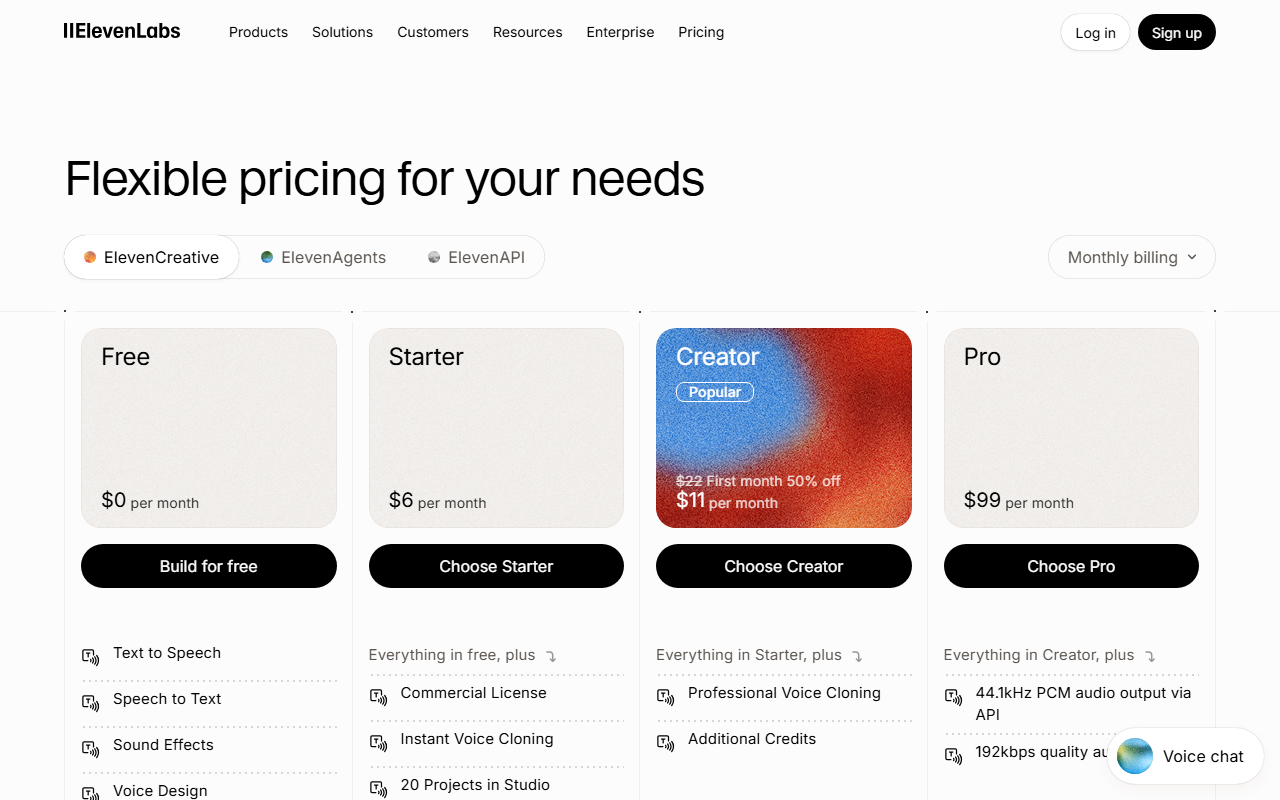 ElevenLabs' pricing page, captured 17 August 2026. Professional Voice Cloning sits on the Creator tier, not the cheaper Starter plan.
Deepgram is the cheapest way to add real-time transcription at scale. Streaming Nova-3 pricing runs $0.0042 to $0.0058 a minute depending on language coverage, and a $200 signup credit covers roughly forty thousand minutes of testing before a card is required, per Deepgram's pricing page (17 August 2026). It does not do voice cloning or narration-quality synthesis. It is a transcription API, full stop.
AssemblyAI's Universal-3.5 model runs $0.21 an hour for pre-recorded audio, and its older Universal-2 model runs $0.15 an hour, with a $50 signup credit (AssemblyAI pricing page, 17 August 2026). Teams choosing between AssemblyAI and Deepgram are really choosing between two accuracy benchmarks and two sets of add-on intelligence, not two price points. More on that below.
Murf AI undercuts ElevenLabs for high-volume narration. Creator runs $19 to $29 a month for 24 hours of generation a year, and the Falcon API for voice agents bills at $0.01 a minute, a fraction of what most conversational synthesis costs elsewhere. Murf licenses every voice from a paid actor rather than training on scraped audio, according to the company's own product description.
The shortlist, continued: agents, compliance and noise
Retell AI is the shortcut past building a voice agent from parts. Infrastructure runs $0.055 a minute, a language-model leg adds $0.08 to $0.16 a minute depending on the model chosen, and the first 20 concurrent calls are free, per Retell AI's pricing page (17 August 2026). The company's homepage claims roughly 600 millisecond latency and HIPAA, SOC 2 Type II and GDPR compliance; it does not publish an independent audit backing the latency figure.
Speechmatics, based in Cambridge, England, is the pick when on-premises deployment is a requirement rather than a preference. Self-hosted speech-to-text is available only on its Enterprise tier, alongside a $100 signup credit on the free plan (Speechmatics pricing page, 17 August 2026). Its published Pro-tier rate carries no stated unit as of this writing, so treat any per-hour number quoted for it elsewhere with caution.
Rev AI is the cheapest automated option here at $0.005 a minute for its Whisper-based models, with a human-transcription fallback at $1.99 a minute for accuracy above 99 percent (Rev AI pricing page, 17 August 2026). New accounts get five hours of free automated transcription to test against a real call set, enough to judge accuracy before committing budget.
Krisp AI solves an adjacent problem: removing background noise from calls already happening, not generating or transcribing them. Core is $16 a month, Advanced is $30 a month, and Enterprise adds HIPAA compliance and on-device processing (Krisp pricing page, 17 August 2026). Pair it with any of the seven tools above rather than choosing between them; it solves a different job entirely.
Deepgram vs AssemblyAI: the transcription decision most teams actually face
Price alone will not decide this one. Deepgram's Nova-3 model costs $0.0042 to $0.0058 a minute on its Growth plan. AssemblyAI's Universal-3.5 costs $0.21 an hour, which converts to roughly $0.0035 a minute, a hair cheaper once the units match. The real difference is model selection and integration surface, not the invoice.
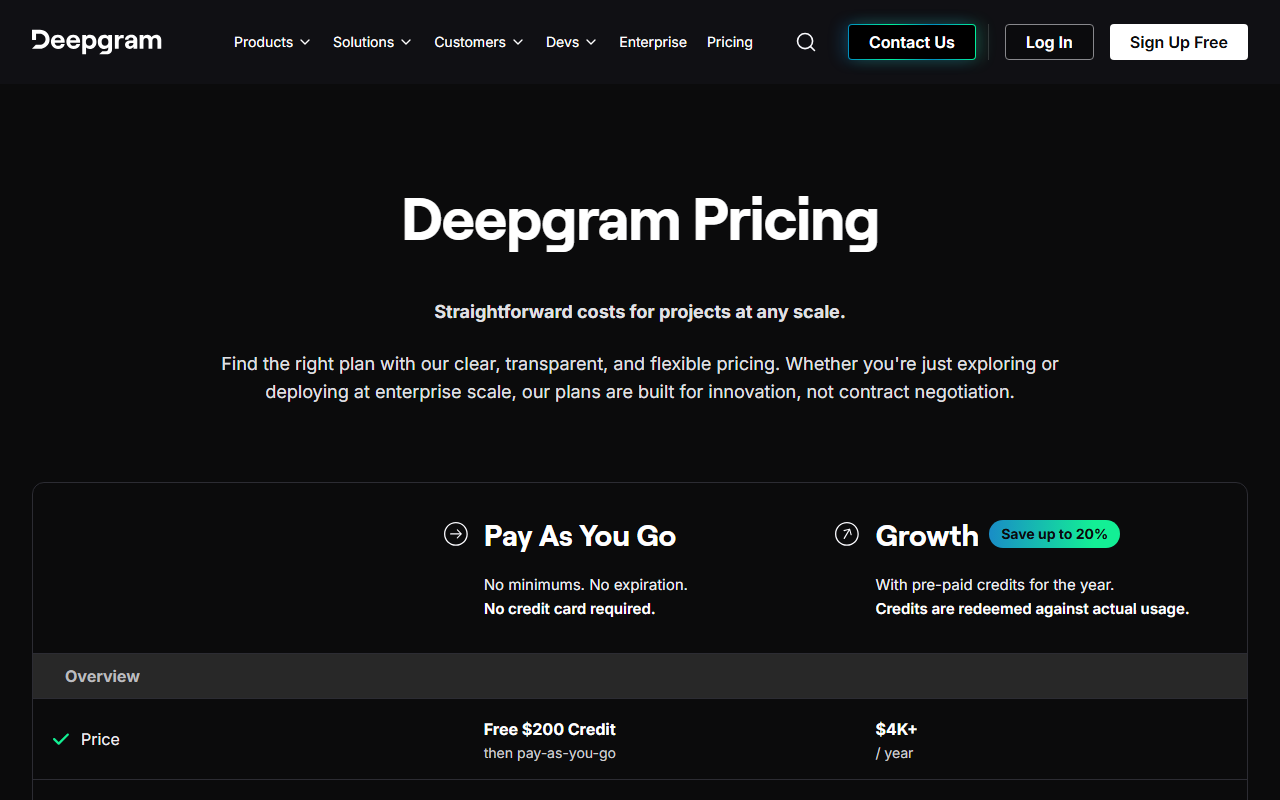 Deepgram's pricing page, captured 17 August 2026. New accounts start with a no-card-required credit large enough to run a full Nova-3 evaluation before paying anything.
Deepgram ships a broader real-time product line, including a newer Flux model built for streaming voice agents, and bills text-to-speech separately through its Aura-2 model at $0.030 per 1,000 characters. AssemblyAI focuses harder on transcription-adjacent intelligence: speaker diarization, sentiment and topic detection layered onto the same call. A team building a pure voice-agent pipeline tends to land on Deepgram. A team mining support-call transcripts for insight tends to land on AssemblyAI. Neither is the wrong answer for the other's use case, but each is the better answer for its own.
ElevenLabs vs Murf AI: cloning, not price, decides this one
Murf's Creator tier costs $19 a month billed annually, or $29 month-to-month, for 24 yearly hours of generation, a little over two hours a month. ElevenLabs' Creator plan costs $22 a month for 121,000 credits, which at ElevenLabs' standard per-character rate works out to roughly two to three hours of narration, by HokAI's own estimate. The two land in a similar monthly cost band for similar monthly output. The gap opens on capability, not sticker price.
The case for paying more sits entirely on Instant and Professional Voice Cloning. ElevenLabs' cloning quality is the reason the company is still the name most reviewers reach for first, and Murf does not offer a comparable cloning tier at any price. If the product needs a specific person's voice, ElevenLabs wins outright. If it needs any competent voice reading a script, Murf wins on flexibility and nobody notices the difference in the output.
Two names to cross off your list
Two names still appear on 2026 roundups that should not. Play.ht was acquired by Meta in July 2025 for its team and technology, according to TechCrunch's reporting on the deal. The API went dark by late July 2025, new signups stopped in August, and the service shut down permanently on 31 December 2025.
Its domain does not resolve today: loading play.ht on 17 August 2026 while researching this article returned a bare ERR_NAME_NOT_RESOLVED, not a parked page or a redirect. Play.ht's own HokAI listing now carries a discontinued flag instead of a comparison score.
Resemble AI has not shut down, but it has changed what it sells. Its current pricing page lists Flex, Team and Business tiers built around fraud and deepfake detection, running from free pay-as-you-go up to $1,000 a month, not the per-character text-to-speech pricing several comparison sites still quote for it.
Resemble AI's own homepage now leads with a claimed 99.5 percent accuracy detecting AI-generated audio, filing its original voice-cloning product under a secondary research heading. A team that lands on Resemble AI expecting a cloning API in 2026 is on the wrong page.
Both cases share a cause. Comparison sites scrape a vendor's numbers once and rarely revisit them, so a dead product or a repositioned one keeps reappearing in "best of" lists years after the facts changed. Checking a live pricing page before publishing is the whole difference.
Who should skip a dedicated voice API entirely
Not everyone needs a line item for this. A team that needs narration for a handful of videos a month, and already pays for a video or presentation tool with a built-in voice feature, gets nothing from adding a second per-minute vendor and a second invoice to reconcile. The same goes for transcription: many meeting and calling tools already bundle it, and paying twice for one capability is a common way a startup's software budget outgrows what its actual usage justifies.
Total cost of ownership matters more than the sticker price here. A per-minute API bills only for audio actually processed, while a bundled feature inside an existing subscription is already paid for whether it gets used this month or not. Buy the dedicated API once volume or quality outgrows the bundled feature. Not before.
The obvious objection: why not just start with an orchestration platform
The strongest case against everything above is that Retell AI already bundles transcription, language-model reasoning and synthesis into one billed-by-the-minute product, so a three-way taxonomy is a distraction for anyone who just wants to ship a voice feature. That argument holds, specifically, for phone and chat agents.
It falls apart for the rest of the category. A team that only needs narration would pay Retell's $0.055-a-minute infrastructure fee plus a language-model leg it never uses, when Murf's Falcon API bills the identical job at $0.01 a minute with no model cost attached. Run the math on a single call instead: twenty minutes on Retell's infrastructure at $0.055 a minute plus its GPT 5.5 tier at $0.16 a minute comes to $4.30, before any phone-number or concurrency fees are added.
A team that only needs transcription for internal analytics has no reason to route audio through a platform built for live calls at all. The taxonomy holds because most voice AI purchases are not phone agents.
What changes this by 2027
The gap between these three buckets is a latency gap as much as a product gap, and latency is the metric moving fastest. Cartesia states sub-90 millisecond time-to-first-audio for its Sonic model on its own product page, close enough to real time that the line between a narration tool and a conversational agent gets harder to draw with every release.
Once synthesis, transcription and orchestration all clear the same speed threshold, the question buyers ask stops being which bucket a tool belongs to. It starts being which vendor will sign a HIPAA business associate agreement without a custom Enterprise call. Right now, two of the eight tools in this shortlist can answer yes.
Frequently asked questions
What is the best AI voice assistant in 2026?
There is no single best pick because the category covers three different jobs. ElevenLabs leads on voice cloning and realism, Deepgram and AssemblyAI are the strongest low-cost transcription APIs, and Retell AI is the fastest way to launch a full phone or chat agent without building the pipeline yourself.
Is Play.ht still available in 2026?
No. Meta acquired Play.ht's parent company, Play AI, in July 2025 and shut the service down permanently on December 31, 2025. Its domain no longer resolves, and any comparison site still listing it as an active option is working from outdated information.
Should I choose ElevenLabs or Murf AI for narration?
Choose ElevenLabs if the product needs a specific person's voice cloned, since its Professional Voice Cloning tier is the stronger of the two. Choose Murf AI if any competent voice reading a script is enough, since its Creator and Falcon API pricing runs lower for equivalent output.
What is the difference between Deepgram and AssemblyAI?
Both offer real-time and pre-recorded speech-to-text at similar per-minute prices once units are converted. Deepgram ships a broader real-time model line including its newer Flux model, while AssemblyAI adds more built-in intelligence like speaker diarization and topic detection on top of the transcript.
Does Resemble AI still offer text-to-speech?
Resemble AI's homepage and pricing page now center on enterprise deepfake and fraud detection rather than voice cloning. Its original synthesis and cloning products are filed under a secondary research section, so buyers looking for a dedicated TTS vendor should treat it as a detection company first.
Covered in this guide
- ElevenLabs: The leading AI voice platform for text-to-speech, voice cloning, and conversational AI agents
- Retell AI: Retell AI builds and deploys realistic AI phone agents with 600ms latency, handling 50M+ monthly calls, and HIPAA/SOC 2 compliance. Rated 4.8/5 on G2 by 1,414 teams.
- AssemblyAI: The best way to build Voice AI apps with production-ready speech recognition and understanding models
- Deepgram: Real-time voice AI APIs for developers: speech-to-text under 300ms, TTS, and voice agents. Used by 200,000+ developers.
- Krisp AI: Removes background noise from calls in real time, with optional meeting recording, transcription, and summaries.
- Murf AI: Ultra-realistic AI Voice Generator with fastest text-to-speech API for voice agents and creators
- Play.ht: [DISCONTINUED] Play.ht was an AI text-to-speech platform with 900+ voices in 142 languages. Meta acquired the company in 2025 and shut it down completely by year's end. See TechCrunch and Meta's official announcement for proof.
- Resemble AI: Generative voice AI and deepfake detection for enterprise trust
- Rev AI: Speech-to-text API transcribing at $0.003/minute across 58+ languages, trained on 3M+ hours with optional human transcription at $1.99/minute for 99%+ accuracy.
- Speechmatics: Speech-to-text API from Cambridge UK covering 55+ languages. Medical model at 93% accuracy, on-prem deployment. Free 4 hrs/month, on-demand from $2.75/hr.
Sources
Still deciding?
This guide covers a handful of options. Smart Match checks every listing in the directory against how you actually work and what you can spend, then hands you the shortlist and the reason behind each pick.
Start Smart MatchRelated guides
- 41 of 100 HokAI Guides Carry a Screenshot. All 106 Still Load.Inside HokAIHow the directory works, verified in the open
- Best AI for Creating YouTube Videos in 2026: A Buyer's GuideBuyer's guideHow to pick, across a category
- Best AI Meeting Assistants in 2026: Do You Even Need One?Buyer's guideHow to pick, across a category
- Best AI Tools for Summarizing YouTube Videos and Podcasts in 2026Buyer's guideHow to pick, across a category
- HokAI vs Insidr.ai: The Sponsorship Price Insidr Never PublishesInside HokAIHow the directory works, verified in the open
- HokAI vs Toolify: What 30,501 Listings Cost You in AccuracyInside HokAIHow the directory works, verified in the open