Claude vs Gemini in 2026: Which Assistant Fits How You Work?
Claude and Gemini are both paid chat assistants with a $20 tier and $100 and $200 steps above it. Anthropic includes Claude Code and Opus access. Google includes Gemini 4 Argon, image and video generation, Gmail and Docs integration and storage. Prices were read from each vendor's own pages on 5 November 2026.
The short version
At about $20 a month, Claude Pro buys a coding agent and the higher-scoring public model, while Google AI Pro buys Gemini 4 Argon, video credits and 5 TB of storage. Choose by job. Carbon, Google's stronger model, is still limited to cyber defenders.
Want this decided for your own case? Find your tools with Smart Match, starting from this guide's question.
Claude Pro and Google AI Pro cost $20 and $19.99 a month on 5 November 2026, and the two bills buy almost nothing in common.
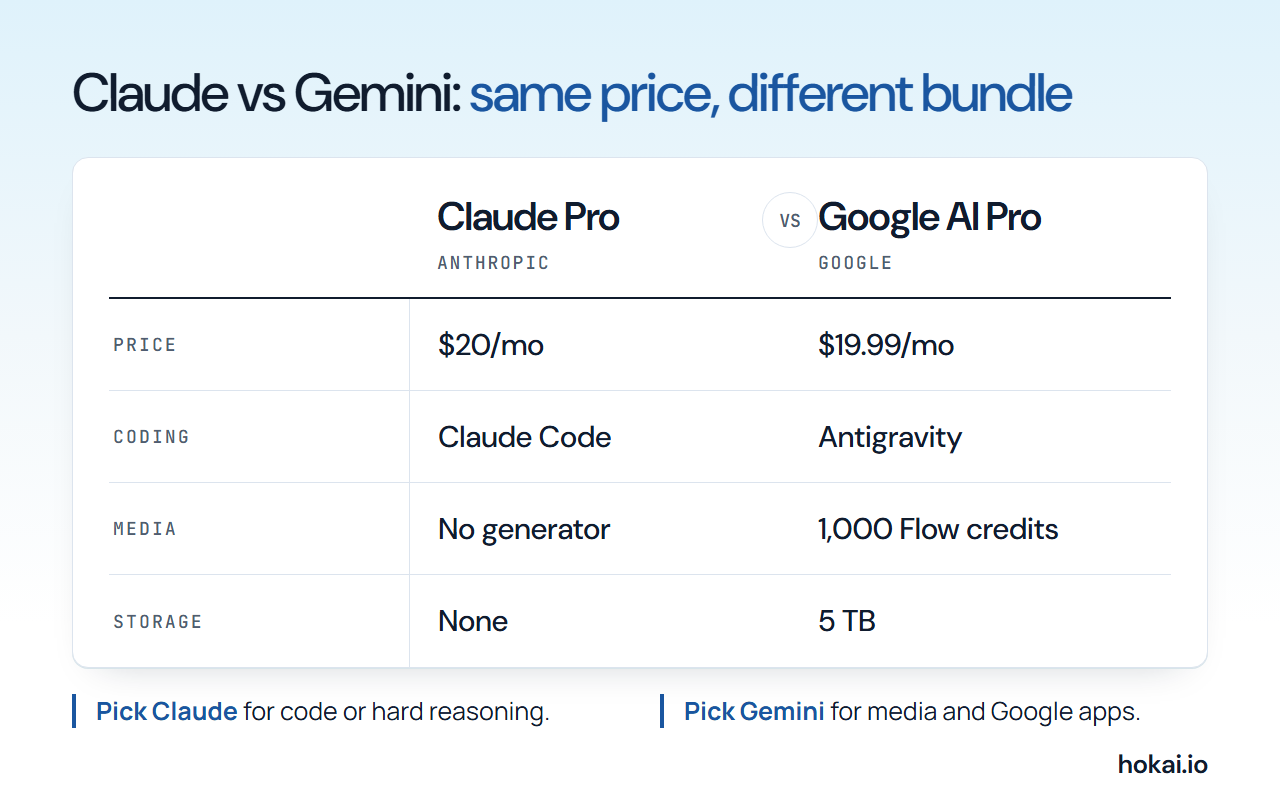 Hokai comparison of what Claude Pro ($20) and Google AI Pro ($19.99) include, from each vendor's plans page as checked on 5 November 2026.
One side spends your money on a coding agent and the stronger model that anyone can buy, while the other spends it on image and video generation, 5 TB of storage and Gemini inside Gmail and Docs, so the right pick depends on which of those things you would honestly use on an ordinary Tuesday afternoon.
This guide prices both ladders from the vendors' own pages, says which plans reach Argon, and names a winner for six jobs. We did not run both assistants side by side on one task. Where a verdict leans on a vendor's own claim, the sentence says so.
- Claude Pro a month, billed monthly
- $20
- $17 on annual billing
- Google AI Pro a month
- $19.99
- Includes 5 TB of storage
- Opus 5.5 API, per million tokens in and out
- $4 and $20
- Anthropic docs
- Argon API, per million tokens in and out
- $2 and $10
- Google's introductory price
What Claude and Gemini cost at each rung of the ladder
Anthropic's pricing page lists four personal plans: Free, Pro, Max and Ultra. Google's plans page lists Free, Plus, Pro and Ultra, with two steps inside Ultra. Both sell the same shape: a free tier, a middle tier, then two steep steps up.
| Monthly price | Claude | |
|---|---|---|
| $0 | Free | Free |
| $4.99 | Nothing at this price | AI Plus |
| About $20 | Pro ($17 if annual) | AI Pro ($19.99) |
| $100 | Max, 5x Pro usage | AI Ultra, 5x Pro usage |
| About $200 | Ultra, 10x Pro weekly | AI Ultra, 20x Pro usage |
The rungs line up. The multipliers do not. That is the trap. Each vendor measures against its own Pro meter, and neither publishes a message count, so a plan that promises five times the usage of its cheaper sibling tells you the ratio but never the number of questions you can ask before the wall appears. Google calls its limits compute-based and says they refresh every 5 hours until a weekly cap. Anthropic uses the same two windows. Same words, different meters.
One real difference sits at the top. Anthropic says Ultra has no 5-hour limit for verified accounts. Google's page does not describe that for either Ultra step.
What the middle rung holds is where the two diverge.
| Plan | Included at about $20 |
|---|---|
| Claude Pro | Claude Code, Research, Claude in Chrome, Microsoft 365, Opus access |
| Google AI Pro | Argon, 1,000 Flow credits, Gmail and Docs help, Chrome auto browse, 5 TB |
The newest Claude model, Fable 5.1, is billed per use through usage credits on that plan. Google adds a lite YouTube Premium plan to its bundle.
The two top plans on the Claude side add $100 and $200 a month in API credits. That matters if you build as well as chat. Google's page lists no credits of that kind.
Who can use Gemini 4 Argon today, and who cannot use Carbon
The brief for this comparison, written in late October, called Argon gated. It is not. Google's Gemini app release notes say that on 13 October 2026 Argon began rolling out globally to Pro and Ultra subscribers.
The plans page splits the models like this.
| Plan | Newest model it gets |
|---|---|
| Free | Flash-Lite |
| AI Plus | Flash, no Argon |
| AI Pro | Argon, plus the Pro and Flash models |
| AI Ultra | The same models, at higher limits |
The answer to "who gets it" is simple: only paying subscribers, and not the cheapest tier.
Search is a separate door. Google says Argon in AI Mode is available only in select countries. The same day, the Antigravity team said the model reached its desktop app and command line tool for paying subscribers. Businesses reach it through the API or eligible enterprise plans.
The gated model is Gemini 4 Carbon. Google's announcement of 28 October says Carbon goes first to a subset of cyber defenders, then to more partners through the Fairwind Program. Developers, businesses and consumers come after, "as soon as possible", with no date. Our access tracker follows which surfaces open.
- Gemini 3.6 Flash 21 JulyReaches every Gemini app user, free or paid.
- Gemini 4 Argon 13 OctoberRolls out to Pro and Ultra in the Gemini app.
- Argon in Antigravity 13 OctoberArrives in the desktop app and CLI for Pro and Ultra.
- Gemini 4 Carbon 28 OctoberAnnounced for a subset of cyber defenders only.
The Claude side is simpler. Every paid plan gets Opus 5.5, and the free plan gets Sonnet 5.5. The newest model sits behind credits at the $20 rung. Higher up it takes up to half your weekly limit. Our guide on which Claude model to use covers that split.
How the top models compare on independent tests and cost per task
Artificial Analysis publishes an Intelligence Index and a cost per task for each model. On its leaderboard, read on 5 November, the scores favour Claude. The cost column adds a twist.
| Model setting | Index | Cost per task | Minutes per task |
|---|---|---|---|
| Opus 5.5, max | 59 | $10.04 | 26.2 |
| Opus 5.5, high | 52 | $3.46 | 9.1 |
| Argon, high | 50 | $9.95 | 26.2 |
| Fable 5.1, xhigh | 50 | $10.85 | 18.6 |
Read from the Artificial Analysis models leaderboard.
Argon at its high setting scores 50 and costs $9.95 a task. Opus 5.5 at high scores 52 and costs $3.46. That is nearly three times the cost for two fewer points.
Argon's token price is half of Opus's, so a cost per task that runs nearly three times higher implies that Argon spends far more tokens to finish the same work, which is an inference we drew from two published columns and not a finding that Artificial Analysis states. Treat it as a lead to test. Nothing more.
Two cautions apply. Each row is a model at one reasoning setting, so these are not whole-product scores. And the leaderboard also lists Carbon at 60, one point ahead of Opus 5.5 at max, but nobody outside the defender programme can use Carbon yet. Our model leaderboard shows how the other models sit, and the Google DeepMind lineup lists every Gemini release.
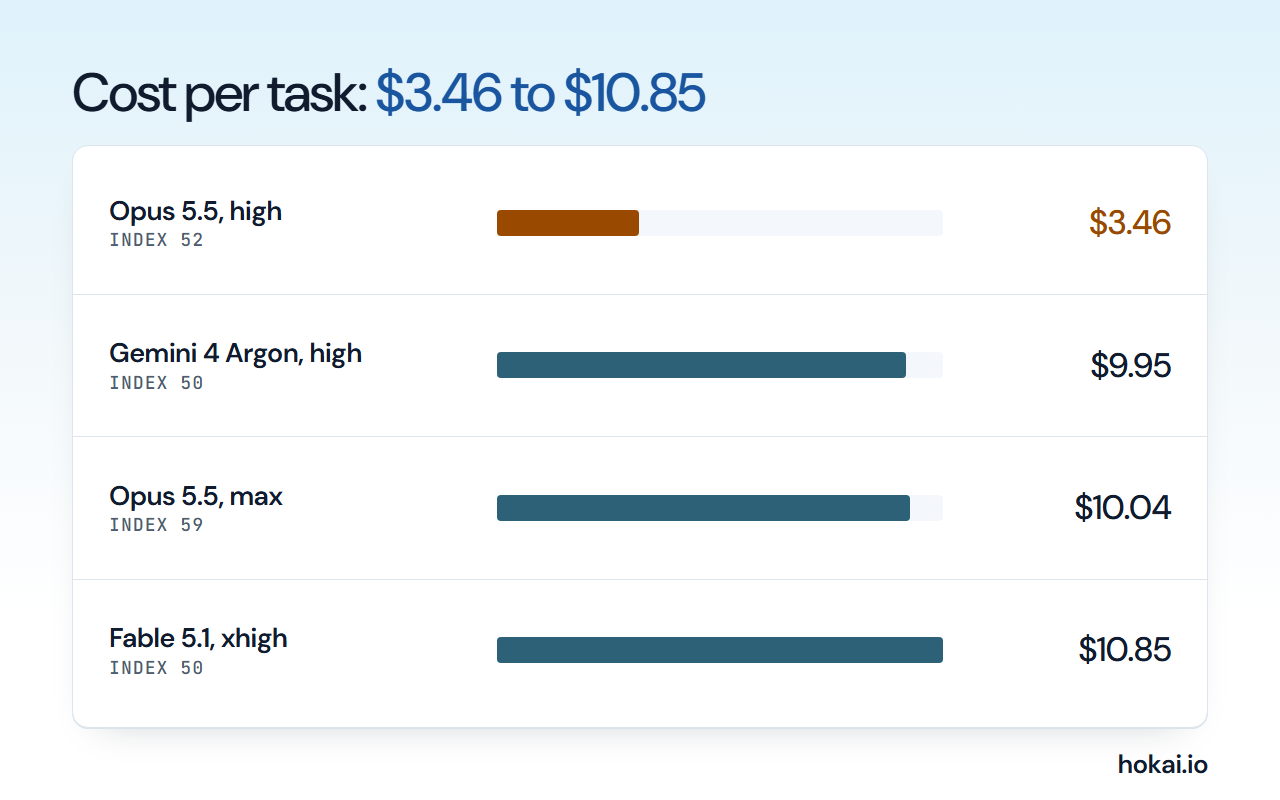 Hokai chart of cost per task, from the Artificial Analysis models leaderboard as checked on 5 November 2026.
If you pay for chat, the better-scoring public model is Claude's. If you pay per token through an API, run your own task first, because the sticker price misleads in the Argon row.
| Model | Input per million | Output per million |
|---|---|---|
| Fable 5.1 | $10 | $50 |
| Opus 5.5 | $4 | $20 |
| Sonnet 5.5 | $2 | $10 |
| Argon | $2 | $10 |
Anthropic's API pricing page gives the three Claude rows. Google's Carbon announcement gives Argon's price and calls it introductory. Google can change it.
Where Claude wins: a coding agent inside the $20 plan
Claude Code is on Pro, Max and Ultra. It is not on Free. That is the whole pitch: one subscription covers chat, a terminal agent and, on the two top plans, API credits for your own builds.
Google's route is different, and it moved this summer. Google's Gemini CLI repository says free access and Pro and Ultra access moved to Antigravity CLI on 18 June 2026. Anyone reading an old tutorial on Gemini CLI will hit a dead end. The working path is Antigravity CLI or the desktop app.
On the plan page, the Pro entry says only "entry rate limits" for the agent model in Antigravity. The two Ultra steps say higher and highest. Anthropic gives Claude Code no separate label, so compare the usage multipliers above. Then test on a real repository before you pay for a year.
The vendor reports its own numbers. Over four weeks, more than 100,000 Alphabet staff saw a 35% rise in agentic code and a 30% drop in post-submit rollbacks, per the Antigravity team. Those figures are vendor-reported. They describe the internal build, not the public one.
Our pick for a terminal coding agent at about $20 is Claude. Three reasons: the higher-scoring public model, a tool named on the plan, and no migration story to explain. If you code in an editor, Cursor or GitHub Copilot may beat both subscriptions.
Where Gemini wins: pictures, video and the Google apps you already use
Gemini wins every job that needs media generation. The free plan includes image generation and editing. Plus adds video generation. Pro adds 1,000 Flow credits, and Ultra adds 10,000 or 25,000. Those credits run Gemini Omni, Google's video model, inside its Flow studio.
The rival's plan table has no photo or video generator on any personal tier. It lists Design, Slides and Docs on every plan, and those make layouts, decks and mockups. The Motion line reads "No" on every personal plan. For a sense of what Google's video side does, read our guide to what Gemini Omni Flash is for.
The second Gemini win is storage and apps. Space is shared across Gmail, Drive and Photos.
| Plan | Storage | Gemini inside apps |
|---|---|---|
| AI Plus | 400 GB | Gmail and Vids |
| AI Pro | 5 TB | Gmail, Docs and Vids |
| AI Ultra | 20 TB or more | Highest limits, plus full YouTube Premium |
That is a lot of bundle. It is also why a family that already lives in Google's apps gets the most from this plan.
A person who already pays Google for extra storage can see the arithmetic. The $19.99 plan holds 5 TB and adds Argon on top. Claude has no storage to offer.
The third win is price at the bottom. Plus costs $4.99. Anthropic has nothing between Free and the $17 annual rate. Plus gets you the Flash model, not Argon, so treat it as a light-use tier.
It also sells agents on top. Gemini Spark reached the Mac app for top-tier subscribers on 30 June, according to the release notes. Gemini 3.6 Flash is open to every app user, free or paid.
Long documents and research: close to a tie
Both vendors cap context at 1 million tokens. One page says "up to 1M", varying by model. The other promises a 1M window on the middle tier and uploads of up to 1,500 pages. The leaderboard lists both flagship models at 1M.
So size is not the tiebreaker. Access to research tools is. The free Gemini plan includes Deep Research. Claude's table shows Research as "No" on Free and "Yes" on Pro. Pay nothing and you still get a research report from one side.
For notebooks built from your own sources, Google also ships NotebookLM, and the middle tier lifts its limits. Developers who want the model without the app can try it in Google AI Studio. For answers with live citations, a search-first tool may serve better than either. Our assistants directory lists the rest.
Here is where we could not decide. We have no first-hand measure of how each model behaves on a 300-page contract. Both vendors publish context size. Neither publishes recall at length on the pages we read. Test your own files first.
Free plans: what you get for nothing
The free tiers differ in kind. Usage on both is "limited", with 5-hour and weekly windows.
| Free plan | What it lists |
|---|---|
| Gemini | Flash-Lite, image generation, Deep Research, Live voice, Canvas, Gems, 15 GB |
| Claude | Chat, web search, code files, memory, Artifacts, Design, Slides, 5 Projects |
The gap shows in the models, and it is not small. Anthropic's table gives Free users Sonnet 5.5 and Haiku 5.5. Google gives the lite model by name. So the free Claude is the stronger writer and code explainer, and the free Gemini is the better researcher and picture maker.
That is a split, not a tie. Pick Claude Free for drafting and debugging questions. Pick Gemini Free when the job is a research report or an image. Neither free plan includes a coding agent, since Claude Code starts at Pro.
You can run both for nothing. That is the cheapest honest test of this whole guide: give each the same three tasks this week, then decide which one earns $20.
Students: one vendor has a free year on offer
Google's release notes for 19 August 2026 say eligible college students can get one year of Pro in the US, or Plus in more than 140 countries, at no cost. The offer can be redeemed until 31 December 2026, and it renews at the standard price unless cancelled.
Anthropic's pricing page lists an Education plan, but it is sold to a whole university, with student and faculty access for all members. We found no individual student discount on the page. If you are a student paying your own way this term, the Google offer wins on cost.
Check the terms before you redeem. A free year that auto-renews at $19.99 is a $240 decision in November 2027, not a gift.
A one-week test before you pay for either
The cheapest way to settle this is to run the same work through both free plans. It costs nothing and takes about an hour a day. Most readers who try it know by Thursday.
- Pick three tasks you do weekly: a document to draft, a file to analyse, and a question that needs sources.
- Paste the same prompt into both assistants. Do not tune either one.
- Score each answer on whether you would send it without edits. Write down a yes or a no.
- Note every time you hit a usage wall and how long the wait was.
- Add one job the other side cannot do at all, such as an image, or a coding agent in your terminal.
If one side wins two of three tasks and never blocks you, buy its middle tier. If they split, buy the tier whose extras you will actually use. If you hit a wall daily on either, that is the signal to move up a rung, and it is the only honest reason to spend $100.
Keep the notes. Plans change without warning, so your own scores, written down with a date beside each one, are the one source that cannot go stale the way a pricing page can between one quarter and the next.
Who should pick which
| Your main job | Pick | Why |
|---|---|---|
| Terminal coding agent | Claude Pro | Claude Code is included at $20 |
| Photos and short video | Google AI Pro | No Claude personal plan lists a generator |
| Gmail and Docs help | Google AI Pro | Gemini sits inside the apps |
| Hardest reasoning, public model | Opus 5.5 | 59 against 50 on the index |
| Free research reports | Gemini Free | Deep Research is on the free plan |
| Lowest paid price | Google AI Plus | $4.99, Flash model only |
This guide was written for a solo professional or a team under ten, adding one subscription. If your answer is "some of each", paying for both is cheaper than a wrong annual commitment on one.
When your stack is neither Google nor Anthropic, Smart Match can narrow the choice by your tools and budget. Our model recommender does the same for API buyers. For the model level, the three-way Argon, Astra and Opus comparison adds GPT-6 Astra, and ChatGPT is the third assistant most readers also price. That pairing has its own guide: ChatGPT vs Gemini.
The best argument against picking Claude
The strongest objection is value. Google gives more for the same money: storage, video, app integration and a YouTube plan. If you count the bundle as the product, Gemini wins at every rung.
That is true for a person who wants the bundle. It is false for anyone who would never touch Flow credits or a 5 TB drive, because a discount on something you do not use is not a discount, however large the headline storage number looks beside the price. Simple as that. The AI part of the $19.99 is the Argon model and the Antigravity limits. On those two items the evidence above leans Claude. Bundle value is real, but only if you use it.
A second objection is that Argon is new and Google moves fast. Correct. Argon is 23 days old, and Google says Carbon follows. The index also changed version recently, so scores from last month do not compare. Read the date on any benchmark, including ours.
Switching cost: what moves with you
Google added import tools on 26 March 2026. Its release notes say you can bring memories and chat history from other AI apps, using a pasted prompt and a ZIP upload. So moving into Gemini is documented.
Moving into Claude is less clear. Anthropic's site menu links an "Import to Claude" page. We did not read it, so we cannot say what it carries over.
The deeper cost sits outside the chat window. A plan tied to Gmail, Drive and Photos storage makes leaving a bigger job than cancelling a chat subscription. Claude holds less of your life, so leaving costs less. That cuts both ways. It is also why you can add it on top of Google rather than instead of it.
Terminal workflows travel better than chats, because a repository, a test suite and a folder of saved prompts work with either agent without any conversion, whereas a year of project instructions and custom setup built up inside one app does not move across by itself. Plan for that gap.
Data handling: what each vendor does with your chats
Google's Gemini Apps privacy page says human reviewers read some of the data it collects. Its advice is blunt: do not enter confidential information you would not want a reviewer to see. The default auto-delete period is 18 months. You can change it to 3, 36 months or indefinite. Reviewed chats are kept for up to three years, even if you delete your activity.
Anthropic's privacy article, dated 17 March 2026, covers the consumer plans and says chats and coding sessions are used to improve models only if you allow it, if a conversation is flagged for safety review, or if you opt in some other way. Incognito chats are never used. Thumbs up or down feedback is stored for up to 5 years.
Neither is a clean win. Both ask for trust. Google's controls sit in its activity settings. Anthropic's default is a setting you can see. For legal, medical or client material, buy a business plan from either vendor. Claude Team starts at $20 a seat on annual billing. Google's Business edition starts at $21 a seat.
What would change this verdict
Three events would flip it.
If Google moves Carbon to Pro and Ultra, its 60 on the index against 59 for Opus 5.5 becomes a tie on paper, at $7.76 a task against $10.04. That would remove the Claude lead on hard reasoning.
If Anthropic ships a photo or video generator on a personal plan, the creative column closes, and the pricing page already hints at the direction by listing a Motion feature in beta, although it shows that feature as unavailable to every individual plan today. Watch for it.
If Google publishes clear Antigravity limits for Pro, the coding gap narrows. Its plans page says only "entry rate limits" today.
Watch Google's release notes for the line that moves Carbon from the Fairwind Program to the Pro plan. The day it appears, Argon's 50 stops being the Gemini number to beat, and someone will have to run the test we could not.
Frequently asked questions
Is Claude or Gemini better?
It depends on the job. Claude is the better pick for coding agents and hard reasoning, since Opus 5.5 scores 59 against Argon's 50 on the Artificial Analysis index. Gemini is the better pick for image and video generation, Google apps and storage. Pay for the one that matches your main task.
How much do Claude and Gemini cost per month?
Claude Pro is $20 billed monthly ($17 on annual billing), Max is $100 and Ultra is $200. Google AI Plus is $4.99, AI Pro is $19.99, and AI Ultra starts at $99.99 with a $199.99 step. Both have a free plan. Prices were read on 5 November 2026 and exclude tax.
Which Gemini plans include Argon?
Google AI Pro and Ultra subscribers can use it in the Gemini app and in Antigravity, rolled out from 13 October 2026. Free and Plus plans cannot. Businesses can reach it through the API or eligible Gemini Enterprise plans. Gemini 4 Carbon is a different model and is limited to vetted cyber defenders.
Does Claude generate images or video?
Anthropic's personal plan table lists no photo or video generator. Claude Design, Slides and Docs make layouts, decks and mockups, and Claude Motion is shown as unavailable on every personal plan. Gemini includes image generation and editing on Free and adds video on paid plans.
Is Gemini CLI still available for coding?
Not for individuals. Google moved free access and Google AI Pro and Ultra access from Gemini CLI to Antigravity CLI on 18 June 2026. Claude Code is included on Claude Pro, Max and Ultra, and is not on the Free plan.
Covered in this guide
- Claude: Claude is Anthropic's AI assistant, with a free tier, Pro, Max and Ultra personal plans, and Team and Enterprise seats. Opus access starts at Pro.
- Gemini: Google's multimodal AI assistant and model family, sold as a free app, tiered subscriptions and a pay-per-token API
- Anthropic: Anthropic is a Public Benefit Corporation started by 7 ex-OpenAI researchers. It builds the Claude model family and counts Amazon and Google among its largest backers.
- Antigravity CLI: Google's successor to Gemini CLI, running subagents and a 5-model picker (Gemini, Claude, GPT-OSS) from the terminal.
- ChatGPT: ChatGPT is OpenAI's AI assistant, with 1.2 billion weekly users by OpenAI's count, the GPT-6 model family and plans that run from a free tier to a premium Pro tier.
- Fable 5.1: Anthropic's second Mythos-class model, released Sept 1, 2026, for long-horizon agentic coding and research at Fable 5's per-token rates.
- Haiku 5.5: Anthropic's smallest and fastest 5.5 model, released October 7, 2026, with a 1M context window, built for high-volume work.
- Opus 5.5: Anthropic's September 2026 flagship LLM with a 1 million token context window, built for long-running agentic coding and computer use.
- Sonnet 5.5: Anthropic's fastest Sonnet-class model, launched in September 2026, with a 1M context and output more than 30% faster than Sonnet 5.
- Cursor: Cursor is an AI code editor built on VS Code, widely adopted across large enterprise engineering teams, with Agent Mode, Tab completion, and Cloud Agents.
- Gemini 3.6 Flash: Released July 21, 2026, Gemini 3.6 Flash is Google DeepMind's Flash-tier model built for agentic coding, computer use and long-context work.
- Gemini 4 Argon: Google DeepMind's Gemini 4 frontier model, generally available on the paid Gemini API: 1M-token context and output, text, image, video, audio and PDF input.
- Gemini 4 Carbon: Google DeepMind's Gemini 4 Carbon, announced in October 2026: a cybersecurity and long-horizon coding model in limited access for approved cyber defenders.
- Gemini CLI: Google's open-source coding agent for the terminal, now limited to enterprise Code Assist licenses after its June 2026 consumer shutdown.
- Gemini Omni: Gemini Omni is Google DeepMind's multimodal world model (May 2026) that generates and conversationally edits 10-second 1080p video from text, image, audio and video.
- Gemini Spark: Gemini Task, called Gemini Spark until Google renamed it, is the Task mode in the Gemini app that runs multi-step jobs and schedules in the background for Google AI Pro and Ultra subscribers.
- GitHub Copilot: GitHub's AI coding assistant with agent mode and MCP support across 6 IDEs, plus a free plan with no credit card required.
- Google AI Studio: Free web-based IDE for building, testing, and deploying generative AI applications with Google's Gemini models
- GPT-6 Astra: OpenAI's flagship model, launched September 2026 as the first ever rated at the Preparedness Framework's Critical cybersecurity level.
Sources
Still deciding?
This guide covers a handful of options. Smart Match checks every listing in the directory against how you actually work and what you can spend, then hands you the shortlist and the reason behind each pick.
Find your toolsRelated guides
- The AI 80s Photo Trend: How to Make Yours (and Turn It Into a Video) in 2026AnalysisWhat changed and who it affects
- What Happened When 7 AI Agents Got Real Bank Accounts and No SupervisionAnalysisWhat changed and who it affects
- AI Development Services in 2026: Which Layer You Actually NeedBuyer's guideHow to pick, across a category
- The AI Tool Ecosystem in 2026: Buy the Meter, Not the CategoryBuyer's guideHow to pick, across a category
- Attio vs HubSpot in 2026: Which CRM for a Startup?ComparisonHead-to-head, with a verdict
- Best Agentic AI in 2026: Manus, Genspark and the Platforms That Finish Whole TasksBuyer's guideHow to pick, across a category