Perplexity vs ChatGPT Search in 2026: Which Gives Better Answers?
Perplexity is an answer engine that cites sources inline, with Free, Pro and Max plans; ChatGPT is a general assistant with a search tool built in, on Free, Go, Plus and Pro plans. Web search is free on both. Perplexity runs Comet, a browser for Mac, Windows, iOS and Android, while OpenAI has retired its own browser.
The short version
Pick Perplexity if you want sourced answers all day and a model picker: Pro is $17 a month on annual billing. Pick ChatGPT if search is one job among writing and coding: Plus is $20. Atlas is retired, so Comet is the only AI browser of the two.
Want this decided for your own case? Find your tools with Smart Match, starting from this guide's question.
Perplexity Pro and ChatGPT Plus sit a few dollars apart, $17 against $20 a month, and that gap is the least interesting difference between them. The interesting one is what each company sells around the search box. One sells an answer engine with a browser and an agent attached. The other sells a general assistant that happens to search the web.
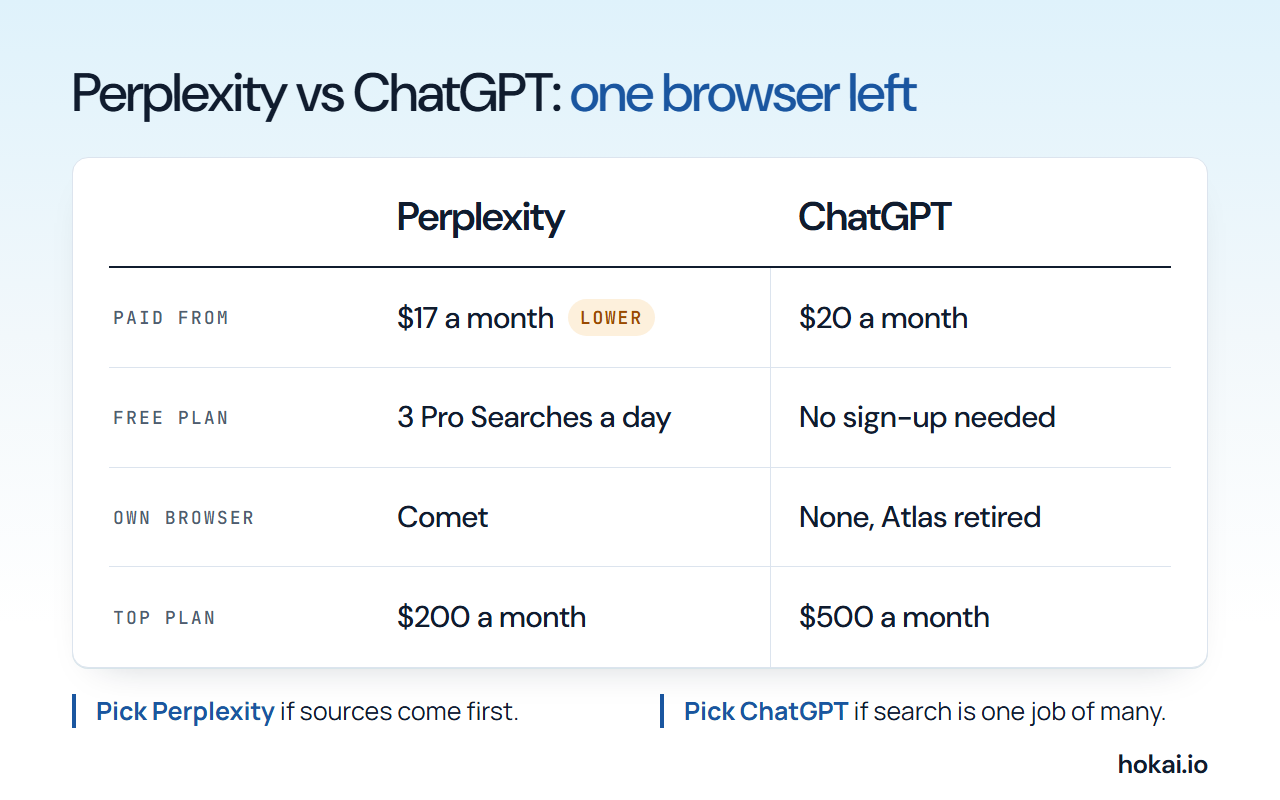 Hokai card comparing the two products, from Perplexity's plan pages and OpenAI's help centre as read on 5 Nov 2026. Perplexity's $17 is the annual-billing figure.
What changed is the browser race. OpenAI's release notes say its AI browser, Atlas, was scheduled to stop working on 9 August 2026, while Perplexity's Comet browser is listed for Mac, Windows, iOS and Android. A 2025 review that pits the two browsers against each other describes a contest that no longer exists.
Three questions settle the choice for a person who checks sources every day. How much does a month of real use cost? How often do you hit a cap? Do you want the answer, or the trail behind it?
This guide reads the plan pages, help centres and release notes of both vendors as they stood on 5 November 2026. We did not run a set of identical queries in both products, so no winner below rests on our own test. It rests on what the vendors publish, and we say where they publish nothing.
- Perplexity Pro, a month on annual billing
- $17
- Monthly price not shown on the plan page
- ChatGPT Plus, a month
- $20
- Billed monthly, no annual option
- Pro Searches a day on Perplexity Free
- 3
- Basic searches are close to unlimited
- Atlas end date in OpenAI's release notes
- 9 Aug
- 2026
What each product is built to do
Perplexity describes itself in one line on its Pro page: an answer engine built around real-time web search, with inline citations on every response. It describes ChatGPT, in the same FAQ, as a conversational chatbot. That is a rival's description of its rival, so read it as positioning, not as a finding.
OpenAI's own words are different. Its search help article says ChatGPT can search the web to answer questions with current information and links to relevant sources, and that it may do so automatically when a question would benefit. Search is a tool inside a chat, not the product.
That difference shapes everything else. In Perplexity you start from a question and get a sourced answer. In ChatGPT you start a conversation, and the model decides whether to look something up. If you ask a pure knowledge question, ChatGPT may never search at all, so a stale answer from one product and a fresh one from the other may only mean that one of them chose to look. Check the sources panel.
The wider field is larger than these two. Our roundup of AI search engines ranks the whole group, and the AI search category page lists every record. This guide stays on the pair people search for by name.
What each one costs, plan by plan
Start with the ladder. The two companies line up at the bottom and split apart at the top.
| Plan | Price | What the vendor says it adds |
|---|---|---|
| Perplexity Free | $0 | 3 Pro Searches a day |
| Perplexity Pro | $17 a month, annual billing | Advanced models, weekly Pro Search limits |
| Perplexity Max | $200 a month | Highest limits, early access |
| ChatGPT Free | $0 | Web search, limited deep research |
| ChatGPT Plus | $20 a month | Expanded deep research and memory |
| ChatGPT Pro | $100, $200 or $500 a month | Three usage tiers |
Perplexity Pro is the annual-billing equivalent. The others are monthly prices.
The Perplexity figures come from two places. The plans section of its Pro page shows Pro at $17 "per month or equivalent, when billed annually" and Max at $167 on the same basis.
The Max help article is the source for the monthly Max price. It says Max costs $200 monthly or $2,000 a year, with annual billing only on the web app. We could not find a monthly Pro price on either page, so we do not print one.
The ChatGPT figures come from OpenAI's help centre. The Plus article says $20 a month, billed monthly, with no annual plan. The Pro tiers article lists three Pro sizes named for their monthly price and says Pro bills monthly only. OpenAI's own pricing page quoted rupiah to our browser, so every dollar figure here comes from the help articles.
There is also a cheaper ChatGPT step called Go, which the pricing page says may include ads. Our guide to ads in ChatGPT covers what that means, and our ChatGPT versus Gemini comparison prices the full ladder in dollars.
Perplexity also sells an Education Pro plan at $10 a month to verified students and educators, and Enterprise Pro from $40 a month per seat, according to its plan comparison article. ChatGPT has no student price on its plan table. It does offer a no-cost teachers plan for American K-12 staff until June 2027.
What you get for nothing
Search is free on both, which makes the free tier the real starting point.
On Perplexity, the plan article says the Free plan gives practically unlimited basic searches, 3 Pro Searches a day and 1 Research query a month. Free users get no advanced model picker and no Comet Assistant queries. Perplexity picks the model for you.
On ChatGPT, the search article says web search is available on Free, Go, Plus, Pro, Business, Enterprise and Edu. It adds that people who are not signed in can use it too. Searches count against your plan's usage limits, and the pricing page promises unlimited text chats on Free, subject to abuse guardrails.
The practical reading is simple. For the "what happened with X today" kind of question, you can use either with no card on file. The paid plans matter only when you want deep research, an agent, or a model you choose.
Where Perplexity wins
Three things hold up on the vendor's own pages.
Citations are the product. Perplexity says every answer carries inline citations, and its help centre says Pro gives 10 times as many citations per answer. We cannot confirm the multiplier from a test, but it tells you the design goal. OpenAI says its responses "may include citations", which is weaker wording.
You choose the model. The Pro page lists Sonar, Perplexity's own fast model, next to GPT-6.1 Sol, Gemini 3.8 Flash, Claude Sonnet 5.5, Kimi K3, GLM 5.3 and Grok 4.7. One subscription reaches models from five other labs. If you want to ask the same question of an OpenAI model and an Anthropic model, you can do it without leaving the page.
The price of entry is lower. Pro undercuts Plus by $3 a month, which is $36 over a year. That is not a big saving, but it is real if you only want search.
The caveat is the help text. Perplexity's Pro help article still names GPT-5.2, Claude Sonnet 4.6 and Gemini 3.1 Pro as its model examples, while its live Pro page names newer ones. The help centre lags the product. Trust the plan page for the list and check the model picker when you sign up.
Where ChatGPT wins
Search is one tool among many. The same $20 buys the rest of the assistant: image creation, voice, projects, scheduled tasks and custom GPTs, per the pricing page. If you also write, code or draft, you pay once.
It works without an account. OpenAI says signed-out visitors can search the web. Perplexity's free tier is also open, but a ChatGPT search costs no sign-up at all.
Local and booking tasks are documented. The search article describes finding restaurants and available reservation times, with availability from OpenTable, Resy or Yelp, depending on the restaurant. It says reservation search works on eligible consumer plans when using GPT-5.6 Sol or GPT-5.6 Luna, and that it is not in voice. Perplexity's pages say nothing of the kind, so we do not claim it either way.
It can replace your browser's search box. A Chrome extension makes ChatGPT the default search engine, and typing !g before a query sends it to Google instead. That is a switching-cost point we cover below.
Our shopping and image search guide goes deeper on the buying side, and the ChatGPT versus Claude comparison covers the assistant questions.
Deep research and monthly limits
Both vendors cap their heavy modes, and both describe the caps in loose terms. Perplexity is the more specific of the two.
| Feature | Perplexity Free | Perplexity Pro | ChatGPT Plus |
|---|---|---|---|
| Pro or deep search | 3 a day | Weekly limits | Expanded |
| Research reports | 1 a month | Monthly limits | Expanded |
| Browser agent | None | Monthly limits | None named |
Perplexity's table gives numbers only at the free tier and the enterprise tiers. Its Pro column says "weekly limits (average use)" and "monthly limits (average use)", and Max says the same for "advanced use". OpenAI's pricing page uses "limited", "expanded" and "maximum". Neither tells a Pro or Plus buyer how many reports a month they will get.
What the limits language tells you:
- The free tiers are comparable. Perplexity states its numbers, while ChatGPT calls its deep research "limited".
- The paid tiers are not published as counts on either side.
- ChatGPT lets you buy credits for some features, such as Codex and Work, once a plan's allowance runs out. We did not check how Perplexity treats overage on its web plans, so we say nothing about it.
So the honest answer to "who gives more deep research" is that neither says. Our roundup of deep research tools compares the field on output instead. For academic work, see the guide to AI for research papers and the general research roundup.
One detail on the Perplexity side. Perplexity Computer now sits at the top of its Pro page, with bonus credits attached to the plans: 4,000 on Pro and 35,000 on Max, shown as limited-time offers. That page puts Computer, not search, in the headline. The company is steering buyers toward agents.
The browser question: Comet is here, Atlas is gone
This is the part most older comparisons get wrong.
OpenAI's release notes carry a section titled "Retiring Atlas". It says OpenAI is deprecating the browser as it brings browser-based agentic capabilities into ChatGPT and Codex. It warns that bookmarks, open tabs and history will not transfer automatically. There is no ChatGPT browser to compare any more.
Perplexity's Comet page lists the browser for Mac, Windows, iOS and Android. The plan article ties Comet Assistant to the paid plans: Free has none, Pro has monthly limits, and Max has the highest weekly limit on browser agent queries.
What that means for you:
- If you want an AI browser from either company today, Comet is the only one with its own app.
- If you want ChatGPT to act on web pages, OpenAI points you to ChatGPT itself and Codex, not a separate browser.
- If you already use Chrome and want to keep it, the ChatGPT search extension is the lighter change.
Other AI browsers exist outside these two companies. Hokai lists Dia, a Chromium browser for macOS and Windows with an assistant that reads across your tabs, and Google Disco, a Labs experiment in a closed macOS beta. If you would rather script a browser than use one, Browser Use is an open-source browser agent. We list them to show the field is wider than the pair, not to rank them.
We have not tested Comet's agent on a real task, so we make no claim about how often it succeeds. Our records on Comet and Perplexity Computer list what each vendor says it does.
Data handling and privacy
Neither vendor trains on your chats if you say no, but they say very different things about how a search is handled. That second part is where a buyer who cares about privacy should look first.
OpenAI is unusually specific. Its search article says ChatGPT typically rewrites your question into one or more targeted queries before it sends them to a search partner, and names Microsoft and Shopify in its privacy links. It says ChatGPT shares general location with those providers, but not your IP address or account information. If memory is on, saved memories may shape the rewritten query.
Perplexity's plan article says Pro and Max offer an opt-out of AI training, and Enterprise tiers say data is never used for model training. We did not find a page that describes how a Perplexity query reaches its search sources, so we cannot compare that step.
Two practical consequences follow:
- If you search health, legal or financial topics, turn off memory in ChatGPT, since saved details can enter the query.
- If you handle client material, neither consumer plan is the right tool. Both vendors point business buyers to their Enterprise tiers.
If you want search inside your own app
Some readers are not asking about a chat window at all. They want search results inside a product they are building.
Perplexity's plan article says its API Platform is separate from the web plans. It is pay-as-you-go, with credits you buy or top up automatically, and it comes with no complimentary credits. It gives no access to the advanced models or Pro features in the web interface.
OpenAI splits it differently. ChatGPT Pro plans include monthly API credits, according to the pricing page, while the Plus article says API usage is separate and billed on its own. In both cases, a chat subscription and an API bill are different purchases.
What switching costs you
Moving between the two costs little, which is good news for a first month.
You lose your chat history and any saved projects when you leave. ChatGPT Plus has no annual plan, so there is no prepaid year to waste. On Perplexity, annual billing is the way to reach the $17 price, so a mistaken yearly sign-up locks in more money than a mistaken monthly one. The Pro billing FAQ says there is no pause option, only cancelling and returning later.
Start monthly on whichever you choose. Switch to annual only after three months of real use.
- Write five questions Ten minutesUse real ones from your week, including one from your own field.
- Run them in both free tiers Thirty minutesSame wording, no follow-ups, no model choices.
- Open every source Thirty minutesClick each citation and check it supports the sentence.
- Count the misses Ten minutesNote unsupported claims and dead links per product.
- Pay for the winner for one month Month oneMonthly billing only.
Which one to pick, by job
| Your job | Pick | Why |
|---|---|---|
| Quick sourced answers all day | Perplexity | Citations are the design goal |
| Search plus writing and coding | ChatGPT | One plan covers the lot |
| Comparing models on one question | Perplexity | Picker spans several labs |
| Restaurant and local lookups | ChatGPT | Documented booking sources |
| An AI browser today | Perplexity | Comet exists, Atlas does not |
| Zero sign-up | ChatGPT | Signed-out search is allowed |
- Perplexity Pro
- $17 a month on annual billing, model picker, Comet Assistant on monthly limits
- ChatGPT Plus
- $20 a month, search inside a full assistant, no browser of its own
- Free search
- both, with Perplexity capping Pro Searches at 3 a day
- Top plan
- Perplexity Max at $200, ChatGPT Pro up to $500
If your week is mostly questions with sources, Perplexity fits better. If search is one of five things you do in an assistant, ChatGPT fits better. If you are still undecided, the Smart Match tool asks about your job and narrows the list.
The turn: citations are not accuracy
One fair objection cuts against the verdict above: citation counts prove nothing. A sourced answer can still misread its source, and OpenAI's own page admits that search results and citations can be incomplete, outdated or incorrect. Perplexity makes no such disclaimer on the pages we read, which is not the same as being more accurate.
That is fair, and it is why the test above says to click every source. Our verdict is about design, not accuracy. Perplexity puts the trail first, so checking is quicker. It does not make the answer right. If a controlled test showed ChatGPT's answers needing fewer corrections, the price and design arguments would matter less than that.
A second objection: the model list is shared. Perplexity runs GPT-6.1 Sol, so why not use OpenAI directly? Because the pairing is the product. You get one search layer over many models for $17 a month. If you only ever use the OpenAI model, ChatGPT is cheaper per feature.
What would change this answer
Four things would move us:
- A published cap. If either vendor states how many reports a month its paid plan gives, the limits table above gets a clear winner.
- A ChatGPT browser returns. OpenAI says it is folding agent features into ChatGPT and Codex. If a new browser ships, the browser section reopens.
- A Perplexity monthly price. We found only the annual-equivalent figure. A monthly price above ChatGPT's would flip the cost argument.
- A controlled accuracy test. Our verdict rests on vendor pages, so an independent comparison would outrank it.
Also keep the field in view. Gemini, Claude, Microsoft Copilot and Grok are rival assistants worth a look, and Hokai lists search-first records like Andi and Consensus in the directory. Our Andi explainer shows what a smaller search-first tool looks like, and Claude versus Gemini covers the other pairing. On raw model quality, the model leaderboard shows the current spread.
Both vendors changed their lineup inside the last few months, so reread the plan pages on the day you buy. The next change worth watching is whether Perplexity or OpenAI publishes real monthly counts for deep research, because that is the one number a buyer cannot get today.
Frequently asked questions
Is Perplexity better than ChatGPT for search?
For sourced answers, Perplexity is built around citations, and Pro gives a model picker that spans several labs. ChatGPT search sits inside a larger assistant. We did not run a controlled accuracy test, so the call rests on vendor pages. Open every citation either way.
How much do Perplexity and ChatGPT cost?
Perplexity Pro is $17 a month on annual billing and Max is $200 a month. ChatGPT Plus is $20 a month and Pro comes in $100, $200 and $500 tiers. Both have a free plan. Prices are US figures read on 5 November 2026 from vendor pages.
Is ChatGPT search free?
Yes. OpenAI says web search is available on Free, Go, Plus, Pro, Business, Enterprise and Edu plans, and that people who are not signed in can use it. Searches count against your plan limits.
Does ChatGPT still have the Atlas browser?
No. OpenAI release notes give 9 August 2026 as the date Atlas stops working, as agent features move into ChatGPT and Codex. Perplexity Comet is listed for Mac, Windows, iOS and Android.
What do I get on Perplexity Free?
Perplexity says Free gives practically unlimited basic searches, 3 Pro Searches a day and 1 Research query a month. It has no advanced model picker and no Comet Assistant queries.
Covered in this guide
- Perplexity: Perplexity AI answers from the live web with numbered citations and lets paid users pick among models from 6 AI labs; a limited free plan exists.
- ChatGPT: ChatGPT is OpenAI's AI assistant, with 1.2 billion weekly users by OpenAI's count, the GPT-6 model family and plans that run from a free tier to a premium Pro tier.
- Andi: AI search for the next generation: answers, not just links
- Browser Use: Open-source browser agent with a hosted cloud: describe a web task in one sentence, get JSON back. The repo has 117,000+ GitHub stars.
- Claude: Claude is Anthropic's AI assistant, with a free tier, Pro, Max and Ultra personal plans, and Team and Enterprise seats. Opus access starts at Pro.
- Perplexity's Comet browser: Perplexity's Chromium-based AI browser with a built-in assistant, free on Mac, Windows, iOS and Android, with 7 headline features.
- Consensus: AI-powered search engine for peer-reviewed research literature
- Dia: Dia is a Chromium browser for macOS and Windows with a built-in assistant that answers from your tabs and apps like Gmail, Slack and Notion.
- Gemini: Google's multimodal AI assistant and model family, sold as a free app, tiered subscriptions and a pay-per-token API
- Google Disco: Google Labs' experimental Chromium browser where Gemini 3 turns open tabs into no-code GenTabs mini apps, in a closed macOS-only beta.
- GPT-6.1 Sol: GPT-6.1 Sol is OpenAI's September 2026 mid-tier reasoning model for coding, computer use and document work, built to sit just below GPT-6 Astra.
- Grok: Chatbot from xAI that searches the web and X live, now sold with Grok Bot and Cursor inside The X Subscription.
- Microsoft Copilot: Microsoft's AI assistant across Windows, Edge, Word, Excel, Outlook and Teams, from a free tier to per-seat work plans on OpenAI's latest GPT-5 models.
- OpenAI: OpenAI builds ChatGPT, the GPT-6 family (Astra, Sol, Luna), Codex and the OpenAI API. It reports 1.2B weekly ChatGPT users and an $852B valuation after its March 2026 round.
- Perplexity Computer: Perplexity's autonomous worker runs research, documents and email tasks in a cloud sandbox, with a Mac and Windows app that adds your local files.
Sources
Still deciding?
This guide covers a handful of options. Smart Match checks every listing in the directory against how you actually work and what you can spend, then hands you the shortlist and the reason behind each pick.
Find your toolsRelated guides
- The AI 80s Photo Trend: How to Make Yours (and Turn It Into a Video) in 2026AnalysisWhat changed and who it affects
- The AI Tools That Do One Microsoft Copilot Job, CheaperBuyer's guideHow to pick, across a category
- Algolia and You.com Both Call Themselves AI Search Infrastructure. They Aren't Rivals.ComparisonHead-to-head, with a verdict
- Arc Browser Hasn't Shipped a Feature in 449 Days. Cloudflare Just Showed Why.AnalysisWhat changed and who it affects
- Attio vs HubSpot in 2026: Which CRM for a Startup?ComparisonHead-to-head, with a verdict
- Best Agentic AI in 2026: Manus, Genspark and the Platforms That Finish Whole TasksBuyer's guideHow to pick, across a category