What Listen Labs Is Actually For, Now That Salesforce Wants to Buy It
Listen Labs is an AI-moderated research platform, founded in 2023, that runs automated video, audio or text interviews with customers at scale, replacing traditional four-to-eight-week research cycles with results in under 24 hours. It raised $69 million at a $500 million valuation in January 2026 and was in acquisition talks with Salesforce for roughly $2 billion as of September 2026.
The short version
Listen Labs walked away from a $1.5 billion funding round because Salesforce is reportedly considering paying close to $2 billion to acquire it outright. The acquisition talk changes nothing about whether the product works: Microsoft, Canva and Chubbies already use it, contracts start around $20,000 a year, and there is no free tier.
Listen Labs turned down a signed $125 million term sheet in September 2026, the same month Salesforce started talking about paying roughly $2 billion for the whole company.
That reversal is why Listen Labs is suddenly turning up in search results next to questions it never used to attract: is it legit, is it free, what does it even do. A company that spent most of 2026 selling AI-moderated customer interviews to Microsoft, Canva and Anthropic is now, for a few news cycles, mostly a valuation story. For a product or insights lead deciding whether to put a live research budget behind Listen Labs this quarter, the acquisition noise is the least useful part of the file.
What Changed: A Signed Round Got Walked Away From
The timeline moved fast enough that most coverage only captured one frame of it. Founded in 2023, Listen Labs closed a Series B in January 2026 at a $500 million valuation, led by a fintech-focused investor with several earlier backers returning. Nine months after launch, the company said its annualized revenue had grown 15 times over, and it had run more than a million AI-moderated interviews.
By September, a growth-stage investor had signed a term sheet for a new round at roughly triple the January valuation. That round never closed. Reporters covering the story found that Listen Labs walked away from the signed paperwork once acquisition talks with Salesforce surfaced.
| Round | When | Amount | Valuation | Status |
|---|---|---|---|---|
| Pre-Series B | 2023-2025 | ~$31M across undisclosed rounds | Not disclosed | Closed |
| Series B | January 2026 | $69M | $500M | Closed |
| Series C | September 2026 | $125M | $1.5B | Signed, then walked away from |
| Acquisition talks | September 2026 | ~$2B reported | Not applicable | Unconfirmed |
Neither company has confirmed a signed acquisition agreement as of this writing.
Walking away from signed paper is not a small internal decision. A round at that size sets option-pool math, employee equity value and hiring plans for two years out.
Choosing acquisition talks over money already on the table suggests the board sees more certain upside in a sale than in staying independent at last month's price. The company has, twice in eight months, had its price tag roughly triple. Sitting with that fact matters more than any single number in it, because none of it says anything about whether Listen Labs the product actually works.
What Listen Labs Actually Does, in Four Steps
Strip away the funding news and this is a research tool built for one job: replace the six-to-eight-week survey-and-focus-group cycle with something an insights team can run in a day.
- Design the study. A team describes its research goal in plain language, and the platform drafts a discussion guide from it.
- Recruit participants. The company draws from what it calls Listen Atlas, a panel it describes inconsistently across its own materials: 30 million verified people in some pages, 50 million-plus on others as of this month. Neither figure is independently audited.
- Run the interview. An AI moderator conducts open-ended video, audio or text interviews in 120-plus languages, asking dynamic follow-up questions on short or interesting answers, the way a trained interviewer would.
- Deliver the report. Raw conversations become an executive-ready report with highlight reels, typically inside 24 hours.
The results, when they land, read as concrete rather than abstract. Chubbies, the shorts brand, lifted youth research participation from 5 to 120 people by removing the scheduling friction of a traditional focus group, and the interviews surfaced a specific liner defect that led to a redesigned bestseller.
At Microsoft, a senior research manager described collecting global customer video stories for a single product anniversary in one day, with the platform assembling a highlight reel automatically as responses came in. The same project would have taken six to eight weeks the old way, and the manager's stated reasoning for switching was blunt: by the time a traditional research cycle delivers an answer, the decision it was meant to inform has usually already been made.
Two more claims come from the vendor's own marketing rather than a customer's mouth. The company says its interviews produce responses three times longer than an average survey question gets, and a "workspace intelligence" feature lets a team search and build on every past study instead of starting from a blank page each time. Both are plausible extensions of the same four steps above, but neither carries an independent customer quote the way the Microsoft and Chubbies outcomes do.
None of this required a $2 billion valuation to happen. It required the product doing what it says, for customers who were paying before Salesforce ever called.
The Money Angle: Is Listen Labs Free? What It Actually Costs
No. There is no free tier and no self-serve signup. Every path on Listen Labs' own site leads to booking a demo, not a checkout page.
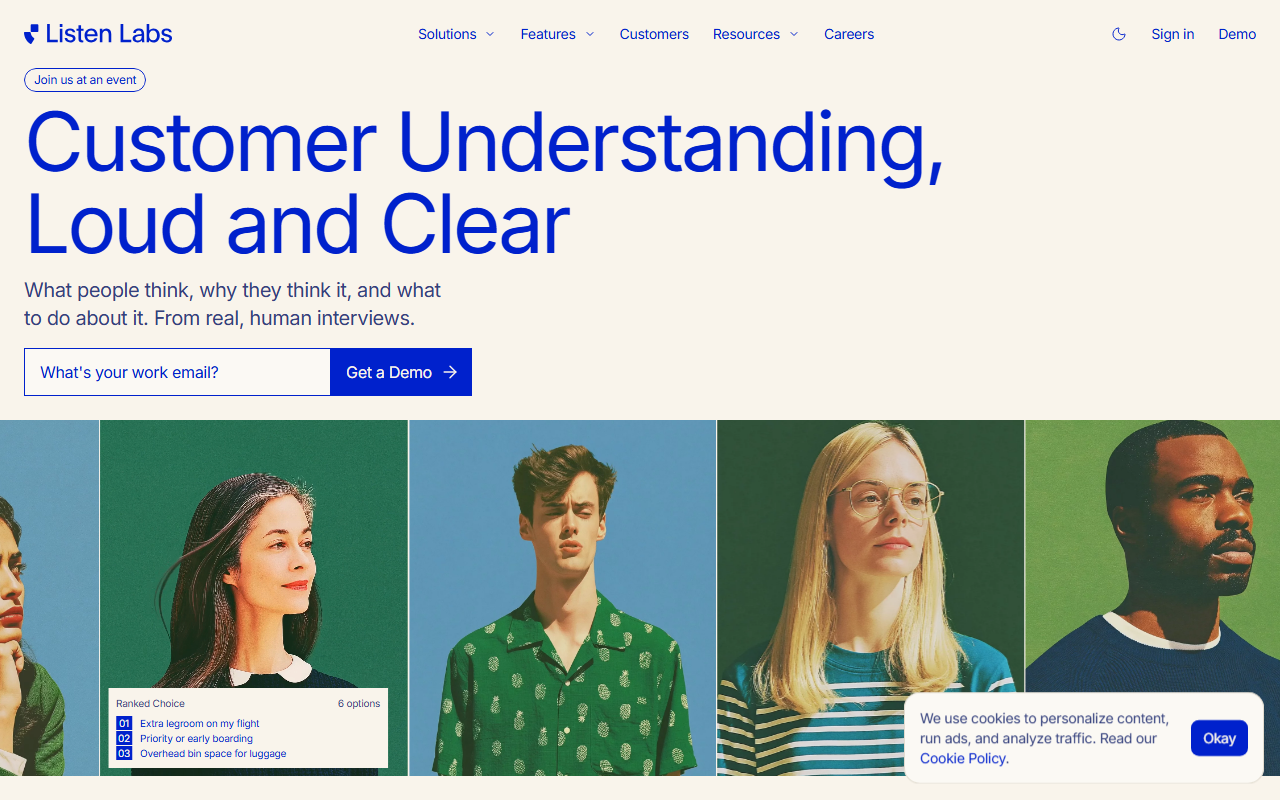 Listen Labs' own site, captured 17 Sep 2026. Every call to action routes to a sales conversation, never a self-serve signup.
Typical annual contracts start around $20,000, structured as a custom enterprise deal rather than a published price list. Per-session costs run on top of that, in the low hundreds of dollars per interview.
That puts Listen Labs closer to hiring a research agency for one engagement than to buying a SaaS seat, and it explains why "is listen labs free" sits near the top of the searches attached to the company's name: the category it competes in has never published prices either, so buyers go looking and find nothing.
For context, that entry price is not the high end of the category. Conveo, a smaller AI-moderated interview platform built on a Y Combinator-backed seed round, sells through custom contracts that HokAI's own research puts noticeably higher per year, billed as prepaid credits priced per interview minute rather than a flat annual fee.
A team that assumes the smaller, less-funded competitor is automatically the cheaper option should check that assumption against its own study volume first. For a framework on what to ask any vendor before signing when its own site gives you no number, see HokAI's pricing verification checklist.
Is Listen Labs Legit? The Compliance Case
The credentials are real and unusually complete for a three-year-old company. Per Listen Labs' own site, the platform holds SOC 2 Type II, ISO 27001, ISO 27701 and ISO 42001 certifications and states GDPR compliance with 256-bit encryption, close to the full stack an enterprise security review typically asks for.
The customer list backs it up:
- Microsoft, which used the platform to compress a research timeline from weeks to a single day
- Canva, named as a customer in reporting on the company's funding history
- Anthropic, which buys an AI-moderated research product rather than building one in-house, itself a small sign of how normalized this category has become inside the industry supposedly disrupting it
- Chubbies, plus two smaller brands with documented outcomes described above
Greenbook's vendor listing also credits the company with winning an insight-industry innovation award in 2024, a detail that predates the 2026 funding headlines by nearly two years and suggests the product had standing in its own field before it had a valuation story attached to it.
Who This Affects Right Now
Four groups have a real stake in what happens next, and coverage of the deal talk tends to blur them into one.
- Teams mid-evaluation. A live trial or request for proposal already open with Listen Labs is not yet a reason to pause. No deal has closed, and the company still needs paying customers regardless of who eventually owns it.
- Existing customers. Microsoft, Canva, Anthropic and the smaller brands above have the most at stake if a new owner changes contract terms, since they already have workflows built around today's pricing and support model.
- Direct competitors. Smaller players in the category, like Conveo, benefit from the distraction. Every week spent managing acquisition rumors is a week a sales team is not fully focused on new deals.
- Salesforce's own customers. If a deal closes, the interview data and pipeline likely feed Salesforce's existing AI and data products, meaning CRM customers may see AI-moderated research show up as a bundled feature rather than a separate purchase.
Notice which group is missing from most coverage of this story: the insights teams who have to decide, this week, whether to sign. HokAI's rundown of the best AI companies in 2026 tracks this same kind of valuation churn across dozens of vendors, and the pattern holds here too. Press attention follows the deal size, not the buyer's actual decision.
What to Do About It Right Now
None of the open questions above require a research team to stop working this week. The acquisition talk is a headline, not a change order, and treating it as a reason to freeze a live evaluation confuses the two. Three concrete actions apply, depending on where a team sits today:
- Mid-trial or RFP already underway. Keep it moving, and ask the sales rep directly whether any acquisition would change the contract term or pricing being offered now. Get that answer in writing before signing.
- Evaluation hasn't started. Use the delay to price out Conveo and at least one traditional research agency alongside Listen Labs, since the acquisition talk does not change the underlying comparison between them.
- Need something lighter than a full platform. A few questions through HokAI's Smart Match will point at a narrower, cheaper tool than either option above.
None of these three steps require waiting on the Salesforce talks to resolve one way or the other.
Where Listen Labs Sits Against the Rest of the Field
The category Listen Labs competes in, sometimes grouped under conversational AI research and survey tools, spans a wide range of price points and depth. Conveo targets a similar AI-moderated interview use case at a smaller scale.
Broader coverage like HokAI's rundown of AI research tools and its meeting assistant comparison covers the adjacent tools that automate the surrounding workflow: transcription, note-taking, follow-up, without running the interview itself. Teams building out a broader customer-data stack alongside a research tool may also want HokAI's AI SDR roundup, the same revenue-team budget line the Salesforce talks are ultimately about expanding.
| Listen Labs | Conveo | Traditional research agency | |
|---|---|---|---|
| Turnaround | Hours to 24 hours | Similar, AI-moderated | 4-8 weeks |
| Sample scale | Hundreds of simultaneous interviews | Smaller cohorts | Limited by moderator headcount |
| Pricing model | Custom enterprise contract | Prepaid per-minute credits | Per-project quote |
| Human moderator required | No | No | Yes |
Neither AI-moderated option publishes pricing the way a self-serve SaaS tool does, which is worth knowing before requesting a demo from either one.
The Case Against Buying In Right Now
The strongest argument against signing this quarter isn't the price. It's what tends to happen to a product after an acquisition like this one closes. HokAI's own coverage of Nvidia's purchase of Hugging Face and of what buyers actually got when Cyera changed hands both found a similar pattern: roadmaps slow during integration, and pricing eventually drifts toward whatever the acquirer's existing customers already pay. A team signing a one-year contract today has no guarantee next year's renewal terms come from the same company, or the same pricing logic.
That risk is real, but it cuts both ways. The Series C collapse shows Listen Labs' existing venture backers are still in the cap table and still have influence over the company's direction regardless of what Salesforce decides. Clay's own valuation swings are a useful reference point here too: a fast-rising AI vendor's headline price moving around does not automatically break what an existing customer is already paying for, or what that customer is getting.
HokAI's guide to spotting a dying AI tool before you build on it lists the signs that actually matter for a vendor relationship: shrinking support response times, a stalled changelog, layoffs among the team a buyer talks to. None of those signs are present here. A rising, unstable valuation is not on that list, and treating it as equivalent to one is a mistake.
What Would Change This Verdict, and What Happens Next
Three things would flip the assessment in this article. First, a closed Salesforce deal followed by pricing or contract changes for existing customers within the first two quarters. Second, the standalone product folded into a broader Salesforce suite in a way that removes the option to buy it on its own. Third, the acquisition collapsing the way the Series C did, forcing the next funding round at a lower valuation, which would be the first real signal that customer growth, not press coverage, sets this company's price.
None of those three things have happened yet. What has happened is that Fortune-scale brands are running research workflows through this product every week, and that fact will still be true whichever way the Salesforce talks land.
Check back on this page after the talks resolve, not before. A verdict written today about a deal that has not closed is a snapshot, not a prediction, and the honest version of this article says so plainly rather than guessing at a headline that has not been written yet.
Frequently asked questions
Is Listen Labs free?
No. Listen Labs has no free tier and no self-serve signup; every path on its site leads to booking a demo. Typical annual contracts start around $20,000, with per-session costs of $300 to $400, billed as a custom enterprise deal rather than a published price.
Is Listen Labs legit?
Yes. It holds SOC 2 Type II, ISO 27001, ISO 27701 and ISO 42001 certifications and states GDPR compliance, and named customers include Microsoft, Canva and Anthropic. It also won the IIEX insight-industry competition in 2024, before the 2026 funding and acquisition headlines began.
Is Salesforce buying Listen Labs?
Talks are reported but unconfirmed as of September 2026. TechCrunch and PYMNTS reported Salesforce discussing a roughly $2 billion acquisition, which led Listen Labs to walk away from a signed $125 million Series C term sheet at a $1.5 billion valuation. No agreement has been announced.
What is Listen Labs' valuation?
Listen Labs was valued at $500 million after its January 2026 Series B. A September 2026 Series C term sheet valued it at $1.5 billion but never closed, and Salesforce has reportedly discussed acquiring the company for close to $2 billion, about 67 times its estimated $30 million in annualized revenue.
What does Listen Labs actually do?
It runs AI-moderated interviews over video, audio or text to replace traditional survey and focus-group research. The process has four steps: an AI helps design the study, recruits participants from its own panel, conducts the interview with dynamic follow-up questions, and delivers a report, typically within 24 hours.
Covered in this guide
- Listen Labs: AI research platform with a 30M-person global panel that runs 300+ simultaneous AI-moderated customer interviews and delivers qualitative insights in under 24 hours.
- Conveo: AI-led qualitative research platform whose AI moderator interviews and analyzes users on video, built on a $5.3M Y Combinator-backed seed round.
- Anthropic: Anthropic, founded 2021 by 7 ex-OpenAI researchers, builds Claude and was valued near $965B after its May 2026 Series H round.
- Canva: Canva, founded 2012, is a $42B Australian design platform with 260M monthly active users, 29M paid subscribers, and $3.5B+ annualized revenue. IPO preparations underway for 2026.
- Microsoft: Microsoft, founded 1975, is a $2.77T public company (NASDAQ: MSFT) with 228,000 employees and $245.3B FY2025 revenue. Copilot AI business run rate exceeded $37B in Q3 FY2026.
Sources
Still deciding?
This guide covers a handful of options. Smart Match checks every listing in the directory against how you actually work and what you can spend, then hands you the shortlist and the reason behind each pick.
Start Smart MatchRelated guides
- Best AI Companies in 2026: Who Is Actually LeadingBuyer's guideHow to pick, across a category
- Best AI Tools for Writing a Recommendation Letter in 2026Buyer's guideHow to pick, across a category
- Claude Max Used to Die by Wednesday. Anthropic's Fix Expires August 19.AnalysisWhat changed and who it affects
- Claude Sonnet 4.6 vs Claude Sonnet 5: What Migrating ChangesComparisonHead-to-head, with a verdict
- HokAI vs FutureTools: What "Freemium" Doesn't Tell You About Claude's PriceInside HokAIHow the directory works, verified in the open
- One Field in Common: Why HokAI Runs Six Page Types, Not OneInside HokAIHow the directory works, verified in the open