What Clay Is Actually For, After a $5 Billion Valuation and a Pricing Fight
Clay is a go-to-market data-orchestration platform that chains enrichment, signal and CRM providers into automated workflows for revenue teams. As of March 2026 its self-serve tiers run $167 to $446 a month, HTTP API access requires at least the Growth plan, and Enterprise pricing is custom and quote-based.
The short version
Clay hit a $5 billion valuation in January 2026 through an employee stock sale, then restructured its pricing in March in a way that raised costs specifically for the solo GTM engineers and small agencies who first made it popular. The platform now clearly favors teams running enough workflows to need full orchestration, not casual API use.
Want this decided for your own case? Find your tools with Smart Match, starting from this guide's question.
On 28 January 2026, Clay let employees cash out $55 million of stock at a $5 billion valuation, more than triple the price set on the same shares eight months earlier.
That climb ran from a $500 million valuation in June 2024 to $5 billion in nineteen months, funded mostly by companies running Clay's workflow platform across dozens of enrichment jobs at once. Six weeks after the tender offer, on 11 March, Clay rebuilt its self-serve pricing.
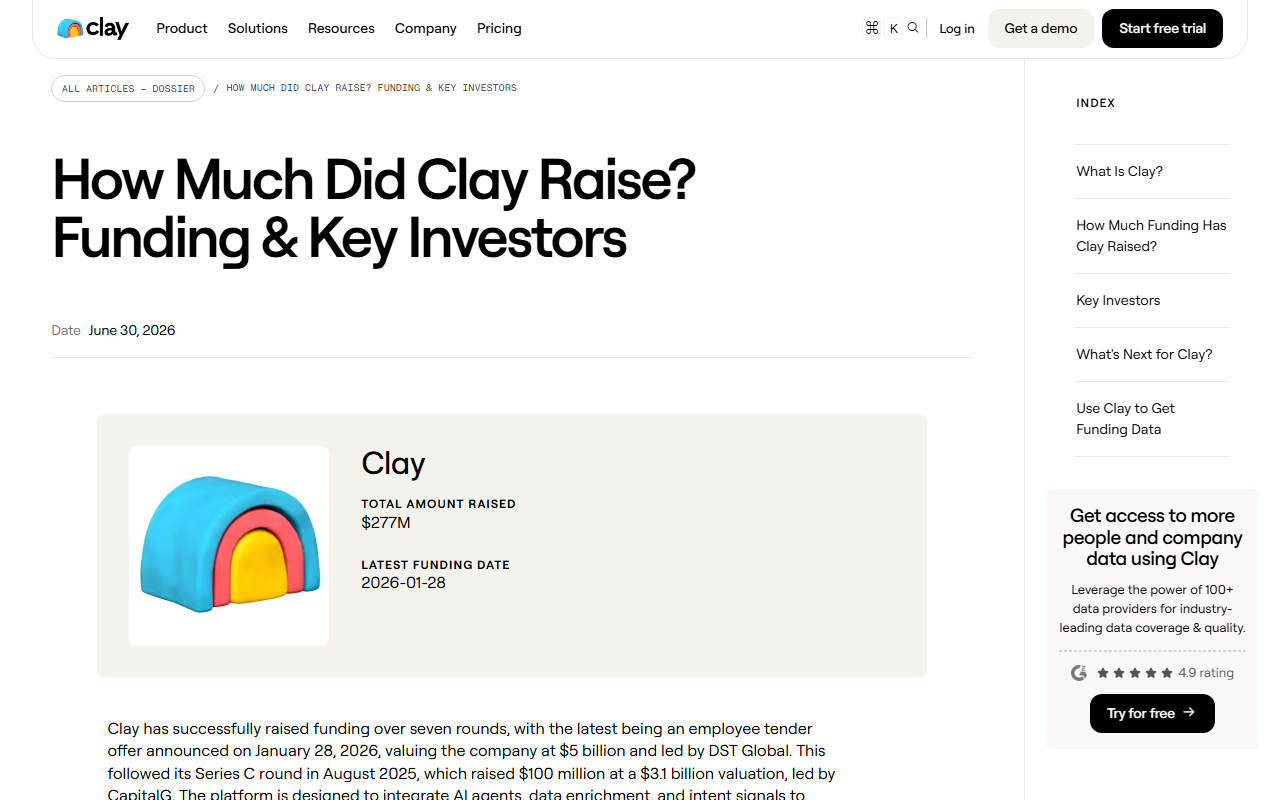 Clay's own funding summary, captured 27 Aug 2026: seven rounds, $277 million total, the January tender the latest entry.
The result raised costs specifically for the users who first made the product a cult tool: solo GTM engineers and small implementation shops running one or two workflows on thin margins. For a RevOps lead deciding whether Clay still belongs in a 20-to-80-person budget, the valuation and the price change are the same story, told twice.
What actually changed
Before March, Clay sold three self-serve tiers: Starter at $149 a month, Explorer at $349, and Pro at $800. HTTP API calls to a company's own systems were free on every one of them.
The new structure has four tiers instead. Free costs nothing. Launch runs $167 a month, starting at 15,000 actions and 2,500 data credits. Growth starts at $446 for 40,000 actions and 6,000 data credits. Enterprise is custom.
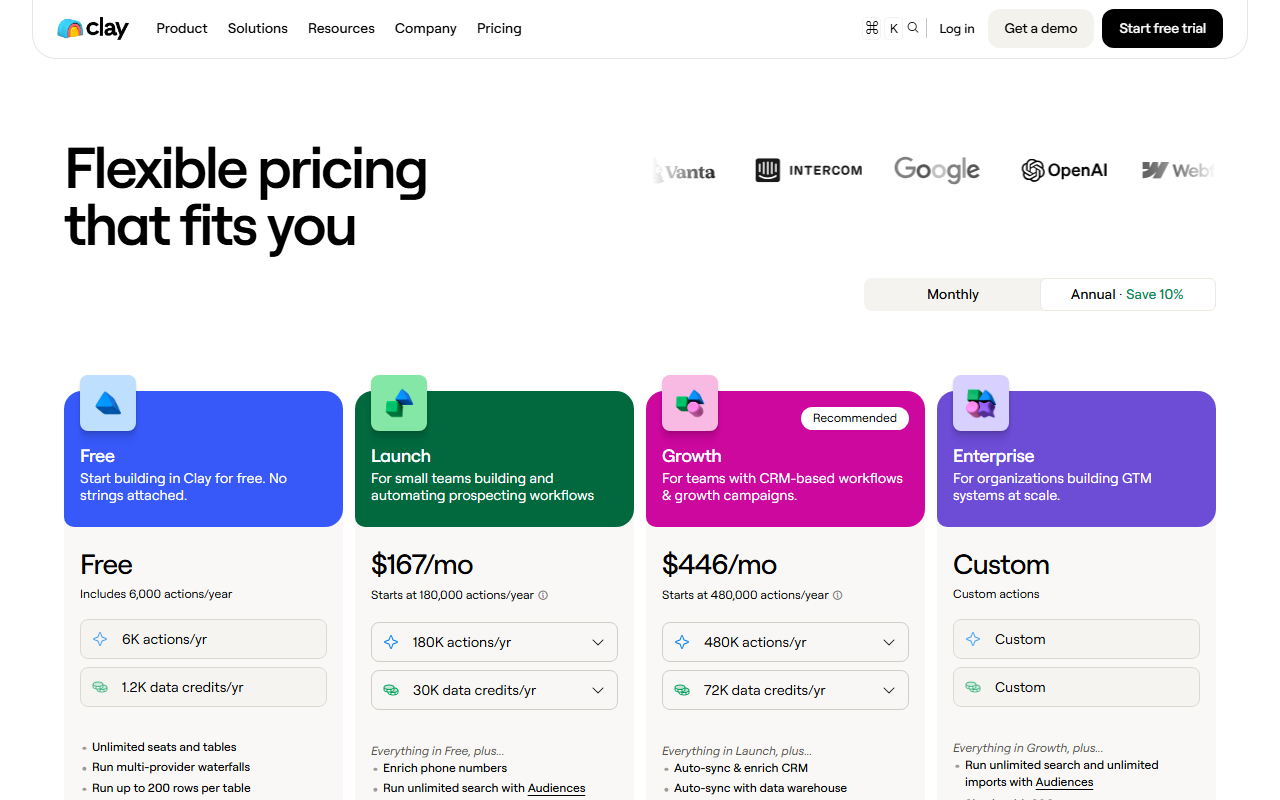 Clay's live pricing page, captured 27 Aug 2026. HTTP API access now sits behind the Growth tier.
Marketplace data got 50 to 90 percent cheaper, and the overage penalty dropped from 50 percent to 30 percent. But HTTP API access moved out of the cheaper tiers entirely. It now requires Growth or above, so a workflow that touched an external system for free before now costs at least $446 a month to run at all.
Clay published its own reasoning for the split. The company said the change was intentionally revenue-negative in the short run, called it a correction of a 2022 mispricing decision, and projected roughly a 10 percent hit to its own revenue. HokAI's own AI SDR tooling roundup already sizes up Clay's data layer against the field; this piece is about what moved underneath that layer.
Who it helps
The math favors scale. Clay's own numbers, published alongside its $100 million ARR milestone in December 2025, show enterprise net revenue retention above 200 percent and zero enterprise churn to date. The company states that 90 percent of standard customers never hit the new action caps at all.
A team running CRM auto-sync, ad-audience pushes and webhook-triggered signals across several workflows barely notices the $446 floor. That is who Clay is being built for now: teams that treat the platform as permanent infrastructure, not a side project.
Who it hurts
The users left out made HTTP calls to their own databases or tools as a matter of course, cheaply, on the old Explorer tier. One operator, quoted in an outside teardown of the change, put it plainly: a single custom API call against their own database now needs the $446-a-month Growth plan to run at all. It used to be free.
Community reaction pointed to Bitscale and Persana AI as cheaper clones built to catch the operators Clay's new floor priced out. Others described a do-it-yourself stack: a database, a job scheduler, and a couple of enrichment APIs, assembled by one engineer for a few hundred dollars a month. Neither clone is in HokAI's directory yet, which is itself a coverage gap worth closing.
The turn
The obvious rebuttal is that Clay published its math for a reason. Nine in ten standard accounts, by the company's own count, sit nowhere near the new caps, which means this change hurts a narrow, vocal segment rather than the median buyer. A company gearing up for its next funding checkpoint has little reason to pick a fight with the customers who pay most of its bills.
That argument holds up against the numbers a $5 billion valuation gets measured on: ARR, enterprise retention, growth rate. It holds up less well against the layer underneath those numbers.
Clay credits its own run from 20 customers to more than 14,000 partly to cold-email agencies and community evangelists, the same solo operators and small shops the March change now taxes most. Losing their goodwill will not show up in this quarter's retention chart. It shows up later, in who stops teaching Clay University courses and running the roughly 70 self-organized community clubs the company counts as part of its growth engine.
What Clay is actually for now
Clay is not, itself, a data source. Its waterfalls sit on top of roughly 150 outside providers.
Company-intelligence feeds like PredictLeads track 120 million companies for funding and hiring signals. Event APIs like Signalbase are built to surface a funding or hiring change within 60 seconds. General-purpose company data comes from names like Crunchbase.
What a Growth-plan customer pays $446 a month for is not that underlying data, which is available piecemeal for less. It is the orchestration: one canvas that chains several of those providers into a waterfall, runs an AI research agent over the gaps, and pushes the result into a CRM or ad platform without a spreadsheet in between.
That is worth the price once a team runs enough distinct workflows to need one system instead of five logins and five bills. Below that line, whether Clay is worth it depends on your stack, your API-call volume, and how many of those 150 providers you would actually use. That is exactly the kind of comparison Smart Match is built to walk through rather than assume. For a direct read on Clay against the self-serve rival most often named as its opposite, see the Apollo vs Clay comparison.
What to watch
Clay has disclosed two tender offers in nine months and a Series C eight weeks before the second one. The next disclosure, whenever it lands, is the real test.
If self-serve or small-agency revenue growth slows measurably below the 3.5x annual pace Clay cited for the year before its January tender, expect a partial walk-back of the HTTP API paywall, or a public pivot toward selling through partner agencies instead of direct signup. If growth holds through that disclosure, the March change was priced correctly, and the backlash was smaller than it looked from outside the affected segment.
The $55 million tender offer already happened, funded by growth Clay does not have to explain to a solo operator. The next test of who Clay is actually for is quieter. It is which tier that operator picks the day their free plan's 500 monthly actions run out.
Frequently asked questions
What is Clay used for?
Clay is a go-to-market data-orchestration platform that pulls records from roughly 150 outside providers, runs AI-driven research on the gaps, and pushes the enriched result into a CRM, ad platform or email sequencer. Teams use it to replace several point tools with one canvas instead of maintaining separate enrichment scripts.
How much does Clay cost in 2026?
Since its March 11, 2026 pricing change, Clay runs four self-serve tiers: Free, Launch at $167 a month, Growth at $446 a month, and a custom Enterprise plan. HTTP API access, previously included on cheaper tiers, now requires the Growth plan or higher.
Why did Clay's March 2026 pricing change cause backlash?
The change moved HTTP API calls, previously free, behind the $446-a-month Growth plan, which raised costs sharply for solo operators and small agencies that had built lean workflows on the old Explorer tier. Clay has said publicly the change was intentionally revenue-negative in the near term and corrected an earlier mispricing decision.
What is Clay's current valuation?
Clay reached a $5 billion valuation through an employee tender offer on January 28, 2026, led by DST Global, up from $1.5 billion at a tender offer eight months earlier. The company reported $100 million in annual recurring revenue in December 2025 and more than 14,000 customers.
What should a small team use instead of Clay?
A team running one or two workflows with light API use may find point tools cheaper than Clay's post-March pricing, including data-provider APIs like PredictLeads or Signalbase bought directly rather than through Clay's marketplace. A tool-matching resource like Smart Match can help weigh the right option against a specific stack and budget.
Covered in this guide
- Clay: AI go-to-market platform with waterfall data enrichment and Claygent AI research agents, with plans from free to enterprise.
- Crunchbase: Crunchbase is a company and investor database used by GTM and VC teams, rated 4.4/5 across 409 G2 reviews, with an AI Scout Agent for deal sourcing.
- PredictLeads: PredictLeads is a company-intelligence API covering 120M+ companies, tracking funding, hiring, and technology signals via API, flat files, webhooks, or MCP.
- Signalbase: Signalbase is a GTM signals API that detects funding, hiring, and M&A events within 60 seconds for sales teams, RevOps, and AI agents via MCP.
Sources
Still deciding?
This guide covers a handful of options. Smart Match checks every listing in the directory against how you actually work and what you can spend, then hands you the shortlist and the reason behind each pick.
Find your toolsRelated guides
- 41 of 100 HokAI Guides Carry a Screenshot. All 106 Still Load.Inside HokAIHow the directory works, verified in the open
- Apollo vs Clay: Which One Should You Buy First?ComparisonHead-to-head, with a verdict
- Bardeen vs Browse AI: Same Comparison, Different Products NowComparisonHead-to-head, with a verdict
- Best AI SDR Tools in 2026: The Data Layer, Not the Autonomous AgentBuyer's guideHow to pick, across a category