Verify Any AI Tool's Pricing in Four Minutes: The HokAI Checklist
To verify an AI tool's advertised price, open the vendor's own pricing page, never a review site or aggregator, switch between the monthly and annual toggle, and check whether any free offer is a time-limited trial or a genuinely ongoing plan. Jasper's page matched HokAI's stored $59-a-month Pro price exactly when both were checked on August 27, 2026.
The short version
A five-step checklist verifies any AI tool's real price on the vendor's own page: confirm the domain, toggle annual against monthly, read whether a free offer is a trial or a real tier, treat custom pricing as a real answer, and date the check. Demonstrated on Jasper, matching HokAI's own listing exactly on August 27, 2026.
Want this decided for your own case? Find your tools with Smart Match, starting from this guide's question.
Jasper's pricing page listed the Pro plan at $59 a month, billed annually, when we checked it on August 27, 2026. HokAI's own listing for Jasper said the same thing, last reviewed eight days earlier. That match is the boring, correct outcome.
It is also not guaranteed. The checklist below is how you find out for yourself, on any tool, in about four minutes, without needing HokAI or any other directory at all.
Disclosure: HokAI wrote this about HokAI.
Why the price you saw last week might already be wrong
Software pricing moves faster than the pages that describe it. Vendor discounting structures shift by the quarter, and a benchmark or comparison article even a month old can misrepresent what a vendor is actually charging today, according to pricing-strategy firm WYN, which tracks how procurement teams get burned relying on stale benchmark databases.
One AI-visibility firm, Datadab, documented a starker version of the same failure. An HR platform killed its $99-a-month Starter plan in the first quarter of 2026, and months later, prospects were still receiving outreach quoting that exact price, because AI systems and review sites kept repeating a number nobody had bothered to update. Datadab calls it a web-cache echo chamber: the same stale figure sits on a review site, a forum thread and a comparison post, so every system that reads the web repeats it with consistent, false confidence.
Regulators are watching the same gap from the other side. The FTC's 2024 Click-to-Cancel rule, which would have required clear disclosure of subscription terms before billing, was struck down by the Eighth Circuit in Custom Communications, Inc. v. FTC in 2025, on the grounds that the agency skipped required procedural steps. The FTC opened an Advance Notice of Proposed Rulemaking in March 2026 to draft a replacement, according to law firm Bryan Cave Leighton Paisner.
Even without that rule in force, the 2010 ROSCA statute remains fully operative and already requires clear disclosure of material terms and a simple cancellation path before a company takes billing information. The FTC has used it against major companies before, including Amazon in 2023 and Uber in 2025, the same BCLP analysis notes.
A separate FTC dark-patterns report, summarized by the National Law Review, singled out drip pricing, where a low number is shown up front and real costs surface only at checkout. The agency's case against LendingClub recovered more than $10 million after the company hid fees behind tooltip buttons on its own site rather than in the price a shopper first saw.
None of that requires a lawyer to work around as a buyer. It requires reading the vendor's own page carefully, and knowing which five things on it tend to move.
Five checks, in that order
The method is simple enough to run before a coffee finishes brewing.
1. Confirm the domain. The page has to be the vendor's own, not a listing on a marketplace, a review aggregator, or an affiliate mirror that may not have refreshed in months.
2. Toggle annual against monthly. Most pricing pages default to whichever number looks smaller and label the other "save," without stating the dollar difference plainly. Read both before quoting either.
3. Read the free-tier wording literally. "Free trial," "freemium" and "free forever" describe three different products with three different bills waiting at the end. A time-boxed trial is not an ongoing free plan, no matter how the marketing copy around it reads.
4. Treat "custom" as the actual answer. Enterprise and Business tiers routed to a sales call have no public number to report. Estimating one and presenting it as fact is worse than saying it requires contact.
5. Note the date you checked. Any price captured today is only as fresh as the moment it was read. Vendors change prices without warning, so the check has an expiration date the moment it's finished.
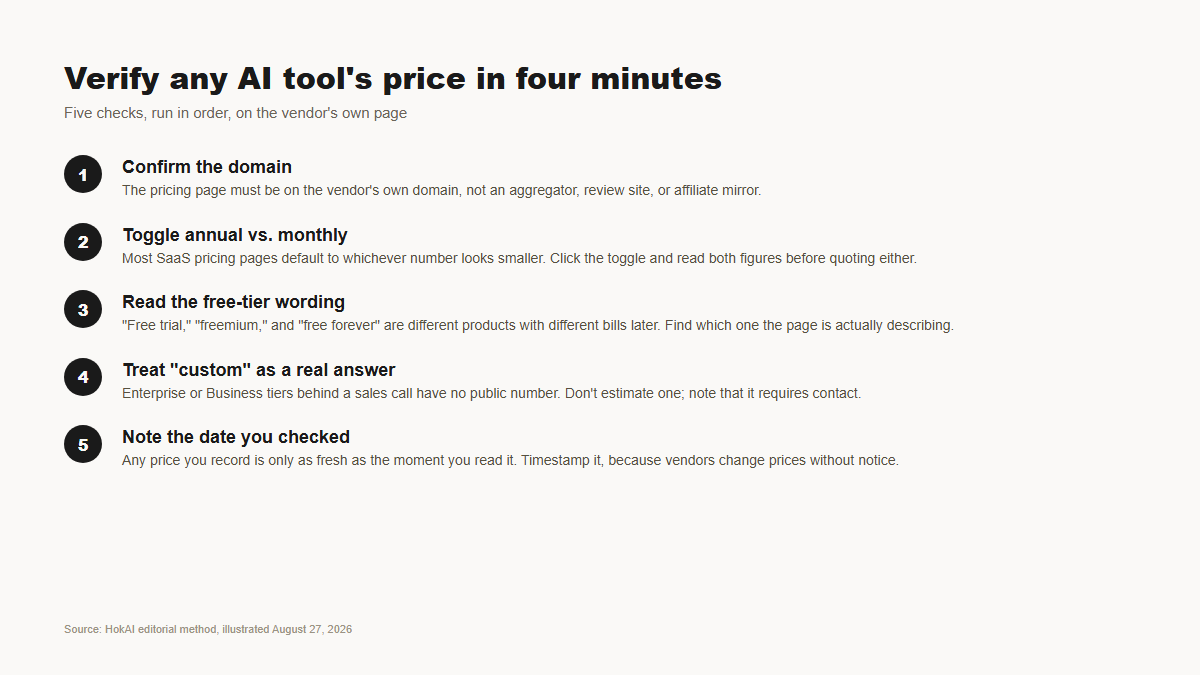 The five checks, illustrated August 27, 2026.
Running it live, on Jasper
We picked Jasper because HokAI's own listing for it was reviewed recently enough to make a fair test: August 19, 2026, eight days before this piece. That is close enough that a mismatch would mean either the vendor moved fast or the earlier check was sloppy.
Step one, the domain: jasper.ai, not a mirror. Step two, the toggle: Jasper's pricing page shows a Monthly and a Yearly tab, with Yearly pre-selected and labeled "Save ~20%." Monthly reads $69 a month per seat; Yearly reads $59 a month per seat, billed across a 12-month term.
Step three, the free-tier wording: there is no ongoing free plan, only a 7-day free trial, stated plainly under the Pro tier rather than buried in a footnote. Step four, "custom": the Business tier carries no public number at all, just a request to contact sales, which the page is honest about rather than dressing up. Step five, the date: this check was run and recorded August 27, 2026.
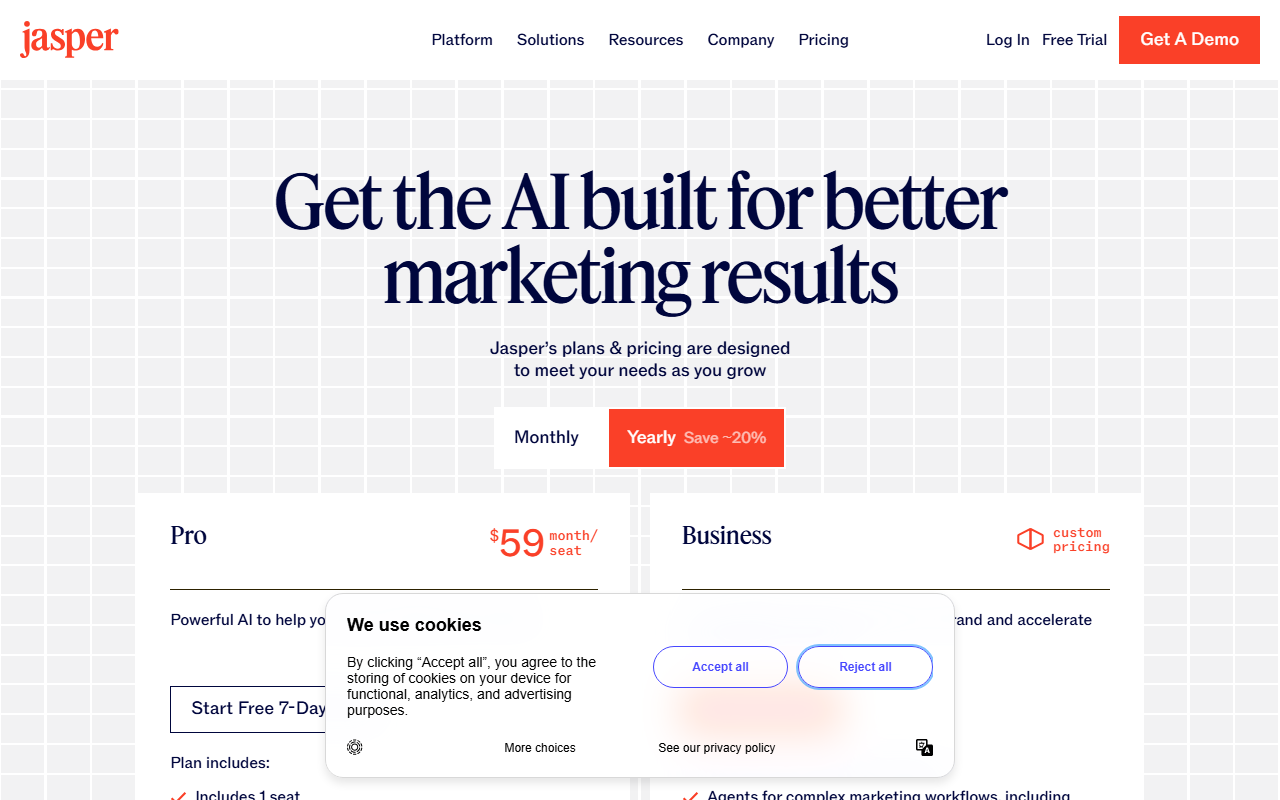 Jasper's pricing page as read on August 27, 2026.
One detail the toggle alone wouldn't have caught: Jasper's Pro plan, at either price, includes exactly one seat. A second user means moving to Business, custom pricing, sales call, the same gate as step four. A buyer who reads only the $59 figure and multiplies it by a team size would be pricing a plan that doesn't exist at that rate.
Every figure matched what HokAI already had on file: $59 monthly-equivalent on the annual plan, $69 on the monthly plan, one seat included, no ongoing free tier, and Business gated behind a sales conversation. The listing on hokai.io carries the same numbers, plus the "CHECKED" date that tells a reader how fresh the record is before they act on it.
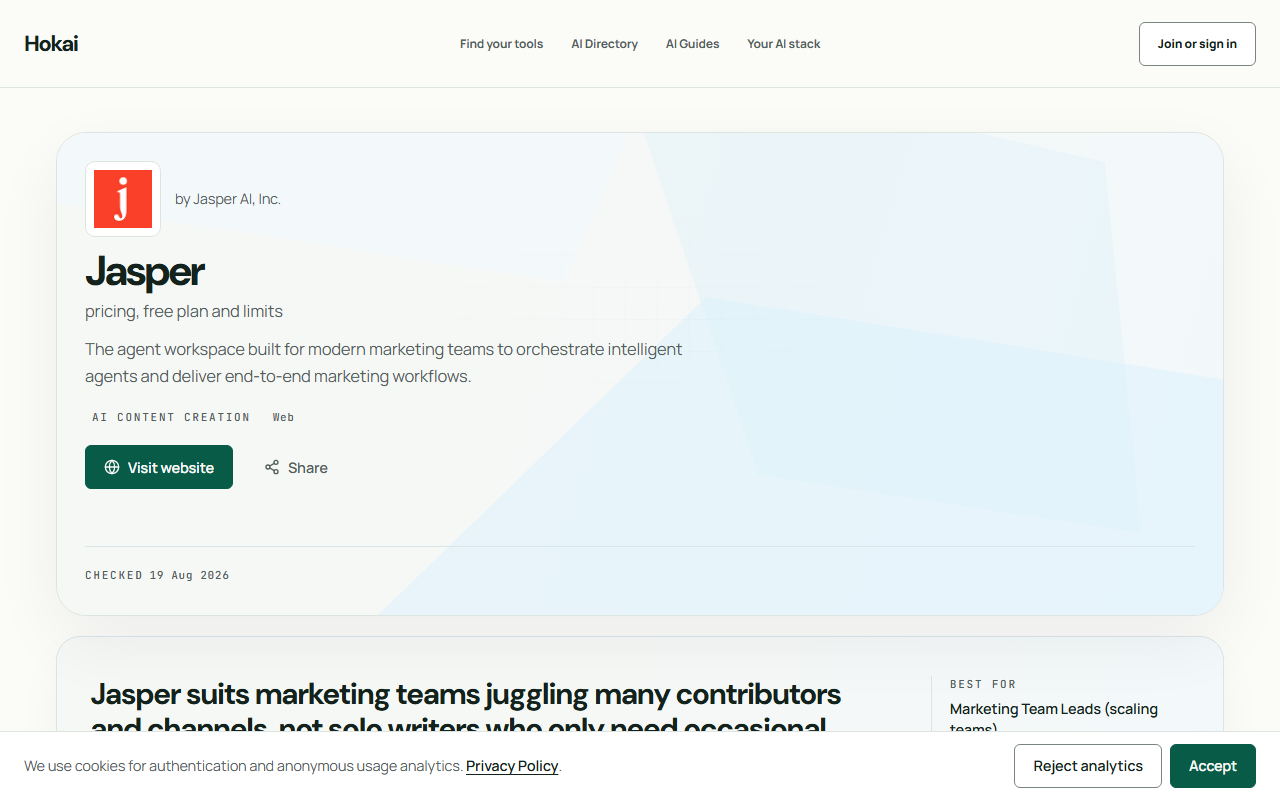 HokAI's Jasper listing, dated the last time a person, not a script, re-read the vendor's page.
The same five checks on a different shelf
The checklist doesn't only work on writing tools. Copy.ai and Grammarly both carry an ongoing free plan on HokAI's own listings, not merely a trial, which is exactly the distinction step three is built to catch.
Writesonic sits at the opposite end: no free tier at all, a paid floor starting at $79, which step three catches just as cleanly by finding nothing to mistake for a free plan. Synthesia, a video tool rather than a writing one, keeps a real free tier but gates its more advanced translation features behind Enterprise, which is what step four is for. A feature can be technically listed and still sit behind a tier with no public price.
Browse the AI content creation category and the pattern holds across dozens of listings: the checklist doesn't care what the tool does, only how its pricing page is built.
Who this checklist isn't for
It breaks down in three specific places. Usage-based or token-metered APIs publish a per-unit rate, not a monthly bill, so verifying the real cost means running an actual metered call, not reading a page.
Enterprise deals that are genuinely negotiated, not just labeled "custom" as a formality, will never resolve to a single public number no matter how carefully the page is read. And pricing that changes by region or currency, common on tools with a strong presence outside the US, may require checking from more than one location to see the figure a given buyer would actually be billed.
For everything else, on any tool in any directory, the same five checks apply. We wrote a longer account of how HokAI applies a version of this discipline across an entire listing, not just its price, in how HokAI verifies a listing before it goes live.
If you'd rather have the shortlist done for you against a real decision, Smart Match asks what the work is first and only then narrows the field, so the checklist above becomes something to double-check rather than something to start from scratch.
Frequently asked questions
How do I check if an AI tool's advertised price is still accurate?
Open the vendor's own pricing page directly, not a review site or directory listing. Toggle between monthly and annual billing, since pages often default to whichever number looks smaller, and check whether any "free" offer is a time-boxed trial or a genuinely ongoing plan. The whole check takes about four minutes and needs no account or paid tool.
What's the difference between a free trial and a free tier?
A free trial gives full or near-full access for a fixed window, commonly a week, after which the account converts to paid or stops working. A free tier is an ongoing plan with permanent limits rather than a deadline. Vendors sometimes blur the two in marketing copy, so the distinction has to be read from the actual terms, not the headline word "free."
Why do AI tool prices change without notice?
Vendor discounting and tier structures shift frequently as companies test what converts, and there is no requirement to announce a price change on the page itself. Third-party sites that quote a vendor's price, including review sites and comparison articles, often go stale faster than the vendor's own page does. One AI-visibility firm calls the result a web-cache echo chamber: an outdated figure gets repeated across enough secondary sources that it starts to look authoritative.
Should I trust a review site's listed price over the vendor's own page?
No. The vendor's own pricing page is the only page with a direct incentive to keep the number accurate, since a wrong price there causes support tickets and billing disputes. A review site, forum post, or comparison article has no such mechanism and can carry a discontinued price for months after a vendor changes it.
How often should I re-check a tool's pricing before committing to it?
Re-check immediately before signing up or renewing, not from memory of an earlier visit, since even a listing checked recently can be superseded by a same-day change. If the decision is high-stakes, such as an annual contract, note the exact date of the check next to the price, the same way a dated directory listing does.
Covered in this guide
- Jasper: Jasper is the agent workspace built for marketing teams, now expanded with a GEO Agent for AI-search visibility, an IQ Agent for automated brand setup, and MCP support for running its agents from other systems.
- Copy.ai: The first AI-native GTM platform for go-to-market teams
- Grammarly: AI-powered writing assistant for better communication
- Synthesia: AI video platform transforming text into professional, multilingual videos with realistic avatars
- Writesonic: Track and grow your brand's presence in ChatGPT, Gemini, and Perplexity with Writesonic's GEO platform. No free plan; paid tiers only.
Sources
Still deciding?
This guide covers a handful of options. Smart Match checks every listing in the directory against how you actually work and what you can spend, then hands you the shortlist and the reason behind each pick.
Find your toolsRelated guides
- Best AI Assistant for Small Business in 2026Buyer's guideHow to pick, across a category
- Best AI Content Creation Tools in 2026: Pick By the Job, Not the CategoryBuyer's guideHow to pick, across a category
- Best AI for Writing a Business Plan in 2026: Tested Picks and a VerdictBuyer's guideHow to pick, across a category
- Best AI for Creating YouTube Videos in 2026: A Buyer's GuideBuyer's guideHow to pick, across a category
- Best AI Tools for Writing a Recommendation Letter in 2026Buyer's guideHow to pick, across a category
- Best AI for University Assignments in 2026Buyer's guideHow to pick, across a category