Best AI Content Creation Tools in 2026: Pick By the Job, Not the Category
AI content creation is not one product category but three overlapping ones: AI writing tools, AI design tools, and AI music or audio generators. As of 2026 no single platform performs at production quality across all three, so buyers typically price and purchase separately for whichever bottleneck, words, visuals or audio, they actually face.
The short version
Solo creators who buy "AI content creation" as one category end up paying for capability they never touch. The real decision is which job is the bottleneck: Jasper or Anyword for words, Canva for visuals, Suno for audio. Buy narrow for the job, skip the all-in-one bundle unless you produce across all three weekly.
Jasper's Pro plan costs $69 a month and cannot design a thumbnail; Canva Pro costs $18 and cannot hold one brand voice across twenty blog posts.
Neither tool is failing at anything. They were never competing, yet "AI content creation" gets marketed as a single shopping decision, and most roundups rank a dozen tools against each other as if they compete for the same job. They do not.
Writing tools, design tools and audio tools solve three different bottlenecks, and a solo creator or one-person marketing team only has one of them at a time. Buying for the category instead of the bottleneck is how you end up with three logins and one tool you actually open.
Postiv AI's 2026 roundup ranks 12 tools, from Jasper to Runway to Midjourney, on one list with no unified scoring across them. Branded Agency's list covers 16, sorted by three evaluation dimensions that never separate "can this write" from "can this make music." Neither tells you which bucket to shop in before handing you a ranked list.
This guide skips the flat ranking. It sorts by the job you are actually stuck on, names real prices from vendor pricing pages, and tells you when the honest answer is to skip a paid tool entirely.
The three jobs hiding inside "content creation"
Before comparing any tools, answer three testable questions.
What are you actually short on? Words, visuals or audio. Not "content" in general. If you cannot name which of the three ate your last five working hours, you do not yet know what to buy.
How often does the gap show up? Daily writing gaps justify a $59-$99 monthly writing tool. A design need that hits twice a month does not justify a dedicated design subscription on top of Canva's free tier.
What does a wrong output cost you? A bad ad headline costs a few dollars in wasted spend, which is what makes Anyword's performance-scoring worth its price. A bad podcast intro costs nothing but a regeneration, which is why Suno's free tier is fine until you need to monetize.
One deliberate omission: video. Generators like Runway and Pika are a fourth job with their own selection criteria (clip length, render limits, licensing) and a separate budget line, and they deserve a full guide rather than two rushed paragraphs here. If video is your bottleneck, this is not your guide.
Here is the whole decision in one table, before the detail:
| Your bottleneck | Pick | Price (monthly / annual per month) | The one caveat |
|---|---|---|---|
| Words, brand voice | Jasper | $69 / $59 | Overkill below daily writing volume |
| Words, conversion copy | Anyword | $49 Starter | Predictions capped at 50 a month on Starter |
| Words, on a budget | Writerly | $4 / $3 | No brand-voice or scoring tooling |
| Visuals | Canva Pro | $18 | Third-party-sourced price; seats cost $25 each on Business |
| Audio | Suno Pro | $10 / $8 | Free-tier output bars commercial use |
| Distribution | Beehiiv Scale | $43 | AI credits tied to subscriber tier, not usage |
Most category roundups skip straight to a ranked list without asking any of these questions, which is exactly how a reader ends up owning a $69-a-month writing tool for a design problem.
If your bottleneck is words: Jasper, Anyword and the budget floor
Jasper is the category's price anchor for dedicated long-form writing. Its Pro plan costs $69 a month billed monthly, or $59 a month billed annually, according to Jasper's own pricing page, and includes a Canvas workspace for on-brand drafting plus two customizable Brand Voices. A 7-day free trial is available before you commit. Jasper is built for teams that need one consistent voice across dozens of pieces a month, not a single blog post.
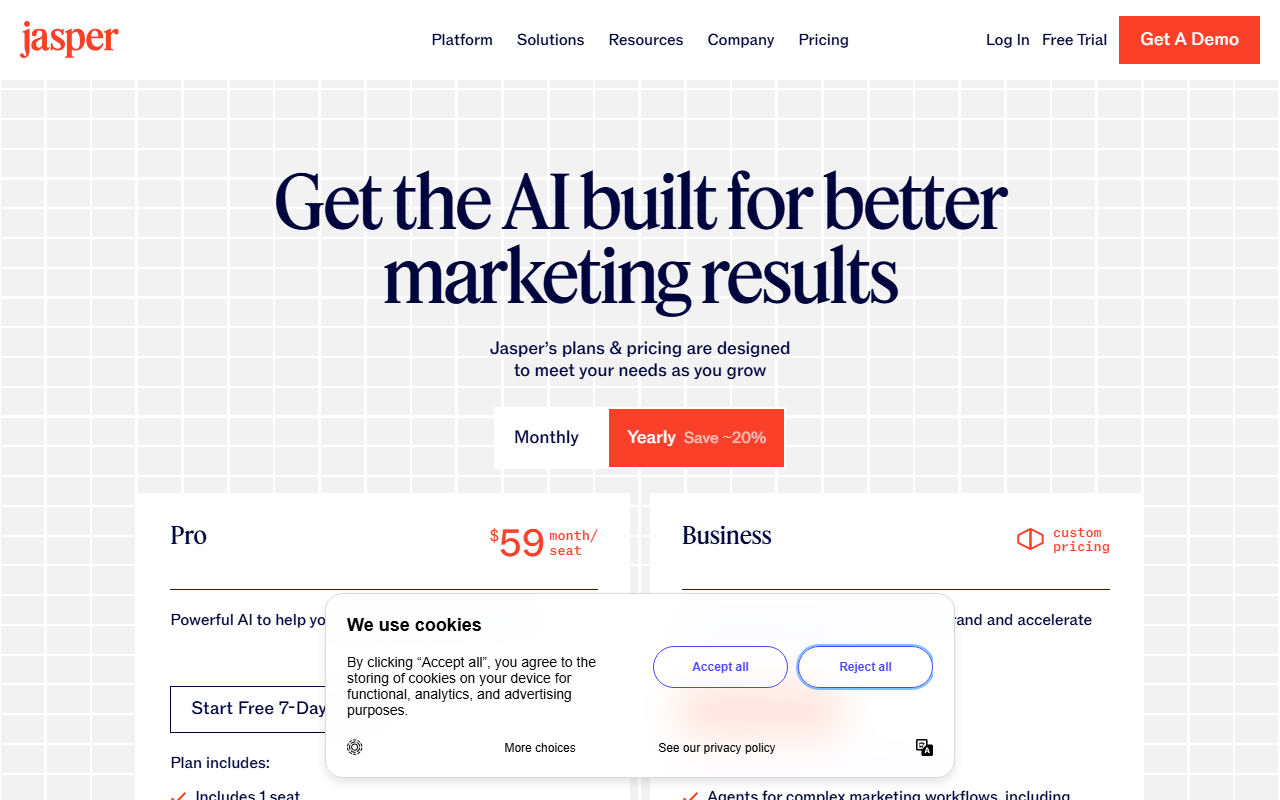 Captured 17 Aug 2026: the $59-a-month Pro price shown here is the annual-billing rate; paying monthly runs $69 instead.
Anyword solves a narrower, more specific problem: it scores copy for predicted performance before you publish it. The Starter plan runs $49 a month for 50 performance predictions and one brand voice; the Data-Driven plan is $99 a month and adds real-time predictions when you manually edit a draft, per Anyword's pricing page. If your writing bottleneck is really "which of these five headlines will convert," Anyword answers that question and Jasper does not.
If both of those prices sound steep for what you write, Writerly is the floor of this category: its Creator AI Chat plan runs $4 a month, or $3 billed annually, for unlimited use of a single seat with core personas and more than 50 templates. It will not match Jasper's brand-voice tooling or Anyword's scoring, but for someone writing a handful of pieces a week who has outgrown a free chatbot's context limits, it is a real option at a tenth of Jasper's price.
If you write daily and need one consistent voice across a team, pick Jasper. If you write ad copy or landing pages where conversion rate is the actual metric, pick Anyword. If your volume is a few pieces a week and price is the constraint, Writerly clears that bar at $3 to $4 a month. None of the three is the right pick for someone writing two social captions a week: that volume does not clear any of their prices.
If your bottleneck is visuals: Canva
Canva is the default answer to "I need a graphic and I am not a designer," and it is worth naming the price move that happened this year. Canva Pro rose to $18 a month (or $144 billed annually), up from $12.99 in prior years, and Canva Business moved to $25 per seat per month with no minimum seat count, according to independent pricing trackers that logged the change in August 2026.
Canva's own pricing page returned an access error to a direct fetch during research for this guide, so that figure is sourced to third-party tracking rather than canva.com directly. It is the one number in this article carrying that caveat.
What that price increase bought is a wider AI feature set folded into Pro: template generation, background removal and brand-kit tools that used to sit behind separate add-ons. For a solo creator, Canva is rarely the bottleneck tool.
It is the one you already pay for, which is exactly why it sets the baseline every other pick in this category has to justify itself against. If a $69 writing tool or a $30 music tool does not clearly earn its place next to a $18 subscription you already have, it does not earn a spot in your stack.
The seat math matters more once you are not solo. A three-person team on Canva Business at $25 per seat runs $75 a month, or $900 a year, with no minimum seat count and no visible volume discount at that size. Jasper's equivalent multi-seat tier is custom-quoted rather than published, so the two cannot be compared to the dollar, but a small team should ask for that Jasper quote before assuming Canva is the cheaper of the two: design seats add up faster than a single $18 headline price suggests.
If your bottleneck is audio: Suno and Udio
Suno is this guide's pick for the music-generation slice of the category, because its tier structure is built around the thing that actually bites buyers: commercial rights, not just generation volume. The free plan gives 50 daily credits, roughly 10 songs, with no commercial use permitted, according to Suno's pricing page.
The Pro plan costs $10 a month billed monthly, or $8 a month billed annually, for 2,500 monthly credits and commercial rights on anything you create. Premier runs $30 a month, or $24 annually, for 10,000 credits and full Suno Studio access.
That commercial-rights gate matters more than the credit count for most buyers. A podcaster who needs one usable intro track a month does not need Premier, but does need Pro, because the free tier's output cannot legally go in a monetized show. Suno's own pricing page puts Pro's 2,500 monthly credits at up to 500 songs, far more than a single monthly intro track will ever use. For that specific buyer, Pro is not really a volume purchase, it is a $10 commercial-rights pass wearing a much bigger plan.
Udio competes directly in the same niche with a similar credit model, and is worth a look if Suno's default vocal style is not landing for your genre. Between the two, the deciding factor is usually which one's default sound you prefer on a 30-second test generation, not price: they sit within a few dollars of each other at every tier.
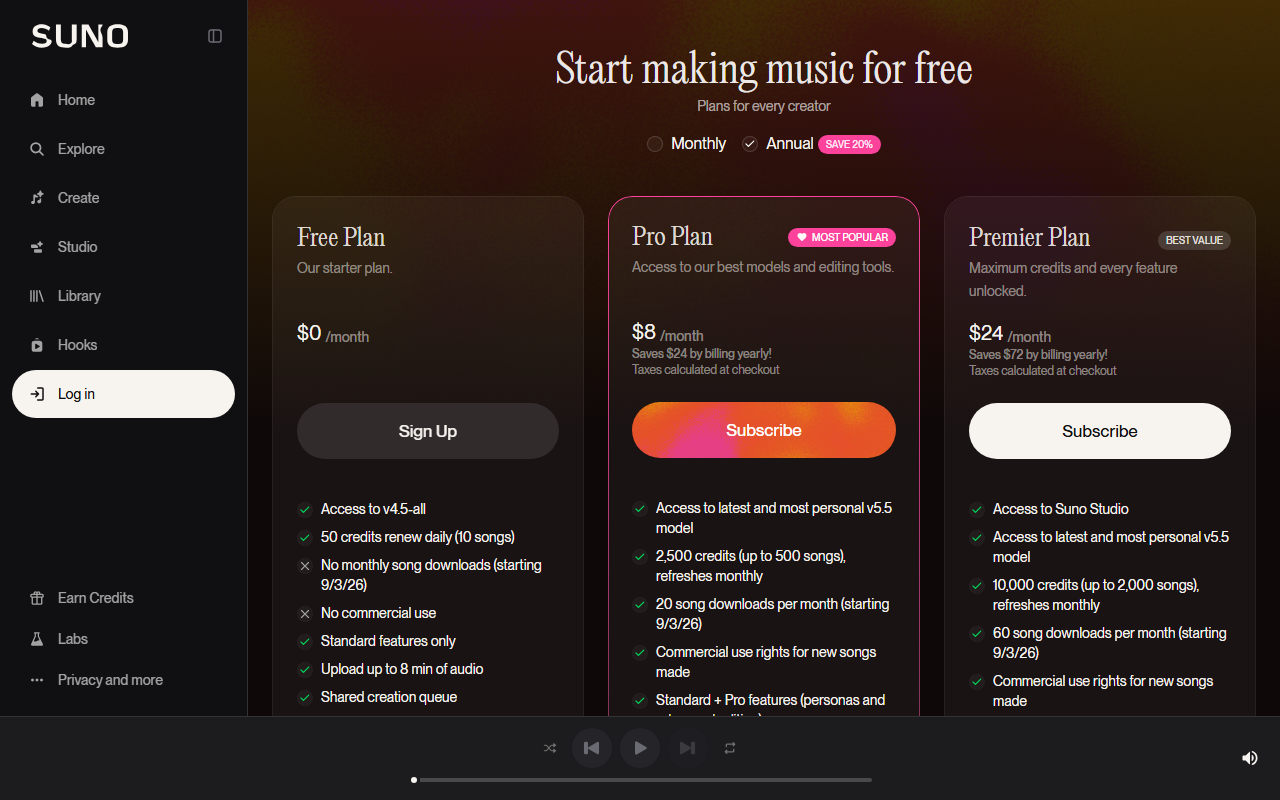 Annual billing was selected for this 17 Aug 2026 capture. Suno lists the Pro plan's 2,500 monthly credits as covering up to 500 songs.
When "content creation" means distribution, not generation
Not every content bottleneck is about making more. Beehiiv is a newsletter platform with generation features attached rather than the reverse, and it belongs in this guide because "I need to publish content" and "I need to generate content" are different problems that the word "content creation" quietly merges.
Beehiiv's free Launch plan caps at 2,500 subscribers with 10 AI credits a day; the Scale plan is $43 a month for up to 100,000 subscribers and 25 daily AI credits, and Max is $96 a month with 50 daily credits, according to Beehiiv's pricing page.
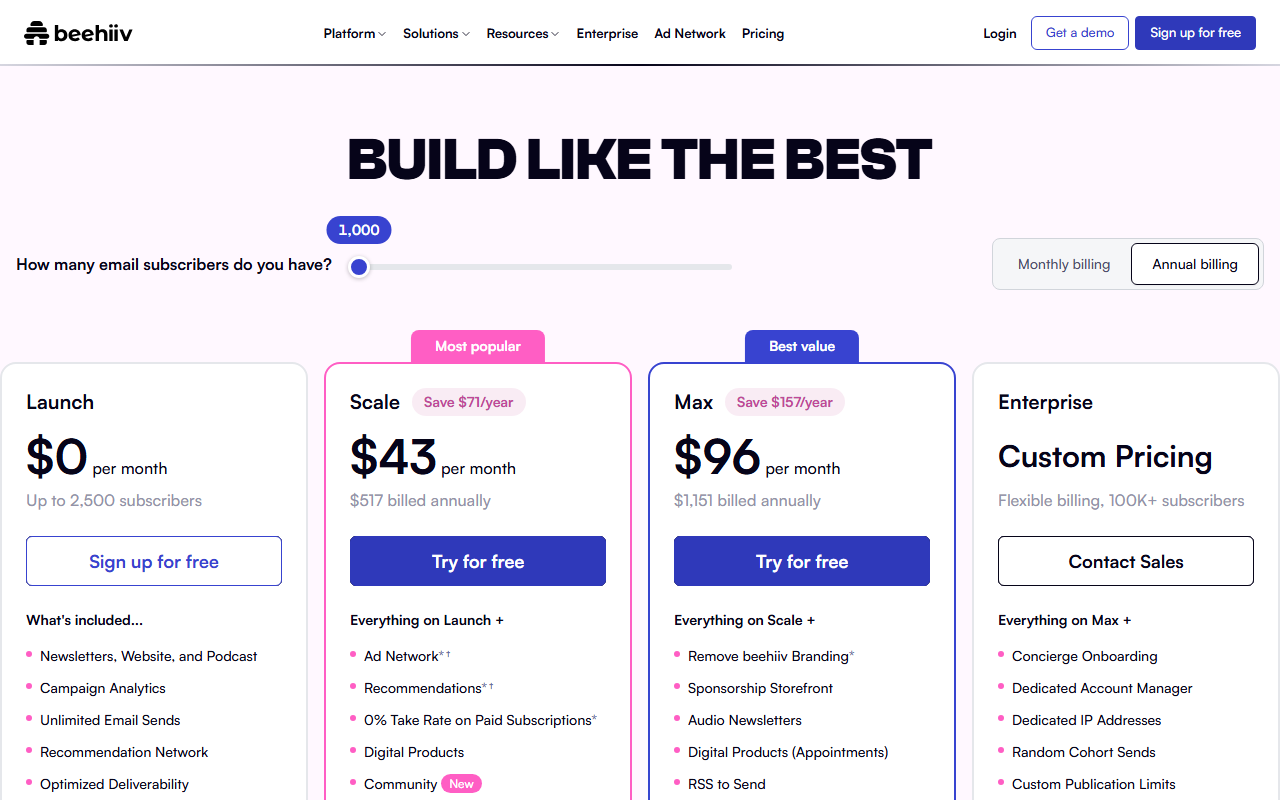 This 17 Aug 2026 capture shows Scale and Max, the only beehiiv tiers with a meaningful daily AI-credit allowance.
If your actual bottleneck is that you have things to say and nowhere to publish them, Beehiiv solves a distribution problem that Jasper, Canva and Suno were never built for. Buying a writing tool when your real gap is an owned channel is the same mistake as buying a category-wide bundle: it treats a specific job as a generic one, just from the opposite direction.
Jasper versus Anyword: the head-to-head most solo writers actually face
The comparison that matters most inside the "words" bucket is not Jasper against ChatGPT, it is Jasper against Anyword, because both target the same buyer: someone already committed to paying for dedicated writing software rather than using a general chatbot for free.
Jasper wins for a content calendar with a fixed brand voice: newsletters, blog series, product pages where consistency across 20 pieces matters more than optimizing any single one. Anyword wins for anything with a conversion number attached to it: ad copy, landing page headlines, email subject lines, where a $49-a-month narrower plan that predicts performance beats a $69-a-month broader plan that does not.
A marketing team running both a blog and a paid-search account genuinely needs both tools, and at $49 plus $59 a month on annual billing, that combined $108 is still cheaper than one Jasper Business seat. Neither tool replaces the other.
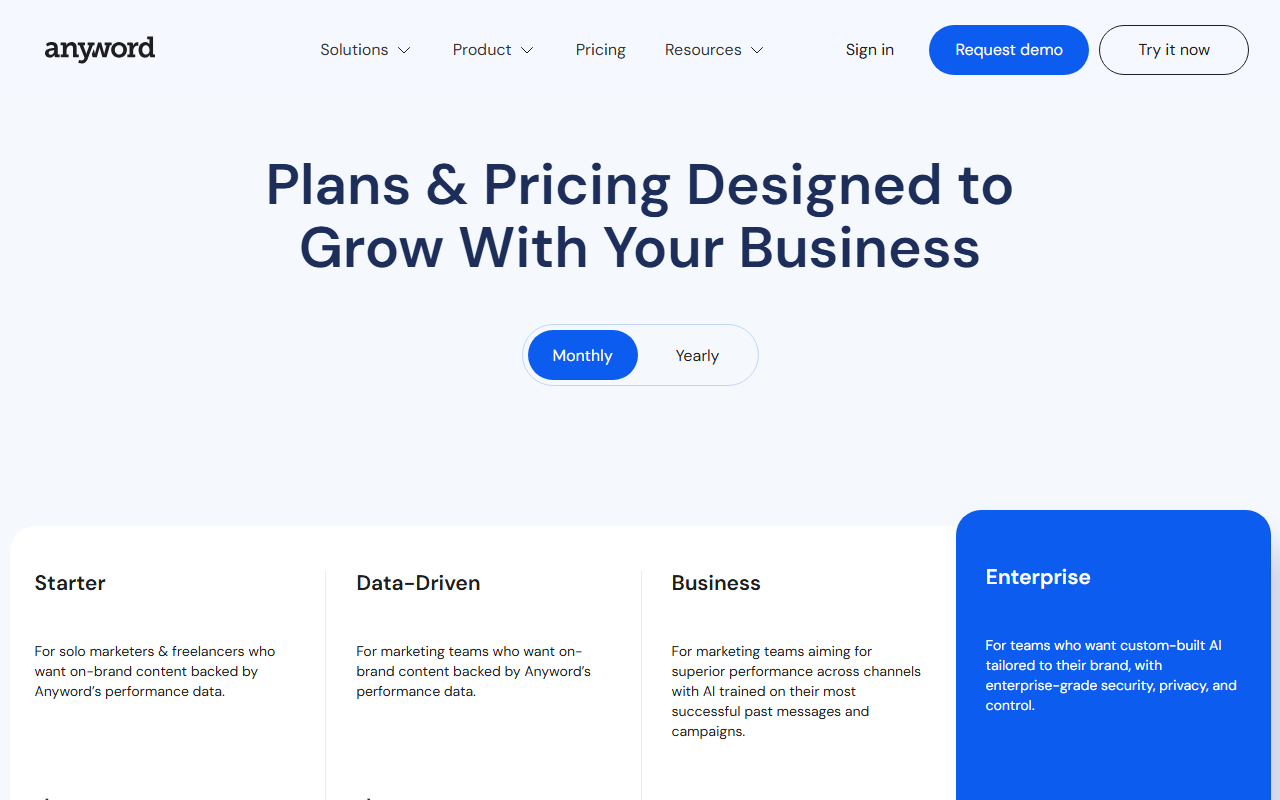 Starter and Data-Driven, seen here on 17 Aug 2026, are the two tiers most solo writers and small teams weigh against Jasper.
Who should skip this category entirely
Here is the fair objection to everything above: a solo creator juggling Jasper, Canva and Suno pays a real cost in context-switching and three separate dashboards, and a single mediocre all-in-one tool might save more time than the money it costs in output quality. That holds above a certain volume: a five-person content team producing daily output across all three formats probably does lose more to tool-switching than to any single tool's weaknesses.
It does not win for the reader this guide is written for. Below roughly five hours a week of content work, the time lost switching between three logins is smaller than the quality lost to a tool that treats writing, design and audio as equally important, when for almost every solo creator they are not. And Canva already covers two of the three jobs, visuals plus a basic AI-write feature, at one price, which quietly removes most of the case for buying an all-in-one on top of it.
If your entire content output is two social captions and one graphic a week, you can likely skip a paid subscription altogether: a general chatbot's free tier writes the captions, and Canva's free plan makes the graphic. Balzac, a credit-billed tool aimed at agencies managing several client accounts at once, is the opposite case: worth a look only once you are producing for clients, not for yourself.
Watch whether Canva's AI feature set or a new entrant ships genuinely competitive audio generation without breaking that $18 price. That is the one move that would collapse this entire "buy narrow" argument into "buy one tool," and as of August 2026 none of the platforms covered here has managed it.
Frequently asked questions
What's the difference between an AI writing tool and an AI content creation tool?
"AI content creation" is the umbrella term the industry uses for what are really three separate product categories: writing tools like Jasper and Anyword, design tools like Canva, and audio or music generators like Suno. A dedicated AI writing tool only covers the words job, while the broader category label covers all three without saying which one any given product actually does well.
Is Jasper or Anyword better for AI content creation in 2026?
Jasper costs $69 a month billed monthly or $59 annually and suits a content calendar that needs one consistent brand voice across many pieces. Anyword starts at $49 a month and is built around performance prediction, scoring copy for likely conversion before it publishes, which makes it the better pick for ad copy and landing pages rather than long-form blog content.
Why did Canva's price go up in 2026?
Canva Pro rose to $18 a month, up from $12.99 in prior years, and Canva Business moved to $25 per seat per month with no seat minimum, according to independent pricing trackers that logged the change in August 2026. The increase folded template generation, background removal and brand-kit tools into the Pro tier that previously sat behind separate add-ons.
What's the best AI tool for commercial-use music and audio?
Suno is this guide's pick for AI-generated music, but its free tier explicitly bars commercial use. The $10-a-month Pro plan (or $8 billed annually) grants commercial rights on new songs along with 2,500 monthly credits, which Suno's own pricing page lists as covering up to 500 songs, far more than most solo creators need.
Do I need more than one AI content creation tool?
Only if you regularly produce more than one type of content: words, visuals and audio. A solo creator doing under five hours of content work a week is usually better off with one narrow tool for their actual bottleneck plus Canva's free tier, since Canva alone already covers basic visuals and simple AI writing at a single price.
Covered in this guide
- Canva: Helps everyone design anything and publish it anywhere
- Jasper: Jasper is the agent workspace built for marketing teams, now expanded with a GEO Agent for AI-search visibility, an IQ Agent for automated brand setup, and MCP support for running its agents from other systems.
- Anyword: AI Content Platform with A/B-Tested Data for Performance-Driven Marketing
- Balzac: Autonomous AI SEO writer that researches keywords, writes 2,500-3,500 word articles, and publishes directly to WordPress, Webflow, or Shopify. Plans from $79/mo.
- Beehiiv: AI newsletter platform with AI content generation, website builder, and paid subscription monetization. Free tier up to 2,500 subscribers.
- Pika: AI creative platform by Pika Labs. Generates video, image and audio from prompts or photos using its own model plus outside AI engines. Free to start; paid plans scale up from there.
- Runway: AI to simulate the world through generative video and world models
- Suno: AI music generator with 100M+ users that creates complete songs with vocals from text prompts. Includes a limited free tier; paid plans add commercial rights and voice cloning.
- Udio: Create professional music with AI from simple text prompts in seconds
- Writerly: AI-powered no-code productivity platform for brand-consistent content creation at scale
Sources
Still deciding?
This guide covers a handful of options. Smart Match checks every listing in the directory against how you actually work and what you can spend, then hands you the shortlist and the reason behind each pick.
Start Smart MatchRelated guides
- Averi vs Balzac: Which Is the Best AI for SEO Content Writing in 2026?ComparisonHead-to-head, with a verdict
- Best AI for Writing a Business Plan in 2026: Tested Picks and a VerdictBuyer's guideHow to pick, across a category
- Best AI for Creating YouTube Videos in 2026: A Buyer's GuideBuyer's guideHow to pick, across a category
- Best AI Tools for Graphic Designers in 2026Buyer's guideHow to pick, across a category
- Best AI for Creating Logos in 2026: Tested Picks & VerdictBuyer's guideHow to pick, across a category
- The Best Free AI for Turning a Photo Into a Video in 2026Buyer's guideHow to pick, across a category