HokAI vs FutureTools: What "Freemium" Doesn't Tell You About Claude's Price
Same product, two directories: FutureTools tags Claude 'Freemium' with no dollar amount and nothing showing it has been rechecked since it joined the database in March 2024. HokAI instead publishes seven dated, priced tiers for Claude, confirmed against Anthropic on July 16, 2026. Pick FutureTools to browse; pick HokAI to price something you already chose.
The short version
FutureTools' Claude listing shows one word for price, 'Freemium,' unchanged since March 2024, with no re-check date. HokAI's Claude record carries seven priced tiers, $0 to $200 a month, verified against Anthropic's pricing page on July 16, 2026. One site wins on discovery; the other wins once you need a checked number.
Want this decided for your own case? Find your tools with Smart Match, starting from this guide's question.
FutureTools' Claude page, read August 31, 2026, carries one pricing fact: the word "Freemium." No dollar figure appears on it, and the newest date on the page reads "Listed Mar 2024."
That single word is the entire priced record for a product both sites list. HokAI's own Claude page, last checked August 19, 2026 and re-confirmed against Anthropic's pricing page in this run, carries seven tiers running from Free at $0 to Max 20x at $200 a month.
The axis here is not who lists more tools. It is what happens to a listing after the day it goes up. FutureTools reviews a submission once, by a person, before it is added. HokAI re-checks the specific fields a buyer would act on, and dates the check.
Disclosure: HokAI wrote this about HokAI.
Six pages, one afternoon, no login required
Every figure below comes from a live read made August 31, 2026: HokAI's own tool records for Claude, ChatGPT and Grok, and the matching FutureTools listing pages at futuretools.io/tools/claude, /chatgpt-openai and /grok-ai. Anyone can repeat all six fetches without an account. FutureTools' own tools index, read the same afternoon, showed "Showing 1-24 of 4233 tools" across 29 categories. Its own search bar placeholder says "4,500+," a few hundred off its own live count, both visible on the same page, the same day.
Same three tools, one word each
Claude, ChatGPT and Grok sit on both sites, which makes them a fair same-day test. On FutureTools, all three carry a single self-selected tag: Freemium. No monthly price, no per-seat figure, no API rate appears anywhere on any of the three pages.
Claude shows 395 upvotes and "In the database since Mar 2024." ChatGPT shows 1,879 upvotes and "In the database since Sep 2024." Grok shows 115 upvotes and "In the database since Feb 2025." None of the three carries a field for when that tag was last checked against the vendor.
On HokAI, the same three tools carry priced, dated tiers instead of a tag. Claude has seven, from a $0 Free plan through $200-a-month Max 20x, verified against Anthropic's own pricing page on July 16, 2026. ChatGPT has six, $0 to $200, features re-checked July 22. Grok has seven, up to $300 for SuperGrok Heavy, verified July 10. The gap holds across all three, not just the one tool this piece opens on.
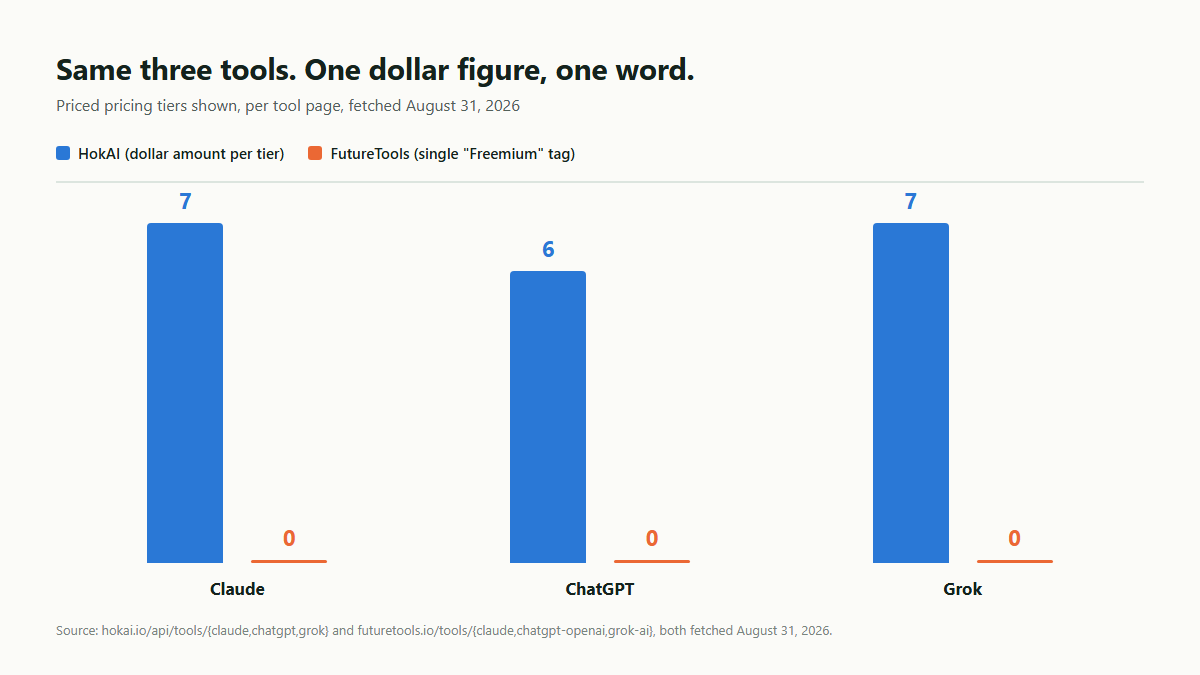 Priced tiers per tool page, fetched August 31, 2026. FutureTools' bars read zero because its pricing field is a single word, not a table.
What FutureTools' own FAQ says it checks
FutureTools does review submissions by hand, and its FAQ says so directly: "The tools that are submitted are manually reviewed, by a human (not AI)," adding that over 75% of submissions never make it onto the site. The stated reasons for rejection are about the product, not its price: a duplicate concept, a low-effort website, a "waitlist only" product, adult content, a Custom GPT Store listing. That is a real quality gate, and by the FAQ's own account it happens once, at intake.
Nothing in the FAQ, the about page or a listing page describes a second pass. Decawork, a tool added to the database in August 2026 with one upvote, carries the same shape as Claude's four-year-old entry: a single Paid tag, vendor-style copy, and no field showing whether either has been looked at again since the day it went up. The submission form itself asks for one of four pricing categories, Free, Freemium, Paid or Open Source, picked by whoever is submitting the tool, not a dollar amount.
 FutureTools' own tools index, captured August 31, 2026. Every card carries a pricing tag; none carries a price.
The policy on HokAI's side of the same trade
HokAI's editorial page commits to the opposite habit: a rolling recheck of every listing, pricing confirmed against the vendor's current page rather than the page it had when it was added, and a visible date stamped on the result. A flat submission fee gets a tool into the directory; it does not buy a ranking. A companion piece on this series, what a rival directory's stale listings cost a buyer, runs the same fetch-and-date method against a different competitor on a different axis, published the same week.
That difference shows up in the field itself, not just the prose around it. FutureTools' pricing field holds one of four values, chosen once by whoever submits the tool. HokAI's pricing field is a table of named tiers, each with its own dollar figure and its own verification date, rebuilt from the vendor's current pricing page rather than a category picked off a dropdown at intake.
Where FutureTools wins
Discovery is the real product here, and on that axis FutureTools earns its audience honestly. Matt Wolfe has personally tested a large share of the tools on the site on camera, on a YouTube channel that sat north of 900,000 subscribers as of early 2026, and the site's own "Matt's Picks" badge marks the ones he says he would use himself.
That is a taste signal no field-verification pipeline replicates: a person who has actually opened thousands of these products, not a checklist confirming a vendor's price did not move since last month. For a reader who does not yet know what they want, FutureTools' own "Recommended right now" strip, which put Claude next to NotebookLM and four other tools on the same row when this piece was researched, is a faster route to something worth trying than a verified spec sheet for a tool they have not heard of yet.
The newsletter built on that judgment reaches, by FutureTools' own count, more than 250,000 readers twice a week, a scale a flat-fee, no-affiliate directory does not chase.
Where HokAI wins
The moment a reader has narrowed the field to two or three names and needs to know what one will actually cost, HokAI's dated fields are built for exactly that question. Smart Match exists for that hand-off: describe the job in a few sentences, answer a short set of follow-up questions, and it returns three ranked tools with the reason each one fits.
Those recommendations are drawn only from records that carry a verification date rather than a submitter's own pick from a dropdown. The 56 company profiles behind those tools carry the same dated-check pattern Claude's page shows above.
The turn
A fair FutureTools reader would say a dated price is only useful once you already know which two or three tools you are choosing between, and taste is what narrows a field of thousands down to that short list in the first place. That is a real point, and it is the same order Smart Match itself assumes: discovery first, verification second.
The difference is which half of that hand-off each site was built to do well. FutureTools was not built to hold a "last verified" date next to a price, and nothing on any of the six pages read for this piece suggests it tries to.
Independent evidence backs why that gap matters more than it used to. One AI-tools writer who tried to keep a single pricing page current found five wrong numbers in a review written just seven weeks earlier, writing that "prices rot" while "dated facts do not," and that "almost every comparison article you read is quietly out of date." A tag set once, at submission, and never re-dated is exactly the shape that produces that kind of rot.
If FutureTools ever puts a "last verified" date next to its pricing tag, the verdict on this piece's one axis flips the day that field appears on the page.
Frequently asked questions
Is HokAI better than FutureTools?
It depends on what the page needs to do. For finding something worth trying that you have not heard of, FutureTools' hand-picked recommendations and Matt Wolfe's own testing are a real edge. For checking what a specific tool costs today, HokAI's dated, verified pricing fields do a job FutureTools' listing pages do not attempt.
Does FutureTools show how much an AI tool actually costs?
Not in dollars. Each FutureTools listing carries one of four self-selected tags: Free, Freemium, Paid or Open Source, chosen by whoever submitted the tool. Claude, ChatGPT and Grok all showed "Freemium" with no monthly price or tier breakdown on the page, fetched August 31, 2026.
How does FutureTools decide which tools get listed?
Its own FAQ says submissions are manually reviewed by a person, not AI, and that over 75% never get approved, most often for being a duplicate concept, a low-effort site, or a product still in waitlist mode. That review happens once, at intake; nothing on the site describes a later re-check of an approved listing's price or copy.
How does HokAI keep its pricing data from going stale?
Every tool's pricing, feature list and vendor URL carry their own verification date, re-checked against the vendor's current pricing page on a rolling schedule rather than fixed at the moment of listing. Claude's tiers were last verified July 16, 2026, and the date is visible on the live page, not just in the API.
Can I use FutureTools and HokAI for the same decision?
Yes, for different halves of it. FutureTools and its newsletter are a reasonable way to hear about a tool for the first time. Once it is on a short list, Smart Match or a direct HokAI listing is where to confirm what it actually costs before paying for it.
Covered in this guide
- HokAI: Singapore-run directory of AI tools, models, agents, skills and services, with a free Smart Match engine that names three picks for the job you describe.
- Claude: Claude is Anthropic's AI assistant, with a free tier, paid personal plans, and Team and Enterprise seats. Opus access starts at the first paid plan.
- Anthropic: Anthropic is a Public Benefit Corporation started by 7 ex-OpenAI researchers. It builds the Claude model family and counts Amazon and Google among its largest backers.
- NotebookLM: AI-powered research assistant that grounds insights in your sources
- Grok: Truth-seeking AI chatbot with real-time web and X integration powered by advanced reasoning.
Sources
Still deciding?
This guide covers a handful of options. Smart Match checks every listing in the directory against how you actually work and what you can spend, then hands you the shortlist and the reason behind each pick.
Find your toolsRelated guides
- 41 of 100 HokAI Guides Carry a Screenshot. All 106 Still Load.Inside HokAIHow the directory works, verified in the open
- Best AI Assistant Apps for Android in 2026, Now That Google Assistant Is DeadBuyer's guideHow to pick, across a category
- Best AI Chatbots in 2026: Pick by the Job, Not the LeaderboardUpdatedRechecked against current sources
- Best AI Coding Assistants in 2026: Pick the Job, Not the BrandBuyer's guideHow to pick, across a category
- Best AI Companies in 2026: Who Is Actually LeadingBuyer's guideHow to pick, across a category
- Best AI for Writing a Business Plan in 2026: Tested Picks and a VerdictBuyer's guideHow to pick, across a category