One Field in Common: Why HokAI Runs Six Page Types, Not One
Split the catalog six ways because the deciding specification differs by type: a model listing prints context window and token price, an agent listing prints autonomy level and guardrails, a skill listing prints protocol and auth scope. One shared table would push all of that into free text nobody can filter.
The short version
HokAI keeps tools, models, agents, skills, services and companies as six separate page types with six field sets. Fetched on 21 August 2026, the six records carried 30 to 91 keys each, and only one subject field, governance, appeared on every one of them.
Anthropic's own documentation calls Claude Code an agentic coding tool. Both nouns sit in that phrase, and each one points at a different purchase.
A team shopping for a coding assistant needs the price per seat and the machines it runs on. A team dropping the same product into a production repository needs something else: how far it goes before a person signs off, whether its actions are logged, how many jobs it will take at once. One row in one table cannot carry both without half its columns sitting empty.
So HokAI runs six catalogs rather than one. Tools, models, agents, skills, services and companies each get their own page type and their own field set. On 21 August 2026 those six tabs held 451, 102, 44, 16, 11 and 54 entries, 678 in all.
Disclosure: HokAI wrote this about HokAI.
The split is a buying aid, not a filing habit. Each page type is a question set, and the question set is what you are really shopping with.
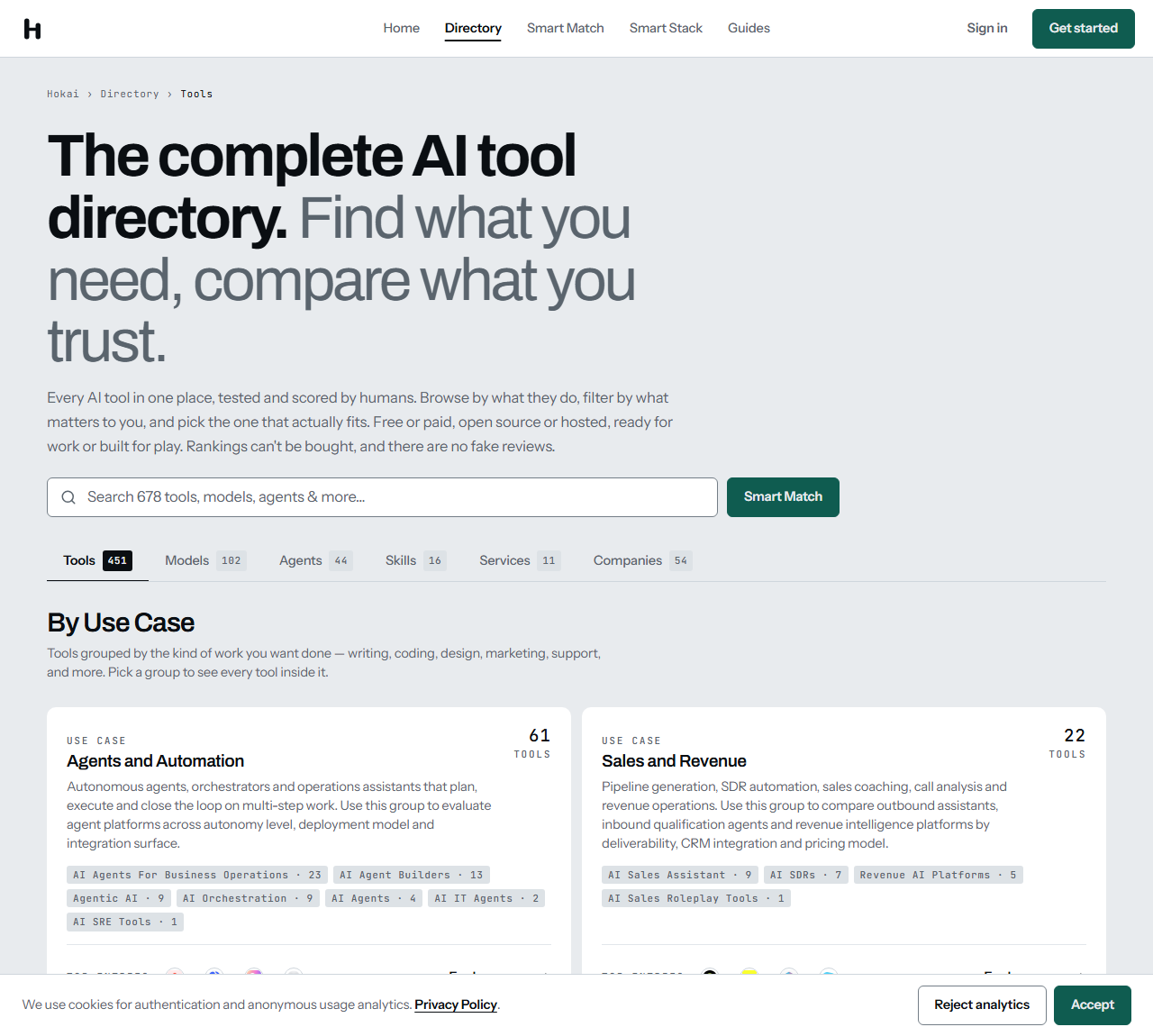 The six tabs of the directory, read on 21 August 2026. The search box counts all 678 entries.
Read the six records yourself
Every listing type publishes its data as JSON on a public endpoint, no key and no account. Fetch one of each and count the keys:
curl -s https://hokai.io/api/tools/cursor
curl -s https://hokai.io/api/models/claude-opus-5
curl -s https://hokai.io/api/agents/claude-code
curl -s https://hokai.io/api/skills/google-sheets
curl -s https://hokai.io/api/services/hetzner
curl -s https://hokai.io/api/companies/anthropic
On 21 August 2026 those six came back with 30, 91, 48, 53, 45 and 38 keys. Strip the plumbing every record shares, the id, the slug, the name, the logo, the timestamps and the SEO block, and the subject matter is what remains: 18 fields for a tool, 75 for a model, 33 for an agent, 38 for a skill, 30 for a service, 26 for a company.
Then intersect those six sets. One field survives. governance is the only subject field carried by all six page types, which is another way of saying these six things have almost nothing in common except a policy question.
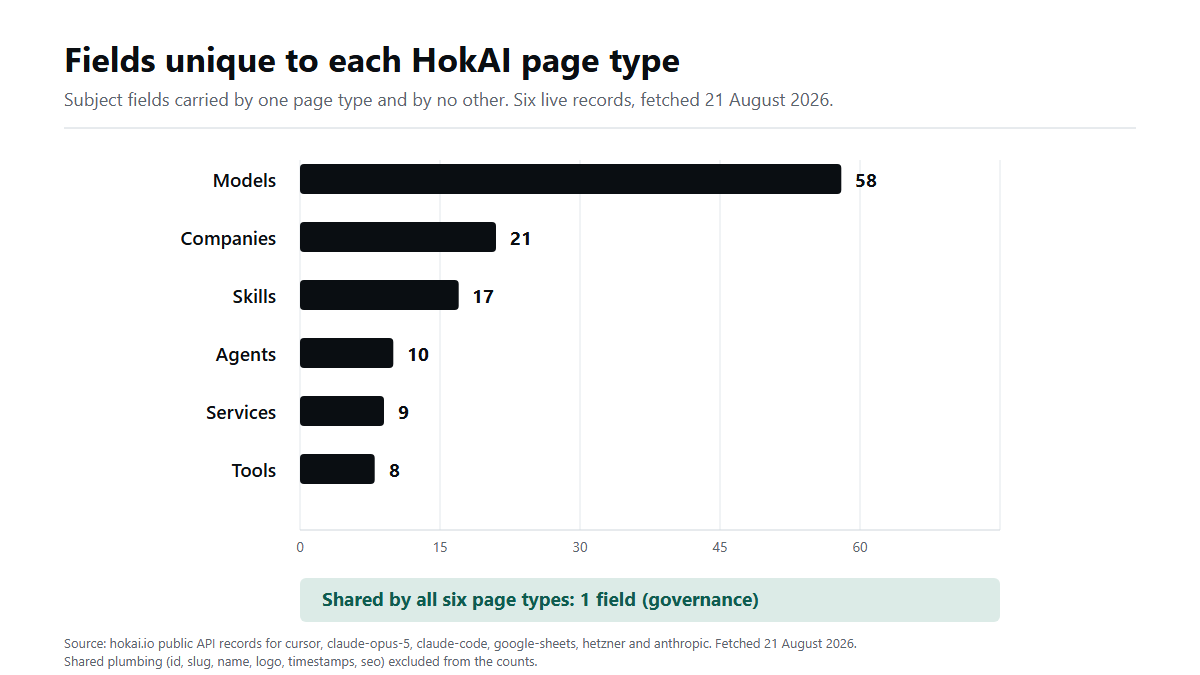 Counted from the six live API records above, 21 August 2026.
What a model page asks that a tool page cannot
The schema.org vocabulary the web uses to describe software gives SoftwareApplication 23 properties of its own. operatingSystem is there. So are memoryRequirements, fileSize and installUrl. There is no property for a context window, a price per million tokens, a training cutoff, or whether the vendor trains on your input.
Those are the first things a buyer asks about a model, and our record for Claude Opus 5 answers them in the header strip: a 1,000,000 token context window, $5.00 per million input tokens, $25.00 per million output, 128,000 tokens of maximum output. Anthropic's own model table, read the same morning, publishes 1M context, 128k max output, $5 in and $25 out, on a training cutoff of May 2026. Four figures, two independent surfaces, no gap.
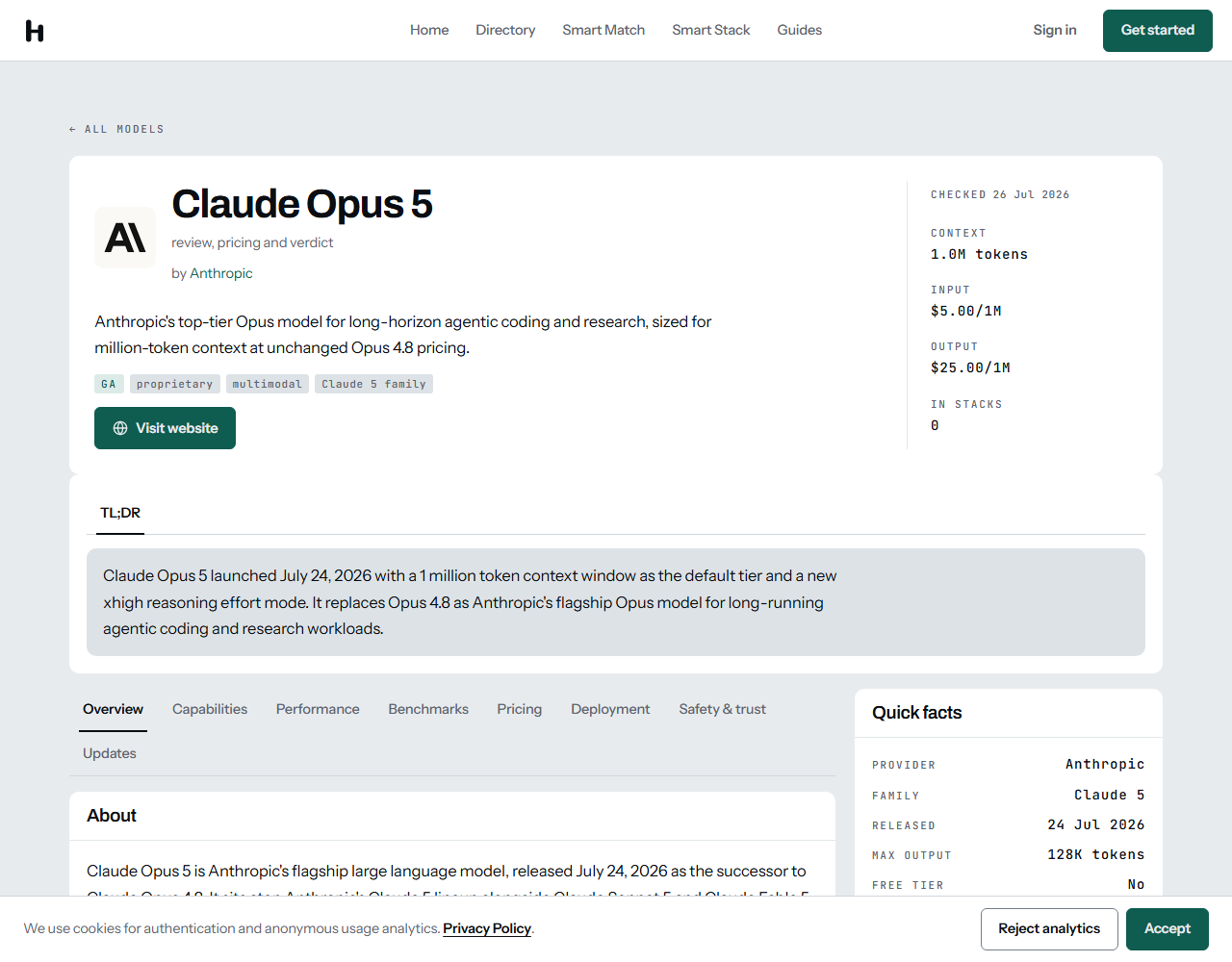 The Claude Opus 5 listing on hokai.io, 21 August 2026, checked against the vendor's published table the same morning.
Fifty-eight of that record's fields exist on no other page type. Parameter count, quantization options, weight formats, cached input price, deprecation date, rate limits in both requests and tokens per minute. Put a model in a tool table and every one of those becomes a sentence inside a description, where nothing can filter it and no crawler can lift it back out.
Autonomy is a field, not an adjective
The agent record for Claude Code carries ten fields no other type has, and its strip leads with the one that decides deployments: autonomy, semi-autonomous. Under it sit the deployment model, the memory type, a ceiling of 5 concurrent tasks, and a guardrail block recording human-in-the-loop as true, audit logging as true, sandboxing as false.
Read that last one twice. A prose blurb says an agent is safe. A field says it is not sandboxed but a person approves its moves, and that is a specific arrangement you can accept or refuse before it touches your repository.
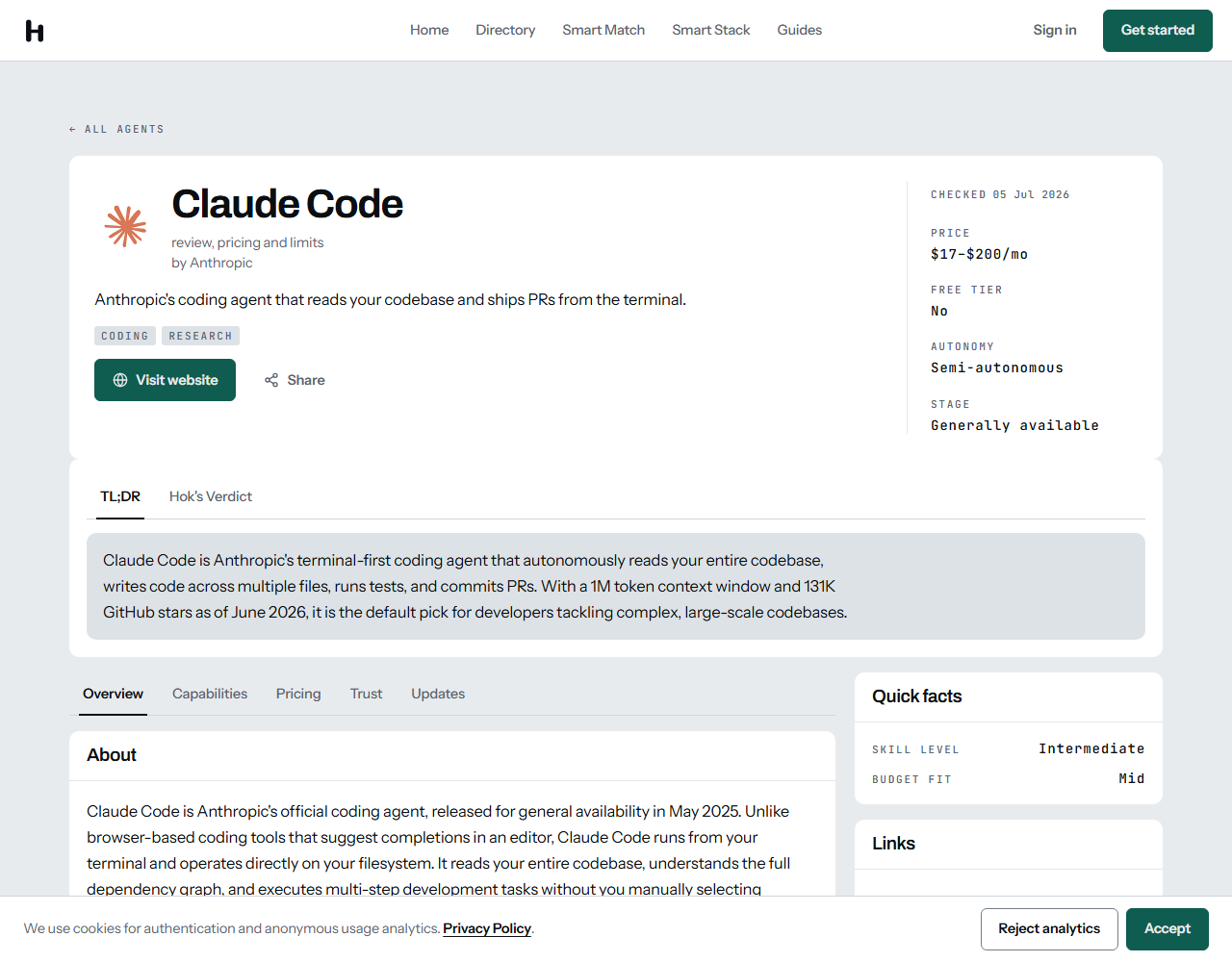 The Claude Code agent listing, 21 August 2026. Where the model page prints a context window, this one prints autonomy.
What a skill declares before you install it
A skill is not a product you open. It is a packaged capability an agent plugs into, and Google Sheets is one, published against the Model Context Protocol, which its authors describe as an open standard for connecting AI applications to external systems.
Its strip prints three things a tool page never asks. Protocol, MCP. Auth, oauth. Latency class, fast. Below them the record lists six kinds of data the skill can reach, from cells and row data to formulas and several spreadsheets at once, plus the clients it runs inside. That access list is the whole decision. You are not buying software here. You are granting reach.
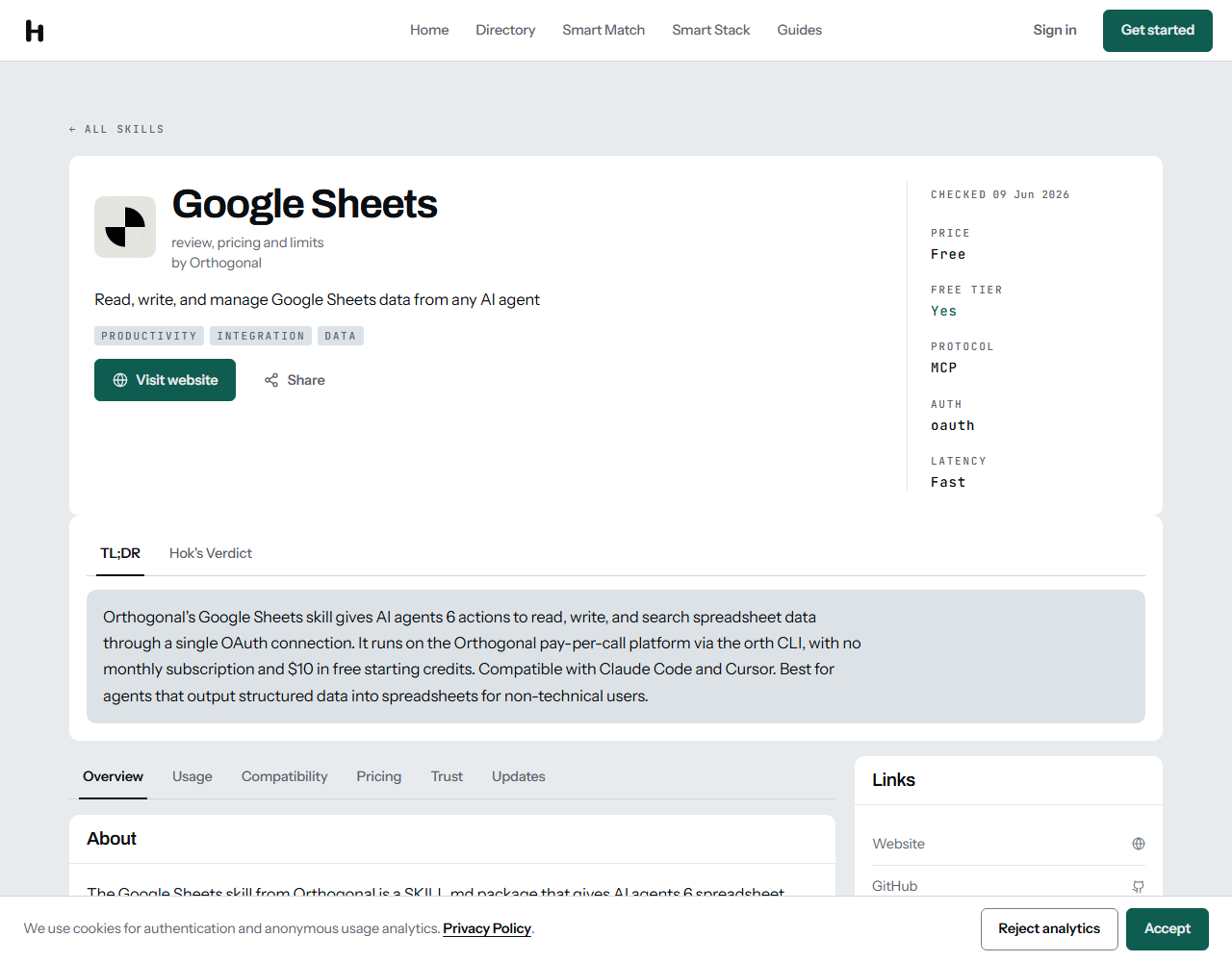 The Google Sheets skill listing, 21 August 2026. Protocol and auth sit where a tool page puts platforms.
One product, two entries, two questions
Claude Code appears twice on hokai.io, once as a tool and once as an agent, and that is on purpose. The tool record files it under AI coding assistants with platform flags for web, Windows, Mac, iOS and Android, because a reader weighing it against Cursor and its six named tiers wants that shape of answer. The agent record leads on a different axis: autonomy, guardrails, and how many tasks run at once.
Same product. Two buyers. Two questions worth answering apart.
The logic stretches across a whole vendor. Anthropic occupies four of the six types at once: a company profile founded in 2021 and run from San Francisco, five Claude models, one agent, and an inference-hosting service. A research lab's compliance certificates have no home on a model spec sheet, and a price per million tokens has no home on a company profile.
Six schemas cost more than one
None of this is free. Six page types mean six field sets to fill, six research routines, six ways for a listing to come up short. A service record like Hetzner's has to carry regions, an uptime figure, bandwidth pricing and GPU plans, none of which any other type collects.
On 21 August 2026 it lists Germany, Finland, the United States and Singapore. The vendor's own cloud page, fetched the same day, says its servers are available in Germany, Finland, Singapore and the USA. Lining up four region names against a live vendor page is work a single free-text description would never have demanded.
Our call is that the trade pays, and the reason is downstream. Fields are what the comparison grids set side by side, what the facet filters count, and what the verification routine tests against a primary source. Paragraphs can be neither compared nor tested.
Who the six-way split is not built for
If you want one flat alphabetical list of everything, this is the wrong shape and the tabs will read as friction. A single table is genuinely better for browsing, and plenty of directories offer exactly that.
The split is weakest where the categories meet. Ask whether a model beats a tool and no shared column can answer, because past governance the two records have nothing to line up. Those questions belong in Smart Match, which reads a described situation instead of a column, or in a guide where a person does the reconciling. Neither one is a grid, and neither pretends to be.
If you are shopping inside a single type, the other five tabs are dead weight to you. That is fine. Most readers use one or two and never open the rest.
What would collapse the six back into one
The falsifier is cheap, and anyone can run it. If the six record types shared most of their subject fields, if the intersection ran to 20 columns rather than one, the split would be cosmetic and a single table with a type label would serve readers better and cost us far less.
Today that intersection is 1. Run the six commands above whenever you like and count it yourself.
Frequently asked questions
What is the difference between an AI tool, an AI agent and an AI skill?
A tool is software a person operates, priced per seat and shipped for particular platforms. An agent works through multi step jobs with some degree of independence, so its listing records an autonomy level, guardrails and a concurrency ceiling. A skill is a packaged capability an agent plugs into, described by its protocol, its auth method and the data it is allowed to reach.
Why does Claude Code have two listings on HokAI?
Because two different buyers arrive with two different questions. The tool listing files it under AI coding assistants and records price and platform coverage across web, Windows, Mac, iOS and Android. The agent listing ignores that and records autonomy, deployment model and a ceiling of five concurrent tasks.
Which page type should I use to compare two language models?
Use the models tab, not the tools tab. A model record read on 21 August 2026 carried 75 subject fields, 58 of which appear on no other page type, including context window, price per million tokens, training cutoff and quantization options. None of those exist on a tool record.
What does the governance field mean on a HokAI listing?
It holds the policy answers a buyer needs regardless of what they are buying, which is why it is the single subject field carried by all six page types. Everything else on a listing is specific to its type. Governance is the one question worth asking of a model, an agent and a hosting provider alike.
Do I need the skills tab if I do not build with agents?
Probably not, and that is a fair reason to ignore it. Skills describe capabilities an agent plugs into, so the fields that matter there are protocol, auth method and the data the skill can reach. If you are choosing software a person opens, the tools tab answers your questions instead.
Covered in this guide
- HokAI: HokAI is an editor-curated, AI-only directory at hokai.io. Listing requires a flat submission fee; rankings cannot be bought. Every Pulse update is verified against a primary source.
- Anthropic: Anthropic, founded 2021 by 7 ex-OpenAI researchers, builds Claude and was valued near $965B after its May 2026 Series H round.
- The agent record for Claude Code: Claude Code posts an 80.8% SWE-bench Verified score, reads entire codebases autonomously, and ships production PRs from your terminal. There is no free tier.
- our record for Claude Opus 5: Anthropic's July 2026 flagship LLM, with a 1M token context window by default and a new xhigh reasoning-effort mode for long agentic runs.
- Cursor: Cursor is an AI code editor built on VS Code, widely adopted across large enterprise engineering teams, with Agent Mode, Tab completion, and Cloud Agents.
- Google Sheets: 6 callable actions let AI agents create, read, and write Google Sheets data through Orthogonal: spreadsheets, cell ranges, rows, and keyword lookups.
- service record like Hetzner's: Hetzner provides cloud VPS, dedicated servers, and object storage across 5 locations with generous included bandwidth and ISO 27001 certification.
Sources
Still deciding?
This guide covers a handful of options. Smart Match checks every listing in the directory against how you actually work and what you can spend, then hands you the shortlist and the reason behind each pick.
Start Smart MatchRelated guides
- 41 of 100 HokAI Guides Carry a Screenshot. All 106 Still Load.Inside HokAIHow the directory works, verified in the open
- AI Development Services in 2026: Which Layer You Actually NeedBuyer's guideHow to pick, across a category
- Best AI Agents in 2026: Autonomy Level Matters More Than BenchmarksBuyer's guideHow to pick, across a category
- Best AI Chatbots in 2026: Pick by the Job, Not the LeaderboardUpdatedRechecked against current sources
- Best AI Coding Assistants in 2026: Pick the Job, Not the BrandBuyer's guideHow to pick, across a category
- Best AI Companies in 2026: Who Is Actually LeadingBuyer's guideHow to pick, across a category