Claude Max Limits After the 50% Boost: What Changed in 2026
As of October 2026, Claude Code weekly limits on Pro, Max, Team and seat-based Enterprise plans are 25% higher than before the May 13 promotion, which gave 50% and ended September 13. Max 5x costs $100 a month and Max 20x $200, and usage credits bill overflow at API rates.
The short version
Anthropic ended the temporary 50% boost to Claude Code weekly limits on September 13, 2026 and made a 25% increase over the pre-promotion level permanent. That is a 17% drop from the promotional peak. Five-hour limits stay doubled, and Max still costs $100 or $200 a month.
Want this decided for your own case? Find your tools with Smart Match, starting from this guide's question.
On September 14, 2026, Anthropic replaced a four-month promotion with a smaller permanent one. The 50% boost to weekly limits, live since May 13, was meant to vanish. Instead, Claude Code weekly limits settled at 25% above where they stood before the promotion began.
That is a gain measured against April and a loss measured against August. A developer on Claude Max who built a week around the boosted ceiling now has about 17% less room than in July, and Anthropic still publishes no absolute number to plan against. This piece started in April as a complaint that Max "dies by Wednesday." Here is what the plan actually delivers as of 26 October 2026, from Anthropic's own help pages.
What happened on September 14
Anthropic's support article for the promotion was rewritten that day. Its opening note says the offer "ran from May 13 through September 13, 2026" and that the company had planned to return weekly limits to their original levels. It then says that "starting September 14, 2026, weekly limits in Claude Code are 25% higher than they were before the promotion" for Pro, Max, Team, and seat-based Enterprise plans.
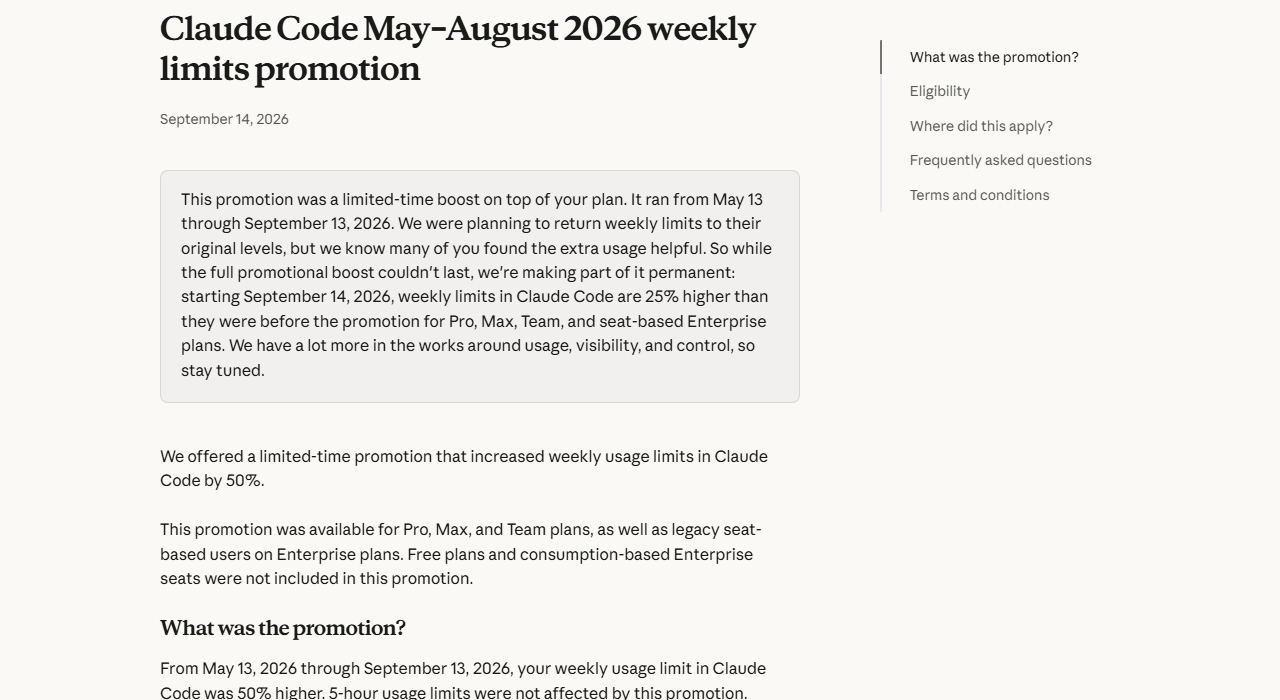 Anthropic's notice at the top of the promotion article, captured 26 Oct 2026.
Three details in that article matter more than the headline:
- The promotion raised weekly limits only. Five-hour limits were not touched by it.
- It applied to Claude Code everywhere: the CLI, IDE extensions, desktop, and web. Limits for Claude chat and Claude Cowork were unchanged.
- The page carries no absolute limits. The company describes every change as a percentage, and tells you to run
/usageto read your own account.
The end date moved repeatedly before it arrived. Coverage of the original ClaudeDevs post says the boost was announced as running "through July 13," and it was later extended to July 19, August 19, August 31, and finally September 13. The August 19 deadline that this article once treated as a cliff was passed quietly. Coverage of an August 29 ClaudeDevs post says it announced the permanent 25% ahead of the support article that confirmed it.
How the two limits interact
It helps to separate the two clocks, because they fail in different ways:
- Five-hour session limit: about bursts. A long afternoon of agent runs can empty it, and it refills on a rolling schedule.
- Weekly limit: about totals. It resets once a week at a time fixed to your account, no matter when you start.
A burst-heavy day hurts the first. A steady week of heavy use hurts the second.
The promotion only ever touched the second clock. That is why people who work in short, intense sessions barely noticed it end, while people who leave agents running across days felt it at once. If you hit the session limit often but rarely the weekly one, the September change is mostly irrelevant to you.
The numbers behind the 25%
Anthropic never states the baseline, so the clean way to read the change is as an index. Call the weekly limit before May 13 equal to 100.
| Window | Weekly limit (Claude Code) | Five-hour limit |
|---|---|---|
| Before May 6 | 100 | Baseline |
| May 13 to Sept 13 | 150 | 2x baseline |
| From Sept 14 | 125 | 2x baseline |
The five-hour column comes from the May 6 announcement, covered below. It carries no end date in any source we found, so it is part of the floor, not part of the promotion.
The arithmetic is the whole story. A permanent 25% sounds like a raise, and against the pre-promotion baseline it is one: 125 against 100. Against the promotional ceiling it is a step down: 125 divided by 150 is 0.83, so about 17% less weekly capacity than June or July. Both statements are true. Which one you feel depends on when you started building habits.
Where the extra capacity came from
The May 6 change was funded by hardware, not goodwill, and it came from the company behind Claude itself. According to The Decoder, Anthropic agreed to take the full computing capacity of SpaceX's Colossus 1 data center: more than 300 megawatts and over 220,000 Nvidia GPUs, expected online within a month.
Three things followed from that announcement:
- Five-hour rate limits for Claude Code were set to double for Pro, Max, Team, and Enterprise customers.
- Peak-time throttling for Pro and Max accounts was removed entirely.
- API limits for the Opus models rose sharply. Tier 1 input went from 30,000 to 500,000 tokens per minute, and tier 4 went from 2,000,000 to 10,000,000.
None of this was labelled temporary. That is why the five-hour doubling survived the end of the weekly boost, and why the floor under a paid plan is genuinely higher than it was in the spring. The weekly boost was the part that was always on a clock.
What Max costs and what it includes
Plan prices have not moved. Per Anthropic's help center and pricing page, as of 26 October 2026:
| Plan | Monthly price | Usage vs Pro | Monthly API credit |
|---|---|---|---|
| Pro | $20, or $17 billed annually | 1x | None |
| Max 5x | $100 | 5x session usage | $100 |
| Max 20x | $200 | 20x session usage | $200 |
Every plan has a session limit that resets every five hours and a weekly limit that resets at a fixed time assigned to your account. Max plans also carry a separate weekly limit for Fable, the premium model tier. On Max 5x and Max 20x, Fable access is capped at 50% of weekly limits. On Pro, Fable runs only on usage credits. The company also says it may apply other caps, "weekly and monthly" or by model and feature, at its discretion.
One newer feature softens the five-hour edge. If the agent hits the session limit partway through a response, it may keep working briefly to finish the step in progress, showing "Usage limit reached, wrapping up." The allowance is small, counts against your weekly limit, and is rolling out gradually, so your account may not have it. On Pro it applies once per weekly period. On Max it can apply at every five-hour limit.
Paying past the wall: usage credits
If you do not want to wait for a reset, usage credits let you carry on at standard API rates. The mechanics, from the current help page:
- Open Settings, then Usage, and enable usage credits.
- Set a monthly spend limit, or choose unlimited.
- Prepay by adding funds, and optionally turn on auto-reload.
- When you hit the session limit, the weekly limit, or the Fable weekly limit, requests switch to credits and keep working.
You are never cut off mid-task, and the reset timing does not change. The price is the API price, so the model you pick matters:
| Model | Input per million tokens | Output per million tokens |
|---|---|---|
| Fable 5.1 | $10 | $50 |
| Opus 5.5 | $4 | $20 |
| Sonnet 5.5 | $2 | $10 |
Anthropic's own tip for controlling the bill is to use its most efficient Haiku model or the latest Sonnet for most work. The which Claude model should I use guide walks through that choice,, and the Haiku 5.5 page lists the smallest model in the lineup.
Two older claims are gone from this page. An earlier version cited a $2,000 daily cap on usage credits, and a one-time $100 transition credit for Fable 5 on Pro and Team Standard. Neither appears on the current usage-credits or pricing pages, so we removed them rather than carry numbers we cannot source.
The API credit that does not help Claude Code
Max includes a monthly credit for the Claude Platform: $100 on Max 5x and $200 on Max 20x. It sounds like free overage money. It is not, for the people most likely to hit a limit.
The credit covers the Claude API, the Console Playground, Managed Agents, and the Agent SDK. It does not apply to interactive Claude Code in the terminal, IDE, desktop, or web. It also does not apply to usage credits in Claude, Claude Code, or Claude Cowork. In short:
- Unused credit expires at the end of each billing cycle and does not roll over.
- You claim it by linking one Console organization, and you cannot change the link yourself.
- New subscribers can claim after seven days on the plan.
- On Team plans, credits are $20 per Standard seat and $100 per Premium seat, pooled and capped at $500 a month.
If you build products on the API, this is a useful perk. If you only want more headroom for the agent, it changes nothing.
The case that Anthropic did enough
The fair counterargument runs like this. Before May, heavy users hit walls. Since then, five-hour limits doubled, peak-hour throttling went away, and a permanent weekly increase landed on top. Calling that a "cut" because a temporary bonus ended is a framing choice, the same way a store ending a sale has not raised its prices.
That argument is mostly right on the facts. The permanent floor is higher than any floor before May. A developer who worked the way they did in April is better off today than they were then, on every axis Anthropic publishes.
The argument fails for one group: teams that reorganized around the boost. Running a second agent in parallel, keeping long sessions open, and letting an overnight job use the spare weekly capacity were all rational at 150. At 125 they are a squeeze. The note itself admits it "was planning to return weekly limits to their original levels", which means the boost was never promised as a baseline. The honest summary is that the plan is better than April and worse than July, and your workflow decides which comparison applies.
What to do now
You do not need a new vendor. You need a measurement, the same discipline the personal AI agent cost guide applies to agents that bill by the token.
- Run
/usagein Claude Code, or open Settings, then Usage, and write down what a normal week consumes. - Compare it against the weeks you remember hitting the wall. If the gap is under 20%, a model downgrade for routine work will absorb it.
- Default to Sonnet-class models for edits and tests, and reserve Opus or Fable for the work that needs it.
- Decide your overflow rule in advance: usage credits with a low monthly cap, or a second seat on another tool.
Two habits pay for themselves quickly. First, split long jobs into smaller sessions with a clear stopping point, so a limit never lands in the middle of an edit you cannot resume. Second, keep a short written note of what each heavy task costs in your own usage meter. After two or three weeks you will know which jobs are worth the premium model and which are not, and that knowledge is worth more than any promotion.
If a second tool is the answer, look for an AI coding assistant with published tiers instead of a rolling promotion.
Cursor and GitHub Copilot are the usual first looks. Windsurf is worth pricing out as a second seat, and Tabnine fits teams that want a self-hosted model rather than a shared quota. Devin bills by completed task, which hedges against a weekly cap in a different way. Teams that gate merges with AI reviewers should also read best AI code review tools, since review runs eat quota too. The Cursor Composer 2 versus Claude Code comparison covers the trade between those two in detail.
When the right answer depends on your stack and budget, Smart Match can turn a few answers about your workflow into a shortlist. If the constraint is budget rather than stack, the model recommender filters by what you are willing to pay. For raw model price and benchmark comparisons, the model leaderboard shows what each option costs per token and how it scores.
Who is affected, plan by plan
The table of plans above hides how differently each group feels this. Here is the split, with Anthropic as the common thread.
- Pro: Weekly limits rose 25% over the pre-promotion level. Fable needs usage credits. The five-hour doubling applies to Claude Code.
- Max 5x and 20x: The same weekly change, plus Fable at 50% of weekly limits and the monthly API credit, which Claude Code cannot spend.
- Team and seat-based Enterprise: Included in both the promotion and the permanent increase. Consumption-based Enterprise seats were excluded from the promotion by name.
- Free: Not eligible for any of this, and the coding agent is not part of the Free plan.
What would change this
Rivals set their own terms. OpenAI and its rivals both sell coding agents under their own plan limits, and ChatGPT subscribers should read those terms directly instead of assuming parity. The full AI tools directory lets you filter by category when you want to compare.
Anthropic closed its note with "we have a lot more in the works around usage, visibility, and control," and the company has now changed these limits at least three times since May. The next change is more likely to arrive as a new percentage than as a published limit. Until an absolute weekly figure is printed, the only reliable number in your plan is the one /usage shows you today, and the habit worth building is checking it before the week starts, not after it stops.
Frequently asked questions
Did the 50% Claude Code weekly limit boost end?
Yes. Anthropic's support article says the promotion ran from May 13 through September 13, 2026. From September 14, weekly limits in Claude Code are 25% higher than they were before the promotion. Five-hour limits were never part of the promotion.
Is the new Claude Code limit higher or lower than in summer?
Both, depending on the baseline. It is 25% above the pre-promotion level, but about 17% below the 50% promotional level, because 125 divided by 150 is 0.83. Anthropic publishes no absolute limits, so use /usage to see your own account.
How much does Claude Max cost in 2026?
Max 5x is $100 a month and Max 20x is $200 a month on the web, per Anthropic's help center. Pro is $20 monthly or $17 a month billed annually. Mobile prices may differ by app platform.
Can I pay for extra Claude usage instead of waiting for a reset?
Yes. Pro and Max plans can enable usage credits, which switch requests to pay-as-you-go pricing at standard API rates once a session or weekly limit is reached. You prepay, set a monthly spend limit, and can turn on auto-reload.
Do the Max monthly API credits work in Claude Code?
No. The $100 or $200 monthly Platform credit covers the Claude API, Console Playground, Managed Agents and the Agent SDK. It does not apply to interactive Claude Code or to usage credits, and unused credit expires each billing cycle.
Covered in this guide
- Claude: Claude is Anthropic's AI assistant, with a free tier, paid personal plans, and Team and Enterprise seats. Opus access starts at the first paid plan.
- Claude Code: Anthropic's agent for the terminal, IDEs, desktop, web and mobile that edits files, runs tests and opens pull requests. There is no free plan.
- Anthropic: Anthropic is a Public Benefit Corporation started by 7 ex-OpenAI researchers. It builds the Claude model family and counts Amazon and Google among its largest backers.
- ChatGPT: ChatGPT is OpenAI's AI assistant, with 1.2 billion weekly users by OpenAI's count, the GPT-6 model family and plans that run from a free tier to a premium Pro tier.
- Fable: The first generally available Mythos-class Claude model, with 1M context and 95.0% SWE-bench Verified. Released June 2026 by Anthropic.
- Fable 5.1: Anthropic's second Mythos-class model, released Sept 1, 2026, for long-horizon agentic coding and research at Fable 5's per-token rates.
- Haiku 5.5: Anthropic's smallest and fastest 5.5 model, released October 7, 2026, with a 1M context window, built for high-volume work.
- Opus 5.5: Anthropic's September 2026 flagship LLM with a 1 million token context window, built for long-running agentic coding and computer use.
- Sonnet 5.5: Anthropic's fastest Sonnet-class model, launched in September 2026, with a 1M context and output more than 30% faster than Sonnet 5.
- Cursor: Cursor is an AI code editor built on VS Code, widely adopted across large enterprise engineering teams, with Agent Mode, Tab completion, and Cloud Agents.
- Devin: Devin is Cognition's autonomous AI software engineer that plans, codes, tests, and ships pull requests, with a Free plan and several paid tiers.
- GitHub Copilot: GitHub's AI coding assistant with agent mode and MCP support across 6 IDEs, plus a free plan with no credit card required.
- OpenAI: OpenAI builds ChatGPT, the GPT-6 family (Astra, Sol, Luna), Codex and the OpenAI API. It reports 1.2B weekly ChatGPT users and an $852B valuation after its March 2026 round.
- Tabnine: Enterprise AI coding assistant with privacy-first architecture, agentic workflows, and flexible deployment
- Windsurf: Windsurf, now Devin Desktop from Cognition, is a VS Code-based editor with local and cloud agents, free with unlimited Tab and Pro at $20 a month.
Sources
Still deciding?
This guide covers a handful of options. Smart Match checks every listing in the directory against how you actually work and what you can spend, then hands you the shortlist and the reason behind each pick.
Find your toolsRelated guides
- The AI 80s Photo Trend: How to Make Yours (and Turn It Into a Video) in 2026AnalysisWhat changed and who it affects
- What Happened When 7 AI Agents Got Real Bank Accounts and No SupervisionAnalysisWhat changed and who it affects
- AI Development Services in 2026: Which Layer You Actually NeedBuyer's guideHow to pick, across a category
- The AI Tool Ecosystem in 2026: Buy the Meter, Not the CategoryBuyer's guideHow to pick, across a category
- Attio vs HubSpot in 2026: Which CRM for a Startup?ComparisonHead-to-head, with a verdict
- Best Agentic AI in 2026: Manus, Genspark and the Platforms That Finish Whole TasksBuyer's guideHow to pick, across a category