How to Spot a Dying AI Tool Before You Build On It
A dying AI tool usually shows public signs before it shuts down: a stalled changelog, an acquired team reassigned to a different product, an unmoved last-updated date, and a lapsed compliance report. Rows AI showed exactly this pattern for three months before its May 2026 shutdown. Checking five such signals catches it early; checking one rarely does.
The short version
Rows AI was acquired by Superhuman in February 2026 and shut down in May with no successor, a pattern visible the whole three months in between: the team moved to Superhuman's own Coda instead of shipping under the Rows brand. A five-signal public checklist, demonstrated on live HokAI listings, catches that pattern before you build on a tool.
Want this decided for your own case? Find your tools with Smart Match, starting from this guide's question.
Superhuman announced it had acquired Rows, the Berlin-built AI spreadsheet, in February 2026. Three months later, in May, Rows shut down with no successor released under its own name.
The acquisition was public the day it happened. So was the shutdown. What was also public the whole three months in between was the pattern joining them: the Rows team moved to work on Superhuman's own Coda instead of shipping anything new under the Rows brand. HokAI's own listing for Rows AI carries that timeline today, dated and sourced, because a tool worth building a workflow on deserves a paper trail before it disappears, not an obituary after.
Most buyers only learn a tool died when their integration breaks. The five signals below are all public before that day, and HokAI already carries two of them, dated, on live listings: one tool that is dead, one that has quietly stopped moving forward while staying online. Neither required insider access to see coming.
Disclosure: HokAI wrote this about HokAI.
What you can check yourself
Two HokAI tool records anchor what follows, both read live on September 3, 2026, alongside outside research on how software teams flag abandonment more broadly. Anyone can repeat these two reads today, on their own schedule, without asking either vendor for access.
Rows AI's page states the February acquisition, the May shutdown, and that Rows' free tier gave 500 monthly AI enrichment tasks with no credit card right up until the day it closed. Arc Browser's page states, today, that Arc "transitioned to maintenance mode in May 2025," with no new feature development since, and names the cost directly: it is losing ground to AI-enhanced browsers like Dia and Comet.
The signal that actually predicted it
An acquisition announcement tells you a company changed hands. It does not tell you whether the product survives. The signal that mattered for Rows sat one layer down: where did the acquired team go?
Superhuman's own account, carried on Rows' HokAI page, says the team joined Superhuman to work on Coda, its collaborative productivity platform, rather than continuing Rows as a standalone product. That reassignment is checkable the week an acquisition closes, months before a shutdown notice goes out. A team folded into someone else's roadmap is a louder signal than the acquisition headline itself, because headcount tells you what the acquirer actually intends to fund.
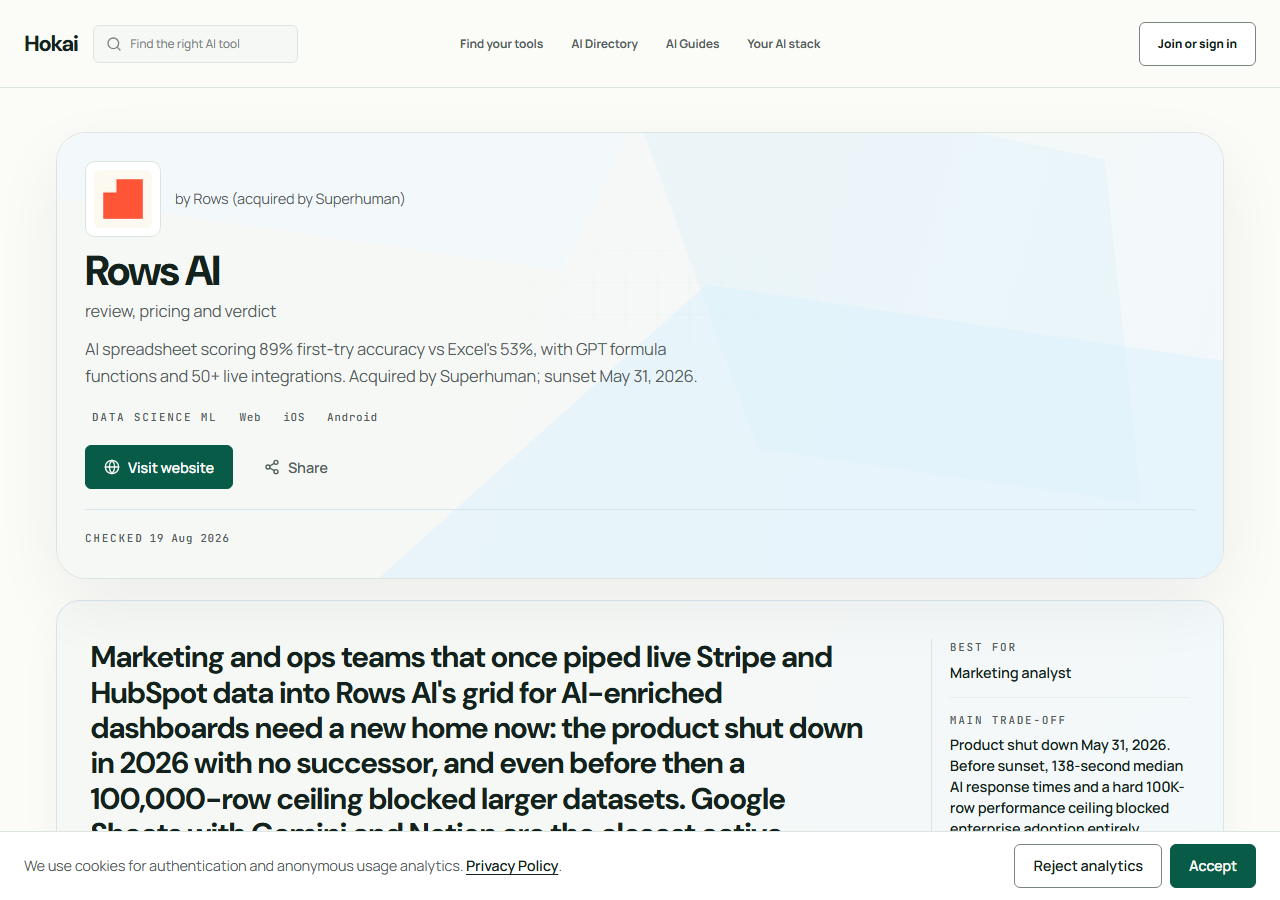 HokAI's Rows AI listing, captured September 3, 2026. The byline names the acquirer, and the trade-off panel states the shutdown date directly.
Rows wasn't a fringe product when this happened. It had raised $33.7 million, scored 89% first-try accuracy on formula tasks against Excel's 53% per HokAI's own listing, and its free tier matched the paid plans on features, capped only at 500 AI tasks a month.
Notion, by contrast, keeps shipping as an independent product today, which is the plain reason HokAI's own comparison FAQ names it the safer pick for a team deciding now. Funding, accuracy and feature parity did not save Rows; it shut down on May 31, 2026. An acquired team's new assignment would have been the earlier warning.
What maintenance mode looks like while it's still live
Rows died outright. Most tools that stop mattering do something quieter first, and Arc Browser is the clean live example. The Browser Company has not shut Arc down; HokAI's own page for it states plainly that the product transitioned to maintenance mode in May 2025, and names the trade-off directly: no new feature development, which is starting to cost it against AI-enhanced browsers like Dia and Comet.
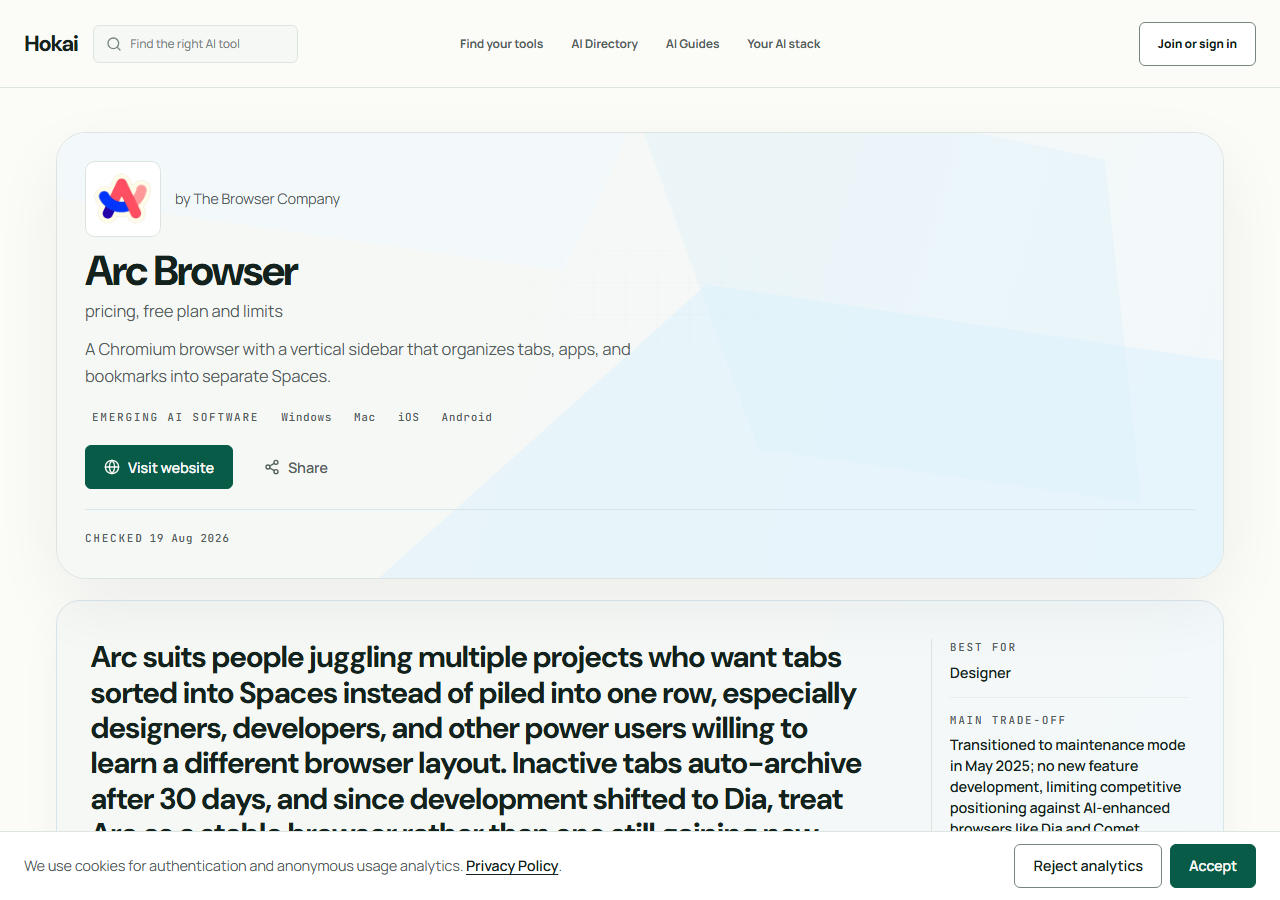 HokAI's Arc Browser listing, captured September 3, 2026. The vendor's own trade-off, stated in the page's own words, not inferred from silence.
Stability AI's page shows the opposite trade-off in its own words: Brand Studio shipped this year as a live replacement for Dream Studio, an active product still being rebuilt rather than one being maintained and nothing more.
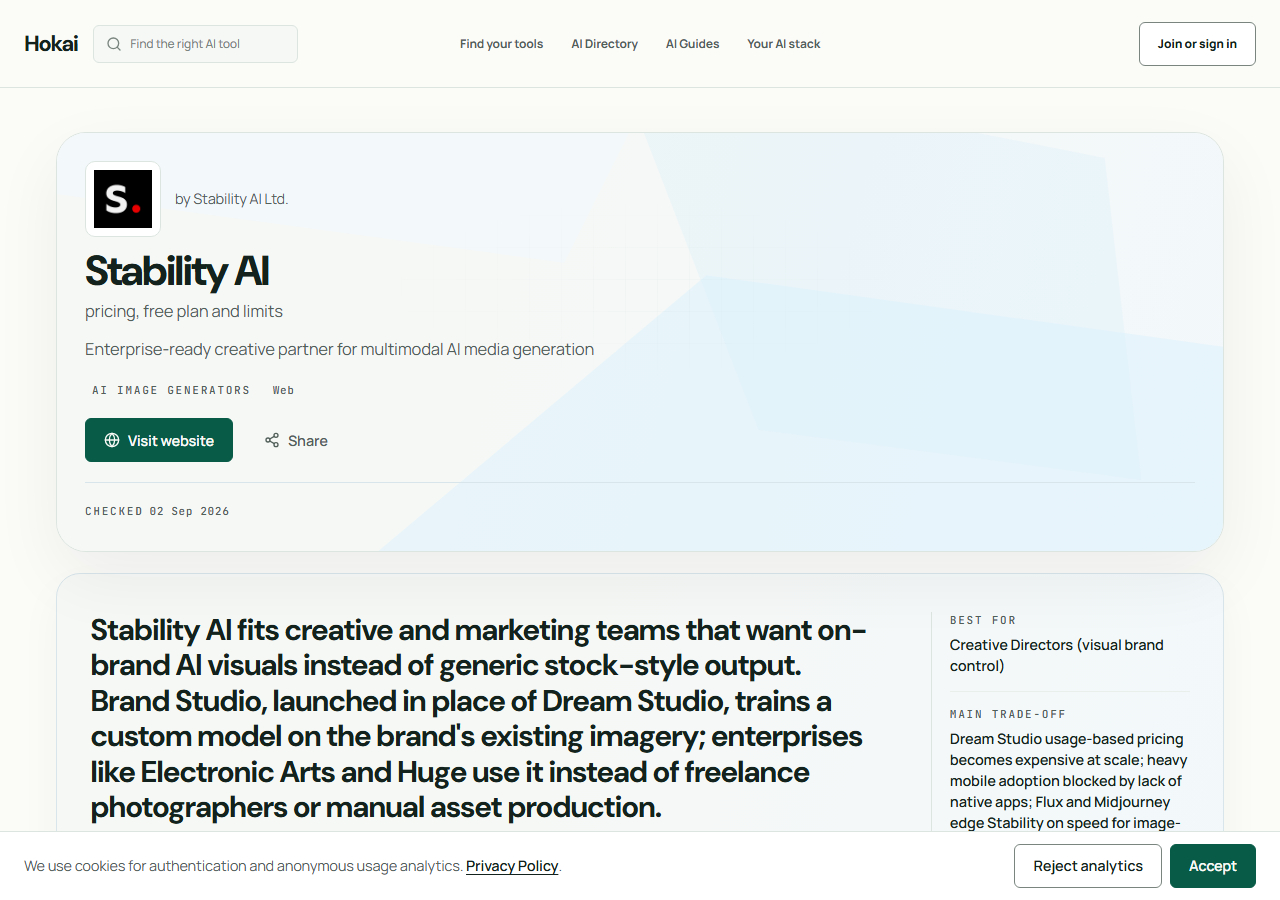 HokAI's Stability AI listing, captured September 3, 2026. A product still shipping new replacements, not one going quiet.
Every HokAI tool page also carries a dated "checked" badge, HokAI's own last review of the listing rather than the vendor's changelog: Arc and Rows both read "Checked 19 Aug 2026," Stability reads "Checked 2 Sep 2026." Two weeks apart proves nothing on its own; it is what the page says about the product, not the date stamp, that actually tells you which of these two is happening.
The checklist
None of these signals needs an account, a sales call, or insider access. Each is something the vendor already published.
The changelog check has a rough industry bar behind it. Engineers tracking stale open-source repositories at scale commonly flag a project once it has gone twelve straight months with no pushes, no pull-request activity, no CI runs and no clone traffic, treating that combination, not any single one of them, as the safe threshold for archiving.
A commercial AI tool with a paying customer base should move faster than that bar. That is why a changelog stuck for even a few months is worth a second look, rather than the full year of patience a quiet open-source side project would reasonably earn.
| Signal | What to check | What it caught |
|---|---|---|
| Changelog or release notes | Has anything shipped in the last few months, or does the log stop mid-year | Arc's public shift to maintenance mode |
| Team destination after an acquisition | Announcement plus a follow-up search for where the acquired team landed | Rows' team moving to Coda instead of Rows |
| A directory's own "checked" or "last reviewed" date | A freshness proxy, not the vendor's own changelog, since it reflects when the listing was reviewed | Read together with the vendor's own stated trade-off, as with Arc above |
| Compliance report age | A SOC 2 report is valid twelve months from issuance; a lapsed one with no renewal notice is a flag procurement teams already watch for | General vendor-risk practice, not HokAI-specific |
| Free tier terms changing suddenly | A cap dropping or a feature moving behind a paywall with no announcement | Not observed in either case here, but a known pre-shutdown pattern |
Running all five takes a few minutes. Running one tells you almost nothing on its own: HokAI's SOC 2 filter and its free-tier filter both exist because a single field, checked in isolation, is a fact and not yet a pattern. The compliance-age check matters most for regulated teams; the free-tier check matters most for anyone already relying on the tier that tends to move first when a vendor is cutting costs before an announcement.
The turn: silence isn't always death
The obvious objection: plenty of software goes quiet because it is finished, not because it is dying. A widely read argument from developer Max Woolf makes exactly this case about open-source projects: a small, feature-complete tool with few dependencies can go months without a commit simply because nothing is broken and nothing new is needed. Reading a still changelog as a death sentence would misjudge every stable, mature product on that basis alone.
That is why the checklist above is five signals and not one. Arc's case combines an explicit maintenance-mode statement from the vendor with a specific transition date; Rows combined an acquisition with a team reassignment and then an actual shutdown notice. A single stale date, by itself, is common and usually means nothing. Two or three of these signals landing on the same product, especially a stated vendor decision plus a stalled changelog, is the combination worth acting on before you build.
Who this checklist isn't for
This is a five-minute public-signals pass, not a replacement for a procurement team's formal vendor risk review. It is built for someone about to pick a tool for their own workflow, not for someone underwriting an enterprise contract.
It also reads differently for infrastructure with thousands of dependents: a well-funded public company's product, or an open-source project with a huge install base, can sit quiet for the reasons Woolf describes rather than the reasons Rows died. Scale changes what silence means; this checklist is built for the newer, smaller, single-vendor tools that make up most of a fast-moving directory, not for the handful of giants everyone already assumes will still be around next year.
It also is not a claim that every tool going quiet is in danger. HokAI's own llms.txt states that its directory publishes "daily-refreshed structured data" covering pricing changes, model releases, compliance posture and acquisitions, which is the same idea as this checklist run continuously instead of once: a one-time read misses a tool that goes quiet six months after you last looked. A reader running this checklist today is doing, for one tool, what that ongoing refresh does across the whole directory.
What changes the next time
The next tool this applies to has not gone quiet yet. Watch for the reassignment, not the press release: the acquisition headline is the least useful moment to check, because it is the one moment every signal still looks fine.
Frequently asked questions
How can I tell if an AI tool is about to shut down?
Check for five public signals: a changelog or release notes that have gone quiet, an acquired team reassigned to a different product instead of the one you use, a "last updated" or "last reviewed" date that has not moved in months, a compliance report (like SOC 2, valid twelve months from issuance) that has lapsed without renewal, and free-tier terms changing suddenly with no announcement. One signal alone rarely means much; two or three landing on the same tool is worth acting on.
What happened to Rows AI?
Superhuman acquired Rows, the Berlin-built AI spreadsheet, in February 2026. The Rows team moved to work on Superhuman's own Coda rather than continuing Rows as a standalone product, and Rows shut down in May 2026 with no successor released under its own name. Its free tier had given 500 monthly AI enrichment tasks with no credit card required, matching the paid plans on features, right up until the shutdown.
Does a tool going into "maintenance mode" mean it is dying?
Not necessarily; it means the vendor has said, or shown, that active development has stopped while the product stays online. Arc Browser is a live example: The Browser Company has not shut it down, but its own page states Arc is in maintenance mode because development shifted to Dia, a different browser from the same company. That is a meaningfully different risk than an acquisition-and-shutdown pattern like Rows AI's, but it still means new features are unlikely to arrive.
Is a quiet changelog always a bad sign?
No. A widely read counter-argument from developer Max Woolf notes that small, feature-complete software with few dependencies can go months without a commit simply because nothing is broken and nothing new is needed, not because it is dying. That is why a single stale date should not be read as a verdict on its own; it becomes meaningful when it lines up with other signals, like an explicit vendor statement or a team reassignment.
What should I check before building a workflow on a new AI tool?
Look at the vendor's own changelog or release notes, check whether the product has a public "last updated" date and how recent it is, search for what happened to the team if the company was ever acquired, and check the age of any compliance report the vendor publishes. HokAI's own tool records carry a dated "checked" line for exactly this reason, alongside the pricing and compliance fields the checklist above relies on.
Covered in this guide
- HokAI: Singapore-run directory of AI tools, models, agents, skills and services, with a free Smart Match engine that names three picks for the job you describe.
- Arc Browser: A Chromium browser with a vertical sidebar that organizes tabs, apps, and bookmarks into separate Spaces.
- Notion: Your AI everything app: All your tools and work in one unified workspace.
- Rows AI: AI spreadsheet scoring 89% first-try accuracy vs Excel's 53%, with GPT formula functions and 50+ live integrations. Acquired by Superhuman; sunset May 31, 2026.
- Stability AI: Enterprise-ready creative partner for multimodal AI media generation
Sources
Still deciding?
This guide covers a handful of options. Smart Match checks every listing in the directory against how you actually work and what you can spend, then hands you the shortlist and the reason behind each pick.
Find your toolsRelated guides
- 41 of 100 HokAI Guides Carry a Screenshot. All 106 Still Load.Inside HokAIHow the directory works, verified in the open
- Arc Browser Hasn't Shipped a Feature in 449 Days. Cloudflare Just Showed Why.AnalysisWhat changed and who it affects
- Best AI Analytics Platforms in 2026: ThoughtSpot, Sisense, Qlik, Databricks and Tellius ComparedBuyer's guideHow to pick, across a category
- Best AI Tools for Writing Excel Formulas and Data Analysis in 2026Buyer's guideHow to pick, across a category
- Best AI for Writing a Business Plan in 2026: Tested Picks and a VerdictBuyer's guideHow to pick, across a category
- Best AI Image Generators in 2026: Pricing, Licensing, and the Real Cost Per ImageBuyer's guideHow to pick, across a category