Jigso vs Modern: Which Should You Use in 2026?
Jigso and Modern are both 2026-era AI IT agents that run inside Slack, but they solve different problems. Jigso is a monitoring layer that scans connected apps like Salesforce and Zendesk and pushes proactive alerts, while Modern is a full IT service management platform that executes and closes tickets end to end.
The short version
Jigso pushes proactive Slack alerts across a company's existing apps for under $20 a seat, while Modern replaces the IT ticket queue itself through an enterprise-only sales process. Pick Jigso for visibility into a mess; pick Modern only if ticket capacity, not visibility, is the actual bottleneck.
Jigso and Modern both showed up in 2026 promising an AI agent that lives inside Slack instead of a separate IT portal, and neither one appears in a single "best AI ITSM platform" roundup published this year.
That is not an oversight. Jigso is not really an ITSM tool at all; it watches your existing apps and pushes alerts, and never resolves a ticket itself.
Modern, a two-person Y Combinator company, was built to replace the ticket queue outright. A reader searching "AI IT agent for Slack" can land on either homepage in the same five minutes and assume they are choosing between two versions of the same thing. They are not. One sells visibility into a mess you still clean up yourself. The other sells the mechanism that cleans it up.
The Verdict: Alerts or a Replaced Ticket Queue
Pick Jigso if the actual problem is that nobody notices a stalled deal or an unassigned ticket until it is already late, and you want that fixed today, self-serve, with no sales call. Pick Modern if the problem is the ticket queue itself, IT is buried in access requests and onboarding tasks, and your team can survive an enterprise sales cycle with a startup that had two employees as of its Y Combinator listing this year.
Neither tool is wrong in the abstract. Each is wrong for the other's job. A RevOps lead drowning in stale pipeline data does not need a workflow automation platform, and a director trying to clear a 400-ticket backlog will not fix that with alerts alone, because alerts were never built to execute the fix.
What Jigso Actually Watches
Jigso launched in 2022 out of New York, with a second office in Tel Aviv, founded by Or Shani and Tomer Naveh on $7.5 million in seed funding. The mechanism is continuous scanning, not search: the product connects to a company's major systems, Slack, Salesforce, and Zendesk among them, then pushes an alert the moment something crosses a threshold, a deal gone quiet for 14 days or a support ticket unassigned for 48 hours.
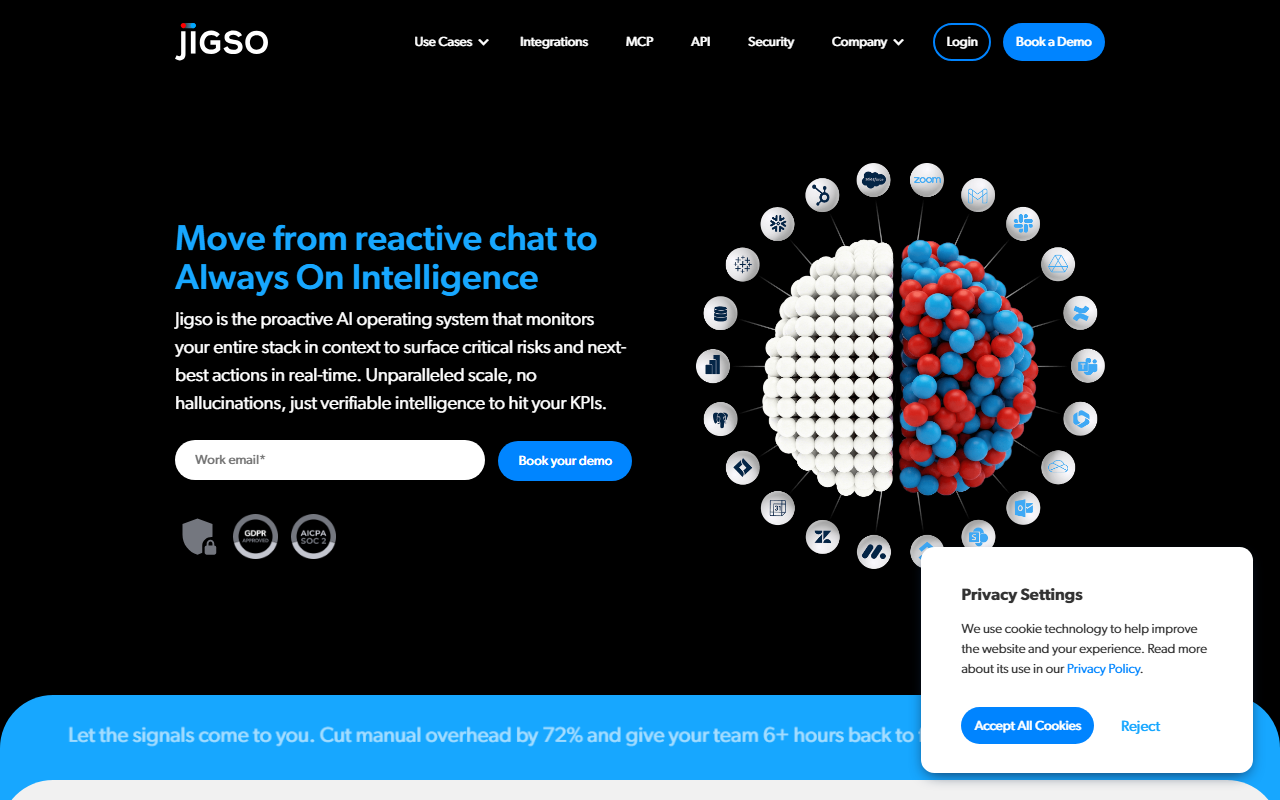 Jigso's homepage, captured 21 Aug 2026. The 72% overhead claim and the compliance badges are both discussed below.
Jigso's own blog draws a sharp line against tools like Glean that answer questions on demand: "Enterprise search optimizes how you work today. Contextual intelligence transforms how you'll compete tomorrow," the company wrote in a comparison post. That is marketing language, but the distinction holds up against the feature list. Search waits for a query; Jigso claims to flag a churn risk before anyone thinks to ask, with 81% accuracy on those predictions specifically, by the company's own account.
The company says its alerts cut manual status-check prep by 72% and return 6 or more hours a week to teams juggling multiple systems, and it lists 2,700 integrated customers on its homepage this year. None of those figures come from an independent audit. Neither do most of the numbers below about Modern; both companies are the only source for their own claims.
What Modern Actually Automates
Modern is a 2026 company, part of the Spring Y Combinator batch, founded by Seb Poole and Aleks Tomovski. Poole previously built the workplace platform later renamed Unmind, which raised more than $100 million; Tomovski spent 15 years on developer platforms, including an early team at Wix. As of this year's YC listing, the company runs on two people.
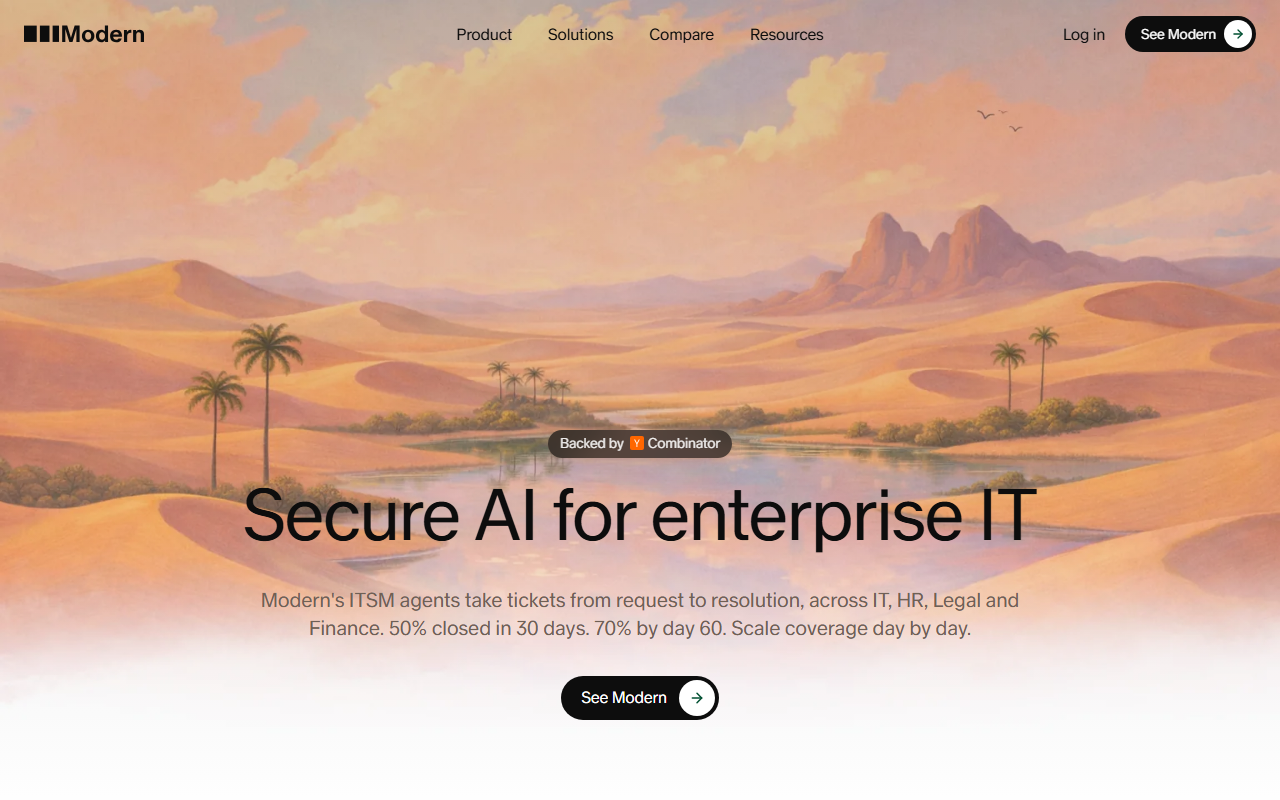 Modern's homepage, captured 21 Aug 2026. The ticket-closure figures cited here are the same ones examined in the Verdict section above.
Where Jigso surfaces a problem, Modern tries to close it. The product connects to more than a dozen enterprise systems, including Zendesk, Salesforce, and Workday, and generates automations from a plain-language description of a request pattern rather than a rules engine an admin configures by hand.
Modern's own published numbers: over 80% of routine IT requests automated end to end, 50% of tickets closed within 30 days of rollout, 70% by day 60, and a 62% cut in ticket-handling volume. Offboarding, the company claims, completes with zero human follow-up in customer deployments, a task that normally eats 2 to 5 days of an IT team's time.
That level of automation is also why Modern will not hand you a price. There is no self-serve signup. Every deal runs through a demo and a scoped proposal, the kind of sales cycle a two-person company can only run so many of at once.
Price: One Is Self-Serve, One Is a Sales Call
Jigso's free Basic tier connects up to 3 systems and covers roughly 30 alerts or questions a month, enough to test the mechanism but not to run a team on. The paid Pro tier lists at $18.99 a user per month on third-party trackers; Jigso's own pricing page returned a 404 error when checked for this article on 21 August 2026, so that figure is the best available number, not one confirmed directly from the company.
Modern publishes no price at all. Its FAQ names two cheaper, self-serve alternatives for teams that want a published number before they will take a call, a fair read of Modern's own positioning: it is not competing on accessibility.
For a team under 50 people, that gap is the whole decision. Jigso can be running inside a Slack workspace before lunch. Modern requires clearing a sales process with a company that, this year, does not yet have the headcount of a mid-sized customer's own IT department.
Where Jigso Wins
Jigso wins for a RevOps manager who already lives inside a CRM and just needs to stop manually checking it every morning. It wins for a customer success team that wants churn signals routed to Slack instead of buried in a dashboard nobody opens. And it wins on cost: at under $20 a seat with a working free tier, a team of ten can trial the whole thing for less than one hour of a Modern sales call is likely to cost in staff time.
Where Modern Wins
Modern wins the moment the bottleneck is IT capacity itself, not visibility into it. A company running several enterprise systems together, with an access-request and onboarding backlog that already has a name, is exactly the buyer the workflow generator was built for. Jigso can alert that same director to a stalled request; it cannot provision the access, revoke it on offboarding, or log the policy check an auditor wants to see. Modern's site lists SOC 2 compliance, which is not something Jigso's product claims to replace.
The Turn: Is Modern's Security Pitch More Than Marketing?
Poole made security the center of a public argument this year, posting that three rival AI ITSM startups gave the same answer when asked how they scope system access and support rollback: "the model decides, here are some logs, rollback is on the roadmap." He set Modern's audit trail against that. The company's own security page backs the claim up in more detail than most competitors publish: workflow access "scoped to required systems and actions using role and policy boundaries," with sensitive operations gated behind approval before they run.
The honest rebuttal is that this argument was never aimed at Jigso in the first place. Poole named direct ITSM rivals trying to win the same enterprise deal Modern wants. Jigso does not execute actions on a company's systems the way an ITSM agent does; it reads and alerts, so the rollback question barely applies to it. Reading a competitive dig at three other startups as a reason to prefer one product over an entirely different one misapplies an argument built for a different fight.
Switching Cost: What Moving Actually Takes
Moving onto Jigso costs an afternoon: connect Slack first, since that is where alerts land by default, then add the sales or support tool one at a time. There is admin time in tuning which thresholds trigger a message, but nothing here requires a vendor on a call.
Moving onto Modern costs a quarter, realistically. A company already running a legacy ticketing system has to map its existing categories into the new workflow generator, get security sign-off on the audit trail Poole is publicly betting the company on, and complete a procurement cycle with a vendor that, this year, has fewer employees than most prospective customers' own IT teams.
A two-person company and an enterprise-only sales process mean Modern is not really purchasable yet by most of the smaller teams currently running Jigso. That gap closes the day a self-serve tier ships with a published price, and it is worth checking back on: a company built to replace legacy ticketing systems will eventually need a way to sell to the customers too small to need one in the first place.
Frequently asked questions
Is Jigso the same kind of tool as Modern?
No. Jigso is a proactive monitoring and alerting layer that watches connected apps like Salesforce and Zendesk and pushes notifications into Slack; it does not execute IT tickets. Modern is a full ITSM platform that automates a ticket end to end, including access provisioning and offboarding. The two only compete for the same budget line, not the same technical job.
How much does Jigso cost in 2026?
Jigso offers a free Basic plan covering up to 3 connected systems and about 30 alerts or questions a month. The paid Pro tier is listed at $18.99 per user per month by third-party trackers; Jigso's own pricing page returned a 404 error when checked for this article on 21 August 2026, so treat that figure as the best available estimate rather than a confirmed vendor price.
How much does Modern cost in 2026?
Modern does not publish pricing. Every deal goes through a demo and a scoped enterprise sales process, and the company's own FAQ points teams that want a published price toward Freshservice or Atomicwork instead. As a two-person, newly launched company, Modern is built for buyers who can absorb a longer sales cycle.
Can a team run Jigso and Modern at the same time?
Yes. The products are not mutually exclusive: both connect to overlapping systems like Zendesk and Salesforce, so a company could use Jigso for proactive alerting while Modern, or a competing ITSM platform, handles ticket resolution. Neither vendor markets itself as a replacement for the other's core job.
Which one should a small IT team try first?
A team under 50 people with a Slack-first workflow and no dedicated ITSM budget should start with Jigso's free tier, since it requires no sales call and surfaces value within a day. Move toward Modern only once the real bottleneck becomes ticket volume that alerts alone cannot fix, and only if the team can clear an enterprise procurement process.
Covered in this guide
- Jigso: Proactive AI operating system for enterprise teams that monitors your entire app stack, surfaces critical risks, detects action items, and delivers real-time alerts in Slack. Free tier available.
- Modern: AI-native ITSM that automates 80%+ of IT tickets inside Slack and Teams with built-in SOC 2 compliance, policy enforcement, and 50% ticket closure in 30 days.
- Glean: Enterprise AI search platform at $300M ARR in 2026, connecting 100+ apps with permissions-aware results, AI agents, and MCP support from ~$50/user/month.
- Zendesk: Omnichannel customer support platform with AI agents, ticket management, and 1000+ integrations for 100,000+ businesses.
Sources
Still deciding?
This guide covers a handful of options. Smart Match checks every listing in the directory against how you actually work and what you can spend, then hands you the shortlist and the reason behind each pick.
Start Smart MatchRelated guides
- Algolia and You.com Both Call Themselves AI Search Infrastructure. They Aren't Rivals.ComparisonHead-to-head, with a verdict
- Best AI Customer Support Software in 2026: What Per-Resolution Pricing Actually CostsBuyer's guideHow to pick, across a category
- Best AI Search Tools in 2026: Match the Tool to the JobBuyer's guideHow to pick, across a category
- Oracle Added Claude Code to Fusion. Its Analyst Ranking Didn't Move.AnalysisWhat changed and who it affects
- Is Notion AI Worth It? The $10 Add-On Is GoneAnalysisWhat changed and who it affects