Best Email APIs for AI Agents in 2026: Inbox or Webhook?
An email API for AI agents lets software send and receive email in code. In 2026 the providers split two ways: inbox APIs such as AgentMail and Resend Inboxes store threads an agent can read and answer later, while Postmark, SendGrid, Amazon SES and Cloudflare Email Service pass each incoming message to your code once and leave storage to you.
The short version
Pick AgentMail if many agents each need their own inbox, and Resend if your app already sends mail and two or three agents should answer it too, minding a free cap that received mail eats into. For send-only alerts choose Postmark, for the lowest cost Amazon SES, and on Cloudflare Workers, Cloudflare's own service.
Want this decided for your own case? Find your tools with Smart Match, starting from this guide's question.
In October 2026 Resend started storing email threads for AI agents, the one job AgentMail has been built around since Y Combinator's summer 2025 batch.
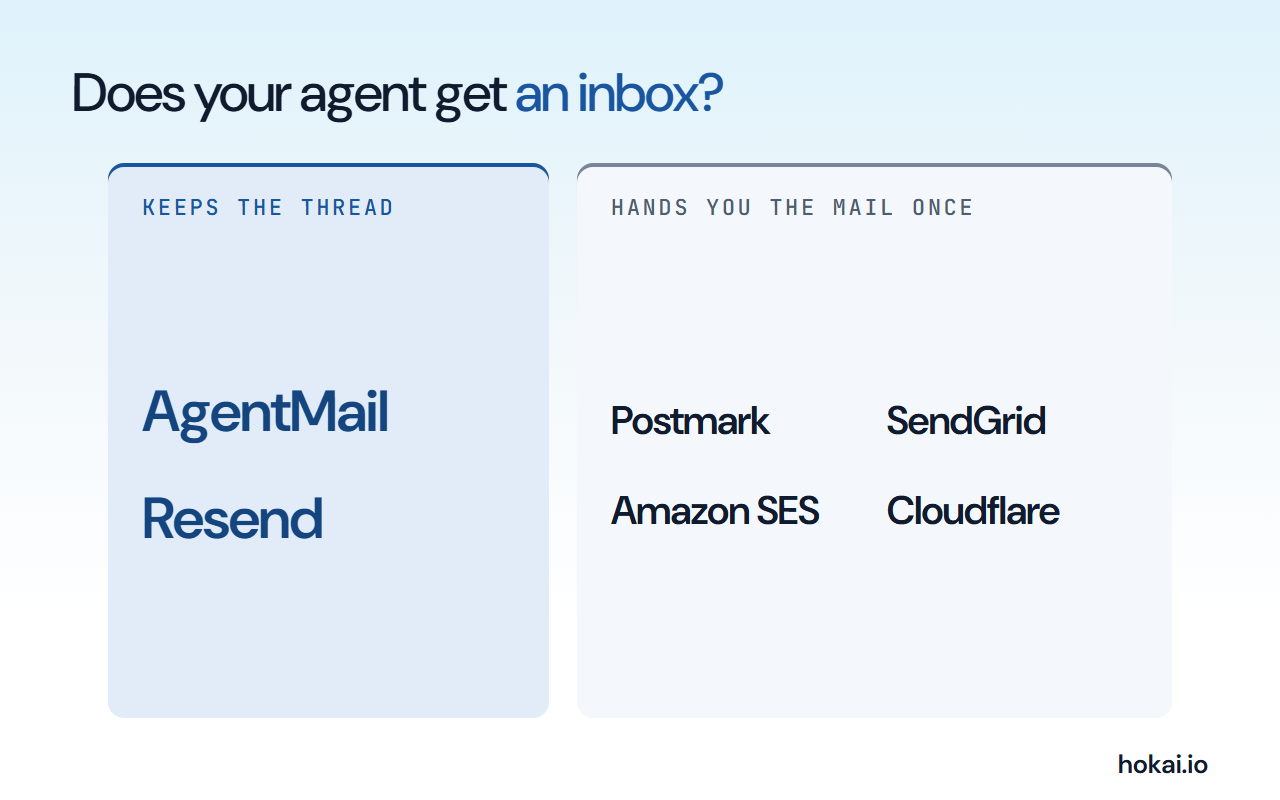 Hokai chart of which email APIs store conversations for an agent, from each vendor's docs and pricing pages as checked on 6 November 2026.
That launch split the market in two. Some email APIs now give an agent an inbox: an address whose messages are kept, grouped into threads and readable tomorrow. The rest send mail well and pass each incoming message to your server once, after which the conversation is yours to keep. So the first question is not price. It is whether your agent only talks, or also has to listen and answer.
This guide compares six services on that question, then on what they cost when mail flows both ways, what the free plans really allow, how long each keeps your data, and what stops a stranger's email from steering your agent. It is written for a developer on a small team wiring email into an agent: a support triage bot, a quote-sourcing agent, or a personal agent such as OpenClaw.
Disclosure: Hokai sends its own email through Resend as an ordinary customer. That buys Resend no placement here, and its limits are listed below with the same care as everyone else's.
Send-only or inbox: the split that sorts the market
A send-only API is built for mail that leaves your app: password resets, receipts, alerts. Postmark is the cleanest example of the type. SendGrid, Amazon SES and Cloudflare can all receive mail too, but each hands an incoming message to your code or your own storage once and moves on.
An inbox API keeps the message. AgentMail creates inboxes through its API and stores every message in threads with labels and drafts, and Resend's Inboxes do the same on a domain you own. Your agent can come back hours later, list what is unread, read the whole history and reply in the same thread.
That difference is real engineering work, not a feature tick. When a commenter on AgentMail's Launch HN thread asked why anyone would not just use Amazon SES, co-founder Haakam Aujla replied that inboxes, threads, search and replies are the missing piece: "None of this comes out of the box with SES." Skip the inbox layer and you write it yourself: storage, grouping replies into threads, search, and rules for deleting old mail.
- Inboxes on every Resend plan
- 3
- Extra inboxes need a paid plan
- Inboxes on AgentMail's Startup plan
- 150
- The plan built for fleets
- Amazon SES per 1,000 emails, each way
- $0.10
- A la carte pricing
- Outbound emails included on Cloudflare Workers Paid
- 3,000
- Inbound is not metered
How to choose an email API for an agent: five questions
These five questions settle most decisions before you open a pricing page. They work even if you ignore the shortlist below.
- Does the agent read replies, or only send? Send-only agents can use any of the six, and the choice comes down to price and logs. An agent that reads needs an inbox layer, bought or built.
- How many addresses? One support address is a different shape from one inbox per customer or per agent. Count them first, because inbox pricing varies far more than sending pricing.
- Does received mail use your quota? Resend and Postmark count inbound mail toward the same allowance as outbound, and Amazon SES bills it separately. Cloudflare routes inbound mail without metering it.
- Where does the agent run? An agent on AWS can read SES events natively, one on Cloudflare Workers gets an email hook, and one inside a desktop or coding client is easiest to wire through an MCP server.
- Who can write to it? An inbox that strangers can email is an input channel for prompt injection. Prefer a provider that lets you scan, hold or restrict mail, and plan a human approval step either way.
If the first answer is "only send", stop at the cost table. If it is "read and reply", the real choice is between AgentMail, Resend, and building the inbox yourself on a cheaper pipe.
The shortlist: six email services for agents, compared
All six were checked against the vendor's own pricing pages and documentation on 6 November 2026. The first table answers whether an agent gets an inbox; the second covers how an agent connects.
| Service | Stores threads for the agent | How inbound arrives | Free option |
|---|---|---|---|
| AgentMail | Yes, the core product | Webhooks, websockets, polling | 3 inboxes, 3,000 emails a month |
| Resend | Yes, Inboxes since Oct 2026 | Webhook or stored inbox | 3,000 a month, 100 a day |
| Postmark | No | JSON webhook, Pro and up | 100 emails a month |
| SendGrid | No | Inbound Parse webhook | 60-day trial |
| Amazon SES | No | S3, SNS or Lambda | Sandbox plus AWS credits |
| Cloudflare Email Service | No | Worker or Agents SDK hook | Inbound only on Workers Free |
| Service | Official MCP server | Best for |
|---|---|---|
| AgentMail | Hosted | Many agents, one inbox each |
| Resend | Hosted and local | App mail plus a few agent inboxes |
| Postmark | Local, 24 tools | Send-only alerts with long logs |
| SendGrid | None found for email | Teams already on Twilio |
| Amazon SES | Sample, not for production | Lowest cost on AWS |
| Cloudflare Email Service | Email MCP in Cloudflare's repo | Agents built on Workers |
"Official MCP server" means one the vendor publishes for its own email product. The Model Context Protocol (MCP) is how clients such as Cursor or Claude call outside tools by name, and our MCP servers guide explains how to vet one before handing it a key.
AgentMail: built so each agent owns an inbox
AgentMail was founded in 2025 in San Francisco and went through Y Combinator's Summer 2025 batch; YC's company page lists a team of 10. The inbox is the unit it sells. You create inboxes through the API, each one keeps threads, labels, drafts and attachments, and new mail reaches the agent by webhook, by websocket, or by a polling webhook that needs no public endpoint.
The extras are aimed squarely at agent builders. Pods keep each customer's inboxes and domains apart, a hosted MCP server is listed on every plan, and there is an official plugin for OpenClaw, which our OpenClaw playbook sets up end to end, plus a guide for the Claude Agent SDK. An agent can even request its own account; until a human verifies it, the docs say it gets one inbox and 10 emails a day, sent only to that human.
On price, the live pricing page lists Developer at $20 a month for 10 inboxes and 10,000 emails. Startup costs $200 a month for 150 inboxes and 15,000 emails a day, with a SOC 2 report included.
Where it pinches. Mail sent from the Free plan carries a "Sent via AgentMail" footer. EU hosting, dedicated IPs and SSO sit on Enterprise. And on 6 November 2026 its docs and its pricing page disagreed about the Free plan: the rate-limits article said there was no monthly cap, while the pricing page said 3,000 a month. Its docs describe the caps as sending limits, and we found no statement either way on whether received mail counts.
- Maker
- AgentMail, Y Combinator Summer 2025
- What you pay for
- inboxes, then sends, domains and seats as add-ons
- New mail arrives by
- webhooks, websockets or polling webhooks
- Safety extras
- Agent Armor scanning (Labs), allowlists and blocklists
- Watch
- the Free plan footer, and check limits on the live pricing page
Resend: app email first, now with inboxes for agents
Resend launched its sending platform in 2023, after starting as React Email, an open source project for building email templates. Inboxes, announced at its Resend Forward event and opened to every user, add stored threads on top: an address on your own verified domain where people and agents work the same conversations, with inbox, sent, archive, trash and spam folders built in.
Each inbox has a built-in triage agent you configure with written instructions and an allowlist of actions, such as drafting a reply or adding labels. Your own agents connect through the API, the CLI, or the official Resend MCP Server, which registers 136 tools in its source. Clients such as Windsurf can add the hosted version with an OAuth login instead of a pasted key.
The paid entry point is Pro at $20 a month for 50,000 emails with no daily cap, and Scale starts at $90 for 100,000.
Every plan includes 3 inboxes. Paid plans with pay-as-you-go switched on add more at $1 each per month, and the Free plan cannot add any.
Now the catches, all read from Resend's own pricing page.
The Free plan allows 3,000 emails a month but only 100 a day, and "each received email counts towards your transactional emails quota." Inbox mail has no allowance of its own, so a busy agent inbox can spend the day's quota before it sends a single reply. Free also gets one webhook endpoint and no fourth inbox. The pricing page lists 30 days of data retention for searching emails and logs on every plan below Enterprise, and upgrading never raises the per-team API rate limit.
Postmark: the careful sender with no inbox
Postmark, now run by ActiveCampaign, is the one to pick when the agent mostly sends and every message has to arrive. It keeps transactional and bulk mail in separate message streams, so a newsletter cannot damage the reputation that carries your login codes.
Its log retention is the longest among the send-only services here. Pro and Platform keep activity 45 days by default and let you extend it to 365, which matters when someone asks months later why an alert never arrived. The official MCP server from ActiveCampaign exposes 24 tools, each tagged read-only, destructive or idempotent, and a diagnoseDelivery tool answers "did this reach them?" in one call.
The limits are about receiving. Inbound processing parses mail to JSON and posts it to your webhook, but only on Pro or Platform, and there is no stored thread. Postmark prices by volume of emails "sent and received", so an agent that gets replies pays for both directions. The free developer plan gives 100 emails a month, and nothing sits between it and the 10,000-email paid tier.
SendGrid: the incumbent, priced for volume
SendGrid has belonged to Twilio since a deal completed on 1 February 2019, valued by Twilio at about $3 billion, and its website now redirects to twilio.com. It is built for scale: dedicated IPs with automatic warm-up on the higher plans, subusers for agencies, and an address validation API.
For a small agent it is a harder sell. The free option is now a trial of 100 emails a day for 60 days, then Essentials starts at $19.95 a month.
Searchable email activity covers 3 days on Essentials and 7 on Pro unless you buy extended history up to 30 days. The Inbound Parse webhook posts incoming mail to your server, and keeping the thread is your job. Twilio publishes an alpha MCP server for its public APIs, but its README does not mention SendGrid, and we found no SendGrid-specific one.
Amazon SES: the cheapest pipe, and the most assembly
Amazon SES is the email service that AWS meters per message. On its a la carte pricing, sending costs $0.10 per 1,000 emails and receiving costs the same, plus small charges for attachment data and for each 256 KB chunk of inbound mail.
Two 2026 details catch new users. AWS added bundled plans, and from 21 July 2026 new accounts start on Essentials at $0.16 per 1,000 unless you switch back to a la carte. And every new account starts in a sandbox, separately in each Region: verified recipients only, at most 200 messages in 24 hours and one per second, until AWS approves a production access request.
Receiving works through receipt rules that drop each message into S3, publish it to SNS or call a Lambda function. Threads, a readable inbox and any safety screening are yours to build. AWS's MCP server for SES is a sample whose README says it is not intended for production. SES fits an agent already running on AWS, ideally one owned by someone who enjoys plumbing.
Cloudflare Email Service: free inbound if you already run Workers
Cloudflare Email Service pairs Cloudflare's existing Email Routing with Email Sending, which entered public beta on 16 April 2026. For agent builders the draw is the Agents SDK: an agent gets an onEmail hook to receive, process and reply to mail in the same code that does everything else.
Pricing follows Workers. Inbound routing is unmetered on both Workers plans. Sending to anyone outside your verified addresses needs Workers Paid, whose minimum is $5 a month, and includes 3,000 emails before charging $0.35 per 1,000.
The trade-offs are clear in Cloudflare's own docs. Sending was still labelled beta on 6 November 2026, new accounts start on a conservative daily quota that grows with reputation, and each message is capped at 50 recipients. Nothing is stored for you: the examples save inbound mail to Workers KV, and the sent-mail preview lasts about seven days.
What it costs when mail flows both ways
Sticker prices compare sending. Agents also receive, so here is one month at 10,000 emails out and 10,000 in, using each service's cheapest plan that can do both. Received mail counts on Resend and Postmark, is billed per message on SES, and is free on Cloudflare.
| Service | Plan that fits | Monthly cost | How it adds up |
|---|---|---|---|
| Amazon SES | A la carte | About $2.90 | 10k out, 10k in, one chunk each |
| Cloudflare | Workers Paid | $7.45 | $5 plus 7,000 sends over the allowance |
| SendGrid | Essentials | $19.95 | No inbound charge listed |
| Resend | Pro | $20 | 20,000 of 50,000 used |
| AgentMail | Developer | $20 | 10,000 sends; inbound counting unstated |
| Postmark | Pro | $29.50 | 10,000 base plus 10,000 extra |
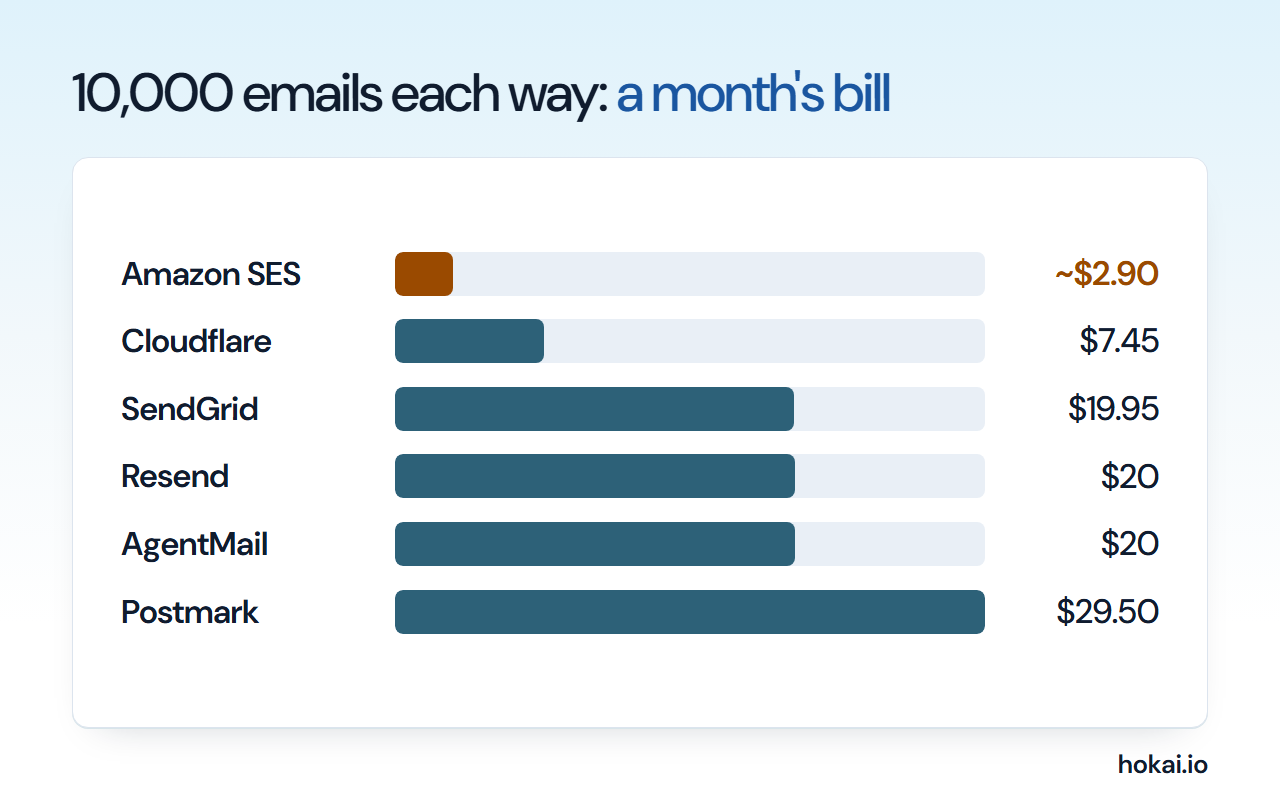 Hokai chart of the monthly cost of 10,000 emails each way, computed from each vendor's pricing page as checked on 6 November 2026; the SES figure assumes one inbound chunk per message.
On SES, sending and receiving 10,000 messages each costs $1 per direction, and the inbound chunk charge brings the total to about $2.90 if no message is larger than 256 KB.
Cloudflare comes to $7.45: the Workers plan minimum plus 7,000 sends at the overage rate. Neither figure includes the code you write to store and thread the mail.
Postmark lands at $29.50 because inbound counts toward volume and needs Pro: the plan's base covers 10,000 emails, and the second 10,000 are billed at $1.30 per 1,000. Resend fits the same traffic inside Pro's 50,000, and AgentMail's Developer plan covers 10,000 sends.
Inbox count changes the picture more than volume does. For two inbox APIs, the bill grows with addresses:
| Inboxes | Resend | AgentMail |
|---|---|---|
| 25 | $42 (Pro plus 22 extra) | $50 (Developer plus 15 extra) |
| 150 | $167 (Pro plus 147 extra) | $200 (Startup) |
Resend comes out cheaper per inbox on paper. The catch is volume: all of those inboxes share Pro's 50,000 emails, inbound included, while AgentMail's Startup plan allows 15,000 sends a day.
Free plans compared: what you can test without paying
Every free option here is enough to wire up an agent and watch one conversation. None is enough to run a busy one.
| Service | Free allowance | The catch |
|---|---|---|
| Resend | 3,000 a month, 100 a day | Received mail counts; 1 webhook |
| AgentMail | 3,000 a month, 3 inboxes | Footer on every sent message |
| Postmark | 100 a month | No inbound processing |
| SendGrid | 100 a day for 60 days | A trial, not a plan |
| Amazon SES | Up to $200 in AWS credits | Sandbox until approved |
| Cloudflare | Unlimited inbound routing | No sending to strangers |
The AWS credits apply to new AWS customers and must be used within 12 months of creating the account. Cloudflare's free tier still lets an agent mail verified addresses in your own account, so a listen-only agent that reports back to you can run without a bill.
Data handling: who keeps the conversation, and for how long
An agent inbox holds customer mail, so retention and location matter as much as features. This is what each service stores by default.
| Service | Stores mail for you | How long |
|---|---|---|
| AgentMail | Yes, in each inbox | By storage cap; 24-hour expiry on request |
| Resend | Yes, in Inboxes | 30-day email and log search below Enterprise |
| Postmark | Activity and content | 45 days, up to 365 |
| SendGrid | Activity log only | 3 to 7 days, 30 paid |
| Amazon SES | No, your S3 bucket | Your own rules |
| Cloudflare | No, your own store | Preview about 7 days |
On compliance, Resend lists SOC 2 Type II and GDPR on every plan, and AgentMail says it completed a SOC 2 Type II audit in 2025, with the report shared on Startup and above. AgentMail runs separate US and EU environments but sells the EU region only on Enterprise. Its optional 24-hour expiry ends access through AgentMail, though its docs note it cannot recall copies a webhook already delivered.
If you build on SES or Cloudflare, retention is entirely your policy. That is a burden and an advantage: nothing leaves your own storage, and nothing is deleted on a vendor's schedule.
Agents read untrusted mail: the safety controls on offer
Anyone can email an agent, which makes the inbox an easy place to plant instructions. AgentMail's Agent Armor, an opt-in Labs feature, scans each received message and marks it clear or review; in Hold mode, flagged mail is kept from your agents until a person releases it. AgentMail also supports allowlists and blocklists for who an agent can write to and hear from, and drops inbound mail that fails DMARC under an enforcing policy.
Resend's controls sit in configuration. Each inbox's built-in agent only takes the actions you enable, and the MCP server's send tool tells the model to ask the user before adding CC or BCC addresses. Its README also recommends an --allowed-file-dirs setting "to stop a prompt-injected agent" attaching files from elsewhere on disk.
Postmark's MCP tags each tool as read-only or destructive, so a client can ask before deleting anything. On SES, Mail Manager offers paid scanning add-ons from vendors including Trend Micro and Spamhaus. None of these replaces a human check on outbound replies to strangers, and our piece on where to put approval gates shows how to add one.
The rule every provider here shares: no cold outreach
These are transactional and agent services, not prospecting tools. Resend's instructions for agents rule out unsolicited bulk email and add that "recipients must have opted in". AWS asks how you collect addresses before lifting the SES sandbox. AgentMail's self-registered agents can only write to their own human until verified.
An agent that sources quotes by writing to suppliers it has never contacted is doing outreach, whatever it calls itself. If that is the plan, cold email is a separate category with its own tools and rules, compared in our Instantly vs Smartlead vs lemlist guide.
Who should skip all six
Not every email-and-AI problem needs an API account.
- You want AI inside your own Gmail or Outlook. That is an assistant, not infrastructure: our AI email assistants roundup covers tools such as Shortwave.
- You want one connector for every app. If the agent needs Gmail, Slack and a CRM more than its own address, a connector platform such as Composio may fit better than an email vendor.
- You run a support team. A help desk with AI built in may already own the inbox; see our customer support guide before building one.
- Your agent only needs to ping you. A chat message may be simpler than email, and agents that need a phone number instead are covered in what AgentPhone is for.
- You want to email strangers at volume. Use the outreach tools linked above, under their rules.
Still unsure which camp your project is in? Smart Match turns a short description of your agent and stack into a shortlist, and the email services directory lists all six providers side by side.
When the obvious pick is wrong
The strongest objection to buying an inbox API comes from the same Hacker News thread: one commenter said they could reach parity "in a weekend" on Cloudflare. For one address and a developer who likes plumbing, that is fair. Cloudflare routes inbound mail for free, SES sends for cents, and both hand you every byte.
What the weekend estimate leaves out is the second month. Someone has to store mail, group replies, search old threads, delete data on schedule and screen hostile messages, and each of those is code you maintain. At three addresses, Resend charges nothing extra for that layer; at 25, AgentMail charges $50 a month in total.
The reverse mistake costs money too. If your agent never reads replies, an inbox API is overhead: Postmark or SES will deliver alerts without charging for storage you never use, and Postmark keeps the longer logs. For agents assembled in frameworks such as Mastra, email is one tool among many, so start with the plain sender and add an inbox when replies start to matter.
A first week with an agent inbox
- Verify the domain Day 1Add the DNS records your provider generates, and enable receiving if it offers it.
- Create one inbox Day 1Start with a single address for one workflow, not one per agent.
- Connect the agent Day 2Use the vendor's MCP server or SDK; prefer OAuth over a pasted key.
- Restrict actions Day 2Allow drafting and labelling first; hold sending to unknown senders.
- Review every reply Days 3 to 7Read the agent's outbound mail for a week before widening its rights.
The connection step is short on both inbox services. These two commands come from the vendors' own docs: the first adds Resend's hosted MCP server to Claude Code, which then asks you to log in, and the second installs AgentMail's TypeScript SDK.
claude mcp add --transport http resend https://mcp.resend.com/mcp
npm install agentmail
Builders still choosing the agent itself can start with our agent builder guide. If the plan is a personal agent, weigh Hermes Agent against OpenClaw first; our head-to-head of the two compares them.
What would change this ranking
Four changes would move these picks, and each is a date to watch.
- Cloudflare takes Email Sending out of beta. Unmetered inbound plus cheap sending would make it the default pipe for agents on Workers.
- Resend separates inbound from its quota, or raises the free daily cap. That would remove its biggest pinch for receive-heavy agents.
- AgentMail aligns its docs and states how received mail counts. Clearer limits would make its pricing easier to plan around.
- Postmark or SendGrid adds stored threads. Then the inbox-or-webhook split would collapse into a price comparison.
The one to watch first is Cloudflare. If Email Sending leaves beta at $0.35 per 1,000 with inbound still free, the cheapest way to give an agent email becomes a Workers project, and the inbox layer becomes the only part left worth paying for.
Frequently asked questions
Do I need a special email API for an AI agent?
Only if the agent has to read and answer mail over time. An agent that just sends alerts or receipts works with any transactional API. One that holds conversations needs stored, threaded mail, which you either buy from an inbox service or build on top of a cheaper sender.
Does received email count toward my sending limit?
On Resend it does: each received message, including inbox mail, uses the same monthly allowance as outgoing mail. Postmark also bills by emails sent and received, and Amazon SES charges per received message. Cloudflare routes inbound mail without metering it, and AgentMail's documentation describes its caps as sending limits without saying how inbound counts.
Can an AI agent sign up for its own email address?
AgentMail lets an agent call a sign-up API and get its own key. Until a human verifies the account, the agent is limited to one inbox and a handful of messages a day, and may only write to that human. The other services here expect a person to create the account and verify a domain first.
Which email APIs have an official MCP server?
AgentMail and Resend both host official MCP servers, and Resend also publishes the same server as an open source package. Postmark's official server comes from ActiveCampaign and covers sending and delivery diagnostics, not inboxes. Cloudflare keeps an email MCP server in its own repository, while AWS only offers a sample for SES and we found no SendGrid-specific server.
Can I use these APIs for cold outreach from an agent?
No. They are built for mail people expect, and Resend's guidance for agents says recipients must have opted in, while AWS asks how you collect addresses before it lifts the sandbox. Prospecting at volume belongs to dedicated cold email tools, which follow their own deliverability rules.
Covered in this guide
- AgentMail: Email inbox API from a Y Combinator Summer 2025 startup that creates inboxes on demand for AI agents, with threads, webhooks, websockets and an MCP server.
- Amazon SES: Amazon Simple Email Service sends and receives email at $0.10 per 1,000 on a la carte pricing, with receipt rules that hand mail to S3, SNS or Lambda.
- AWS: Amazon Web Services (AWS), launched 2006, is the world's largest cloud platform: $128.7B FY2025 revenue, roughly 29% global market share, and 200+ services.
- Cloudflare's: Cloudflare, founded in 2009, runs a network in 335 cities and sells Workers AI, AI Gateway and Vectorize beside its security and CDN products.
- Cloudflare Email Service: Cloudflare email routing and sending for Workers, with unlimited inbound and an Agents SDK onEmail hook; sending has been in beta since April 2026.
- Composio: Agents call one Composio endpoint to search, authorise and run tools across hundreds of apps; 11 meta-tools, OAuth handled for you.
- Cursor: Cursor is an AI code editor built on VS Code, widely adopted across large enterprise engineering teams, with Agent Mode, Tab completion, and Cloud Agents.
- Hermes Agent: Hermes Agent is Nous Research's MIT-licensed self-improving AI agent, past 250,000 GitHub stars by October 2026. Self-hosted, model-agnostic, with optional paid Nous Portal plans.
- Mastra: Open-source TypeScript framework for building AI agents and workflows, routing to 90+ model providers through one interface.
- OpenClaw: OpenClaw is a free, MIT-licensed agent gateway: one self-hosted process connects your chat apps to the AI model you choose, with the OpenClaw Foundation as steward.
- Postmark: Transactional email API from ActiveCampaign with inbound parsing on Pro, up to 365 days of activity retention, and an official 24-tool MCP server.
- Resend: Developer email API for transactional and marketing mail that added Inboxes in October 2026, so each AI agent can own an address on your domain.
- Resend MCP Server: Resend's official MCP server, MIT-licensed with 136 tools, lets Claude, Cursor or Codex send email, read inbox threads, reply and manage domains.
- SendGrid: Twilio's email API, acquired in a deal valued at about $3 billion in 2019, for transactional and marketing mail with an Inbound Parse webhook.
- Shortwave: The world's smartest AI email assistant: organize, write, and automate your inbox with natural language prompts
- Windsurf: Windsurf, now Devin Desktop from Cognition, is a VS Code-based editor with local and cloud agents, free with unlimited Tab and Pro at $20 a month.
Sources
Still deciding?
This guide covers a handful of options. Smart Match checks every listing in the directory against how you actually work and what you can spend, then hands you the shortlist and the reason behind each pick.
Find your toolsRelated guides
- AI Development Services in 2026: Which Layer You Actually NeedBuyer's guideHow to pick, across a category
- The AI Tool Ecosystem in 2026: Buy the Meter, Not the CategoryBuyer's guideHow to pick, across a category
- Attio vs HubSpot in 2026: Which CRM for a Startup?ComparisonHead-to-head, with a verdict
- Best Autonomous AI Agents in 2026: How Much Control to Hand OverBuyer's guideHow to pick, across a category
- Best AI App Builder in 2026: Pick by What You're BuildingBuyer's guideHow to pick, across a category
- Best AI Assistant for Office Work in 2026Buyer's guideHow to pick, across a category