What AgentPhone Is Actually For
AgentPhone is a Y Combinator-backed telephony API provisioning US or Canada phone numbers for AI agents, handling calls and SMS through one webhook with a native MCP server. As of September 2026 it has not published per-minute pricing, unlike rivals AgentCall and Plivo, and does not provision numbers outside the US and Canada.
The short version
AgentPhone gives an AI agent a US or Canada phone number in minutes through a native MCP server, which suits developers building inside Claude Code or Cursor. It has not published a per-minute rate anywhere, and rivals AgentCall and Plivo both disclose theirs once you check.
A Y Combinator company with two employees now provisions a phone number for an AI agent in about the same time it takes to run an npm install. AgentPhone hands a Claude Code or Cursor session a working US or Canada number, a webhook for calls and texts, and a native MCP server, with no carrier account and no phone number vendor to negotiate with first. The same server works from Windsurf too.
That is a genuinely useful shortcut for a narrow job: a developer already building an agent inside an MCP client who needs that agent to make or receive a real call today. It is not, on the evidence AgentPhone itself publishes, a default pick for anyone building telephony into a product at any scale, because the two things a buyer checks first, price and reach, are the two things AgentPhone will not put on a page.
What Is AgentPhone, Actually
AgentPhone is built by Manav Modi and Meet Modi, according to the company's Y Combinator profile (Spring 2026 batch), and run out of San Francisco with a two-person team. Meet Modi's listed background is AI agent infrastructure work at Meta for WhatsApp, which serves more than 280 million businesses. That is a specific, checkable credential, not a marketing line.
The product itself is infrastructure, not an AI model. AgentPhone's own governance disclosure states plainly that transcription and text-to-speech are "pass-through integrations with third-party providers," the same arrangement used across most conversational AI platforms, where a company like Speechmatics supplies the speech-to-text layer underneath someone else's product.
AgentPhone does not train or run a proprietary model; it routes calls, texts and the resulting transcript to whatever agent code, and whatever underlying model, is driving that code. That could be Claude Opus 5, a comparable model from Anthropic or OpenAI, or several models routed through a gateway like AIML API instead of one vendor's SDK hardcoded in. A team picking among them can check the current model leaderboard rather than defaulting to whichever one shipped a demo first.
Six features do the actual work, per AgentPhone's own site and GitHub organization:
- A unified webhook that delivers voice calls and SMS in one identical event format
- Real-time call transcription, so agent code only ever touches plain text
- Instant number provisioning for US and Canadian numbers, with area code selection
Three more round out the list:
- A native MCP server, installable with a single command, for Claude Code, Cursor, Windsurf, Zed and other MCP clients
- Official Python and Node.js SDKs, with confirmed support for Google's Agent Development Kit, LangChain and Replit
- GitHub integrations covering CrewAI, the OpenAI Agents SDK, and a Sentry-on-call tool that turns production alerts directly into phone calls
That last item is worth sitting with. AgentPhone's own sentry-on-call GitHub repository converts a monitoring alert into a phone call, which is a real, specific, oddly compelling use case: an on-call engineer gets rung by an agent instead of paged by a bot. The company's own MCP server repository sits at 121 stars, last updated August 29, 2026, and a separate Claude Code plugin repository was updated as recently as September 4, 2026. This is active, not abandoned.
Who This Affects
LangChain and Replit are both named as early adopters on AgentPhone's own Y Combinator profile, alongside teams at Google's Agent Development Kit. That is a specific, sourced claim about who is actually using this today, not a guess about who might.
The fit is narrow and real: a solo developer or a three-to-six person team already writing agent code inside Claude Code or Cursor, who wants that agent to answer a call, send a confirmation text, or leave a voicemail, without first becoming a telephony engineer. AgentPhone's MCP server means provisioning a number is a conversation with the coding agent, not a separate integration project. For an appointment-reminder bot, a two-factor callback flow, or an outbound sales-qualification agent still in prototype, that speed is the entire value proposition.
It fits less well the moment a team needs a phone number outside the United States or Canada, needs a documented compliance posture beyond SOC 2 Type I, or needs to know this month's telephony bill before finance signs off on it.
What To Do Before You Start
Getting a working number takes minutes, but four things need to be true first, based on what AgentPhone's own docs and GitHub repositories actually document rather than what the landing page implies:
- An MCP-compatible client already in use, since the fastest path assumes one; the plain REST API and the Python or Node SDKs exist for everyone else, but lose the one-command setup:
npx agentphone-mcp- Tolerance for unknown unit economics, since no per-minute or per-message rate is published anywhere the company controls
- A US or Canada use case only, with no near-term plan that depends on a number in another country
- A willingness to route anything regulated (health data, payment verification, anything HIPAA-adjacent) around AgentPhone rather than through it, given its own compliance data marks HIPAA coverage as false
A team that cannot check all four honestly is choosing AgentPhone on vibes rather than fit, which is exactly the gap this piece exists to close.
Who Should Skip It
Three groups get a worse deal from AgentPhone than from an alternative already on the market:
- Teams serving customers outside the US and Canada, since AgentPhone provisions numbers in those two countries only, unlike Plivo's 150-plus country network
- Anyone who needs a quoted, published price before committing engineering time, since AgentPhone's pricing page states no rates at all
- Teams that need HIPAA coverage specifically: AgentPhone's own compliance data marks it as not HIPAA compliant, unlike some category peers
None of these are hidden. They are simply not on the homepage, which is a different problem than being false.
What It Costs, As Far As Anyone Can Tell
AgentPhone's pricing page carries no numbers at all, only a prompt to book a call with the team. Its own documentation FAQ, read on September 18, 2026, is more specific but still incomplete: every account starts with five dollars of free credit and no card required, phone numbers cost three dollars a month each, and an optional call-recording add-on runs five dollars a month.
What the FAQ does not state anywhere is a per-minute voice rate or a per-message SMS rate, the two numbers that actually determine a real bill at volume. AgentPhone has not published them on its site, in its docs, or in its GitHub repositories.
That gap looks different once it sits next to the two closest points of comparison.
| Platform | Starting cost | Published per-minute voice rate | Geographic reach | MCP support |
|---|---|---|---|---|
| AgentPhone | $5 free credit, $3/mo per number | Not published | US, Canada | Yes, native |
| AgentCall | Free tier; Pro at $19.99/mo + usage | $0.035/min voice, $0.40/min managed AI voice | Not specified on pricing page | Yes: Claude, Cursor, Windsurf |
| Plivo | $10 free credit | $0.0010/min outbound, $0.0028/min inbound, $0.03/min AI voice add-on | 150+ countries | No |
Sources: AgentPhone docs FAQ and pricing page (accessed 2026-09-18), AgentCall homepage (accessed 2026-09-18), Plivo pricing page (accessed 2026-09-18).
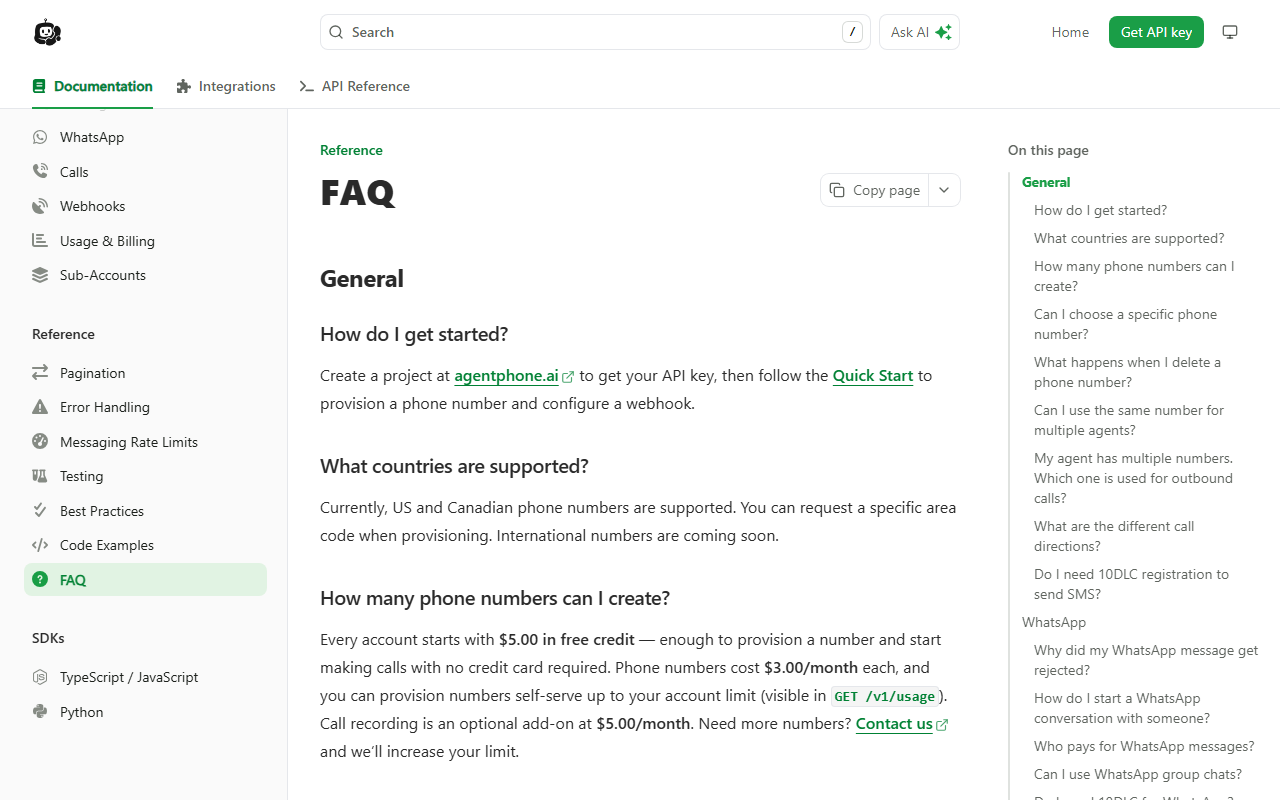 AgentPhone's own FAQ, captured 18 Sep 2026. Fixed fees are documented; per-minute and per-SMS rates are not.
Plivo's numbers are the most transparent of the three by a wide margin, and they come with carrier-grade reach: over 150 countries, a stated 99.99% platform uptime, and a no-code agent studio for teams that would rather describe a voice flow in plain English than assemble one from a Python SDK. Its published AI voice agent add-on, thirty thousandths of a dollar per minute on top of telephony, is the only one of the three anyone can put in a spreadsheet without calling sales first.
The Direct Competitor Nobody Compares On Numbers
AgentPhone has a close, direct rival: AgentCall, which describes itself as programmable phone numbers for AI agents and already publishes a comparison post pitting itself against AgentPhone by name. AgentCall's own pricing, read from its homepage on September 18, 2026, includes a free trial (one US number, five inbound AI minutes over 72 hours), a Pro tier at $19.99 a month plus usage, and an upcoming Agent Startup tier at $189 a month.
It also ships caller memory, persistent context across calls, on every plan, which it markets directly against Vapi, Bland and Retell AI for not including that by default.
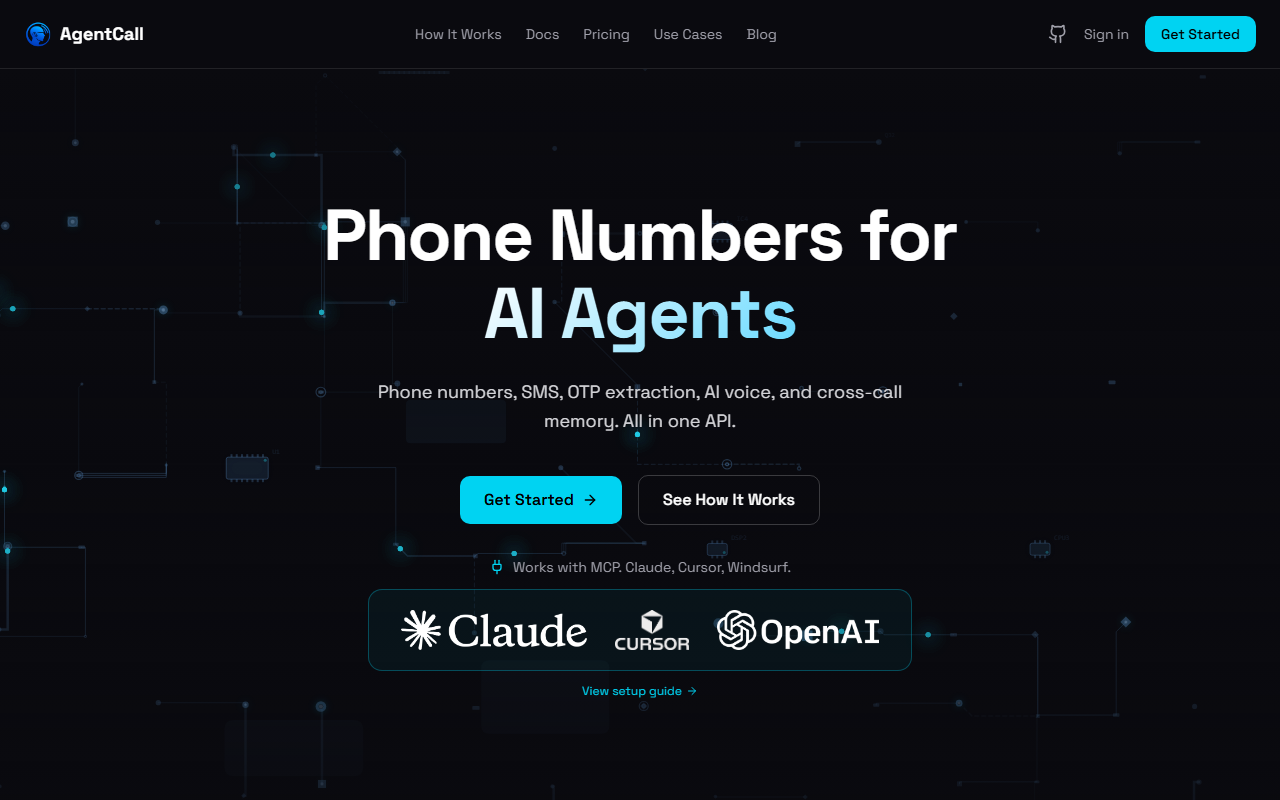 AgentCall's homepage, captured 18 Sep 2026. It advertises the identical MCP client list AgentPhone does, which is why the pricing gap below matters more than the MCP feature itself.
The two products converge on the exact same MCP client list: Claude, Cursor and Windsurf. That convergence matters more than either company's marketing copy suggests.
The Turn: MCP-Native Is Not the Differentiator It Sounds Like
AgentPhone's pitch leans hard on being MCP-native, and the feature is real: a working phone number reachable from inside a coding agent's own tool-calling loop, with no custom API wrapper. The strongest case against treating that as a real advantage is that AgentCall ships the identical MCP integration, for the identical three clients, and does it while publishing a price.
If the two products cover the same clients the same way, the thing actually separating them stops being the MCP support. It becomes everything AgentCall discloses that AgentPhone does not: a visible price, a free trial with a stated minute cap, and caller memory built into every plan rather than left to the developer to wire up.
An MCP server is table stakes in this category now, not a moat. What still differs is whether a team can budget for the bill before they sign up, or whether the job actually calls for a full conversational platform from the AI voice assistants category, like Retell AI, instead of raw telephony infrastructure at all.
Data Handling and Compliance
AgentPhone lists SOC 2 Type I certification on its own marketing site, verified by AICPA, and its stored governance data marks HIPAA compliance as false and its EU AI Act status as minimal risk, on the reasoning that it is an infrastructure layer with no autonomous decision-making of its own. That framing is defensible: AgentPhone does not decide what the agent says, it only carries the call.
But it also means the actual privacy and retention posture of a conversation running through AgentPhone depends on whichever model and agent framework sits on top of it, not on AgentPhone itself.
A team evaluating this for anything touching patient data, financial account verification, or another regulated flow needs the compliance answer in writing before the number is provisioned, not after the first production call.
What to Watch
Two things would change this piece's verdict. If AgentPhone publishes a per-minute voice and SMS rate on its own pricing page, the single biggest objection to it disappears, since the product itself already works and the ecosystem of confirmed early adopters (LangChain, Replit, Google's Agent Development Kit) suggests real usage, not just a demo.
If it expands provisioning past the US and Canada, it stops being disqualified for any team with international customers by default. Neither has happened as of September 18, 2026. Anyone evaluating it before then should ask for the actual per-minute number directly, in writing, before writing any integration code against it.
For a team still deciding which telephony layer to wire an agent into at all, running the exact same job, answer a call, send a text, transcribe a conversation, through more than one candidate before committing is the difference between a two-hour prototype and a rebuild in three months. HokAI's Smart Match exists for exactly that comparison, matched against the constraints that actually apply: budget, geography and compliance, not just which MCP clients a landing page lists.
Two related decisions tend to follow this one. If the same team is also choosing the coding agent that will write the integration, HokAI's guide to the best AI coding assistants covers that separately. If the question is build-versus-buy for the whole agent rather than just its phone line, the AI agent builders guide is the more relevant read.
Anyone stacking a fuller voice pipeline on top of AgentPhone's pass-through transcription should read the AI voice assistants guide, since the actual STT and TTS choice discussed there is exactly what AgentPhone leaves to the developer.
AgentPhone earns its place for the one job it was built for: a developer inside Windsurf or a similar MCP client who wants an agent on the phone this afternoon. It has not yet earned the case for anything past that, and it has not tried to, since it has not published the numbers that case would require. Compare it against the full AI SDK category before picking, since category neighbors including n8n solve adjacent orchestration problems the phone layer alone will not.
Frequently asked questions
How much does AgentPhone cost?
AgentPhone's documentation states a $5 free credit with no card required, a $3 per month fee for each phone number, and an optional $5 per month call-recording add-on. It has not published a per-minute voice rate or a per-SMS rate anywhere on its site, docs, or GitHub as of September 2026.
Does AgentPhone work outside the US and Canada?
No. AgentPhone provisions phone numbers in the United States and Canada only. A team needing international coverage should look at an alternative like Plivo, which covers more than 150 countries.
Is AgentPhone HIPAA compliant?
No. AgentPhone's own compliance data marks HIPAA compliance as false, though it does hold SOC 2 Type I certification verified by AICPA. Teams handling patient data should get written confirmation of the compliance posture before sending any covered data through it.
How is AgentPhone different from AgentCall?
Both provide phone numbers for AI agents with native MCP support for Claude, Cursor and Windsurf. The practical difference is disclosure: AgentCall publishes its pricing, including a free trial and a $19.99 monthly Pro tier plus usage, while AgentPhone requires booking a call to learn its rates.
Who is actually using AgentPhone?
AgentPhone's Y Combinator company profile names early adopters at LangChain, Replit and Google's Agent Development Kit team. The company's GitHub organization also shows integrations for CrewAI and the OpenAI Agents SDK, with recent commits as of September 2026.
Covered in this guide
- AgentPhone: AgentPhone gives any AI agent its own US or Canadian phone number via 1 API call, with unified voice, SMS, real-time transcription, and built-in MCP support.
- Plivo: AI voice agents layered on Plivo's own carrier-grade telephony, billed at $0.03 per agent minute plus metered telephony fees.
- AIML API: Unified gateway to 1000+ AI models from one OpenAI-compatible endpoint. Access GPT-5, Claude Sonnet 5, Sora 2, and Flux. No free plan — pay-as-you-go from a $20 prepaid credit.
- Anthropic: Anthropic, founded 2021 by 7 ex-OpenAI researchers, builds Claude and was valued near $965B after its May 2026 Series H round.
- Claude Opus 5: Anthropic's July 2026 flagship LLM, with a 1M token context window by default and a new xhigh reasoning-effort mode for long agentic runs.
- LangChain: Observe, evaluate, and deploy reliable AI agents
- n8n: AI workflow automation platform for technical teams
- OpenAI: OpenAI builds the GPT-5.6 model family (Sol, Terra, Luna), o3, ChatGPT (900M+ weekly users), and the OpenAI API. Closed a $122B round at an $852B valuation in March 2026, the largest private funding round in history.
- Replit: Cloud coding environment where you describe an app in plain English and AI builds and deploys it.
- Retell AI: Retell AI builds and deploys realistic AI phone agents with 600ms latency, handling 50M+ monthly calls, and HIPAA/SOC 2 compliance. Rated 4.8/5 on G2 by 1,414 teams.
- Speechmatics: Speech-to-text API from Cambridge UK covering 55+ languages. Medical model at 93% accuracy, on-prem deployment. Free 4 hrs/month, on-demand from $2.75/hr.
- Windsurf: Windsurf is an agentic AI IDE by Cognition AI featuring Cascade agents, Codemaps, and integrated Devin cloud workflows — used by developers in 70+ languages, starting free with Pro at $20/month.
Sources
Still deciding?
This guide covers a handful of options. Smart Match checks every listing in the directory against how you actually work and what you can spend, then hands you the shortlist and the reason behind each pick.
Start Smart MatchRelated guides
- AI Development Services in 2026: Which Layer You Actually NeedBuyer's guideHow to pick, across a category
- The AI Tool Ecosystem in 2026: Buy the Meter, Not the CategoryBuyer's guideHow to pick, across a category
- AIML API vs OpenRouter: Which AI Gateway Should You Use in 2026?ComparisonHead-to-head, with a verdict
- Best AI Coding Assistants in 2026: Pick the Job, Not the BrandBuyer's guideHow to pick, across a category
- Best AI Companies in 2026: Who Is Actually LeadingBuyer's guideHow to pick, across a category
- The Best AI for Qualitative Data Analysis in 2026 Depends on What You Already HaveBuyer's guideHow to pick, across a category