The Best AI for Qualitative Data Analysis in 2026 Depends on What You Already Have
AI for qualitative data analysis falls into two categories: AI-moderated interview platforms like Listen Labs and Conveo that gather new research data, and coding software like Dovetail, NVivo, ATLAS.ti and MAXQDA that analyzes existing transcripts through AI-assisted theme clustering and code suggestions.
The short version
Best AI for qualitative data analysis splits into two jobs: Listen Labs and Conveo gather new interviews, while Dovetail, NVivo, ATLAS.ti and MAXQDA analyze transcripts you already have. None publish self-serve pricing except Dovetail's free plan. Listen Labs' pending Salesforce acquisition is the one live risk worth watching before signing a contract with any vendor here.
Salesforce is reportedly weighing a $2 billion purchase of Listen Labs, the AI research startup whose interview platform this guide names first.
That deal is still unconfirmed, but the fact that it is even on the table tells you something about a category most buyers search for expecting a stable shortlist. The market for AI-moderated research splits into two purchases that barely overlap: tools that gather brand-new interviews, and tools that analyze data a team already has sitting in a folder.
A search for "best AI for qualitative data analysis" usually means one or the other, and picking from the wrong half wastes more budget than picking the "wrong" vendor within the right half. The tools below were checked against their own pricing and product pages this week, not against a roundup that copied last quarter's numbers forward.
How to Choose: Are You Gathering Data or Analyzing What You Already Have
Most roundups on this topic list eight to ten tools in one flat table. That is honest about how crowded the market is, but it skips the one question that actually narrows the list.
Gather. A research question exists but no interviews do yet, and the job is designing a study, recruiting participants and running the conversation. Listen Labs and Conveo sit here.
Analyze. Transcripts, support tickets or open-ended survey text already exist, and the job is coding it, clustering it into themes and summarizing it. Dovetail, NVivo, ATLAS.ti and MAXQDA sit here.
Buying an interview platform to solve a backlog of uncoded transcripts is buying a research agency replacement for a filing problem. The opposite mistake is just as common: buying coding software, then still scheduling and running every interview by hand, the exact six-to-eight-week cycle the gather tools exist to shrink.
Three questions settle which half of the list applies before opening a single pricing page.
- Does a transcript or survey export already exist for this project? Yes points to the analyze half; no points to the gather half.
- How many studies does this team run in a year? Under 10 rarely justifies either category's contract minimums.
- Would a server breach expose the underlying data? Health, legal or unreleased-product content changes which certifications matter.
The Shortlist for Gathering New Interviews
Both tools in this half of the market sit inside HokAI's conversational AI research and survey category, a directory section that also covers voice agents built for unrelated jobs, so browsing the category alone will not separate the two uses.
Listen Labs, founded in 2023, runs the interview itself. An insights team describes a goal in plain English, the platform drafts a discussion guide, and it recruits from a panel the company now states as 50 million-plus possible respondents. An AI moderator then conducts video, audio or text interviews in more than 120 languages, asking dynamic follow-up questions.
A report with highlight reels typically lands inside 24 hours. Every path on the company's site leads to booking a demo rather than a signup form. Typical annual contracts start around $20,000, plus per-session costs in the low hundreds of dollars, priced as a custom enterprise deal.
Named customers on Listen Labs' own site include Microsoft, Canva and Anthropic. A Microsoft research manager has described compressing a global customer-story project from six to eight weeks down to a single day using the platform.
Conveo: The Smaller Alternative to Listen Labs
Conveo runs the same basic job at smaller scale. Its own AI moderator interviews and analyzes users on video, built on a $5.3 million Y Combinator-backed seed round, well under the roughly $69 million Listen Labs raised in its January 2026 Series B. Conveo's contracts are custom too, metered in prepaid credits that draw down by the interview minute instead of a single yearly sum.
HokAI's dedicated coverage of the Listen Labs acquisition talks found Conveo's cost for comparable study volume runs noticeably higher than Listen Labs' entry price. Check that against your own expected volume before assuming the smaller, less-funded vendor is automatically cheaper.
Neither platform publishes self-serve pricing, and neither removes a human researcher's judgment from study design or final interpretation. What both replace is the calendar time a traditional research agency needs: a four-to-eight-week cycle of scheduling, moderating and manually transcribing sessions before analysis can even begin, compressed here into a process that starts producing usable interview data within days of a study going live.
That compression is the entire pitch, and it is also the thing a buyer should stress-test in a demo rather than take on faith: ask to see a full report from a real past study, not a curated highlight reel, before signing a year-long contract on the strength of a sales conversation alone.
The Shortlist for Analyzing Data You Already Have
Search "qualitative data analysis software" outside AI-focused publications and a different set of names dominates: Dovetail, NVivo, ATLAS.ti and MAXQDA. None of these run interviews. They take a customer transcript, a batch of open-ended survey answers or a folder of support tickets, and help a person code it into themes.
Dovetail has simplified its own pricing to two tiers as of this research. A Free plan at $0 covers one project and one feedback channel, with access to AI Chat. An Enterprise plan at custom pricing adds unlimited channels, projects and "AI Agents" that track feedback signals continuously. Its AI features also include automatic theme clustering, generated summaries and dashboards, and translation across 75 languages.
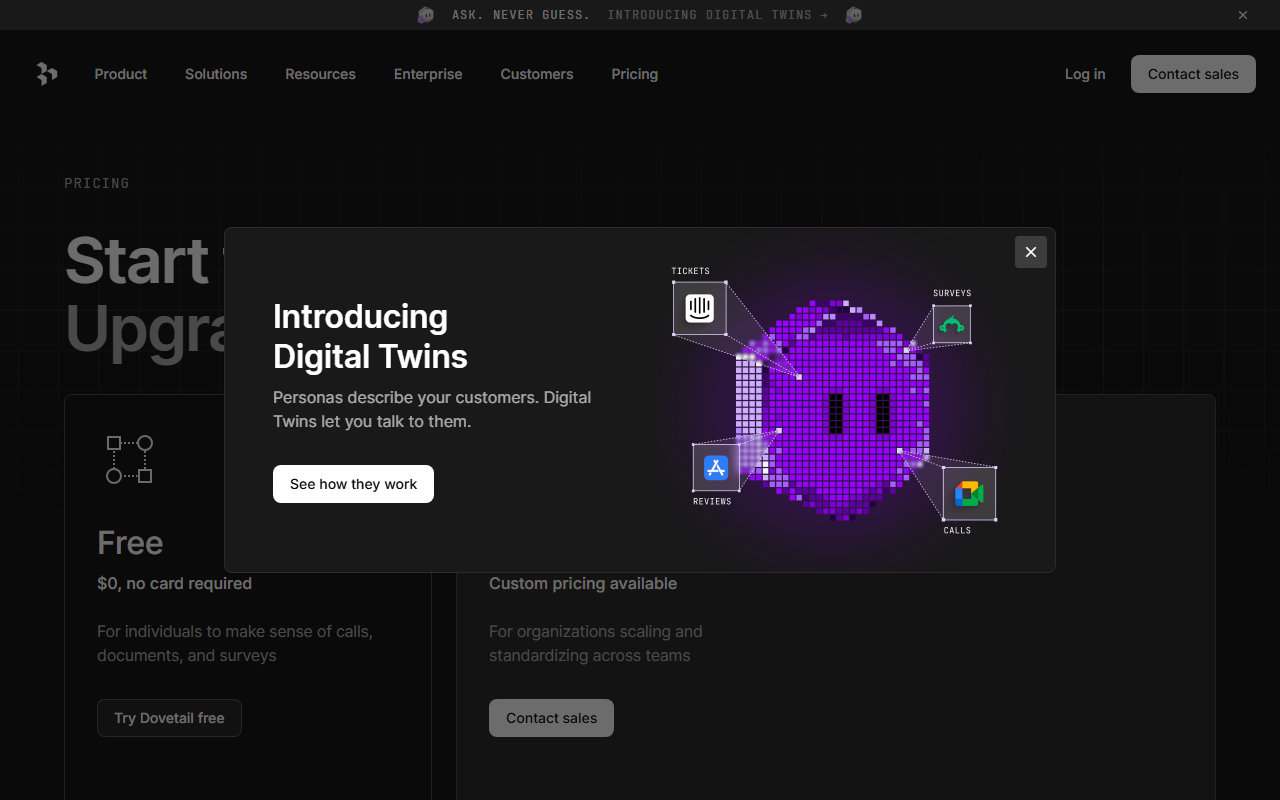 Dovetail's pricing page, captured 18 Sep 2026, behind a "Digital Twins" launch promo the company has not removed. The two tiers underneath are unchanged: a permanent free plan and a custom quote, nothing in between.
NVivo, ATLAS.ti and MAXQDA are the older, university-rooted tools here, and all three have added AI to a workflow built around manual coding rather than rebuilding around it. NVivo's maker, Lumivero, sells its AI as a separate paid add-on: an "AI Assistant" listed at $250 a year, on top of whatever the base license tier costs.
Lumivero also sells a $499-a-year transcription add-on, and the base license price itself requires picking a commercial tier to see. MAXQDA follows a similar pattern with its own "AI Assist," split into a free tier for occasional single prompts and a paid premium tier sold in 6-month or 12-month blocks for frequent use.
Both MAXQDA and NVivo offer a 14-day free trial of the full product. ATLAS.ti supports coding across text, audio, video and images, wider format coverage than the other two, but caps its trial more tightly at five active-use days inside a 20-day window. An unfinished project past that window reverts to a 10-document, 50-quotation limit rather than locking outright.
What Everything Actually Costs
| Tool | Job | Entry price | Free option | What the AI does |
|---|---|---|---|---|
| Listen Labs | Gather | ~$20,000/year contract + per-session fee | Demo only, no free tier | Designs guide, recruits panel, moderates interview, writes report |
| Conveo | Gather | Custom, prepaid per interview-minute | Demo only, no free tier | Moderates video interviews, analyzes responses |
| Dovetail | Analyze | $0 (1 project) or Enterprise custom | Yes, permanent free plan | Clusters themes, summarizes, chat over your data |
| NVivo | Analyze | Base license + $250/yr AI add-on | 14-day trial | Coding suggestions, sentiment, $499/yr transcription add-on |
| ATLAS.ti | Analyze | Subscription via online shop, custom | 5 active days in 20 | Coding suggestions across text, audio, video, image |
| MAXQDA | Analyze | Base license + paid AI Assist add-on | 14-day trial, free AI Assist tier | Coding suggestions, 50+ language transcription |
A paragraph is a poor place to compare six prices at once, which is why this is a table and not a sentence. None of the six vendors above publish a number a buyer can act on without a sales call or a signup flow. HokAI's own pricing verification checklist covers what to ask a vendor before signing when its site gives no figure.
What 14 Days of a Free Trial Can and Cannot Show You
A trial is only useful if it can complete one full cycle of the work a team actually does, and the trial lengths above are not interchangeable.
MAXQDA and NVivo both give a full 14 calendar days, enough time to import a batch of existing transcripts, build a codebook, run the AI's coding suggestions against it, and check the output against a researcher's own read of the same data. ATLAS.ti's shorter window rewards a team that plans the trial as one concentrated week rather than spreading a look at the tool across a month of spare afternoons.
NVivo's trial is harder to use well for a second reason on top of the shorter comparison: the AI Assistant and transcription features are separate add-ons layered on top of the base license, so trialing the free base product alone will not show what the AI-assisted workflow actually looks like.
That add-on structure is about to change. Lumivero's own shop currently advertises "NVivo AI Cloud" arriving October 6, 2026, described as AI-native and methodology-first, with existing subscribers who buy now getting access the moment it launches. Whether that folds today's separate $250 and $499 add-ons into the base product, or simply adds a third paid layer, is not yet published anywhere on the site.
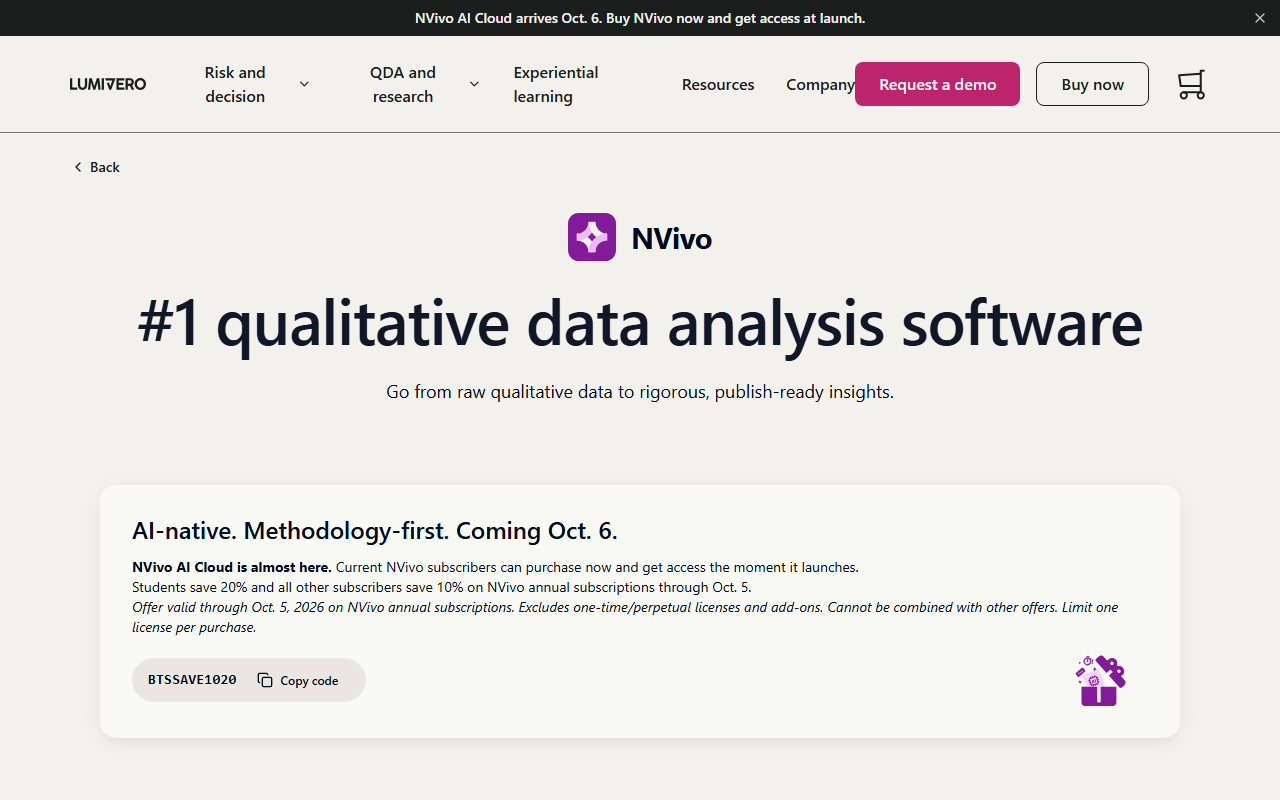 Lumivero's NVivo shop, captured 18 Sep 2026. A new AI-native product is announced for October, ahead of any detail on how it changes today's add-on pricing.
Dovetail sidesteps the trial question entirely: its free plan never expires, so a team can test theme clustering and summarization against real data indefinitely before deciding whether the Enterprise jump is worth it. That is the one structural advantage its two-tier pricing holds over every subscription-tiered competitor above.
Listen Labs and Conveo skip trials in favor of a sales demo, which tests the sales conversation more than the product itself. Neither company offers a self-serve way to run one real study before signing a contract.
Who Should Skip All of This
- Fewer than 10 interviews a year. Setup time and contract minimums outweigh what either half of this list saves at low volume. HokAI's guide to picking the right AI for a specific research job fits occasional, smaller-scale work better.
- Data too sensitive for a vendor's panel or servers. Legal, medical or unreleased-product research often cannot leave an internal system at all, no matter how many certifications a vendor lists.
The honest answer for that last case is an internal tool or a negotiated data-processing agreement, not a shortlist pick from this guide. A third group belongs somewhere else entirely: meetings and calls, not structured interviews. HokAI's meeting assistant comparison covers transcribing everyday calls, a different workflow than coding a study built around a discussion guide.
Data Handling Is the Question Most Comparisons Skip
A competing roundup covered AI capabilities and pricing across ten tools in detail but almost no mention of data privacy per tool beyond a single footer link. That gap matters here more than in most software categories, because the raw material is often a named person talking on video about frustrations, purchases or health.
Listen Labs is the most transparent of the group on this point. Its site lists a GDPR compliance statement alongside four separate security certifications: one SOC 2 Type II audit and three ISO standards covering information security, privacy information management and AI management specifically.
Dovetail, NVivo, ATLAS.ti and MAXQDA all publish enterprise-grade compliance documentation too, but none of it surfaced on the general marketing pages checked for this guide, meaning a buyer has to dig rather than find it on the pricing page.
Conveo, the smallest company in this list by disclosed funding, had the least public detail on data retention and encryption at the time of this research. That is not evidence of a problem on its own, only evidence that a security review belongs before a contract, not after one is assumed from a marketing page.
A GDPR mention on a homepage is not the same commitment as a signed data-processing agreement. A European team should ask each vendor two specific questions before a contract, not after: where interview recordings and transcripts are physically stored, and how long panel or participant data is retained once a study closes.
None of the six companies above answer either question on a public page. The answer only exists in a sales conversation, and it should be requested in writing rather than taken as implied by a certification badge sitting on a homepage.
The Turn: The Cheapest Vendor Here Might Be the Riskiest One to Standardize On
The obvious advice is to pick whichever tool costs least for your volume. That breaks down for the vendor most likely to win on price in the gather half of this list: Conveo, small, venture-backed at a fraction of Listen Labs' funding, and the kind of company HokAI's own reporting already flagged as sitting in an unsettled market.
Standardizing an entire research workflow on the cheapest AI-moderated platform is a two-year bet on a company that has not yet proven it survives a downturn, or an acquisition offer the way its larger competitor is currently being tested.
That risk cuts the other way too. HokAI's coverage of what changed after Nvidia bought Hugging Face and of what buyers got after Cyera changed hands both found the same pattern: roadmaps slow during integration and pricing drifts toward the acquirer's existing customers, but the product itself rarely disappears overnight.
HokAI's look at how Clay is valued today makes a related point from the other direction. A young company's sticker price can jump around for reasons that have nothing to do with whether an existing customer's contract, features or support quietly get worse.
Nvidia remains the most-documented example of an acquisition's aftermath playing out in the AI industry right now, and the lesson generalizes past one vendor. The safer rule is not "avoid the smaller vendors." It is "do not sign a multi-year contract with any vendor above without first asking what a change of ownership would do to price or support."
Is It Safe to Just Use a General Chatbot Instead?
For a handful of interviews, pasting a transcript into a general-purpose chatbot and asking it to summarize themes works, and costs nothing beyond an existing subscription. OpenAI's ChatGPT, Anthropic's Claude and Google's Gemini all handle a one-off summary about equally well, and the choice between the three general chatbots matters far less than the choice between any of them and a dedicated tool.
A general chatbot has no persistent codebook and no way to track a code consistently across 40 interviews. It leaves no audit trail showing how a theme was derived, three things a formal qualitative analysis process usually needs to defend its conclusions later.
Treat a general chatbot as a scratchpad for a single transcript, never a substitute for Dovetail's clustering or a coding tool's codebook. Never paste a transcript containing a real name or a health detail into a product that may retain it for training.
What Would Change This Verdict
Four things would move a tool from one column of this guide to the other, or out of it entirely. Lumivero's own announced "NVivo AI Cloud," due October 6, 2026, is the nearest one: if it rebuilds NVivo's workflow around AI natively rather than selling it as a bolt-on add-on, the "old tools with AI bolted on" framing above stops applying to NVivo specifically, ahead of any similar move from ATLAS.ti or MAXQDA.
Beyond that, if NVivo, ATLAS.ti or MAXQDA added a live AI-moderated interview feature matching Listen Labs, the gather-versus-analyze split this guide is built on would collapse into one category.
If the Salesforce talks covered in HokAI's dedicated reporting close and change contract terms for existing customers, that is the first concrete signal worth checking before any renewal. If Conveo publishes a funding round or a customer list at Listen Labs' scale, the "smaller vendor, more risk" caveat above stops applying to it specifically.
None of those four things have happened as of this research. A product or insights team choosing this week between an interview platform and a coding tool is deciding which half of the job needs solving first, not chasing the loudest funding headline. The same valuation churn tracked across the wider market in HokAI's rundown of AI companies in 2026 shows this pattern is now standard for AI vendors of every size, not a reason to wait for the market to settle before buying anything.
HokAI's Smart Match works through that decision faster than a tenth comparison article, if the two-job split above still leaves the choice unclear for a specific study volume and data sensitivity.
Frequently asked questions
What's the difference between Listen Labs and Conveo?
Both are AI-moderated interview platforms that gather new research data rather than analyze existing transcripts. Listen Labs is the larger, more funded of the two, with contracts starting around $20,000 a year and customers including Microsoft and Anthropic. Conveo is a smaller Y Combinator-backed alternative that bills per interview minute and, per HokAI's research, tends to cost more per year at comparable volume.
Is there a free AI tool for qualitative data analysis?
Dovetail offers a permanent free plan covering one project and one feedback channel with AI Chat access. MAXQDA and NVivo offer 14-day free trials instead, and ATLAS.ti caps its trial at five active-use days inside a 20-day window.
Do I need coding software like NVivo or ATLAS.ti if I already use an AI interview platform?
Usually yes, if the interview platform's own report doesn't go deep enough. Listen Labs and Conveo both produce a summarized report from an interview, but neither replaces the theme-by-theme coding a dedicated tool like Dovetail, NVivo or ATLAS.ti performs across dozens of transcripts at once.
Is it safe to put interview transcripts into ChatGPT for analysis?
For a single low-stakes transcript it can work as a scratchpad, but ChatGPT, Claude and Gemini all lack a persistent codebook and an audit trail for how a theme was derived, and most consumer chat products retain conversation content for training unless a business-tier setting is turned off. Never paste a transcript with a real name or health detail into a general chatbot.
Will the Listen Labs and Salesforce acquisition talks change its pricing?
No deal has been confirmed as of this research. If a Salesforce acquisition closes, HokAI's dedicated coverage of the story tracks what changes for existing customers; a live evaluation or trial already in progress is not, on its own, a reason to pause.
Covered in this guide
- Listen Labs: AI research platform with a 30M-person global panel that runs 300+ simultaneous AI-moderated customer interviews and delivers qualitative insights in under 24 hours.
- Conveo: AI-led qualitative research platform whose AI moderator interviews and analyzes users on video, built on a $5.3M Y Combinator-backed seed round.
- Anthropic: Anthropic, founded 2021 by 7 ex-OpenAI researchers, builds Claude and was valued near $965B after its May 2026 Series H round.
- Canva: Canva, founded 2012, is a $42B Australian design platform with 260M monthly active users, 29M paid subscribers, and $3.5B+ annualized revenue. IPO preparations underway for 2026.
- Google: Google (Alphabet, NASDAQ: GOOGL), founded 1998, serves 8B+ monthly Search users with Gemini 3.5, 190,820 employees, and $402.84B FY2025 revenue.
- Microsoft: Microsoft, founded 1975, is a $2.77T public company (NASDAQ: MSFT) with 228,000 employees and $245.3B FY2025 revenue. Copilot AI business run rate exceeded $37B in Q3 FY2026.
- Nvidia: Founded 1993, NVIDIA is the world's most valuable company (~$4.85T, July 2026), building the GPUs, CUDA stack, and open Nemotron models that run most of the AI industry.
- OpenAI: OpenAI builds the GPT-5.6 model family (Sol, Terra, Luna), o3, ChatGPT (900M+ weekly users), and the OpenAI API. Closed a $122B round at an $852B valuation in March 2026, the largest private funding round in history.
Sources
Still deciding?
This guide covers a handful of options. Smart Match checks every listing in the directory against how you actually work and what you can spend, then hands you the shortlist and the reason behind each pick.
Start Smart MatchRelated guides
- Best AI Companies in 2026: Who Is Actually LeadingBuyer's guideHow to pick, across a category
- Best AI Tools for Writing a Recommendation Letter in 2026Buyer's guideHow to pick, across a category
- Best AI Quiz Generators in 2026Buyer's guideHow to pick, across a category
- ChatGPT Can Still Shop For You. It Just Can't Check You Out Anymore.Buyer's guideHow to pick, across a category
- ChatGPT vs Grok in 2026: Pricing, Benchmarks and the Trust GapComparisonHead-to-head, with a verdict
- ChatGPT vs Kimi: Which Should You Use in 2026?ComparisonHead-to-head, with a verdict