Jev Alternatives in 2026: Cloudflare Clef vs Strands Decider and the Rest
A decision model returns a probability for each allowed answer to a typed question instead of generating text. Jev costs $0.042 per million input tokens, Clef-flash $0.038, full Clef $0.24, and Strands Decider 2B has no API fee because you host it. Output is free on the hosted options.
The short version
Choose Jev for a managed API with a data processing agreement, Cloudflare Clef when agents already run on Workers AI and speed decides, and Strands Decider for free local hosting. Most scores are vendor reported, so test two candidates on 200 of your own labelled examples first.
Want this decided for your own case? Find your tools with Smart Match, starting from this guide's question.
Pick Jev if you want one managed API with a data processing agreement and you can live with 64,000 tokens of context. Pick Cloudflare Clef if your agents already run on Workers AI and latency decides the purchase. Pick Amazon's Strands Decider if the model must run on your own hardware for no per-token fee. Everything else in this guide is the evidence for those three sentences, plus the newer options that arrived in the five weeks after Jev launched.
The category is young enough that most numbers come from the vendors selling the model. That changes how you should read it, because a vendor table that ranks the vendor first tells you where its team looked hardest, and a table written by a rival about someone else's model is the closest thing to a neutral reading the category currently offers. A decision model is cheap to test and slow to trust, so the useful question is which one to pilot first, not which one has won.
The prices below were read on each vendor's own pages on 16 October 2026. Where we only have press coverage, the text says so. Scores are labelled with the benchmark version that produced them, because the versions are not comparable.
What a decision model is, in one short section
A decision model does not write text. You send it a state (a support ticket, an invoice, a log excerpt) and a list of typed questions. It returns a probability for each allowed answer, and your code acts on the probabilities. TypeSafe, the company behind Jev, calls the class "System One". The questions come in three types: yes or no, pick one from named options, and a score on an ordered scale.
That is the whole idea. The practical effect is that you replace a prompt like "classify this ticket and reply in JSON" with a typed call that returns numbers. Output is free or close to it, and responses arrive in tens to hundreds of milliseconds instead of seconds.
If you are still deciding whether you need a general model at all, our guide on how to choose the right LLM covers that first step.
What each option costs
Short version first. Prices are for input tokens only, because Jev, Clef and the OpenAI option do not bill output. Strands Decider has no price because Amazon's open-source group does not sell it as an API.
| Option | Input price per million tokens | How you run it | Licence |
|---|---|---|---|
| Jev 1.13 and 1.14 | $0.042 | TypeSafe API | Hosted service |
| Clef-flash (9B) | $0.038 | Workers AI | Apache 2.0 |
| Clef-omni (30B MoE) | $0.15 | Workers AI | Check model card |
| Clef (27B) | $0.24 | Workers AI | Apache 2.0 |
| Strands Decider 2B | None, your hardware | Local server | Apache 2.0 |
Sources: TypeSafe docs (models page) and Cloudflare Workers AI pricing, both read 16 October 2026. Jev's page quotes $42 per billion tokens, which is the same rate.
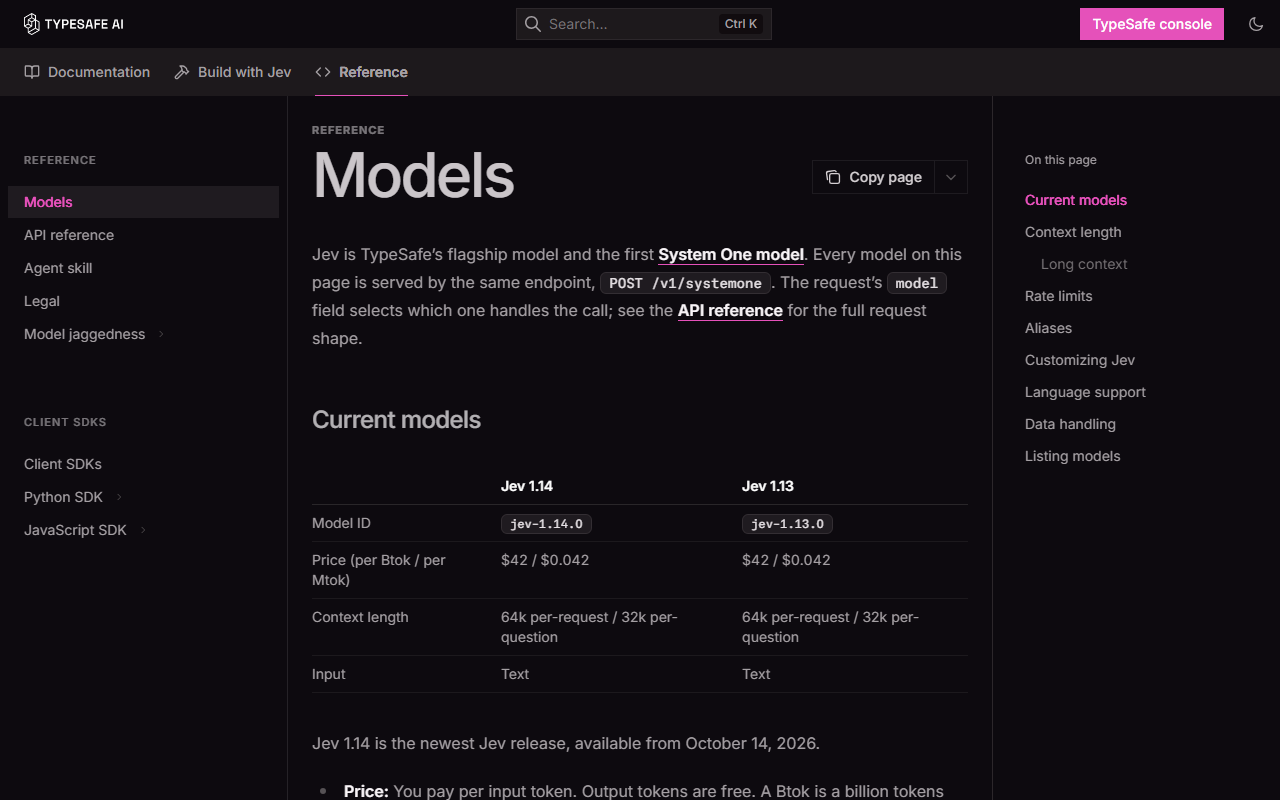 TypeSafe docs, Models page: price per billion and per million tokens plus the context limits, captured 16 Oct 2026.
Two readings of that table matter. First, Clef-flash is about 10% cheaper than Jev per token, while full Clef costs about 5.7 times as much. Second, a price per million tokens hides the real bill. A decision model reads your state once and scores every question against it, so a request with ten questions over one 3,000-token state costs the state once.
For a wider view of price across general models, see the cheapest LLM API guide and the model leaderboard.
Where Jev wins
Jev is the reference product. TypeSafe AI shipped it first, on 15 September 2026, and every competitor describes itself relative to Jev's request shape. Three things are in its favour.
The first is paperwork. Jev's docs state that it is not trained on customer requests or responses, and they point to a Data Processing Agreement and zero data retention for enterprise customers. If your security team asks for a signed DPA before anything touches production, Jev has the shortest path.
The second is accuracy on hard questions, as measured by a rival. In Cloudflare's own Decision Index 0.2.1 table, Jev scored 78.3 on GPQA Diamond against 48.0 for Clef and 51.0 for Clef-flash. On MMLU-Pro it scored 82.7 against 65.9 and 65.3. Those are Cloudflare's published numbers about a competitor, which makes them more credible than a vendor praising itself, though still a single run.
The third is a steady release cadence, with a clear alias system that lets a team stay on a tested release while another team tries the preview. Jev 1.14 became available on 14 October. The alias jev-latest still points at 1.13.0, and jev-preview points at 1.14.0, so you choose when to move.
Where Jev loses
Jev takes text only. That is the first limit. It accepts no audio, images or video, so those must be converted before you send them. Its default limits are 64,000 tokens per request and 32,000 per question. A long-context header lifts both to 262,000 tokens, but the docs say that costs speed and accuracy.
You also cannot tune it. TypeSafe states that Jev is not fine-tuned with customer data and that the same weights serve every account. You shape answers through the state, the instructions and the criteria on each question. English is the primary language, and the docs say other languages, including CJK scripts, are handled but not equally well.
Rate limits are set per organization and visible in the console, which means you find your ceiling after you sign up.
Where Cloudflare Clef wins
Cloudflare released Clef on 1 October 2026 as a family of open-weight decision models. The 27B model sits on a frozen Qwen3.8-27B backbone, from Alibaba Cloud. Clef-flash is the 9B variant, and Clef-omni adds audio and video input. The weights are on Hugging Face under Apache 2.0, and all three run on Workers AI.
Speed is the pitch. Everything else is secondary. In Cloudflare's launch run, median latency was 209.3 ms for Clef, 38.8 ms for Clef-flash and 524.1 ms for Jev. On 9 October Cloudflare said a new serving stack made hosted Clef up to 2x faster with unchanged weights. Its figures were a median of 152 ms at about 800 input tokens, 305 ms at about 3,400 and 1,635 ms at about 16,000. These are vendor measurements, not independent ones.
Clef also beat Jev on two of Typesafe's own workflow evals in Cloudflare's table: 64.7 on invoice processing exact actions and 62.9 on security incidents. Jev won a third, agent trace observability, 71.6 to 68.5. So the accuracy gap runs both ways, and it depends on the task. Full detail is on the Cloudflare Clef page.
Cloudflare says Clef is compatible with Jev's API, so an existing Jev integration can be pointed at Clef by changing the model ID. That claim is Cloudflare's, and you should test it with your own schemas.
Where Clef loses
Hosted Clef has a context of 65,536 tokens, about the same as Jev's default. Media tokens share that window with the questions, and if they overflow, the text state is truncated.
At $0.24 per million input tokens, full Clef is the priciest option in the table. The cheaper path is Clef-flash, but its GPQA Diamond and MMLU-Pro scores in the vendor table are the lowest listed.
Lock-in is the other cost. Small, but real. Workers AI is convenient if you already deploy to Cloudflare, and a detour if you do not. The Apache 2.0 weights soften that, since you can host them elsewhere, but a 27B model needs real GPU memory.
Where Strands Decider wins
Strands Decider 2B was released on 1 October 2026 by Strands Labs, the open-source group at Amazon behind the Strands Agents SDK. It is a LoRA adapter on a Qwen3.5-2B base with a small readout head. There is no hosted API, no per-token price, and no account to open. The weights and scripts are Apache 2.0.
That makes it the only option here whose marginal cost is zero. Press coverage of Amazon's figures reports a median of 106 ms on an NVIDIA RTX 3090 and about 150 ms on an M3 MacBook for small tasks. Those are secondary reports of vendor figures, not our measurements. The Strands Decider 2B page has the full detail, and Amazon's cloud arm, Amazon Web Services, is not selling it as a managed service.
Self-hosting suits teams that handle regulated data, run offline, or process enough volume that per-token fees stop being a rounding error on the monthly cloud bill. Our guide on how to run AI locally covers the hardware questions, and it applies here. For a general model on the same hardware, see the local coding models guide.
Where Strands Decider loses
It is small. It trails the larger ones on its own maker's table. The v19 card reports 72.3% on the public JevBench set, which is 167 correct out of 231 tasks, with a Brier score of 0.348. The newer qwen3.5-v1-2610 checkpoint lists 180 of 231. The checkpoints in the same repository built on Gemma 4 12B and a 26B-A4B variant score 200 and 207.
The card is frank about weak spots, and it is worth reading in full before you commit, since a list of known failure modes written by the people who trained the model is more useful than any headline score. A changed question often returns the same answer when the state and options are fixed, long multi-step documents are the hardest tier, and the score and yes or no types transfer poorly to rubrics unlike the training mix.
The server also has no authentication. The card says it is meant for local experiments, so you must put your own gateway in front of it. Runners such as Ollama and LM Studio are built for text generation, and they are not the supported path.
The other options worth a look
Three more products matter, and one of them has a document you can read yourself.
Liquid AI d1-3B. Liquid AI published d1-3B on Hugging Face. Its card lists 3.12B parameters, a base of LFM2.5-VL-3B, text and image input, and a 32,768-token context. Liquid says it reaches 8 ms per decision on an RTX 4090 and 30 ms on an Apple M5 Pro for a single question. It scored 48.57 on Decision Index 0.2.1, scored by Liquid with the official scorer and not submitted to the public leaderboard. The licence tag is lfm1.0, which is not Apache 2.0, so read the terms before commercial use.
OpenAI Decisions API. OpenAI runs a dedicated POST /v1/decisions endpoint. Its docs say it is in public beta with general availability expected in the coming weeks, that gpt-6-luna is the only supported model, and that it handles text, images or both. OpenAI claims typed answers about 10x faster than the Responses API. The request schema differs from Jev's, so it is not a drop-in swap.
The pricing page lists GPT-6 Luna at $0.10 per million input tokens in its main text table. Secondary coverage says Decisions bills input only at that rate, but we could not confirm that line on OpenAI's own page.
Microsoft-Decision-1. Press coverage says Microsoft lists a 9B model on Foundry at $0.042 per million input tokens, built on Qwen3.5-9B, with benchmarks supplied only by Microsoft. We did not read Microsoft's own page, so treat it as reported, not verified.
Beyond these, community projects such as distilled Jev copies, encoder models and wrappers that turn any chat model into a decision endpoint exist. We did not verify them against repositories for this guide, so we leave them out of the comparison.
What the scores can and cannot tell you
Every vendor says "calibrated", "fastest" or "best". Each number below names its source and version.
| Model | Score | Benchmark and version | Who measured |
|---|---|---|---|
| Strands Decider 2B v19 | 72.3% | JevBench public set | Strands Labs |
| Strands qwen3.5-v1-2610 | 180 of 231 | Same 231 tasks | Strands Labs |
| Liquid d1-3B | 48.57 | Decision Index 0.2.1 | Liquid, official scorer |
| Jev 78.3, Clef 48.0 | GPQA Diamond | Decision Index 0.2.1 | Cloudflare |
Do not compare rows across versions, hardware setups or question mixes, because each of those changes the result by more than the gap between most of the models in this guide. A JevBench percentage and a Decision Index score are different instruments, so a bigger number on one board says nothing about the other.
Latency has the same problem. Cloudflare's 38.8 ms for Clef-flash, Liquid's 8 ms on a 4090 and Strands' 106 ms on a 3090 describe different hardware, different state lengths and different question counts. None of them is a fair race.
The honest use of these numbers is to shortlist, then run your own 200 labelled examples through two candidates. For a ranking of general models on price and benchmarks, the model leaderboard shows absolute figures with their sources.
Who should pick which
The right choice depends on where your code already runs and what your security team demands.
- Agent builder on Cloudflare. Start with Clef-flash on Workers AI. It is the cheapest hosted option, it sits next to your Workers, and Cloudflare says a Jev integration moves over with a model ID change.
- AWS shop. Strands Decider has no managed Amazon service, so you run it on your own instances. It suits pre-filters in front of a bigger model, and it pairs with the Strands Agents SDK or LangChain wiring.
Two more profiles follow.
- Self-hoster with images. Liquid d1-3B reads images at 3B parameters, and it fits edge devices. Check its licence first.
- Enterprise needing a DPA. Jev publishes a DPA and zero data retention for enterprise customers. Ask Cloudflare and OpenAI for their equivalents in writing.
- Team that wants the strongest answers on hard questions. Jev led in Cloudflare's own GPQA Diamond and MMLU-Pro rows.
If your situation is a mix, the Smart Match tool takes your constraints and narrows the field, and the model recommender filters by budget and data terms.
What switching costs
The good news first. The request shape is converging. Jev's endpoint is POST /v1/systemone, and a survey post dated 11 October reports that several open models expose the same path. Cloudflare says Clef is compatible with it. OpenAI is the exception, with its own schema.
If you build against the Jev shape now, a move to Clef or a local model should be a model ID and a base URL. You still need to re-tune confidence thresholds, because each model is calibrated on its own data. TypeSafe advises pinning a versioned ID instead of an alias if you have tuned thresholds against one version. That advice holds across vendors.
Budget a week for the evaluation, not the code. Really. The integration is an afternoon. The threshold tuning, run against your own labelled examples and repeated each time a vendor ships a new version, is the work that actually decides whether the model earns its place in production.
Data handling
For hosted options, ask three questions: is the request stored, is it used for training, and can you get that in a signed document. TypeSafe's docs say Jev is not trained on customer data and publish a DPA. Cloudflare says hosted Clef requests stay unread, unstored and out of training data unless a customer opts into its fine-tuning service. OpenAI's data controls apply to its API generally, and you should confirm how they cover the Decisions beta.
Self-hosting removes the question for the model. It adds one for the server. Strands' own server has no authentication, so a careless deployment exposes your inputs to your own network.
Adversarial text is a risk everywhere. Plan for it. Early coverage of Strands flagged that hostile text inside an agent's input can push a verdict. Treat the probabilities as a signal, put a human or a second check on high-stakes branches, and log which model version answered.
The case against buying one at all
The best argument against this whole category is that you may not need it. A small trained classifier on your own labelled data can be cheaper, faster and better on your exact task than any general decision model. If you have 5,000 labelled tickets and a stable label set, train that and skip the API.
A second argument: your existing LLM may be good enough already. If a routing call runs a few hundred times a day, the bill is trivial and the seconds do not matter. A decision model pays off at high volume, in tight latency budgets, or where you need calibrated probabilities rather than a confident-sounding sentence.
The answer to both is the threshold test. Take 200 labelled examples, run them through your current method and one decision model, and compare accuracy and cost. If the gap is under a few points and volume is low, keep what you have.
What would change this verdict
Three things would move the ranking. An independent benchmark that runs Jev, Clef and Strands on the same hardware and the same version would replace the vendor tables in this guide. A price cut from TypeSafe below Clef-flash would remove Cloudflare's cost edge. And general availability of OpenAI's Decisions API with a published input price would make it a serious fourth option.
Jev 1.14 is also new, and the Jev numbers in the vendor tables may predate it. The next thing to watch is whether OpenAI's published Decisions rate lands under $0.10 when the beta ends.
Frequently asked questions
What are the main Jev alternatives in 2026?
The verified options are Cloudflare Clef and Clef-flash on Workers AI, Amazon Strands Decider 2B for local hosting, Liquid d1-3B for edge and image input, and the OpenAI Decisions API in public beta. Each has its own price, licence and request format.
Is Cloudflare Clef cheaper than Jev?
Only the small one. Clef-flash is $0.038 per million input tokens against $0.042 for Jev, about 10% less. Full Clef is $0.24 per million, roughly 5.7 times Jev. Prices were read from each vendor on 16 October 2026 and may change.
Can I self-host a decision model?
Yes. Strands Decider 2B and Cloudflare Clef weights are Apache 2.0, and Liquid d1-3B ships under the LFM Open License v1.0. Strands runs on a laptop or a single GPU, but its server has no authentication, so put your own gateway in front.
Are the benchmark scores for these models independent?
Mostly not. The figures in this guide come from the vendors, from Cloudflare comparing against Jev, or from Liquid and Strands Labs scoring their own models. Benchmark versions differ, so scores from JevBench and Decision Index 0.2.1 should not be compared with each other.
Can I switch from Jev to another model easily?
Often, but not for free. Cloudflare says Clef accepts the same API as Jev, so the model ID can change, while OpenAI uses its own schema. You still need to retune confidence thresholds, because each model is calibrated on different data.
Covered in this guide
- Jev: TypeSafe's first System One Model, launched in 2026: skips text generation for typed, calibrated decisions software can act on directly.
- Cloudflare Clef: Cloudflare Clef (27B) and Clef-flash (9B): open-weight decision models from 2026 that return probability-scored answers from text, image and video input.
- Strands Decider 2B: Amazon Strands Labs open decision model (Oct 2026): Apache 2.0, Qwen3.5-2B base, 72.3% on JevBench v19 (vendor-reported).
- Alibaba Cloud: Alibaba Cloud, founded 2009, is China's top cloud provider (35% share) and builds the Qwen AI models, which passed 1 billion Hugging Face downloads in 2026.
- Amazon: Amazon, founded 1994 in Seattle, builds the Nova foundation model family and Bedrock, AWS's managed AI platform serving enterprise customers worldwide.
- Amazon Web Services: Amazon Web Services (AWS), launched 2006, is the world's largest cloud platform: $128.7B FY2025 revenue, roughly 29% global market share, and 200+ services.
- Cloudflare: Cloudflare, founded in 2009, runs a network in 335 cities and sells Workers AI, AI Gateway and Vectorize beside its security and CDN products.
- Gemma 4 12B: Gemma 4 12B is Google's June 2026 open-weight multimodal model with a 256K context window and native audio/video input on 8GB of VRAM.
- GPT-6 Luna: GPT-6 Luna (Sept 2026) is OpenAI's lowest-cost GPT-6 model, tuned for high-volume chat, extraction and classification with six adjustable reasoning-effort levels.
- Hugging Face: The AI community building the future. Platform for discovering, sharing and collaborating on machine learning models, datasets and applications.
- LangChain: Observe, evaluate, and deploy reliable AI agents
- Liquid AI: Liquid AI is an MIT CSAIL spinout with over 3,100 Liquid Foundation Model variants built for phones, cars, and other edge devices instead of the cloud.
- LM Studio: Free desktop app that runs open LLMs locally on llama.cpp and MLX, with an OpenAI-compatible local server and an optional $20 cloud plan.
- Microsoft: Microsoft, founded 1975, is a $2.77T public company (NASDAQ: MSFT) with 228,000 employees and $245.3B FY2025 revenue. Copilot AI business run rate exceeded $37B in Q3 FY2026.
- Ollama: MIT-licensed runtime that runs open-weight LLMs on macOS, Windows and Linux with a local API, plus an optional paid cloud for larger models.
- OpenAI: OpenAI builds ChatGPT, the GPT-6 family (Astra, Sol, Luna), Codex and the OpenAI API. It reports 1.2B weekly ChatGPT users and an $852B valuation after its March 2026 round.
- Qwen3.8-27B: A dense 27B vision-language model from Alibaba's Qwen team, open-weight since 2026 with native text, image, and video understanding.
- TypeSafe AI: San Francisco AI lab that emerged from stealth in 2026 to build Jev, a machine-native decision model for real-time software automation.
Sources
Still deciding?
This guide covers a handful of options. Smart Match checks every listing in the directory against how you actually work and what you can spend, then hands you the shortlist and the reason behind each pick.
Find your toolsRelated guides
- The AI Tool Ecosystem in 2026: Buy the Meter, Not the CategoryBuyer's guideHow to pick, across a category
- Best Agentic AI in 2026: Pick the Job, Not the GeneralistBuyer's guideHow to pick, across a category
- Best AI Chatbots in 2026: Pick by the Job, Not the LeaderboardUpdatedRechecked against current sources
- Best AI Code Review Tools in 2026 (Including Open Source)Buyer's guideHow to pick, across a category
- Best AI Coding Assistants in 2026: Pick the Job, Not the BrandBuyer's guideHow to pick, across a category
- Best AI Companies in 2026: Who Is Actually LeadingBuyer's guideHow to pick, across a category