Four Lanes, 95 Guides, and Not One Outside Its Band
The 95 HokAI guides published before this one all fall within the word range their category declares, and none cites fewer than four sources. That consistency is the point of labelling. The trade is a narrow menu: no tutorials, no opinion columns, no standing benchmark tables.
The short version
Every guide on HokAI carries one of four lanes. The label states what the piece owes a reader: a verdict, selection criteria, a consequence, or a disclosure. Lanes also fix how long each piece may run and how many sources it must cite before publication.
Every one of the 95 guides HokAI published between August 3 and August 24, 2026, landed inside the word band its lane declares. This one makes 96.
That is not a claim about stamina. It is the reason a lane label sits at the top of every guide HokAI runs. Each piece carries one of four lanes, and the lane is a promise about what the article owes you before you read a word of it: a comparison owes a verdict between named products, a buyer's guide owes the criteria behind its shortlist, an analysis owes a consequence, and an Inside HokAI piece owes you the line that comes next.
Disclosure: HokAI wrote this about HokAI.
Four promises, not four folders
The lanes are not evenly sized, and they were never meant to be. Counted the moment before this piece went up, the public guides API held 37 buyer's guides, 29 news analyses, 22 comparisons and 7 Inside HokAI pieces. Together they hold 151,295 words and cite 810 sources.
Newsrooms have sorted work this way for a long time. The Trust Project publishes eight Trust Indicators for news sites, and the third is Labels, which exists so a reader can tell reporting from opinion without guessing. Schema.org encodes the same instinct in markup, splitting Article into subtypes that include NewsArticle, Report, ScholarlyArticle, TechArticle and AdvertiserContentArticle.
A folder tells you where a file sits. A lane tells you what the file agreed to do.
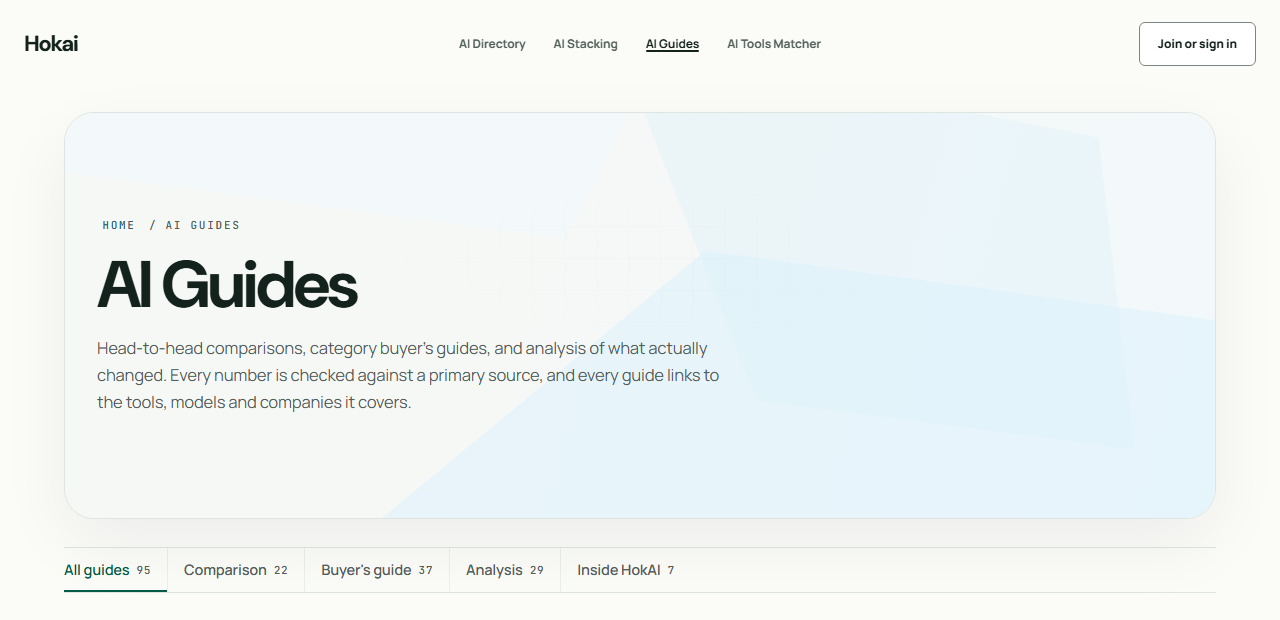
The lane row on hokai.io/guides, August 24, 2026. The counts are the filter, not decoration.
Nielsen Norman Group calls the judgement readers make at that moment information scent: people pick links using "cues that they get from the link label" plus whatever they already know. A lane is a cue with a rule behind it.
What a comparison owes: a verdict
Qodo vs Greptile runs 2,046 words and casts four tools: Qodo, Greptile, CodeGen and Dosu. Its subtitle says what the lane demands, which is what actually separates two nearly identical pitches.
A comparison that ends in "it depends on your needs" has taken your time and returned nothing. So that piece runs sections headed "Where Greptile wins", "Where Qodo wins" and "What actually changes the answer". A reader gets the call and the condition that reverses it. The two extra tools are there because the honest response to "which of these two" is sometimes "neither, look at this third thing."
Twenty-two comparisons sit in that lane today. The shortest runs 1,456 words and the longest 2,046.
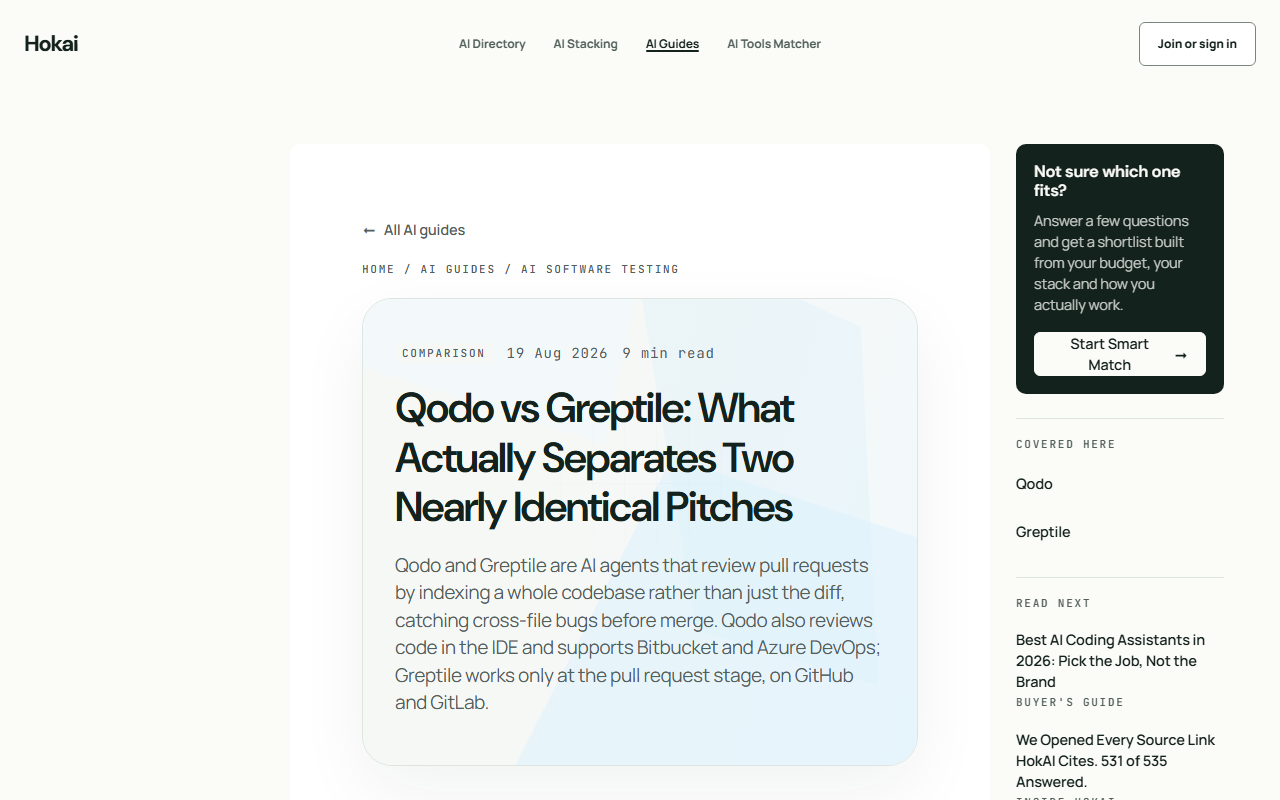
Qodo vs Greptile on hokai.io, captured August 24, 2026. The lane is printed above the headline, before the reader commits.
What a buyer's guide owes: the criteria
Best AI Meeting Assistants in 2026 is 2,216 words, and its subtitle asks whether you even need one. That question is the lane working as intended. A buyer's guide that cannot argue against the purchase is a shopping list.
The longest guide in the corpus is Best AI Search and Retrieval Infrastructure at 2,311 words, casting Exa alongside three others. Length is the tell here. Choosing from a field takes more room than choosing between two, so the buyer's-guide band starts where the comparison band is already halfway done.
Google's own guidance for content creators asks whether a reader will "leave feeling like they've had a satisfying experience." Criteria are how a shortlist earns that. In the meeting-assistant guide, four screening questions come before any product is named, and Fathom is one of six that cleared them.
What an analysis owes: a consequence
Kling and the Sora shutdown runs 1,147 words. It names a date, names the cost nobody priced, and links Kling beside the company behind it.
News analysis is the shortest lane by design: 29 pieces averaging 1,051 words. The band tops out at 1,400 because a consequence read that needs 2,000 words has usually stopped reading the news and started padding. Say the thing that changed. Say who it bills.
What an Inside HokAI piece owes: the disclosure
The fourth lane is the one this article sits in, and it is the smallest. Seven pieces had published in it before this one, running 1,471 to 1,785 words, and all seven carry the same six-word disclosure directly under the opening. Earlier entries in the lane counted our source links and explained why the directory runs six page types rather than one.
Writing about your own work is the easiest place to cheat. The lane exists so that it happens in the open, with the same sourcing floor as everything else.
The band each lane writes inside
Every lane declares a word range before anything is written, and the range is checked before a piece can publish. Here is what the four bands are, and what the 95 published guides actually did inside them.
News analysis declares 900 to 1,400 and lands between 944 and 1,225. Comparison declares 1,400 to 2,200 and lands between 1,456 and 2,046. Buyer's guides declare 1,800 to 2,800 and land between 1,861 and 2,311. Inside HokAI declares 1,200 to 2,200 and lands between 1,471 and 1,785.
Zero guides fall outside. Not one of the 95.
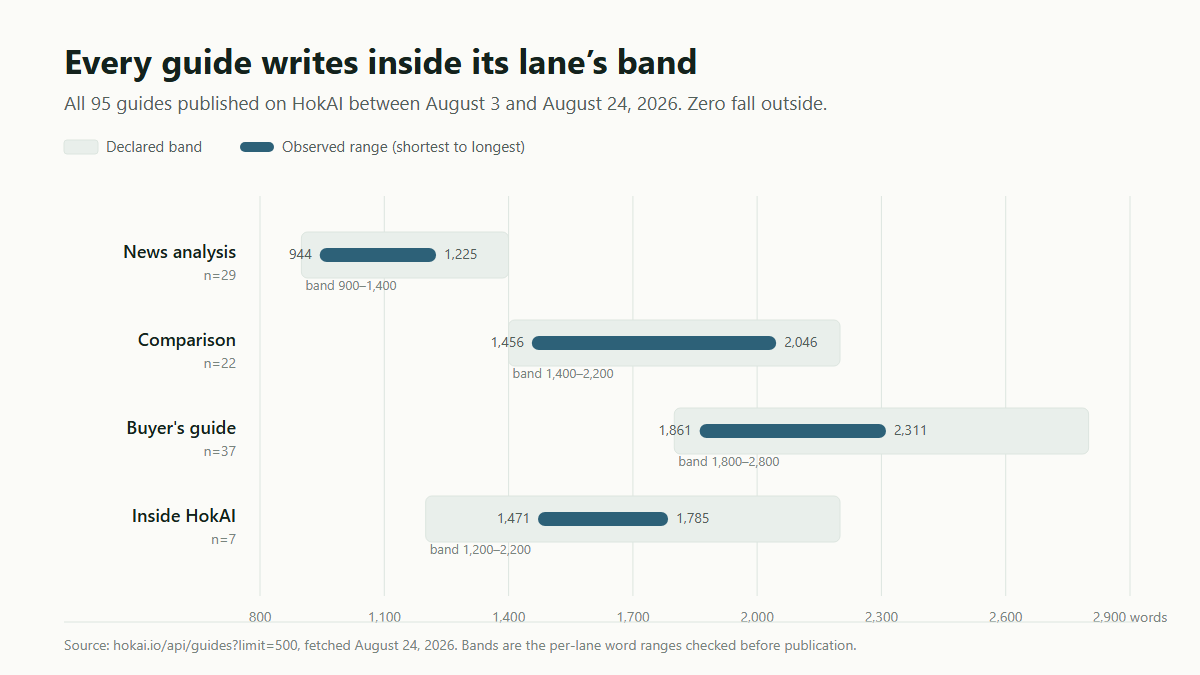
Observed word ranges against the declared band for each lane, from the public guides API on August 24, 2026.
The spread matters more than the compliance. If all four lanes produced the same length, the labels would be paint. They do not: the median news analysis is 1,039 words and the median buyer's guide is 1,978, which is close to twice as long for a different job.
The floor under all 95
The second rule every lane shares is a sourcing floor. No guide publishes with fewer than four sources that resolve, and across the corpus the count runs from 4 to 15 with a mean of 8.5. Two guides sit exactly on the floor. The rest cleared it.
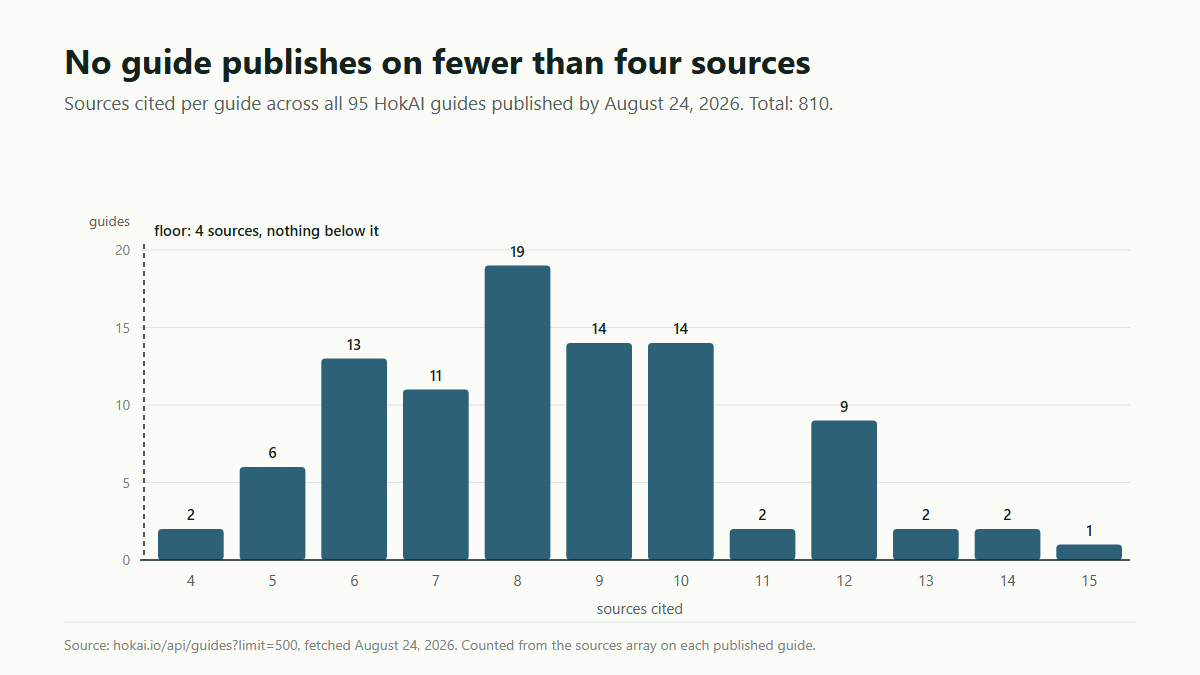
Sources cited per guide across the whole corpus, counted August 24, 2026. Nothing sits left of four.
Structure carries a floor too. Ninety-one of the 95 guides link exactly four directory entities, and the corpus holds 375 entity links in total. That is the edge between an article and the tools directory it argues about, and it is why a guide cannot be written about products the directory has never recorded. Behind those links sits a catalogue of 684 records spread across the six directory types, with tools much the largest group at 457.
Run the count yourself
None of this needs an account or a screenshot to check. One request to the public guides API returns every published piece with its lane, its word count and its source list, and the response carries a lane_counts object so the four totals do not have to be tallied by hand.
curl -s "https://hokai.io/api/guides?limit=500"
Sum word_count by lane and the bands above reappear. Count the sources array on any record and the floor holds. If a number in this article has moved since August 24, 2026, that request is where you will see it first.
The reader this scheme isn't for
Four lanes is a narrow menu, and it excludes work that other sites do well. There is no tutorial lane, so a reader who wants step-by-step setup instructions for one product is better served by that vendor's own documentation. There is no opinion column, so anyone looking for a columnist's running commentary on the industry will find the analysis lane too clipped and too dated to enjoy.
There is also no standing benchmark table, the kind that gets re-run monthly and cited as a scoreboard. That is real work and some sites are built around it.
And if you would rather skip reading altogether, the lanes are the wrong door. Smart Match asks a handful of questions and returns a short list, which is a faster path than any 2,000-word guide when you already know the shape of your problem.
A label is the cheapest promise a publisher can make and one of the easier ones to break quietly. The only thing that turns it into information is that it gets checked before the piece goes out, and that anyone can re-run the check afterwards.
Frequently asked questions
What do the four lanes on HokAI guides mean?
Each lane states what a piece owes you before you start reading. A comparison names a winner for a stated buyer, a buyer's guide shows the criteria behind its shortlist, a news analysis explains a consequence, and an Inside HokAI piece carries a disclosure. The label appears at the top of every guide.
Does a HokAI comparison always name a winner?
Yes, for a stated buyer, and it also says what would flip that call. A comparison that ends without a verdict has not done the job its lane promises. Most comparisons also cast two extra products, because sometimes the right answer is neither of the two in the title.
How long is a HokAI buyer's guide compared with a news analysis?
Buyer's guides run 1,800 to 2,800 words and news analyses run 900 to 1,400. Across the 95 guides published before this one, the median buyer's guide was 1,978 words and the median news analysis 1,039. Choosing from a field takes more room than reporting one change.
Does HokAI publish tutorials or opinion columns?
No. There is no tutorial lane and no opinion column, and there is no standing benchmark table either. Readers who want setup instructions for a single product are better served by that vendor's own documentation.
How can I see every HokAI guide and its lane in one request?
Request the public guides API at hokai.io/api/guides with a limit of 500. The response lists every published piece with its lane, word count and sources, plus a lane_counts object holding the four totals. No account is needed to read it.
Covered in this guide
- HokAI: HokAI is an editor-curated, AI-only directory at hokai.io. Listing requires a flat submission fee; rankings cannot be bought. Every Pulse update is verified against a primary source.
- Exa: Search API that ranks the web by meaning for AI agents and retrieval pipelines, with six search types, an asynchronous research Agent and an official MCP server. A free Starter plan with monthly credits needs no payment method.
- Fathom: AI notetaking for meetings - summarize conversations to focus on what matters
- Greptile: AI code review agent that indexes your whole codebase, not just the diff, to catch cross-file bugs before merge; used by 22,000+ engineering teams.
- Kling: Kuaishou's text-to-video platform with native 4K, lip-synced audio in 5 languages, and free daily credits. Used by 60M+ creators; plans from $6.99/month.
- Qodo: AI code review and test generation platform with a multi-agent architecture that scores highest for real-bug detection among independently benchmarked code review tools.
Sources
Still deciding?
This guide covers a handful of options. Smart Match checks every listing in the directory against how you actually work and what you can spend, then hands you the shortlist and the reason behind each pick.
Start Smart MatchRelated guides
- 41 of 100 HokAI Guides Carry a Screenshot. All 106 Still Load.Inside HokAIHow the directory works, verified in the open
- The AI 80s Photo Trend: How to Make Yours (and Turn It Into a Video) in 2026AnalysisWhat changed and who it affects
- The AI Tool Ecosystem in 2026: Buy the Meter, Not the CategoryBuyer's guideHow to pick, across a category
- The AI Tools That Do One Microsoft Copilot Job, CheaperBuyer's guideHow to pick, across a category
- Algolia and You.com Both Call Themselves AI Search Infrastructure. They Aren't Rivals.ComparisonHead-to-head, with a verdict
- The Best Free AI for Turning a Photo Into a Video in 2026Buyer's guideHow to pick, across a category