Best AI Search & Retrieval Infrastructure Tools in 2026
AI search and retrieval infrastructure is the set of tools that feed outside or private data into an AI system. Web search APIs return live results, document parsers convert files into clean text, vector databases store embeddings for fast lookup, and memory layers persist state across an agent conversation.
The short version
The eight tools grouped under 'AI search and retrieval infrastructure' actually split into four separate jobs: live web search, document parsing, vector storage, and agent memory. Buying one tool to solve all four almost always means the wrong pick for at least one job. Identify which layer is missing before comparing vendors, then pick from that layer's shortlist alone.
Exa and Reducto both show up in searches for "best AI search infrastructure tools," and one returns a ranked list of live web pages while the other turns a scanned PDF into structured JSON. Exa and Reducto are not competitors. They are not even adjacent.
Six more tools carry the same "AI search and retrieval infrastructure" label: You.com, Algolia, Context.dev, LanceDB, Mem0, and Zerox. Between them, these eight products cover four distinct jobs in an AI pipeline: pulling live results from the open web, converting a company's own files into clean text, storing the resulting vectors for fast lookup, and giving an agent a memory that survives past a single session.
A team that shops for one winner across all four ends up choosing blind. A team that first identifies which single job is unfilled saves a signup, a credit card, and a rewrite three months later when the mismatch surfaces.
The category label hides four different jobs
That is the actual decision buried under the category label, and it is the one this guide answers first.
Directory listings and review sites tend to flatten all eight into one ranked table, sorted by traffic or by how recently the vendor raised a round. That sorting answers a question nobody asked. A team evaluating Mem0 for agent memory gets nothing useful from seeing it ranked against Algolia, a full-text search product built for e-commerce catalogs a decade before agent memory was a category at all. The layer each tool sits in, not its rank in a roundup, is what determines whether it is even a candidate.
How to choose: find the layer that's actually missing
Before comparing any two vendors, work out which of these four questions describes the gap in the stack today.
Does the agent need to reach the live web, or only your own data? If an LLM call needs a current stock price, a competitor's pricing page, or this week's news, that is the web-search layer: Exa, You.com, or Algolia. If the data already lives in a database, a document store, or a set of internal PDFs, none of the three help, because they search the open internet, not a private corpus.
Is the input a file, or already text? A scanned invoice, a 200-page PDF with merged table cells, or a spreadsheet full of handwriting is not usable by an LLM until it becomes structured text. That is what Reducto and Zerox do. If the source is a live web page instead of a file, Context.dev does the same conversion for URLs rather than uploads.
Where do the resulting embeddings live once they exist? Every RAG pipeline eventually needs a place to store vectors and retrieve the nearest matches fast. LanceDB is the storage layer in this list: an embedded, open-source database built on the Lance columnar format, with a managed cloud tier still in public beta as of August 2026.
Does the agent need to remember anything across sessions? A vector database returns whatever is closest to a query, with no concept of which memory is current, contradicted, or stale. Mem0 sits a layer above storage and decides what a long-running agent keeps, updates, or discards.
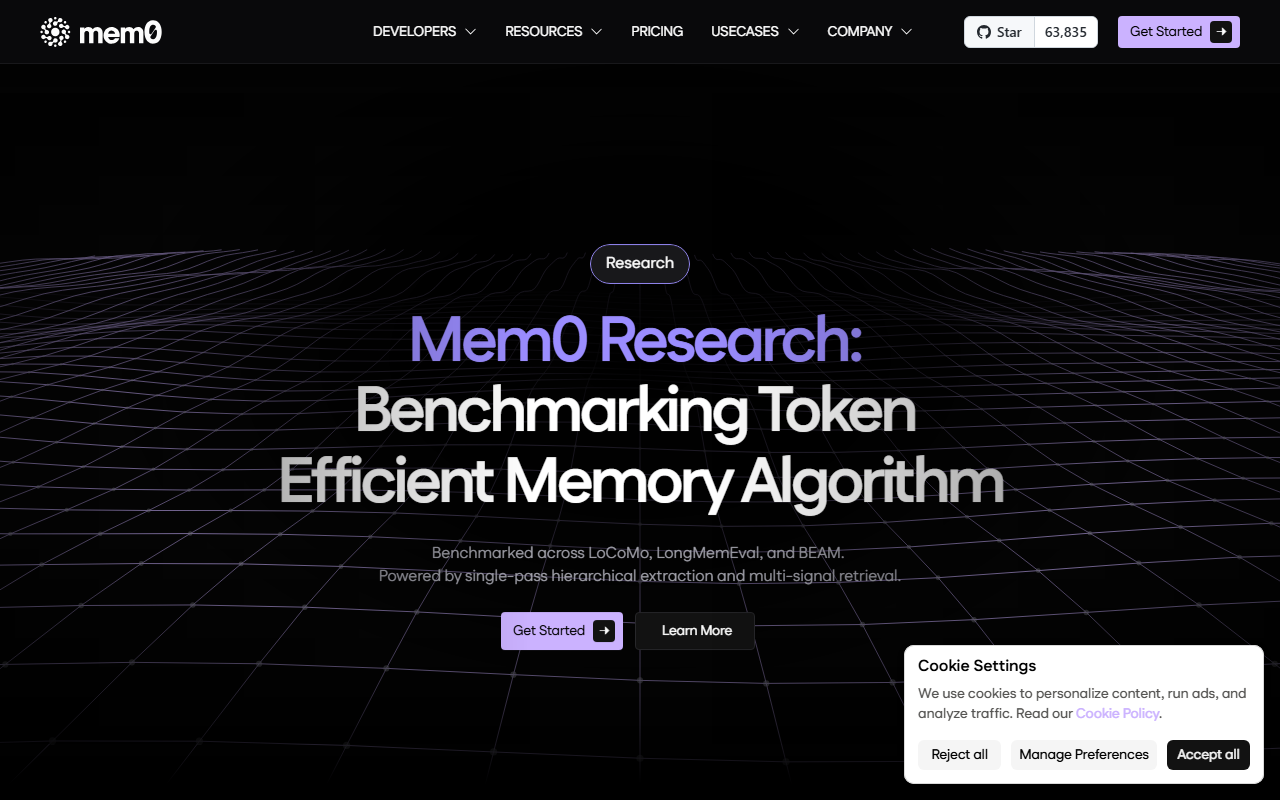 Mem0's own benchmark page, captured 23 Aug 2026. The LoCoMo score cited in this guide comes from here, not a third party.
What is the actual budget and volume? A side project running a few hundred queries a month has different math than a product serving 50,000 users. Every price below is quoted per unit, not as a flat subscription, because the eight products here bill on usage almost without exception.
Answer those five and the shortlist below narrows to one or two rows, not eight.
Two decisions this guide deliberately skips
Orchestration frameworks that stitch a retrieval pipeline together, LangChain and LlamaIndex chief among them, sit a layer above everything in this guide and belong to a separate buying decision. If the actual gap is orchestration rather than any of the four layers above, that is a different guide's question, not this one's.
General-purpose vector databases built for massive, multi-tenant scale are also out of scope here. Pinecone and Weaviate are the two names that come up most in that conversation, and neither is in HokAI's catalog under this category. LanceDB earns its spot in this guide because it targets the embedded, single-node use case rather than that end of the market.
The shortlist
| Your bottleneck | Pick | Starting price | The one caveat |
|---|---|---|---|
| Agent has no live web access | Exa | $7 per 1,000 requests (10 results included) | Deep search adds 4 to 40 seconds of latency per the deep-reasoning tier |
| Same gap, tighter budget | You.com | $5 per 1,000 calls | Its Answer API is tuned for synthesis, not raw link relevance |
| Full-text search on your own catalog | Algolia | Free up to 10,000 searches and 50,000 records a month | AI Ranking and AI Synonyms sit behind the $1.75-per-1,000 Grow Plus tier |
| PDFs and scans need structuring | Reducto | 15,000 credits included, then $0.015 per credit | SOC 2 and HIPAA appear only as unanswered FAQ headings on its own pricing page |
| Same gap, zero budget | Zerox | Free, MIT licensed | Self-hosted: you supply and pay for the vision model it calls |
| Live web pages, not files, need converting | Context.dev | Free for 250 to 500 credits, then $25 a month | Structured extraction costs 10 credits against 1 for a plain scrape |
| Vectors need somewhere fast to live | LanceDB | Free, open source under Apache 2.0 | Cloud tier has no public rate card yet; it is still in beta |
| Agent needs memory across sessions | Mem0 | Free up to 10,000 add requests a month | The $19 Starter tier caps retrieval at 5,000 calls a month |
A few of these are worth a second look on their own. Algolia's own site claims over 1.75 trillion searches handled annually across upward of 18,000 client brands, a figure that makes it the only product on this list with the scale history of a pre-LLM search vendor rather than a 2024-or-later AI-native startup.
LanceDB is the newest by funding stage: a $30 million Series A led by Theory Ventures in June 2025 brought its total raised to $41 million, per the company's own announcement, with CRV, Y Combinator, Databricks Ventures, and Runway also participating.
Exa vs You.com: the real head-to-head
If the missing layer is live web search, these two are what most teams actually end up comparing, because both ship an API built for agents rather than for humans typing into a search box.
The technical difference is real. Exa uses neural embeddings to match intent rather than keywords, which is why Cursor and Cognition's Devin coding agent use it for web access, according to Exa's own customer list. That approach costs more and runs slower: $7 per 1,000 requests against You.com's $5, and roughly 900 milliseconds of latency with synthesis enabled against You.com's 600.
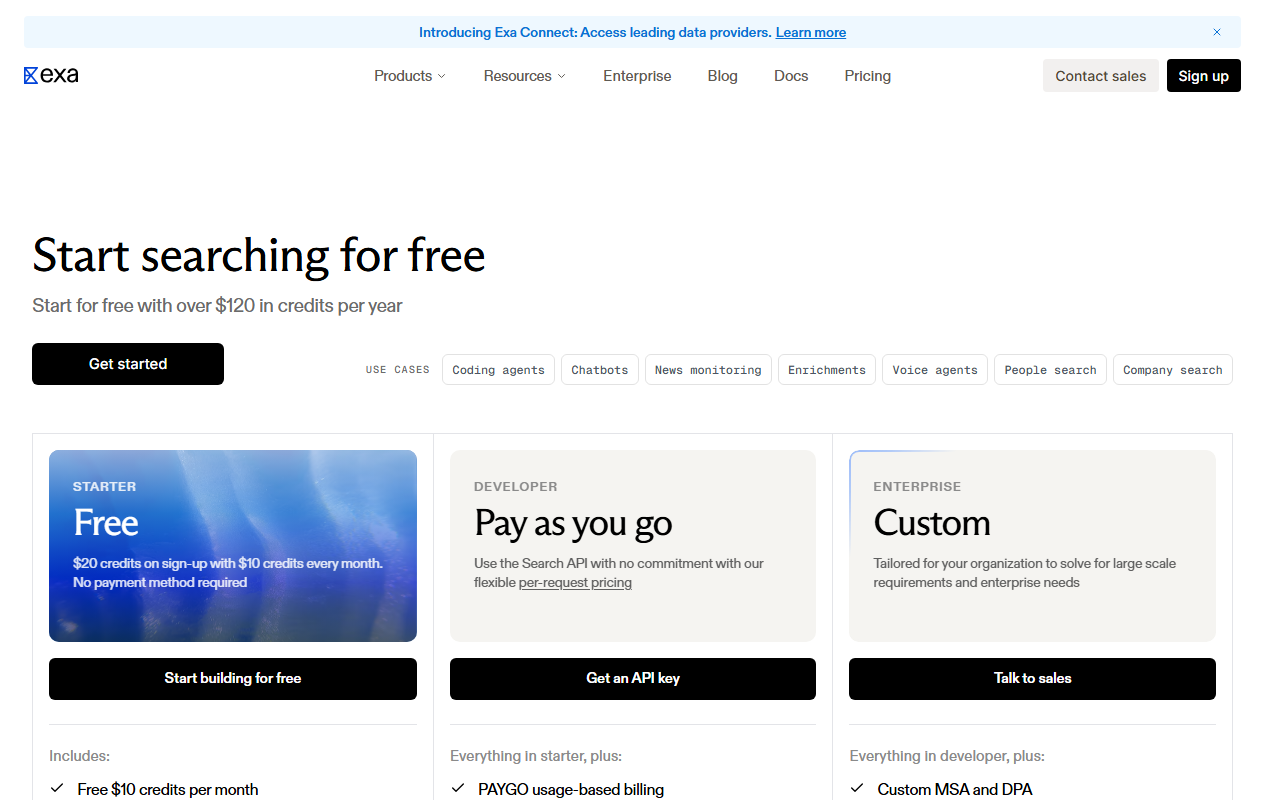 Exa's three pricing tiers, captured 23 Aug 2026. The Developer tier is where the per-request math in this guide comes from.
You.com's advantage isn't raw relevance. It's breadth: a separate Contents API at $1 per 1,000 pages extracts clean markdown from any URL, and its Answer API claims 93.48% accuracy on the SimpleQA benchmark, a number it publishes on its own pricing page.
Pick Exa when the agent is doing research-heavy work where a handful of highly relevant sources beats a large pile of roughly relevant ones, the case Cognition made when it built Devin's web access on top of it. Pick You.com when the workload is high volume, latency-sensitive, and would rather have a cheaper, faster answer than the single best possible one. Neither is a mistake. Buying either one to also solve a document-ingestion or memory problem is.
There is a third option worth naming even though it did not make the shortlist table. You.com's own Research API, priced at $12 per 1,000 calls across five depth tiers from Lite to Frontier, is aimed at multi-step questions that need several searches synthesized into one answer, a different job again from either the Web Search API or Exa's single-query relevance. A team choosing between these three should be choosing by the shape of the question its agent actually asks, not by which vendor's homepage looked more polished.
Reducto vs Zerox: managed accuracy or free and open source
Both convert files into text an LLM can use. The similarity mostly stops there.
Reducto combines custom models with frontier vision models to produce what its own site calls "accurate, citation-ready outputs" across more than 30 file types, including tables, charts, handwriting, and scans. It bills 15,000 credits included, then $0.015 per credit, with a 20% discount for async batch jobs that accept a 12-hour turnaround.
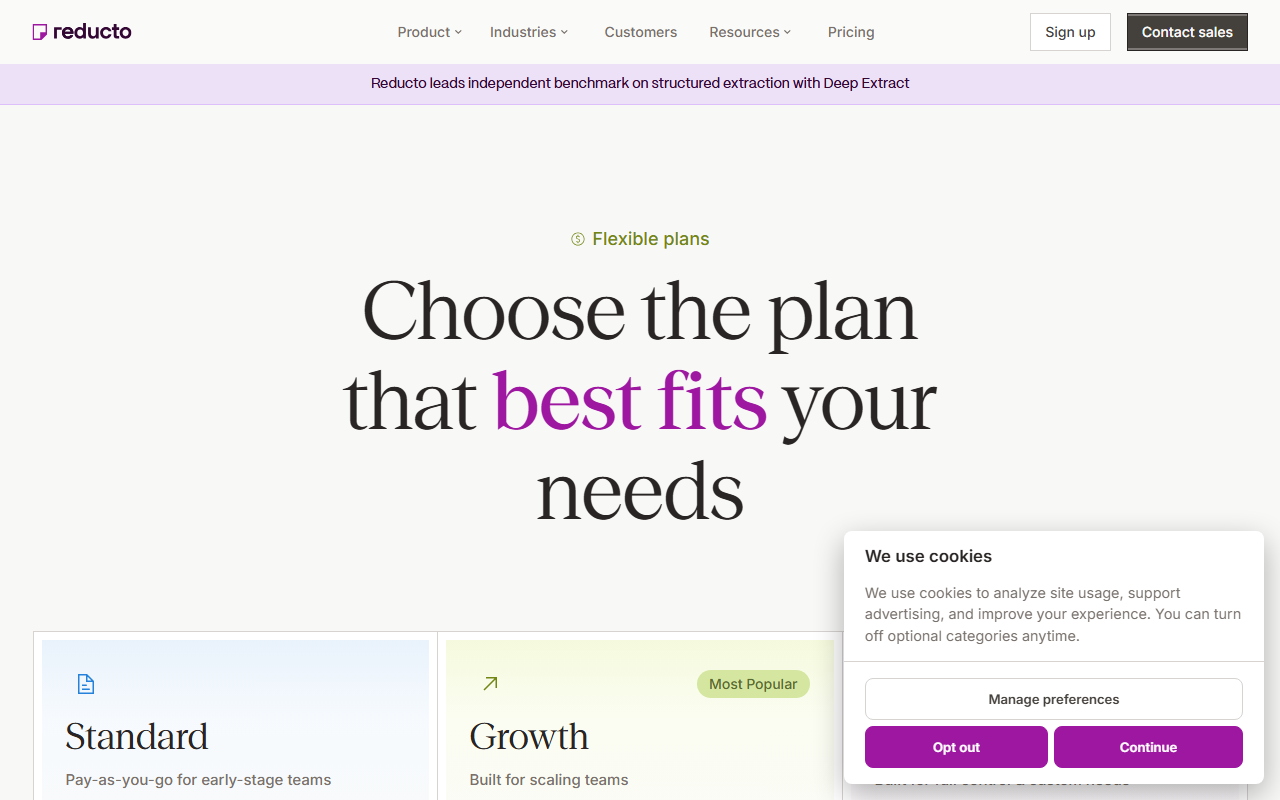 Reducto's plan tiers, captured 23 Aug 2026. Standard is the pay-as-you-go tier priced in this guide.
Its pricing page lists SOC 2 and HIPAA compliance as FAQ headings without disclosing certification detail. That is worth confirming directly with Reducto before committing a regulated workload to it rather than assuming from the heading alone.
Zerox is a different bet entirely: a free, MIT-licensed library on GitHub that converts PDFs, DOCX files, and images to markdown by calling a vision model you provide, whether that's GPT-4o, a Claude model on Bedrock, or Gemini. There is no vendor bill beyond whatever the model call costs.
For a two-person team validating a RAG demo before it has a paying customer, that is the obvious starting point. For a fintech processing thousands of scanned statements a month where a parsing error becomes a compliance problem, Reducto's managed pipeline and per-field citations are worth the per-credit cost, because manually auditing Zerox's raw output at that volume would cost more than the credits.
When none of these eight tools are worth adopting
A lot of AI projects do not need any of these eight products, and reaching for one out of habit is its own kind of mismatch.
A catalog small enough to fit in memory, roughly a few hundred thousand vectors or fewer, often does not need a dedicated vector database at all. Postgres's pgvector extension or SQLite's vector extensions handle that scale inside infrastructure a team already runs, and adding LanceDB or a managed alternative mostly adds a second system to operate for a problem Postgres already solved.
Similarly, a product that only needs keyword search over a static site with a few hundred pages is usually better served by a client-side search library than by signing up for Algolia's usage-based tiers. The pattern across both cases is the same: these tools earn their price when the data, the query volume, or the accuracy requirement outgrows what a general-purpose database or a bundled framework feature can do.
There is a third case worth naming. A team that has already adopted an orchestration framework such as LangChain or LlamaIndex sometimes finds that framework's built-in loaders and retrievers cover a basic version of the ingestion or storage layer well enough for a first version.
Reaching for a dedicated tool from this list before that built-in path has actually run out of headroom is optimizing a problem that has not shown up yet. The eight products here are worth adopting once the framework default demonstrably breaks: a parsing error rate that shows up in support tickets, a query latency that a demo cannot hide, or a memory feature the framework simply does not have.
The turn: when one vendor covering two layers wins
The obvious objection to "buy by layer, not by category" is operational. Stitching together three or four point solutions means three or four bills, three or four authentication flows, and three or four vendor SLAs to monitor. For a small team, that overhead can cost more in engineering time than the mismatch it avoids.
That objection is correct past a certain vendor count. It is exactly why You.com bundling web search and content extraction under one account, or Algolia bundling crawling, full-text search, and AI ranking under one contract, are the right call for a team willing to accept a narrower fit in exchange for one integration instead of two.
The layered approach in this guide is the right default when the four jobs are genuinely separate needs with different requirements. It stops being the right default the moment a single vendor's second feature covers the second job well enough, and the only way to know that is to check the vendor's current feature list, not the one it shipped with.
The four layers mapped here are still consolidating. A tool that solved exactly one job eighteen months ago increasingly ships a second, the way You.com added its Contents API alongside search. Before buying any of the eight tools in this guide, check what each one covers today rather than what it was known for when this guide was written.
Frequently asked questions
What is the difference between an AI search API and a vector database?
An AI search API such as Exa or You.com queries the live web and returns ranked results in real time. A vector database such as LanceDB stores embeddings a pipeline already generated and returns the nearest matches on demand. One reaches outside your data, and the other organizes what you already have.
Do I still need a document parser if I already use a RAG framework like LlamaIndex?
Usually yes. LlamaIndex orchestrates the retrieval pipeline, but it still needs clean text to work with, and a scanned PDF or a spreadsheet with merged cells rarely converts well on its own. Tools like Reducto and Zerox sit in front of that pipeline and handle the conversion first.
Is Exa or You.com better for an AI agent that needs live web access?
Exa's neural embeddings tend to surface more relevant results for research-heavy queries, which is why Cursor and Cognition's Devin agent use it, according to Exa's own customer page. You.com's Web Search API costs less per call, at $5 per 1,000 calls against Exa's $7. Pick Exa when relevance matters more than price, and You.com for high query volume on a tighter budget.
Can any of these AI retrieval tools be self-hosted instead of run as a hosted API?
LanceDB and Zerox both can. LanceDB's open-source core runs embedded inside an application under an Apache 2.0 license, and Zerox is a free, MIT-licensed library that calls a vision model you supply yourself. The other six tools in this guide are hosted-only products as of August 2026.
What does agent memory like Mem0 add that a vector database does not?
A vector database returns whatever is closest to a query, with no sense of which memory is current or contradicted. Mem0 adds a layer on top that decides what a long-running agent keeps, updates, or discards, scoring 92.5 on the LoCoMo benchmark. That is a different job from storage: deciding what an agent should remember at all.
Covered in this guide
- Exa: Search API that ranks the web by meaning for AI agents and retrieval pipelines, with six search types, an asynchronous research Agent and an official MCP server. A free Starter plan with monthly credits needs no payment method.
- Reducto: Reducto turns PDFs, scans, and spreadsheets across 30+ file types into structured JSON for RAG pipelines and AI agents, with agentic OCR correction.
- You.com: AI Search APIs & Infrastructure for Enterprise Teams
- Zerox: Zerox is a free, MIT-licensed library that turns PDFs and 26+ document formats into clean markdown using vision models like GPT-4o, though development appears to have stalled.
- Algolia: AI search and retrieval platform powering 1.75 trillion searches annually for 18,000+ businesses with semantic search, vector embeddings, and AI agents.
- Context.dev: Context.dev scrapes pages to markdown, extracts brand assets, and crawls entire sites via one API. Free: 500 credits. Trusted by 5,000+ companies.
- LanceDB: LanceDB stores 100M+ vectors on a single node as an open-source, embedded database built on Apache Arrow, backed by $41M in funding.
- LangChain: Observe, evaluate, and deploy reliable AI agents
- LlamaIndex: The world's most accurate agentic OCR and document-specific AI workflows for enterprise automation
- Mem0: Mem0 gives AI agents persistent memory through one API, scoring 92.5 on the LoCoMo benchmark with its V3 algorithm released in 2026.
Sources
Still deciding?
This guide covers a handful of options. Smart Match checks every listing in the directory against how you actually work and what you can spend, then hands you the shortlist and the reason behind each pick.
Start Smart MatchRelated guides
- The AI Tool Ecosystem in 2026: Buy the Meter, Not the CategoryBuyer's guideHow to pick, across a category
- Algolia and You.com Both Call Themselves AI Search Infrastructure. They Aren't Rivals.ComparisonHead-to-head, with a verdict
- Best AI Note-Taking Tools in 2026: Brain2, Glasp, Mem, and Gemini Notebook ComparedBuyer's guideHow to pick, across a category
- Best AI Orchestration Tools in 2026: How to Actually ChooseBuyer's guideHow to pick, across a category
- Context.dev vs You.com: Which Should You Use in 2026?ComparisonHead-to-head, with a verdict
- Inngest vs LlamaIndex: Why the Comparison Is the Wrong QuestionComparisonHead-to-head, with a verdict